
You've probably had the same call before lunch, the one where a contractor sends a fire safety quote and asks which extinguisher should go on the wall, the café line, or the office corridor. The decision looks small, but in a Queensland commercial site it quickly becomes a compliance question, because the wrong unit, the wrong location, or the wrong service record can turn into an audit finding later. A portable fire extinguisher is never just a red cylinder on a bracket, it's part of a documented fire safety system that has to stand up to AS 2444 selection and siting, AS 1851 maintenance, and the realities of tenancy handover, insurance review, and day-to-day use.
Table of Contents
- Why Your Extinguisher Choice Is Really a Compliance Decision
- How the Modern Extinguisher Actually Works
- Choosing the Right Extinguisher Type for Each Fire Class
- Siting and Mounting Rules That Pass an Audit
- AS 1851 Maintenance Cycles and What Gets Logged
- When Not to Use an Extinguisher, and Other Real Decisions
- Putting It Together for Your Next Service Visit
Why Your Extinguisher Choice Is Really a Compliance Decision
The quote lands on your desk, and the differences look simple on paper, a 4.5 kg dry chemical powder, a 3.5 kg CO2, or a 9 L water unit. In practice, that choice affects who can use the unit, what kind of fire it can cover, how much mess it will make, and whether the installation will still make sense when an auditor, insurer, or incoming tenant asks for records.
Selection starts with the risk, not the product list
For Queensland workplaces, the first question is what fire risk exists in each area, because AS 2444 is the selection and location standard for portable extinguishers and fire blankets in commercial premises, while AS 1851 governs ongoing maintenance and recordkeeping. That means the extinguisher you buy is already tied to how it will be mounted, inspected, and documented later. If a warehouse zone has packaged combustibles, a switchboard room has electrical risk, and a kitchen has cooking oil risk, those are three different decisions, not one generic purchase.
Practical rule: don't buy the cheapest extinguisher first and decide where it goes later. On a site walk, that usually becomes a rework job.
The Australian commercial reality is that the wrong selection doesn't always fail in a dramatic way. It often fails because the unit is present but poorly matched to the hazard, the label doesn't suit the room, or the service contractor has to write a defect note that becomes part of the compliance file. That's why extinguisher choice is the first link in a compliance chain, not a standalone safety purchase.
The strongest foundation for why this matters is the long effectiveness record for portable extinguishers in incipient fires. NAFED's 34-year dataset found 12,505 successful extinguishments across 13,221 reported fire incidents, or 95% (NAFED effectiveness report). That figure matters because it reinforces the point behind workplace placement, when the fire is still small and the right unit is close at hand, a portable extinguisher can stop escalation before structural damage becomes severe.
How the Modern Extinguisher Actually Works
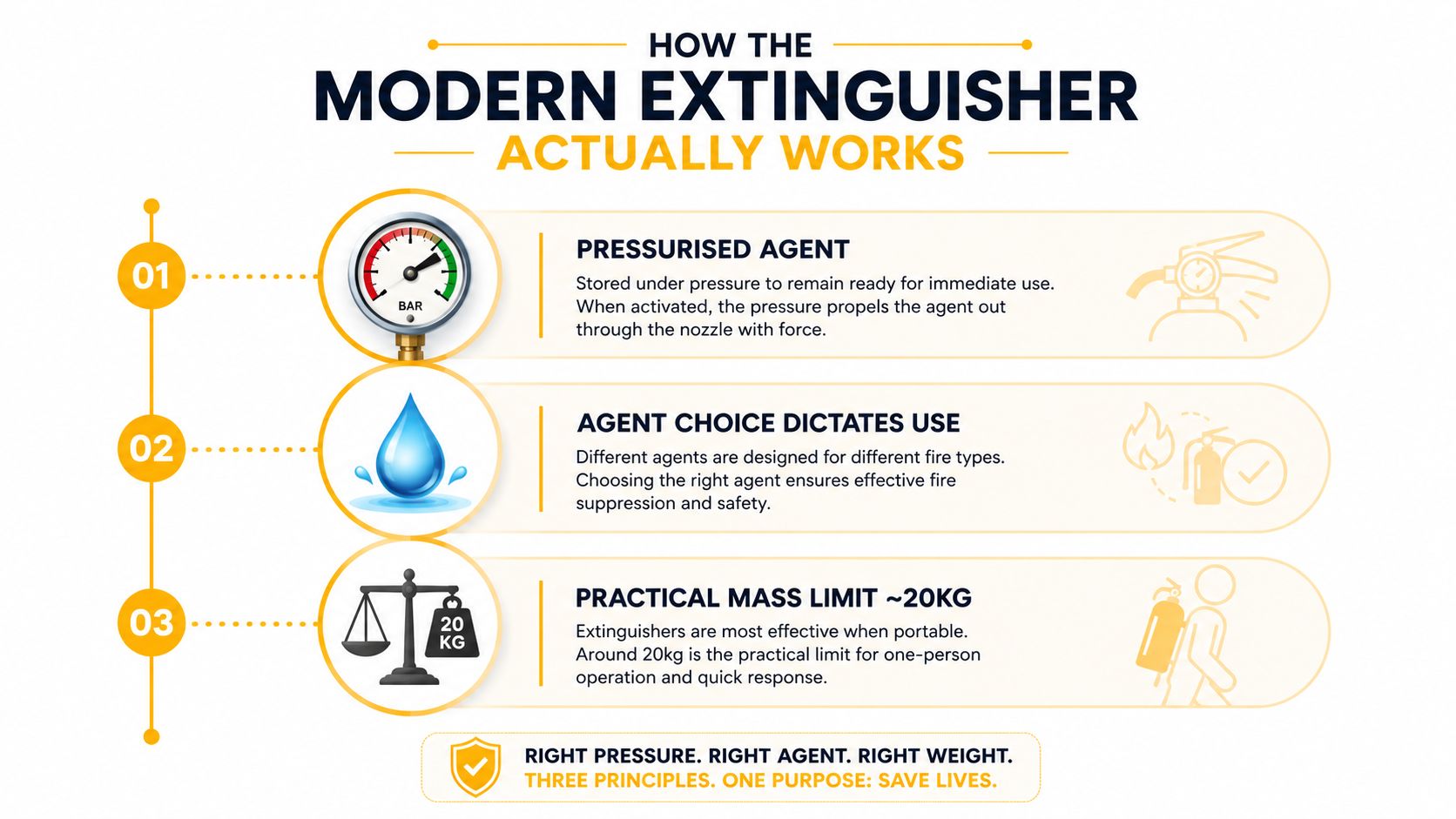
A portable extinguisher works because it combines three things in one unit, stored agent, pressure, and a discharge path that a person can carry and aim quickly. That sounds obvious until you're the person walking it down a corridor or lifting it off a bracket at shoulder height, because the practical limit isn't just fire performance, it's whether the unit stays hand-portable and usable under stress.
Why the modern form exists at all
The idea has a long paper trail. The first recorded extinguisher patent was granted in England in 1723 to Ambrose Godfrey, and the first portable extinguisher is generally traced to 1819, when Captain George William Manby developed a 3-gallon unit using potassium carbonate solution under compressed air pressure (portable extinguisher history). Later milestones included Almon M. Granger's 1881 design, the first carbon tetrachloride portable extinguisher in 1911, the first carbon dioxide extinguisher in 1924, and by 1928 the modern-looking powder extinguisher had begun to emerge.
Those milestones matter because each one solved a site problem that still exists today. Pressure made the unit self-contained, compact form made it carryable, and improved powders made it adaptable to more than one class of fire. That's why the extinguisher in your plant room or tenancy corridor looks like a standardised first-aid tool now, not a workshop experiment.
The practical ceiling is usability
For Australian commercial units, the handling limit matters as much as the chemistry. Portable extinguishers used for commercial compliance are typically selected and tested against AS 1841, with practical performance benchmarks that include a fully charged unit remaining hand-portable at no more than about 20 kg, CO2 fill density not exceeding 0.75 kg/L, and a 2A-or-higher unit delivering at least 13 seconds of effective discharge (AS 1841-related compendium). That's the trade-off you feel in the field, more agent can improve knockdown, but it also makes mounting, access, and one-handed carry harder.
A unit that's too heavy on the wall is often the one nobody wants to grab in a hurry.
That's why “portable” is a design constraint, not a marketing word. If the unit can't be carried by the person standing closest to it, then the site needs to rethink the agent type, mounting point, or both.
Choosing the Right Extinguisher Type for Each Fire Class
The label on the extinguisher is the decision-maker. In Australian fire planning, the class rating tells you whether the unit is suited to Class A, B, C, D, or K/F risks, and that classification governs whether the extinguisher cools, smothers, or suppresses without conducting electricity. A technician can match the device to the hazard in seconds, but the business pays for the mismatch later if the wrong agent leaves residue, fails to control the fuel, or creates a new clean-up problem.
What each agent does on a real site
Water units are straightforward on ordinary combustibles, but they're not for energised electrical equipment or flammable liquids. Foam adds usefulness on some liquid fires because it helps smother the surface, yet it still isn't a one-size-fits-all answer for every commercial zone. Dry chemical powder covers the broadest range of common commercial risks, which is why it shows up so often in offices, warehouses, and mixed-use premises, but the residue is the trade-off, especially around electronics, fitted joinery, and any space where a clean restart matters.
CO2 deserves special handling because it is electrically non-conductive, which makes it useful around switchboards and some equipment rooms. The downside is that it has a limited discharge window and no cooling effect, so if the fire has already warmed surrounding fuel or spread beyond the first item, the unit may not give you enough working time. Wet chemical belongs in kitchen grease risks, where cooling and saponification matter, and specialised units exist for metal or other niche hazards, but those are site-specific products, not general commercial defaults.
The practical benchmark for whether a unit can be applied before fire growth outruns the response is discharge time, and standards-based time expectations sit in the 8 to 13+ second range depending on the unit and rating (CFR fire class and discharge reference). That's one reason powder often wins on versatility, but not always on tidiness or equipment protection.
Extinguisher Types Against Common Commercial Fire Risks
| Extinguisher type | Fire classes covered | Typical commercial use | Key trade-off |
|---|---|---|---|
| Water | Class A | Offices, storerooms, paper-heavy areas | Limited class coverage |
| Foam | Class A, B | Workshops, some storage and liquid-risk areas | Not for every electrical risk |
| Dry chemical powder | Class A, B, C | Warehouses, mixed-risk sites, general premises | Residue and cleanup on equipment |
| CO2 | Class B, C | Switchboards, server-related spaces, equipment rooms | Short discharge window, no cooling |
| Wet chemical | Class F/K | Commercial kitchens | Specific to cooking oils and fats |
| Specialised units | Class D and niche risks | Metal-handling or unique process areas | Narrow use case |
The standard that sits behind the choice
In Queensland commercial work, AS 2444 is the selection and location reference, and the extinguisher series under AS 1841 shapes the product side of the conversation. If a fire risk is mixed, the installer usually has to balance broader coverage against residue, handling weight, and whether the unit can be reached fast enough to matter. That's why the right answer is often zone-specific, not building-wide.
Related commercial extinguisher supply and maintenance examples
Siting and Mounting Rules That Pass an Audit
A correctly chosen extinguisher can still fail the visit if it's hidden, blocked, or mounted where staff can't reach it fast. Most audit findings I see aren't about exotic engineering mistakes, they're about access, visibility, and the site team treating the extinguisher like background furniture.
What auditors look for first
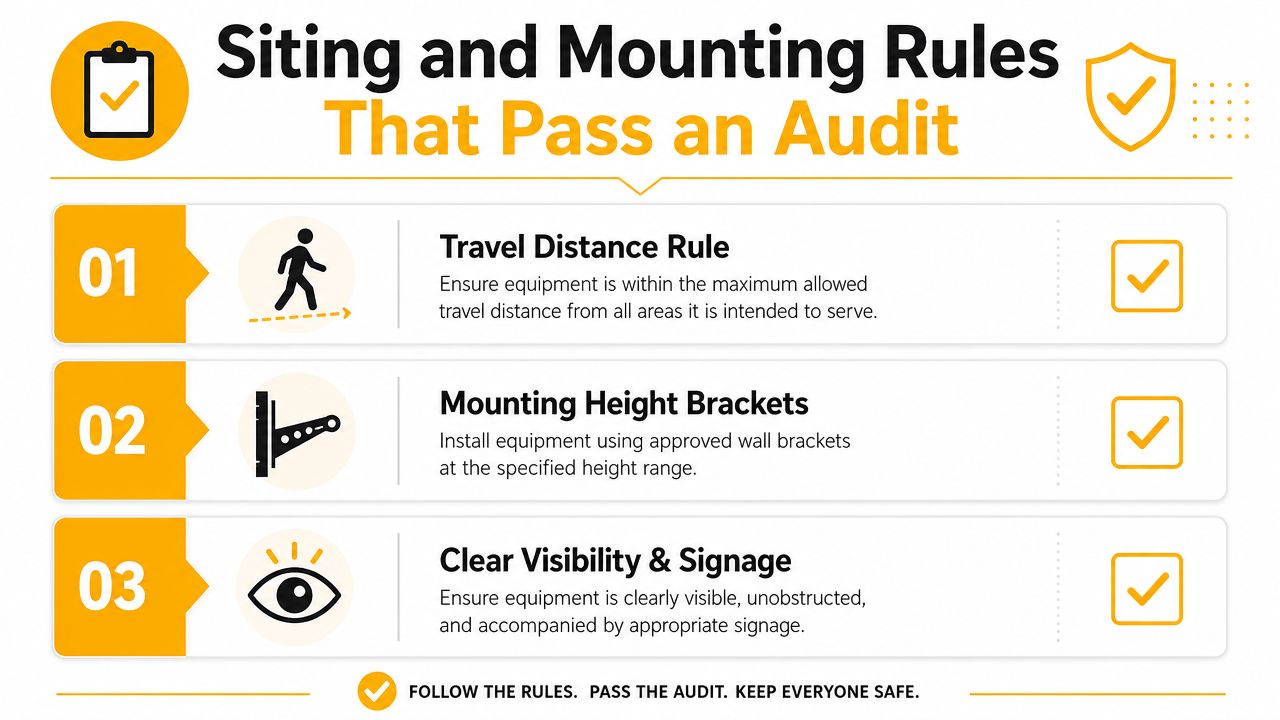
AS 2444 puts the focus on usable placement. The practical checks are simple, travel distance from the point of work, mounting height that keeps the unit reachable, and signage that makes the extinguisher easy to find from the normal approach path. A compliant unit that sits behind stock, behind a door swing, or around a blind corner is still a problem because nobody can use it quickly without exposing themselves to avoidable risk.
In real Queensland sites, the repeat issues are consistent, blocked access in storerooms, units mounted too high, and signs that have faded or disappeared after a tenancy change. Back-of-house office areas near plant rooms also need more care than a typical reception corridor because the hazard profile changes, which means siting has to follow the worst-case risk in the area, not the average one.
If a staff member has to move boxes to reach the extinguisher, the site is already out of shape.
A floor-plan check that actually works
Use a plain walk-through method before the contractor arrives.
- Check travel path first: stand at the furthest occupied point in the zone and confirm the extinguisher can be reached without weaving through stock, machinery, or a locked door.
- Check mounting height next: the handle should be reachable without awkward lifting, and the unit should be fixed so it doesn't get kicked, hidden, or knocked loose.
- Check visibility last: signs should identify the extinguisher before someone is right on top of it, especially in corridors, warehouses, and shared tenancy areas.
The placement logic matters more than the bracket style. A wall-mounted unit in the wrong place can be worse than a cabinet-mounted unit in the right place, because the issue is access and identification, not just hardware protection.
For mixed premises, the cleanest answer is to map the hazards by zone and then position extinguishers to the riskiest part of the floor plan. Cabinet-based placement options and their compliance implications are worth reviewing when a unit needs protection from impact, tampering, or tenancy traffic.
AS 1851 Maintenance Cycles and What Gets Logged
An extinguisher that looks fine on the wall can still fail an audit if the servicing trail is incomplete. In Queensland commercial practice, AS 1851 turns extinguisher upkeep into a documented cycle, so the question isn't only whether the unit is present, it's whether the records prove it stayed serviceable.
What happens on the maintenance cycle
The routine service structure is straightforward. Monthly visual checks confirm the unit is present, accessible, and showing no obvious damage. Annual maintenance is the deeper service point, where the technician checks the condition of the extinguisher, the pressure or fill state, and the general serviceability of the assembly. Defects get logged, corrected, or escalated, and the unit is either recharged or replaced when service condition demands it.
That record trail is what survives a tenancy handover or insurer question. A tag without context is weak. A tag plus a documented defect note, a corrective action record, and a current service date gives the manager something defensible when someone asks why a unit was out of service, swapped, or relocated.
What needs to stay on file
A workable compliance folder doesn't need to be complicated.
- Inspection evidence: current tags and notes showing the unit was checked on cycle.
- Condition records: pressure readings, physical condition, and any visible defects.
- Corrective actions: recharge, replacement, relocation, or signage fixes.
- Service history: enough records to show the program has been continuous, not improvised.
Many SMEs fall short in this area. The extinguishers are mounted correctly, but the service file is patchy enough that no one can prove the building stayed compliant across the year. That gap becomes a problem at audit time, and it's especially painful when a tenancy changes or a landlord asks for records after a commercial lease event.
AS 1851 service-cycle references and related maintenance topics are worth keeping close if your property manager, contractor, and tenancy files all need to tell the same story.
The unit on the wall is only half the job, the paperwork has to match it.
When Not to Use an Extinguisher, and Other Real Decisions
Owning an extinguisher doesn't mean using it. The safest public guidance is simple, use one only if the fire is small, confined, and the exit is behind you, otherwise evacuate immediately. That rule matters because the person standing there under stress has seconds, not time for a training slide deck.
The yes or no rule in plain English
If the fire is growing, if smoke is pushing you back, or if you'd have to move deeper into the hazard to reach the exit, the extinguisher is the wrong choice. That's especially true in kitchens, small storage areas, and warehouse aisles where one bad angle can cut off your exit path fast. The unit is a first-response tool, not a rescue plan.
A café and a warehouse can both be fully fitted out and still face different outcomes. In the café, staff often need to decide quickly whether a small pan fire is still manageable or whether the room needs to clear. In the warehouse, the same decision is filtered through stock layout, aisle width, and whether the staff member can back out safely after discharging the unit.
The practical gap is what happens after the near-miss or discharge. The extinguisher may need immediate replacement or service, the defect or use event has to be recorded, and the site file should show what happened and when. That record matters because the next question is usually not, “Did the staff know PASS?”, it's, “Can you prove the system stayed in control after the incident?”

The decision point after a discharge or defect
If a unit has been used, tagged defective, or found out of service, the business has to treat it as a compliance event, not a housekeeping task. The replacement timing, service record, and next inspection all need to be visible in the same file. That's what keeps a near-miss from turning into a bigger audit issue later.
The strongest site rule is still the simplest one, if you can't stay low-risk and keep your exit path clear, you evacuate. That decision protects staff, and it protects the business from pretending a fire was “handled” when it was really only interrupted.
Putting It Together for Your Next Service Visit
A good extinguisher program makes the next service visit predictable. Before the technician arrives, confirm that each zone still has the right extinguisher type for the fire class risk, the units are visible and accessible, and the mounting position still matches the floor plan after any tenancy changes or stock reshuffles.
A pre-service checklist worth running
- Match each zone to the hazard: kitchen, electrical, office, warehouse, and flammable-liquid areas should not all rely on the same logic.
- Walk the access paths: make sure nothing blocks the extinguisher, the sign, or the approach route.
- Gather the service file: keep the last twelve months of tags, defect notes, and corrective actions in one folder before the visit.
That prep gives you the outcome that matters most, a file that can stand up in an audit, insurance review, or tenancy handover. It also gives you a quick way to judge service quality, because a decent contractor should leave you with clear tag dates, logged gauge readings where relevant, and a handover trail that isn't built on guesswork.
If the provider can't show you the paper trail, the wall brackets don't mean much.
If your site needs portable fire extinguisher supply, relocation, servicing, or a compliance check that ties selection and AS 1851 records together properly, Celtic Fire & Security can help across North Brisbane, Moreton Bay, the Sunshine Coast, Somerset, and Ipswich. For a practical review of your current extinguishers, siting, and maintenance records, visit Celtic Fire & Security and book a site discussion with a technician who works to the relevant Australian Standards.
No responses yet