
You're managing a Queensland workplace when the alarm sounds. Near the loading area, a pallet of cardboard has caught fire, and the nearest wall-mounted extinguisher is within reach. The instinct is understandable: grab it and attack the flames. The safer question is different: is this a small, suitable, immediately controllable fire, or is evacuation already the correct response?
Knowing how do you use a fire extinguisher means more than memorising P.A.S.S. You need to identify the Australian fire class, choose a compatible agent, raise the alarm, protect your retreat path, and recognise when smoke, heat or rapid spread has made first attack unsafe. Queensland Fire and Emergency Services makes those limits clear in its fire extinguisher information sheet.
Table of Contents
- When an Extinguisher Is the Right First Response
- Using the P.A.S.S. Technique Correctly
- Matching Australian Fire Classes and Extinguisher Agents
- Choosing Dry Chemical or Wet Chemical Extinguishers
- Electrical Hazards and Essential Safety Conditions
- Real Workplace Scenarios and When to Retreat
- A Practical Fire Extinguisher Readiness Plan
When an Extinguisher Is the Right First Response
Before removing an extinguisher from its bracket, decide whether the fire is small enough to fight safely. An extinguisher is a short-duration first-attack tool, not permission to remain in a dangerous area. A cardboard fire contained in one bin may be suitable. Flames spreading across stacked pallets, burning through a ceiling, or producing heavy smoke require evacuation.
Confirm these five conditions:
- Size: One suitable unit can address the fire.
- Escape: A clear retreat path remains behind you.
- Alarm: People nearby know about the fire and evacuation has started.
- Fuel: You can identify what is burning and select the correct extinguisher.
- Atmosphere: Smoke and heat have not made the area unsafe.
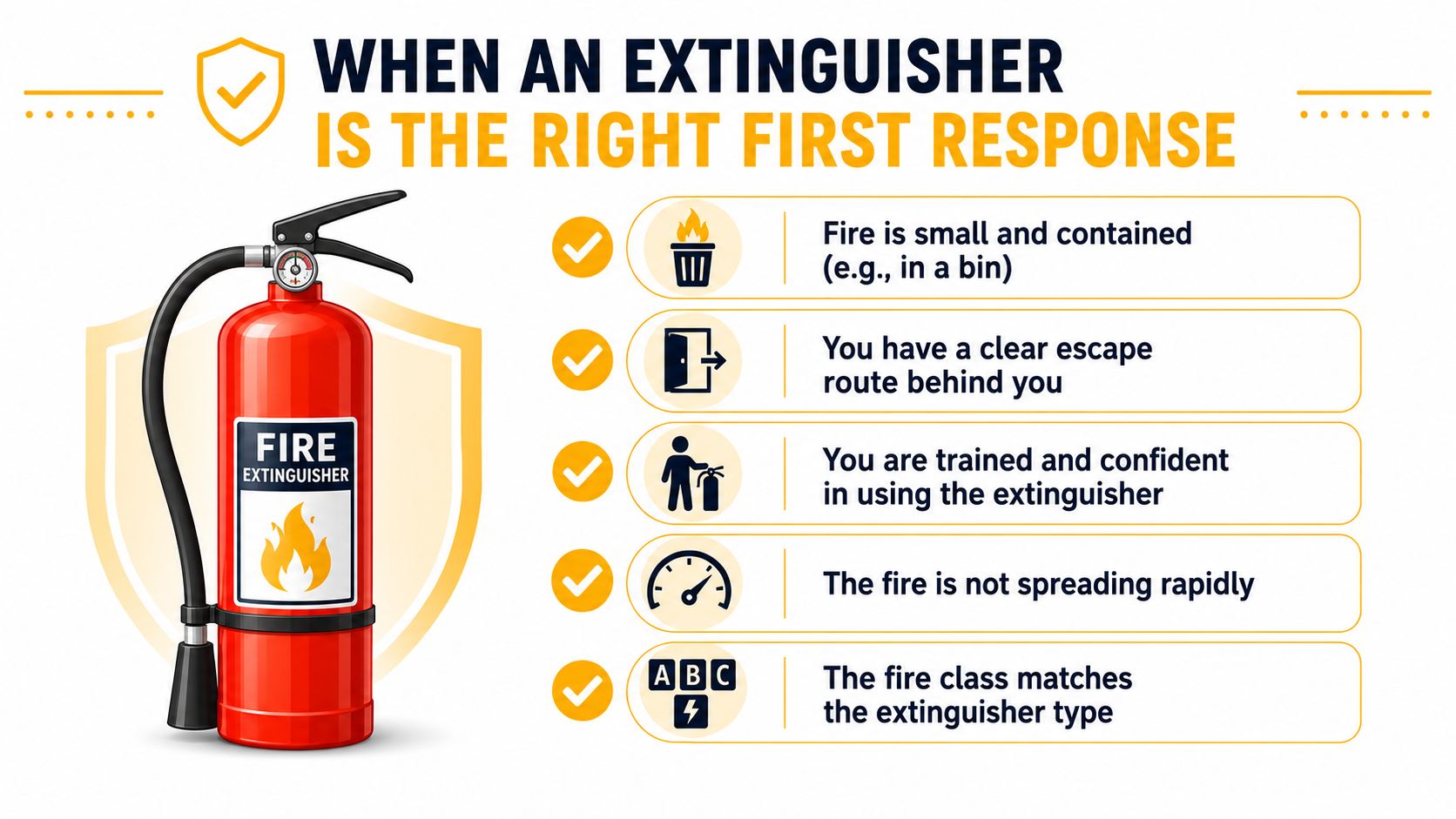
Practical rule: If you cannot identify the fuel, reach the extinguisher without moving towards danger, or retreat immediately, evacuate.
Queensland guidance also requires the agent to suit the fuel, any electrical hazard to be addressed with a non-conducting agent, and the fire to be extinguishable quickly without risking personal safety. Other people should already be evacuating. A wall-mounted unit may be correctly installed but still unsuitable for the incident.
Raise the alarm and contact emergency services if the fire is beyond a small, contained first attack. In Queensland, call 000 or 112 where appropriate. Do not delay evacuation while searching for another extinguisher, and never re-enter after leaving. Follow the site emergency plan and relevant AS/NZS requirements when selecting, locating and maintaining workplace equipment.
Using the P.A.S.S. Technique Correctly
P.A.S.S. is the Australian operating method for a portable fire extinguisher:
- Pull the pin. Remove the safety pin or locking device so the handle can operate. The tamper seal may break as you do this. Keep the nozzle pointed away from yourself and others.
- Aim low. Direct the nozzle at the base of the fire, not at the flame tips or smoke. Suppression works at the fuel source, where the agent can interrupt combustion, cool the material or displace oxygen.
- Squeeze the handle. Apply firm, controlled pressure to discharge the extinguisher. A steady application gives you better control than repeatedly pumping the handle.
- Sweep side to side. Move the nozzle across the base of the flames. As the fire retreats, work forward only when the route remains safe. If the flames surge, stop and retreat.
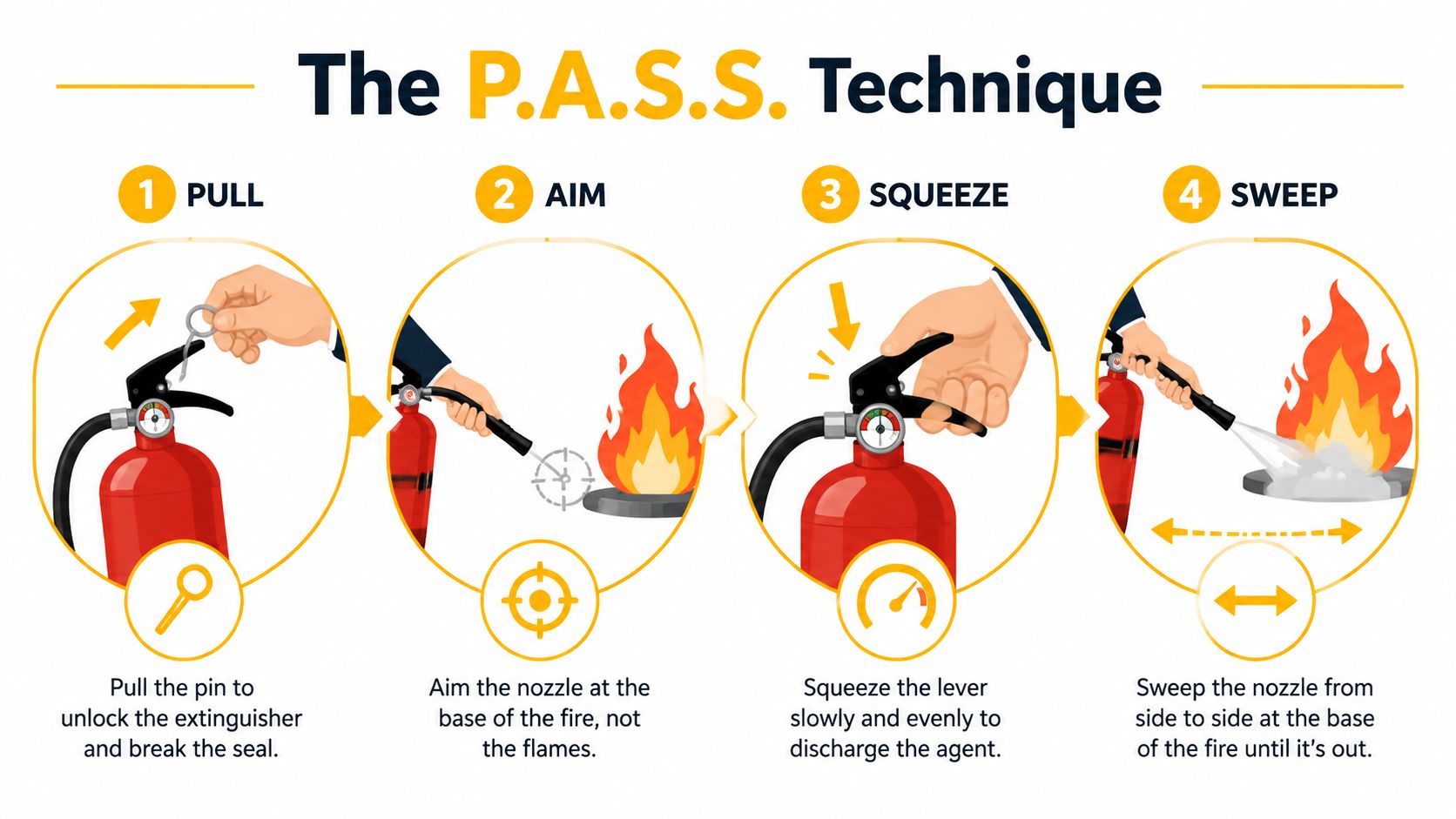
The four actions should flow together as one first-attack movement. Don't walk into the fire while concentrating on the sequence. Keep your body positioned so the exit remains available, maintain enough distance to avoid unnecessary heat exposure, and watch the area for flare-ups or hidden burning material.
Aiming at the top of the flames doesn't remove the fuel, so the fire can continue underneath and re-ignite. Short, uncontrolled bursts can also reduce your ability to sweep the base effectively. The nozzle should follow the burning edge, not chase smoke above it.
Remember: P.A.S.S. only operates within a wider safety decision. If the fire grows, smoke thickens, the extinguisher runs out, or your retreat becomes uncertain, leave immediately.
Workplace training should include a practical demonstration with an appropriate training or empty extinguisher where the training provider permits it. Rehearsing the hand movements helps staff understand the pin, handle and nozzle before stress makes fine control difficult. It doesn't replace evacuation training, equipment selection or site-specific emergency procedures.
Matching Australian Fire Classes and Extinguisher Agents
Australian workplaces use fire classes that must be matched to the extinguisher label. Don't rely on a familiar colour or assume the nearest unit is suitable. Australian standards and guidance connect extinguisher selection with the fuel involved, electrical risk and the approved agent.
The main classes are:
- Class A: Ordinary combustibles, including paper, timber and cardboard.
- Class B: Flammable liquids, such as petrol, paints and solvents.
- Class C: Flammable gases, including LPG and acetylene.
- Class D: Combustible metals, generally found in specialist industrial or workshop environments.
- Class E: Energised electrical equipment.
- Class F: Cooking oils and fats, particularly in commercial kitchens.
Class E describes the electrical hazard while equipment remains energised. Once power is safely removed, the remaining burning material may fall into another class, such as Class A or Class B. This is why isolation, where safe, changes the risk assessment but doesn't make an unsuitable agent safe during the initial electrical event.
The Australian extinguisher types guide provides further context for choosing equipment in commercial premises.
| Fire Class | Typical Fuel | Compatible Agent Examples |
|---|---|---|
| Class A | Paper, timber, cardboard | Water, foam, dry chemical powder |
| Class B | Petrol, paints, solvents | Foam, dry chemical powder, carbon dioxide where suitable |
| Class C | LPG and acetylene | Dry chemical powder |
| Class D | Combustible metals | Specialist dry powders selected for the metal |
| Class E | Energised electrical equipment | Non-conducting agents, including dry chemical powder or carbon dioxide |
| Class F | Cooking oils and fats | Wet chemical |
Agent compatibility is not a minor technical detail. Water can spread burning liquid and can conduct electricity. An unsuitable powder or agent can fail to control the fuel, while a cooking-oil fire needs equipment designed to cool and suppress hot fats without creating dangerous splashing or flare-up.
Choosing Dry Chemical or Wet Chemical Extinguishers
For many general workplace hazards, AB(E) dry chemical powder is the practical broad-range option. The Marine Safety Queensland suitability matrix identifies AB(E) dry chemical powder as suitable for Class A, Class B, Class C and energised electrical fires. That makes it relevant to workshops, plant rooms, vehicle bays and areas near electrical switchboards, subject to the specific installation and risk assessment.
Wet chemical has a narrower but critical purpose. It's designed for Class F cooking oils and fats in commercial kitchens. The agent cools the fuel and forms a suppressing layer over the hot oil, reducing the chance of continued burning and flare-back when used correctly.
| Feature | AB(E) Dry Chemical Powder | Wet Chemical |
|---|---|---|
| Primary role | Broad workplace coverage | Commercial kitchen cooking oils and fats |
| Australian classes | A, B, C and E | F |
| Suitable locations | Workshops, plant rooms, vehicle bays and electrical areas | Commercial kitchens and cooking appliances |
| Main strength | Versatility across several fuel types | Cooling and suppressing hot cooking oils and fats |
| Important limitation | Powder residue can contaminate equipment and enclosed areas | Not a general substitute for electrical or flammable-gas protection |
The trade-off is operational. Dry powder can interrupt a fast-developing fire across several fuel types, but its residue may affect machinery, switchboards and clean-up requirements. Wet chemical is the correct specialist choice for a fryer or commercial cooking appliance, but it doesn't turn into a general-purpose extinguisher for every kitchen hazard.
Never use water or foam on burning cooking oil, and don't use either on live electrical switchboards. Read the extinguisher label before acting, confirm the fire class, and make sure staff know which unit is mounted for which hazard.
Electrical Hazards and Essential Safety Conditions
Energised electrical equipment creates a firm boundary. A burning switchboard, distribution board, solar inverter or live machine must be treated as an electrical fire until the power has been isolated and confirmed safe. Water and foam must not be directed at live equipment.
Only an extinguisher with a suitable non-conducting agent should be considered for an energised electrical fire. AB(E) dry chemical powder and carbon dioxide are common examples used for electrical hazards, but the extinguisher label and site risk assessment control the decision. The electrical fire extinguisher guidance should be reviewed alongside the equipment manufacturer's instructions and workplace emergency plan.
Before any first attack, confirm all of these conditions:
- Alarm raised: People nearby know there's a fire.
- Emergency call made: Someone has called 000 or 112.
- Correct agent available: The extinguisher suits the electrical hazard and any secondary fuel.
- Retreat path clear: You can move away without crossing cables, smoke or another hazard.
- Fire remains small: The extinguisher is suitable for the size and location of the fire.
- Air remains tenable: Smoke and toxic fumes aren't overwhelming the space.
- Power isolation is possible: The supply can be isolated without exposing anyone to additional danger.
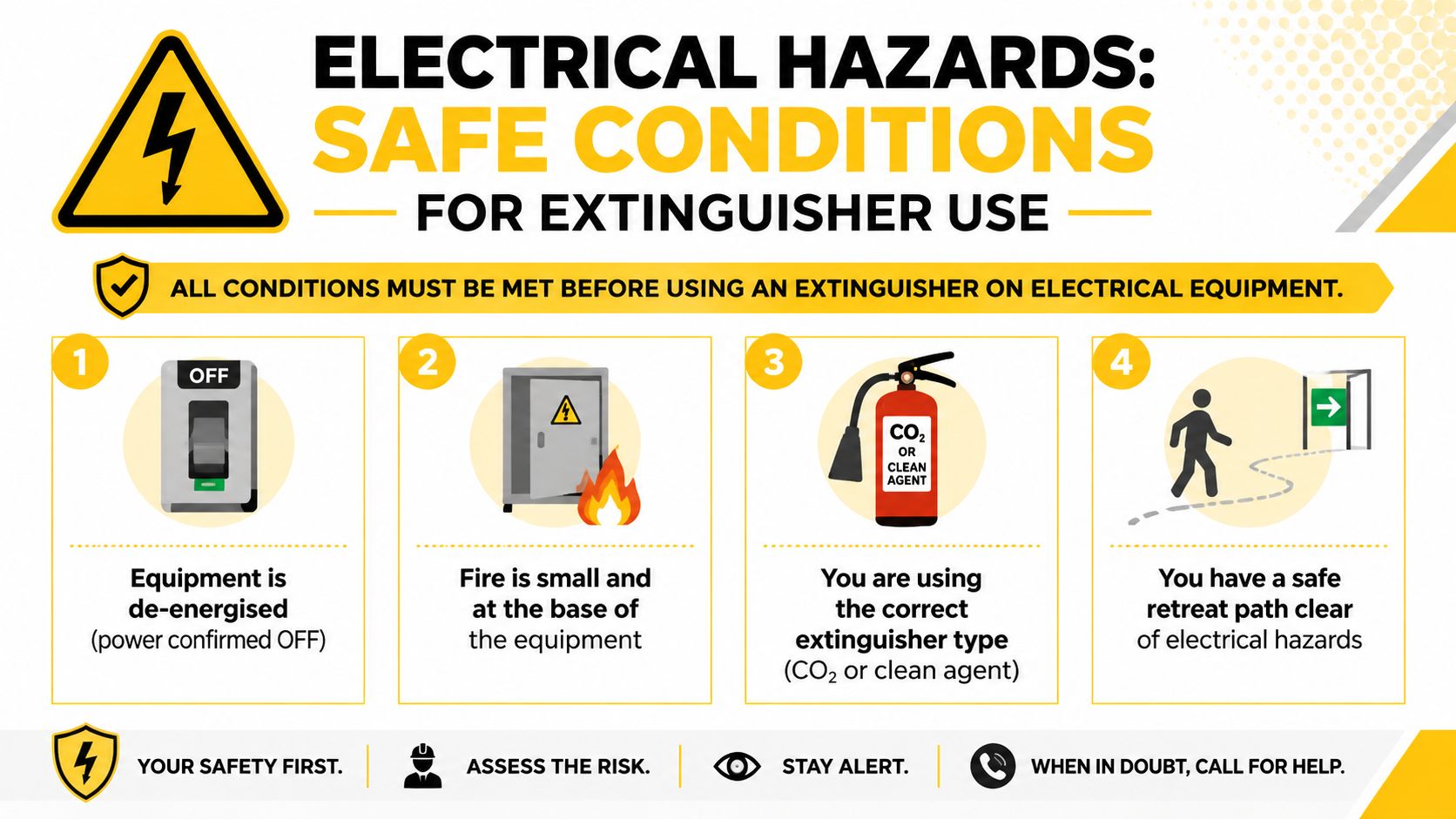
If any condition fails, don't attempt to hold the fire at the switchboard. Isolate power only where it's safe, close the door if you can do so without entering danger, evacuate, and wait for Queensland Fire and Emergency Services. Closing a door can limit the fire's access to air and slow the movement of smoke, but never delay escape to do it.
Electrical fires can conceal heat inside equipment and cable pathways. A flame that appears controlled at the front of a panel may continue behind covers or within connected equipment. Treat any return of smoke, crackling, arcing or renewed flame as a reason to withdraw.
Real Workplace Scenarios and When to Retreat
A small office bin fire can justify a controlled first attack. The alarm is raised first, a colleague calls 000, and the operator checks that the extinguisher is an appropriately labelled 2.5 kg AB(E) dry chemical powder unit. With the exit behind them and the paper fire contained inside the bin, they use P.A.S.S. at the base of the flames, then withdraw once the fire is out and wait for firefighters to inspect the area.
The important decision happens before the discharge. The operator hasn't assumed that every office fire is safe. They've confirmed the fuel, selected a compatible agent, kept the escape route open and made sure assistance is already on the way.
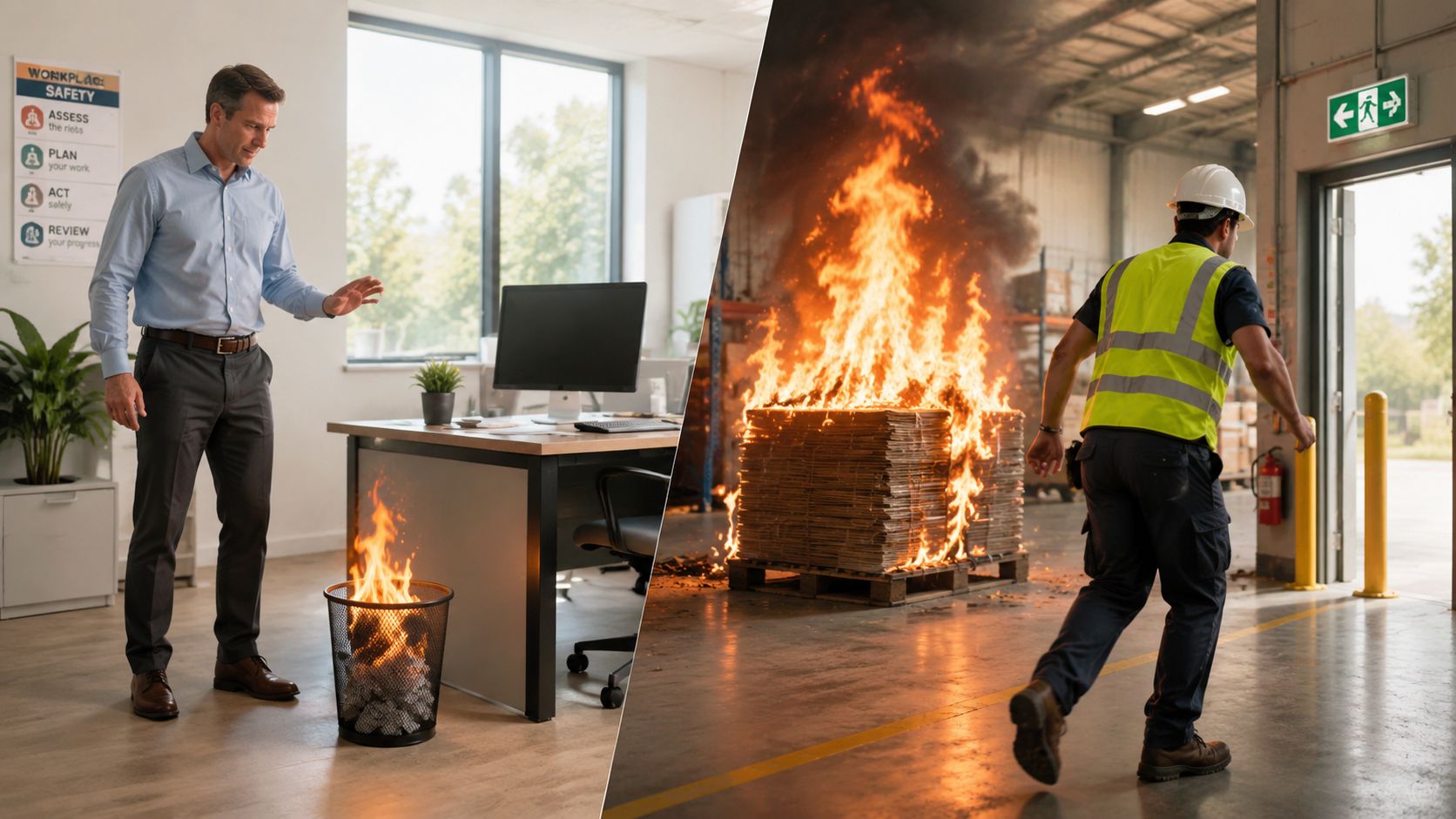
A bench grinder fire presents a different decision. Oily swarf catches, flames grow towards an electrical distribution board, and the smoke layer begins to drop. The operator retreats immediately rather than trying to work around the electrical hazard, isolates the upstream breaker at the main switchboard only if that can be done safely, closes the door without re-entering danger, and evacuates to the assembly point.
A safe retreat isn't a failed response. It's the correct outcome when the fire changes faster than the operator can control it.
The boundary moves quickly when a fire spreads across surfaces, reaches stored fuel, produces heavy smoke or threatens electrical equipment. Don't pursue flames into another room, don't reopen a door to check the fire, and don't return for tools or personal property. Firefighters can assess hidden heat and re-ignition risks with the equipment and breathing protection required for the conditions.
A Practical Fire Extinguisher Readiness Plan
Readiness is built into routine workplace checks. Managers should confirm:
- Equipment matches hazards: Each extinguisher suits the Australian fire class and fuel present.
- Service records are current: Inspection, testing, recharging and servicing follow AS 1851. Use the Standards Australia maintenance reference, and record completed work.
- Visual checks are logged: Staff check access, condition, pin, tamper seal, label and pressure indication. A documented workplace fire extinguisher check helps identify defects before an emergency.
- Access is clear: Signage remains visible, the unit is mounted appropriately, and stock does not obstruct it.
- People can act safely: Staff understand P.A.S.S., alarm procedures, evacuation routes and the point where retreat is required.
Queensland Fire and Emergency Services states that extinguishers must comply with AS/NZS 1841.1:2007. The Australian portable-extinguisher standards also include AS 2444 and the AS 1841 series. These requirements support suitable selection, installation and maintenance, but they do not replace judgement during a developing fire.
An extinguisher supports the emergency plan; it does not replace evacuation. Keep routes clear, maintain smoke and heat alarms, test emergency systems, and make the assembly point known. If the extinguisher cannot control the fire within roughly 30 seconds, retreat, close the door if safe, evacuate and call 000.
Celtic Fire & Security supplies, installs, tests and maintains commercial fire extinguishers, alarms, emergency lighting and related fire-protection systems across North Brisbane, Moreton Bay, the Sunshine Coast, Somerset and Ipswich. Visit Celtic Fire & Security to arrange a workplace extinguisher assessment, compliant servicing plan and staff fire-awareness support.
No responses yet