
A realistic Brisbane commercial CCTV installation cost is AUD 2,800 to AUD 6,000 for a 4-camera system and AUD 5,000 to AUD 9,000 for 8 cameras, including the NVR, cabling, and commissioning. Larger or more difficult sites can cost considerably more once access, multi-floor cabling, storage, and after-hours work are included.
You may be looking at three quotes for the same North Brisbane shop, warehouse, office, or hospitality venue and wondering how they can be so far apart. One supplier might quote for cameras only, another might include an NVR and basic setup, while a professional installer prices the cable routes, network hardware, testing, documentation, and the disruption involved in working around your business.
After more than 20 years servicing commercial sites across South East Queensland, the pattern is familiar. The camera count matters, but it rarely explains the whole price. Site access, mounting height, cable pathways, recording retention, licensing, commissioning, and compliance usually decide whether a project stays near the lower end of the range or moves into a much larger investment.
Table of Contents
- Understanding the Real Commercial CCTV Installation Cost
- Brisbane Commercial CCTV Pricing Ranges by System Size
- How Site Constraints Drive Up Installation Costs
- Key Components That Add to Your CCTV Installation Cost
- Budgeting for Compliant Commercial CCTV Installation
- Why Choosing a Licensed QLD Provider Protects Your Investment
Understanding the Real Commercial CCTV Installation Cost
A business owner often starts with a simple question, “What does one camera cost?” That question is useful for an initial estimate, but it's a poor way to judge a complete commercial system. A camera still needs a suitable mount, a reliable cable path, network or power infrastructure, recording capacity, configuration, testing, and a secure handover.
National pricing data places installed IP CCTV at about AUD 700 to AUD 1,500 per camera, with a four-camera small-business package typically around AUD 2,200 to AUD 5,300 and an eight-camera high-resolution system around AUD 5,000 to AUD 9,000. These figures reflect installed pricing rather than equipment-only costs, making them more useful for Queensland businesses preparing a genuine project budget. See the Australian commercial security cost guide for the published pricing context.
Equipment-only quotes versus installed pricing
An equipment-only quote may list four cameras and a recorder at an attractive price, but leave important work outside the headline figure. The final invoice can change when the installer finds that the communications cabinet is on another floor, the ceiling is inaccessible, the warehouse requires high-reach equipment, or the existing network can't support the proposed cameras.
A proper quote should clearly separate:
- Camera hardware: The camera type, resolution, lens, environmental rating, infrared capability, and mounting hardware.
- Recording equipment: The NVR, surveillance storage, recording settings, export capability, and user access.
- Cabling and infrastructure: Cable, containment, patching, switches, terminations, labelling, and any required network work.
- Labour and commissioning: Installation, configuration, day and night testing, staff handover, and documentation.
- Ongoing services: Maintenance, software support, repairs, remote access, and any recurring licences.
Practical rule: If a quote doesn't explain what happens to the footage, how the cable gets to each camera, and who commissions the system, it isn't yet a dependable project price.
Why Queensland conditions matter
A retail tenancy with accessible ceiling space is very different from a high-bay warehouse, a multi-level office, or an active hospitality venue. North Brisbane and the wider South East Queensland market includes older buildings, busy commercial centres, industrial estates, and premises where installation must happen without interrupting trade.
Licensing also matters. A compliant provider should be able to explain the relevant QBCC requirements, security licensing, electrical work, Australian Standards, privacy obligations, and site safety controls that apply to the proposed installation. That accountability costs more than a box delivered to site, but it gives the business a system designed to work reliably and a clearer compliance position at handover.
Brisbane Commercial CCTV Pricing Ranges by System Size
Brisbane pricing becomes easier to understand when system size is treated as a starting point rather than a fixed formula. A single fitted camera may be quoted at AUD 150 to AUD 400, while a four-camera wired system may sit around AUD 800 to AUD 2,000 and a six to eight-camera system around AUD 1,500 to AUD 3,500, according to a Queensland-focused pricing guide covering Brisbane, the Gold Coast, and the Sunshine Coast. Those figures are useful benchmarks, although a commercial-grade project with full recording, structured cabling, and commissioning can sit higher. The regional figures are outlined in this Queensland CCTV installation cost guide.
For standard commercial IP systems, installed pricing commonly sits around AUD 400 to AUD 800 per camera, while higher-resolution or AI-enabled systems can move toward AUD 700 to AUD 1,500 per camera installed. The important distinction is that the higher figure isn't just the price of a more expensive lens. Higher-resolution cameras create additional demands on the NVR, storage, network capacity, configuration, and testing.
A practical system-size comparison
| System size | Typical cost range (AUD) | Notes |
|---|---|---|
| Single fitted camera | AUD 150 to AUD 400 | Suitable for a focused entry, counter, gate, or small risk area, subject to recording and cabling requirements |
| Four-camera wired system | AUD 800 to AUD 2,000 | Queensland guide range for a wired system, with commercial projects potentially higher once full recording and commissioning are included |
| Four-camera commercial IP system | AUD 2,800 to AUD 6,000 | Brisbane planning range including NVR, cabling, and commissioning |
| Six to eight-camera system | AUD 1,500 to AUD 3,500 | Queensland guide range, with final pricing influenced by system capability and installation conditions |
| Eight-camera high-resolution system | AUD 5,000 to AUD 9,000 | Installed range where recording, cabling, and higher storage requirements are included |
The table shows why two apparently similar quotes can't be compared by camera count alone. A low-cost wired package may assume short, accessible cable routes and modest recording requirements. A commercial IP system may include a dedicated NVR, surveillance-rated storage, PoE switching, structured cabling, device configuration, and acceptance testing.
Why eight cameras don't simply cost twice as much
Moving from four cameras to eight adds more devices and cable runs, but it can also require a larger NVR, additional storage, increased PoE capacity, more network planning, and longer commissioning. If the cameras record at higher resolution or need analytics, the recorder and storage workload rises again.
The result is a non-linear cost curve. A professional installer may recommend fewer, better-positioned cameras in low-risk areas and more detailed coverage at entrances, loading zones, cash-handling points, or vehicle access areas. That design approach often produces better evidence than installing the same camera model everywhere just because a package includes it.
How Site Constraints Drive Up Installation Costs
Two businesses can specify the same number of cameras and receive very different quotes. A standard office building may offer accessible ceiling tiles, nearby communications rooms, and moderate mounting heights. A high-bay warehouse may require long cable paths, containment, traffic controls, lift access, and work around shelving, stock, forklifts, or restricted operational zones.
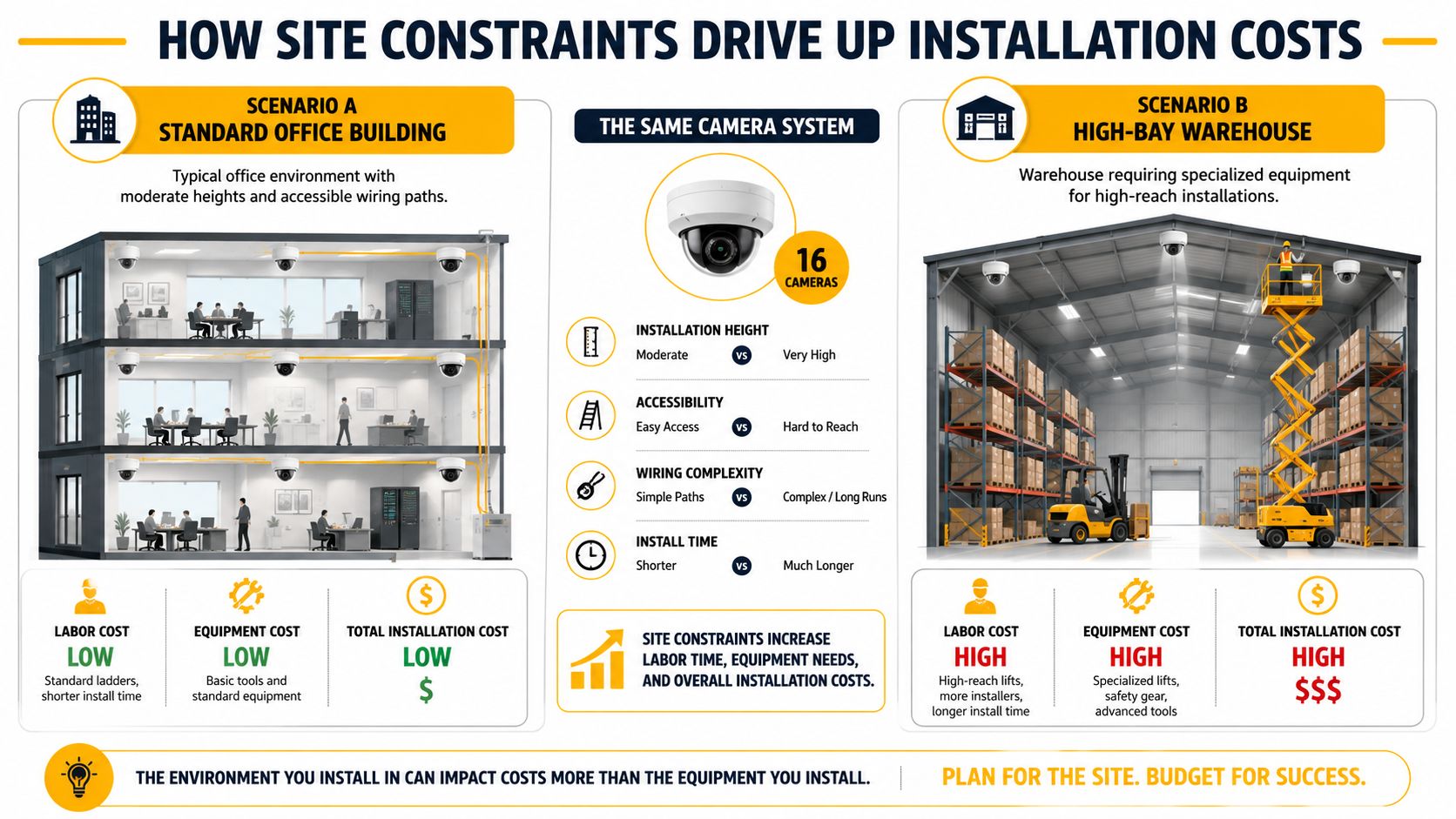
Brisbane-specific commercial benchmarks place installed IP systems at roughly AUD 700 to AUD 1,500 per camera. Labour, access difficulty, and infrastructure complexity can add as much as double the cost of a basic installation, particularly where the installer must work at height or create new pathways. The Brisbane commercial CCTV pricing guide explains the relationship between site conditions and installed cost.
The same camera count, different work
A multi-level office can still be demanding. Vertical cable routes may need fire-rated penetrations, additional containment, coordination with building management, and careful work around occupied suites. A shopfront might require neat surface-mounted conduit because there's no practical ceiling path, while a warehouse may need heavy-duty containment to protect cabling from impact.
The main cost drivers are practical:
- Access: Restricted areas, tenant coordination, security inductions, and limited work windows slow the installation.
- Height: High-mounted cameras may require a scissor lift, boom lift, scaffolding, or additional safety controls.
- Distance: Long cable paths consume more materials and labour, particularly where the recorder or network cabinet is remote.
- Building fabric: Concrete, masonry, steel framing, fire-rated walls, and difficult roof spaces require specialised tools and methods.
- Operating conditions: Active businesses may need staged work, isolation of work areas, protective measures, or after-hours attendance.
A camera mounted in the right location with a protected cable route is worth more than a cheaper camera that becomes inaccessible, obstructed, or unreliable.
For a commercial-grade four-camera installation, published Brisbane benchmarks place projects around AUD 3,000 to AUD 5,000 in suitable conditions. A 16-camera system can rise to AUD 9,000 to AUD 18,000 where analytics, extended retention, difficult access, or infrastructure work is involved. The cost difference isn't waste. It reflects the work required to make the system safe, serviceable, and usable in the actual building.
An installer should identify these conditions during a site survey rather than treating them as surprise variations. Businesses also need to consider how surveillance interacts with broader property protection. For related planning around building risks and repair responsibilities, see this guide to building insurance and repairs.
The following video provides useful visual context for how commercial CCTV systems are planned and installed.
Key Components That Add to Your CCTV Installation Cost
Camera hardware is visible on a quote, so it gets most of the attention. The parts that determine whether the system performs properly are often less obvious. Cabling, switching, recording, storage, configuration, and commissioning can account for a substantial part of the work even when the camera count is modest.
Start with the cable pathway
Ask how each camera will connect to the recorder or network. A professional installation may require Category cabling, conduit, tray, patch panels, cable supports, weather protection, fire-stopping, and labelled terminations. The cable itself is only one part of the job. The installer must route it without creating damage, avoid unsafe support methods, protect it from interference or impact, and leave a clear record for future servicing.
A short route through an accessible ceiling is straightforward. A route across a warehouse, between floors, or through a finished commercial tenancy takes longer and may need containment or specialist access equipment. This is why an equipment-only quote can look cheap until the building is inspected.
Check the network behind the cameras
IP cameras need a stable network and suitable Power over Ethernet capacity. The quote should identify whether existing switches can supply the required power and data performance, or whether the system needs new PoE switches, fibre uplinks, a secure cabinet, surge protection, or network separation.
A business shouldn't assume that an existing office network is automatically ready for continuous video. The installer needs to consider camera workload, recorder connection, remote viewing, user permissions, cybersecurity, and future expansion. Poor network planning can produce dropped footage, unreliable remote access, or disruption to other business services.
Size recording and storage around the evidence required
The NVR isn't just a box that saves video. Its capacity must match the number and type of cameras, recording mode, image quality, motion activity, and retention requirement. Higher-resolution cameras and extended retention increase the amount of storage needed, while analytics may add software or configuration requirements.
Use these quote questions to expose missing components:
- NVR capacity: Is the recorder sized for the proposed cameras and future additions?
- Storage: Is the included storage suitable for the required retention and recording settings?
- Export: Can staff find, export, and verify footage without specialist assistance?
- Commissioning: Will the installer test focus, lighting, time settings, playback, and export?
- Handover: Are passwords, user roles, diagrams, warranties, and maintenance details documented?
A system that records but can't produce usable footage during an incident hasn't delivered its intended purpose. Commissioning is therefore a cost, but it's also the point where the installer proves the design works in real conditions.
Budgeting for Compliant Commercial CCTV Installation
A realistic budget starts with the outcome the business needs, not the number of cameras a salesperson can fit into a package. An entrance may need facial detail, a loading bay may need a broad operational view, and a plant area may need coverage that remains useful in low light. Each location should have a defined purpose before equipment is selected.
For a small commercial site, current Australian guides place 4 to 8 IP cameras around AUD 2,500 to AUD 6,000 installed, while larger multi-floor or public-facing premises can reach AUD 8,000 to AUD 30,000 depending on access, after-hours work, and storage requirements. These figures are based on installed projects, not camera hardware alone, as shown in this national commercial CCTV pricing reference.
Build the budget in separate layers
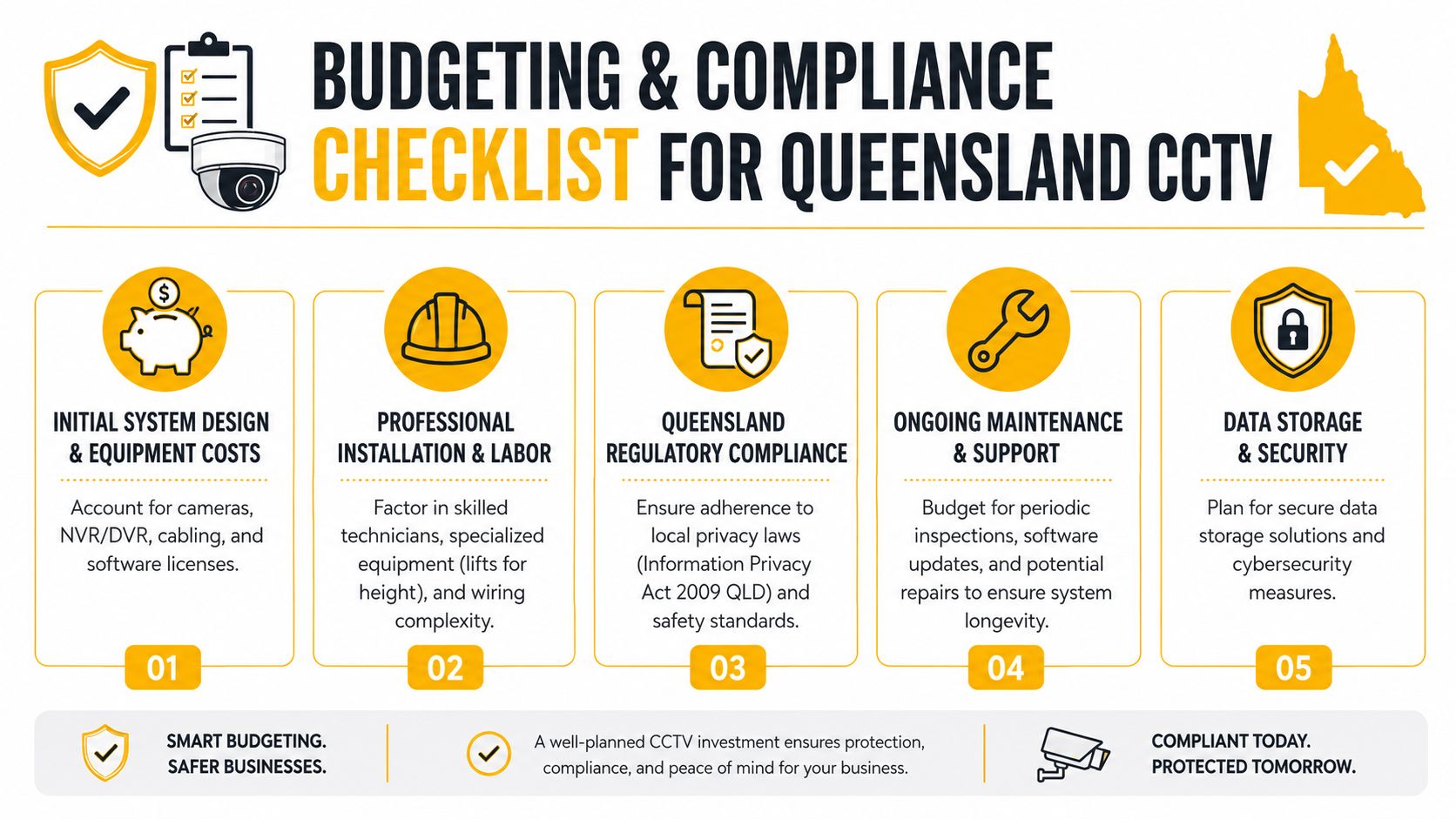
A useful quote makes the cost structure visible. Treat these as separate budget decisions rather than one unexplained total:
- System design and equipment: Include cameras, mounts, NVR or other recording hardware, storage, software, and required licences.
- Installation labour: Allow for cable routes, containment, penetrations, mounting, access equipment, safety controls, and work around trading hours.
- Network and electrical support: Confirm PoE capacity, cabinet space, power, surge protection, and any required electrical work.
- Compliance and documentation: Request test records, commissioning results, as-built information, user access controls, privacy signage guidance, and relevant certificates.
- Maintenance and support: Plan for cleaning, focus checks, firmware management, storage health, repairs, replacement equipment, and periodic system testing.
Treat compliance as part of the system
Queensland businesses should ask how the proposed work aligns with Australian Standards, applicable building and electrical requirements, privacy obligations, and QBCC licensing responsibilities. CCTV also involves personal information, so the business needs a clear purpose for surveillance, controlled access to footage, appropriate signage, secure storage, and a retention approach that reflects the operational need.
Compliance isn't a decorative line item. It affects who performs the work, how cables and penetrations are installed, how electrical components are handled, how footage is protected, and what documentation the business receives. A low quote that omits these responsibilities may leave the owner with unreliable evidence and difficult questions after an incident or audit.
For premises with wider safety obligations, coordinated records can also matter. Businesses may find it useful to review how commercial fire safety inspections are managed alongside security and maintenance schedules, particularly where one facility manager coordinates several compliance services.
Why Choosing a Licensed QLD Provider Protects Your Investment
The cheapest quote often looks attractive because it leaves out the work that carries responsibility. If the provider doesn't survey the site properly, document the cable routes, secure the network, test footage after dark, or explain who can access recordings, the business may save money at purchase and spend more on corrections later.
A QBCC-licensed provider with current security and electrical licences can take responsibility for a more complete installation process. That includes assessing the site, specifying suitable equipment, completing the work under the appropriate licences, testing the system, recording the results, and supporting the installation after handover. Australian Standards and relevant codes should shape the work from design through maintenance, not appear as a sentence at the bottom of a quote.
What professional accountability looks like
A credible commercial proposal should identify assumptions and exclusions. It should explain the proposed camera purpose, recording method, storage, cabling, network requirements, access arrangements, commissioning process, warranty, and support pathway.
Look for evidence that the provider can:
- Survey before quoting: Confirm heights, pathways, cabinet locations, lighting, access restrictions, and operating hours.
- Design for usable footage: Match lenses and positions to identification, incident review, or general observation requirements.
- Protect the infrastructure: Use suitable containment, secure equipment, controlled access, and sensible network practices.
- Test the finished system: Verify live views, recording, playback, export, time synchronisation, night performance, and user permissions.
- Maintain the installation: Provide scheduled servicing, fault response, system checks, and documentation updates.
Celtic Fire & Security has serviced the fire and security industry for more than 20 years, with a documented track record of 1000+ completed projects. Its stated capability covers sales, installation, testing, documentation, and servicing across North Brisbane, Moreton Bay, the Sunshine Coast, Somerset, and Ipswich, supported by QBCC licence 1183612, security provider licences 4626868 and 4695612, and electrical licence 89015.
The right comparison isn't the lowest camera price. It's whether the finished system will produce usable footage, remain maintainable, satisfy the site's compliance needs, and give your team a clear response when something fails. Businesses considering a broader integrated solution can also review the options for a commercial security alarm system.
Celtic Fire & Security supplies, installs, commissions, and maintains commercial CCTV systems for retail, hospitality, office, industrial, strata, and property sites across South East Queensland. Visit Celtic Fire & Security to discuss your site, receive a practical installed-cost assessment, and plan a compliant system around the footage your business needs.
No responses yet