
A facility manager in a Brisbane warehouse opens a fire hose reel cabinet and finds a clean drum, an apparently current service tag, and no flow-test result anywhere in the site records. The reel looks ready, but nobody has proved that it can deliver water at the required rate or that the hose will run out without binding.
That gap is common in commercial premises. Fire hose reel maintenance isn't just cleaning the cabinet or signing a tag. It combines condition checks, operational testing, water-flow verification, defect rectification and records that demonstrate the work was completed by an appropriately qualified person. Queensland guidance requires prescribed hose reels to receive six-monthly and yearly service inspections under the state fire-safety framework, with maintenance recorded as evidence of service (Queensland Fire and Emergency Services advisory notes).
Table of Contents
- What Fire Hose Reel Maintenance Actually Involves
- The Australian Standards Behind Hose Reel Servicing
- Six-Monthly Visual Inspection Checklist
- Annual Flow and Performance Testing
- Common Failure Points We See on Site
- QLD Compliance and Record-Keeping Requirements
- Maintenance Schedule and the 2026 AS 1851 Transition
What Fire Hose Reel Maintenance Actually Involves
A clean reel can still fail. The hose may be kinked behind the drum, the nozzle may be partially blocked, or the water supply may lose pressure when the valve opens. A signed tag without a measured result tells a facility manager that someone attended, but it doesn't necessarily show that the equipment performed.
Proper servicing works through several layers:
- Six-monthly condition checks: Confirm signage, access, leakage, hose movement and corrosion. Queensland Government guidance identifies these as part of the six-monthly inspection rhythm (Queensland Government fire safety maintenance guidance).
- Annual performance testing: Unwind the hose, operate the reel and measure water flow. The annual inspection goes beyond a visual check by including a more thorough unwind test and flow-rate check (Queensland Government fire safety maintenance guidance).
- Five-yearly hose durability testing: Industry guidance aligned with AS 1851-2012 identifies a five-yearly hydrostatic pressure test for the hose assembly (AS 1851-2012 sample).
- System readiness: Where a reel is supplied by a pump set, the pump must be inspected and started monthly, so reel maintenance may depend on the wider water-supply arrangement (Queensland Government fire safety maintenance guidance).
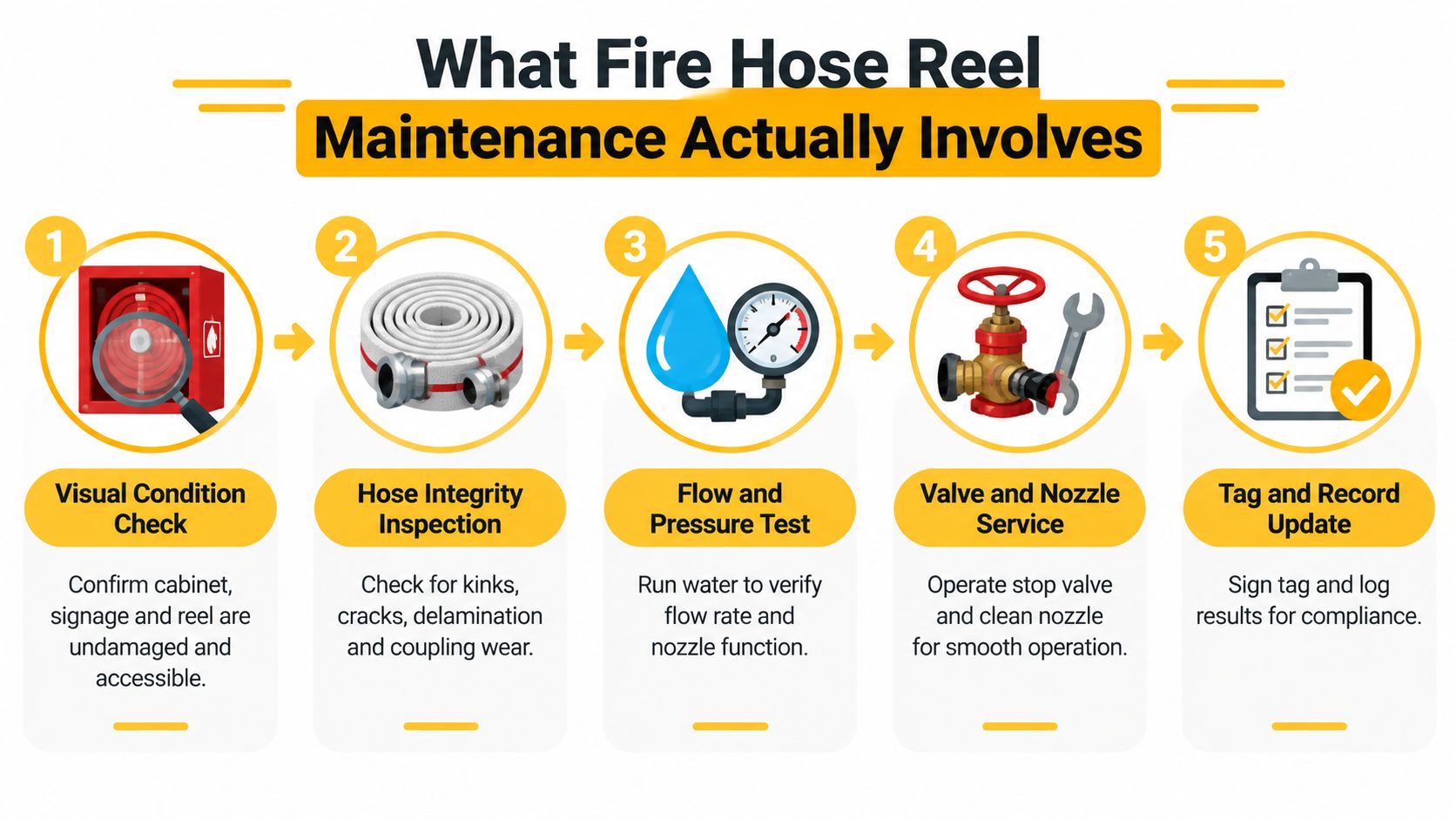
The record is part of the service, not an administrative extra. A useful maintenance entry identifies the asset, date, work completed, test result, defects, corrective action and technician details. In Queensland, a maintenance tag together with an invoice or maintenance report can provide evidence that the service occurred (Queensland Fire and Emergency Services advisory note).
Practical rule: If the logbook only says “checked” and contains no performance result or defect status, ask what was actually tested.
The Australian Standards Behind Hose Reel Servicing
A reel can be installed correctly and still fail its maintenance obligations. The standards answer different site questions, so the technician's report needs to show which task was performed and under which reference.
AS 2441-2005 covers the distribution, location and installation of fire hose reels. It applies when equipment is selected, positioned, connected or commissioned during construction, refurbishment or relocation. It is not a complete servicing procedure. Its maintenance direction points users to AS 1851 (Standards Australia listing for AS 2441-2005).
AS 1851-2012 provides the maintenance framework for existing equipment. For hose reels, that framework includes six-monthly inspection, annual inspection and testing, and the five-yearly hydrostatic pressure milestone used in Australian maintenance practice. The service record should show the inspection date, test result, defects and corrective action, rather than stating that the reel was checked.
| Aspect | AS 2441, Installation | AS 1851-2012, Maintenance |
|---|---|---|
| Main purpose | Distribution, location and installation of hose reels | Routine inspection, testing and servicing |
| Used when | Installing, relocating or modifying equipment | Maintaining existing equipment through its service life |
| Practical focus | Position, connection and installation arrangement | Condition, operation, flow performance and records |
| Key maintenance question | Was the reel installed correctly? | Is the reel ready to operate and can that be demonstrated? |
| Compliance evidence | Installation and commissioning information | Tags, service reports, test results and defect records |
Queensland facility managers also need to account for the 13 February 2026 transition identified for essential fire safety measures maintained under AS 1851-2012 in the applicable jurisdiction. The date matters during audits because a six-monthly or annual visit is only part of the evidence. Records must connect the asset to the work completed and demonstrate how defects were handled, alongside the applicable QDC MP 6.1 obligations.
Ask the technician which standard governs the job. Installation, relocation and connection questions belong with AS 2441. Ongoing service, testing and records belong with AS 1851-2012 and Queensland requirements. For a plain-language explanation, see this guide to the Australian fire hose reel standard.
Six-Monthly Visual Inspection Checklist
A reel can pass a quick walk-by and still fail when someone needs to use it. During the six-monthly visit, the technician should confirm that a person can locate the reel, open the cabinet, pull out the hose and operate the controls without an obstruction or obvious defect.
Begin at the cabinet exterior. Check that the reel remains accessible, its location sign is attached and legible, and stored goods have not narrowed the approach. Warehouse pallet layouts change, retail displays move, and corridor space is often reassigned. The reel's compliance depends on usable access at the time of inspection.
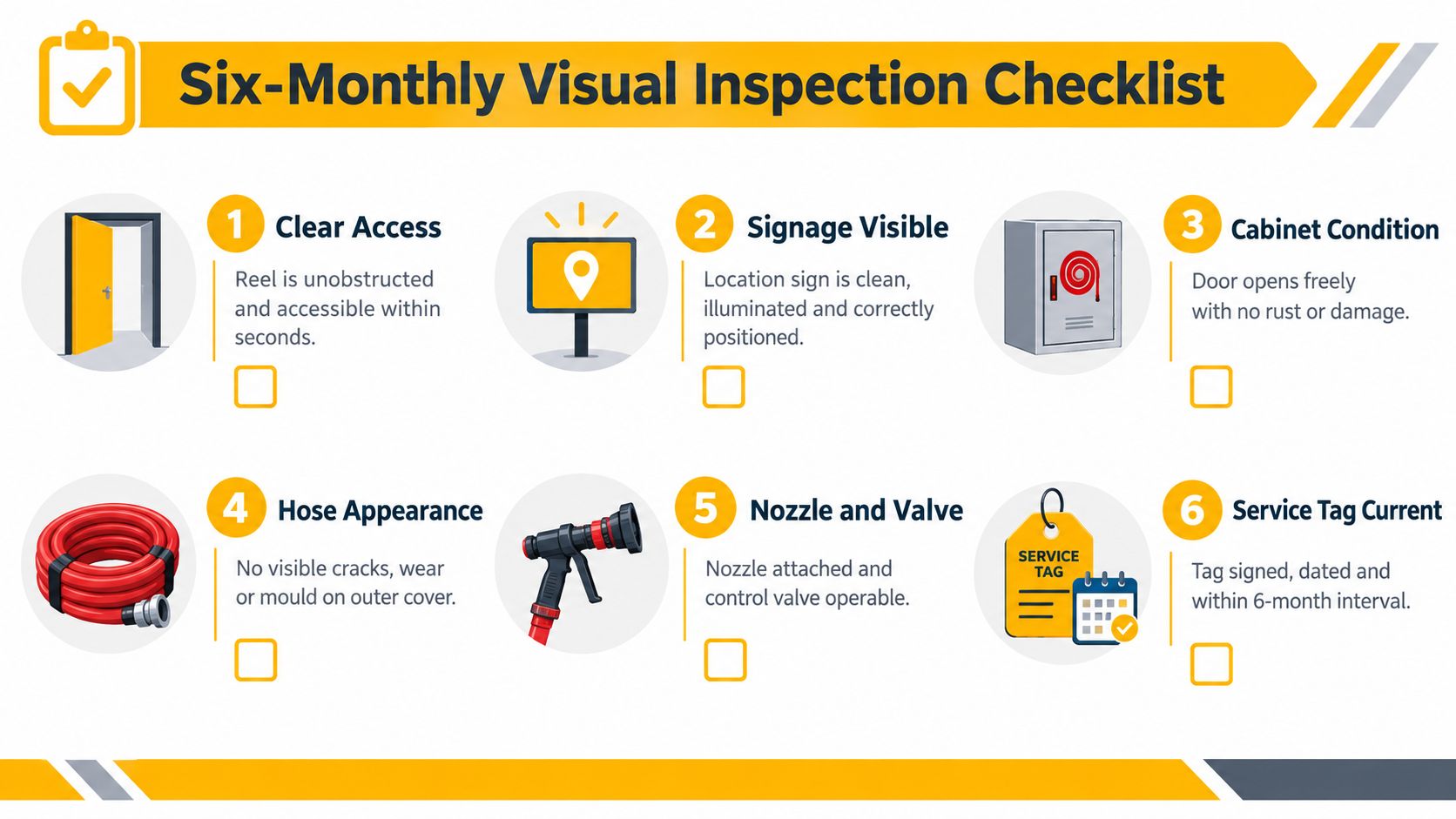
What the technician checks
- Signage and identification: Confirm that the label and location sign are attached, visible and legible.
- Access and cabinet operation: Open the cabinet fully, check that the reel can be reached, then confirm the door closes and latches correctly.
- Hose condition: Look for visible damage, severe wear, mould or deterioration that could affect use.
- Freedom of movement: Turn the drum and pull the hose away, checking for binding, twisting or catching.
- Valve, nozzle and fittings: Operate the stop valve and nozzle, then inspect fittings for leakage or corrosion.
- Maintenance evidence: Check that the service tag is current and the inspection result is recorded on site.
Queensland maintenance guidance identifies signage, leakage, hose freedom of movement and corrosion among the six-monthly inspection points. Record every defect in the service report, including defects corrected during the visit. A defect requiring follow-up work should show its status, responsible party and next action so the audit trail does not end with a verbal handover.
The hose should be withdrawn far enough to expose resistance or kinking, rather than only turning the drum a fraction. If the drum binds part-way, stop pulling, identify whether the hose is caught on the guide, cabinet or drum, and record the reel as requiring attention if the cause cannot be corrected safely during the inspection. Commercial fire safety inspections also rely on coordinated checks and clear records across the site.
Annual Flow and Performance Testing
A reel can look clean, turn freely and still fail when water is demanded. The annual service answers the question a visual inspection cannot: does the reel deliver the required flow under operating conditions?
The technician runs the hose out fully enough to test the installed arrangement, opens the stop valve and measures discharge with suitable flow-testing equipment. The assessment covers the hose, nozzle, valve and water supply together. Opening the valve briefly, or testing only at the drum without recording a result, does not show how the reel performs in use.
The benchmark figures are 0.33 L/s for a 19 mm hose reel and 0.41 L/s for a 25 mm hose reel. Dynamic inlet pressure should reach at least 220 kPa during discharge, consistent with the applicable maintenance requirements.
| Hose diameter | Minimum flow | Dynamic inlet pressure | Maximum hose run |
|---|---|---|---|
| 19 mm | 0.33 L/s | At least 220 kPa during discharge | Confirm the installed hose arrangement |
| 25 mm | 0.41 L/s | At least 220 kPa during discharge | Confirm the installed hose arrangement |
Record the result against the actual reel, not just the building. Low flow may come from a restricted nozzle, internal hose deterioration, a partly closed isolation valve or a supply that loses pressure under discharge. The reel furthest from the supply, or positioned highest in the system, can be the limiting point even when a nearby reel passes.
What belongs in the record
The annual test record should identify the reel and include:
- Hose size and asset location: Match the result to the physical equipment.
- Flow result: Enter the measured discharge in litres per second.
- Pressure result: Record inlet pressure during discharge.
- Operational condition: Note hose withdrawal, nozzle operation, valve movement and leaks.
- Defects and action: State whether the reel passed, failed or requires rectification.
- Technician details: Identify and sign off the person who performed the test.
These details support an audit-ready maintenance trail and make follow-up work clear. A recorded flow result below 0.33 L/s on a 19 mm reel should trigger a supply-side check before the reel itself is replaced.
Common Failure Points We See on Site
The first reel fault often appears when someone pulls the hose. The drum doesn't turn smoothly, the hose feels unusually heavy, or the first section comes away while the rest stays trapped. Restricted withdrawal can result from kinks, flattening or deterioration that isn't obvious from the outside of the coil.
A second pattern shows up around brass and connected fittings. Corrosion, powdery deposits and slow weeping at the inlet swivel, hose connection or nozzle coupling indicate that water has been affecting the assembly. A small leak may also reduce confidence in the equipment's condition and create a larger problem when the valve is fully opened.
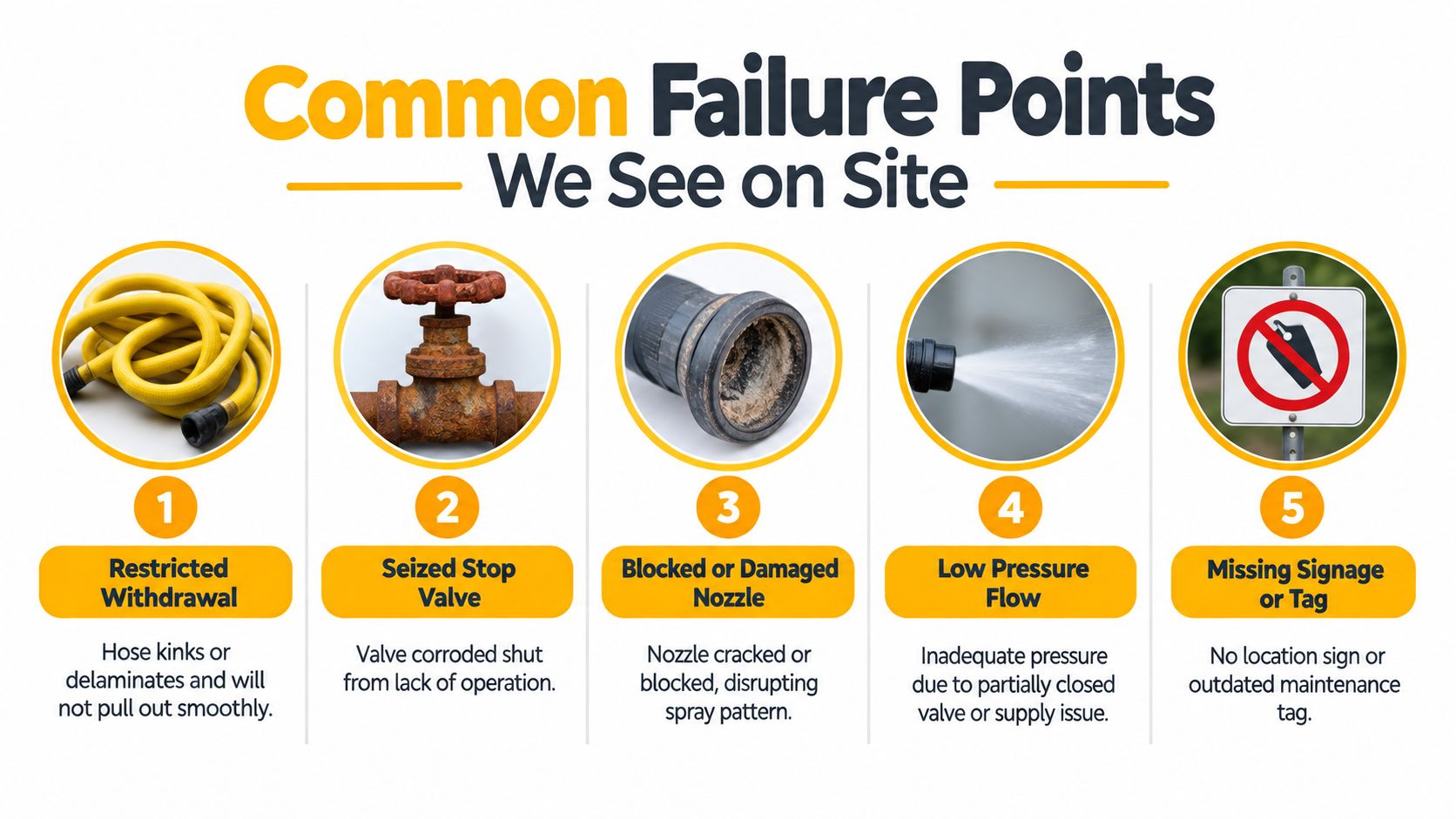
Faults that need more than a quick glance
- Restricted withdrawal: A kinked or degraded hose catches on the drum or guide instead of running out cleanly.
- Valve resistance: A stop valve can become difficult to operate when it hasn't been exercised or has developed corrosion.
- Nozzle blockage: Grit, paint or damage can disrupt the water pattern, reduce discharge or prevent the nozzle from shutting correctly.
- Low-flow performance: A partly closed isolation valve or supply issue can look like a reel defect until the water arrangement is checked.
- Missing evidence: An absent location sign or outdated tag creates an immediate compliance gap, even if the equipment appears intact.
Water-supply faults deserve a measured diagnosis. Before replacing a reel, the technician should check the isolation arrangement and any pump-set relationship, because a supply restriction can produce a low-flow result without the hose assembly being the original cause.
The main trade-off is speed versus certainty. A visual check takes less time, but it won't establish flow performance. An annual operational test takes more planning because the hose must be run and water discharged, yet it gives the facility manager evidence about how the complete installation behaves.
A hose reel that looks tidy isn't necessarily a hose reel that's ready.
That distinction matters most in older Queensland sites, where cabinets may have been painted, storage areas altered or fittings exposed to humid conditions. The defect log should show whether the issue was repaired, isolated, replaced or referred for further assessment.
QLD Compliance and Record-Keeping Requirements
For a Queensland commercial building, hose reel maintenance records form part of the fire-safety evidence. The occupier must ensure prescribed maintenance is completed in accordance with Queensland Development Code MP 6.1 and by an appropriately qualified person. The Queensland Development Code obligation should be checked against the current code applying to the building, not inferred from a contractor's standard service sheet.
The technician's qualification and the contractor's authority matter during an audit. The person carrying out the inspection or test should be identifiable, appropriately qualified for that task and linked to the result. A signed name without a clear business, date, asset reference or scope of work leaves gaps that are difficult to resolve later.
Build an audit-ready record set
Keep physical and digital evidence together in one building file. The file should contain:
- Current maintenance tags: Each reel should have a durable tag showing service information and the responsible technician's details.
- Service reports: State what was inspected, what was tested and which defects were found.
- Invoices or service confirmations: A maintenance tag supported by an invoice or maintenance report can provide evidence that service occurred, provided the documents identify the relevant asset and work.
- Flow-test results: Retain the measured annual result, including the test conditions where recorded, rather than a generic pass tick.
- Defect and rectification records: Record the original issue, action taken and evidence that the work was closed.
- Asset register: Match each tag and report to a specific reel, cabinet or location.
The site logbook should answer five questions quickly: which reel was serviced, when was it serviced, what did the technician test, did it pass or require action, and where is the supporting evidence?
A tag confirms attendance, but it rarely explains a failed flow result, a replaced nozzle or a restriction found during testing. The report and defect history give an owner, occupier, insurer or auditor enough detail to assess the asset's condition and the response to any fault.
Keep the records usable
Do not scatter documents across email inboxes, contractor portals and unrelated maintenance folders. Use one compliance location for the building, with an asset register linking each reel to its service history. For sites with multiple tenancies or buildings, separate records by asset location so a reviewer can trace the result without relying on memory.
Retrieval is the practical test. If a manager cannot produce the tag, service report and rectification evidence for a selected reel, the process is not audit-ready, even when the cabinet looks clean. A controlled record set also makes the six-monthly, annual and five-yearly schedule easier to verify when obligations and standards change.
Maintenance Schedule and the 2026 AS 1851 Transition
A reel may have a current service tag and still leave a facility manager exposed if the underlying records are incomplete. The maintenance calendar must connect each reel to its due date, responsible party, test result and follow-up action. It also needs to show how the site is preparing for Queensland Development Code MP 6.1 obligations and the AS 1851-2012 transition on 13 February 2026.
| Interval | Required work | Record or action |
|---|---|---|
| Monthly, where supplied by a pump set | Inspect and start the pump | Record the pump check and any abnormal condition, using the Queensland Government maintenance guidance as a reference |
| Six-monthly | Inspect signage, access, leakage, hose movement and corrosion | Update the tag and service record, then log defects |
| Annually | Complete the more thorough unwind inspection and measured flow-rate check | Record flow, pressure, operational findings and corrective action |
| Five-yearly | Complete the hose assembly hydrostatic pressure test | Record the test outcome and arrange replacement or rectification where required |
| After damage or alteration | Reassess the affected reel and surrounding installation | Record the event, inspection result and any repairs |
The five-yearly pressure test is a durability checkpoint, not a replacement for routine servicing. A hose can develop restricted access, nozzle faults, leakage or poor flow between pressure tests. The six-monthly and annual work therefore remains necessary.
Preparing for 13 February 2026
The transition to AS 1851-2012 on 13 February 2026 changes the planning requirements for affected Queensland facilities and other Australian jurisdictions applying the updated rule. Confirm the applicable servicing approach with the fire-protection contractor, then check that open defects, asset records and test evidence are ready for review.
QDC MP 6.1 obligations also make record retrieval part of the practical compliance task. Before the next visit, review overdue work and unresolved defects. Request the service report, measured flow result, pressure information, useful photographs, maintenance tag details and proof that rectification has been completed. A preventative program can cover hose reels and other fire-protection assets together, but each system still needs its own inspection and test evidence. For wider planning, see commercial fire protection servicing.
Use the next service cycle to close the gaps:
- Book the next six-monthly inspection: Confirm access arrangements and remove stored goods blocking cabinets.
- Confirm the annual test: Require measured flow and pressure results, not only a signed attendance record.
- Review the asset register: Match every reel to its location, tag and service history.
- Close defects promptly: Record the repair, replacement or further assessment, and retain supporting proof.
- Prepare for the transition: Confirm the applicable AS 1851-2012 servicing method before the 13 February 2026 milestone.
Celtic Fire & Security supplies, tests and maintains commercial fire hose reels, with scheduled preventative maintenance and compliance reporting for businesses across North Brisbane, Moreton Bay, the Sunshine Coast, Somerset and Ipswich. To arrange a site review or discuss an audit-ready maintenance program, visit Celtic Fire & Security.
No responses yet