
A shop owner in Fortitude Valley can lock the front door on Friday night, set a phone notification, and still return on Monday to a damaged roller door and an empty storeroom. The problem usually isn't a lack of technology. It's a system that detects movement but cannot reliably communicate the event, identify the affected area, support a response, or satisfy the owner's insurer.
That's why security alarm systems for small business should be treated as part of a layered risk plan, not as a keypad and a siren bought from a shelf. The right setup depends on the building, stock, access routines, lease obligations, monitoring arrangement, false-alarm exposure, and the way CCTV, access control and fire systems interact.
Queensland businesses also need a standards-aware approach. The Australian alarm standards have a long history, with AS 2201.1 originating in 1978 before later revisions and its joint redesignation as AS/NZS 2201.1:2007 on 12 April 2007. The related transmission standard followed a similar development pathway, with AS 2201.5 forming part of the 1978 series before later revision and redesignation as AS/NZS 2201.5:2008. Standards Australia's information on AS/NZS 2201.5:2008 shows that commercial alarm design and transmission have been shaped by an established national standards framework, rather than a short-lived product trend.
Table of Contents
- Why Small Businesses Need a Smarter Alarm Strategy
- How Commercial Alarm Systems Actually Work
- Main Alarm System Types for Small Business
- Key Features That Drive Real-World Performance
- Compliance, Monitoring, and Cost Considerations
- Integrating Alarms With CCTV, Access Control, and Fire Systems
- Choosing and Commissioning the Right Alarm Setup
Why Small Businesses Need a Smarter Alarm Strategy
A Fortitude Valley retailer can secure the shopfront, lock the rear entry and still leave the most exposed areas unprotected. Staff may use the back door, high-value stock may sit in a storeroom, and the premises may be empty for hours. A domestic alarm might sound a siren, yet fail to supervise every circuit, protect a roller door, maintain communication during an outage, or set out who responds when the owner is asleep.
The buying decision also has to account for insurer questions, landlord requirements and shared staff access. A low-cost system can become expensive when nuisance activations send the owner to site repeatedly, access codes are poorly managed, or event records are too limited to explain what happened. Cost matters, but the lowest purchase price does not necessarily produce the lowest operating cost.
Queensland operators should also treat electronic security as part of a wider risk plan. The Australian Cyber Security Centre recorded approximately 144 cybercrime reports per day, estimated annual losses of about $300 million from report data, and found that 62% of survey respondents had experienced a cyber security incident. Those figures concern cyber incidents rather than physical intrusion, but the ACSC small-business survey results show why owners need to consider detection, communications, monitoring and electronic systems together.
Practical rule: Specify the alarm around the site's failure points, not the longest feature list.
False alarms can turn an intended control into a daily burden. An Australian Institute of Criminology historical review recorded police advice that approximately 99% of alarms were false at one point, with police attending about 2,000 false alarms each month. The AIC review of private security remains a useful warning for Queensland businesses. Poor detector placement, weak supervision and incomplete staff training increase unnecessary activations, while unsuitable monitoring arrangements can leave the owner responsible for every response.
The practical question is: what combination of detection, signalling, monitoring, physical security and response will still work when the premises is empty? That answer should also account for CCTV, access control and fire-system interfaces, along with the standards and insurer conditions that apply to the site.
How Commercial Alarm Systems Actually Work
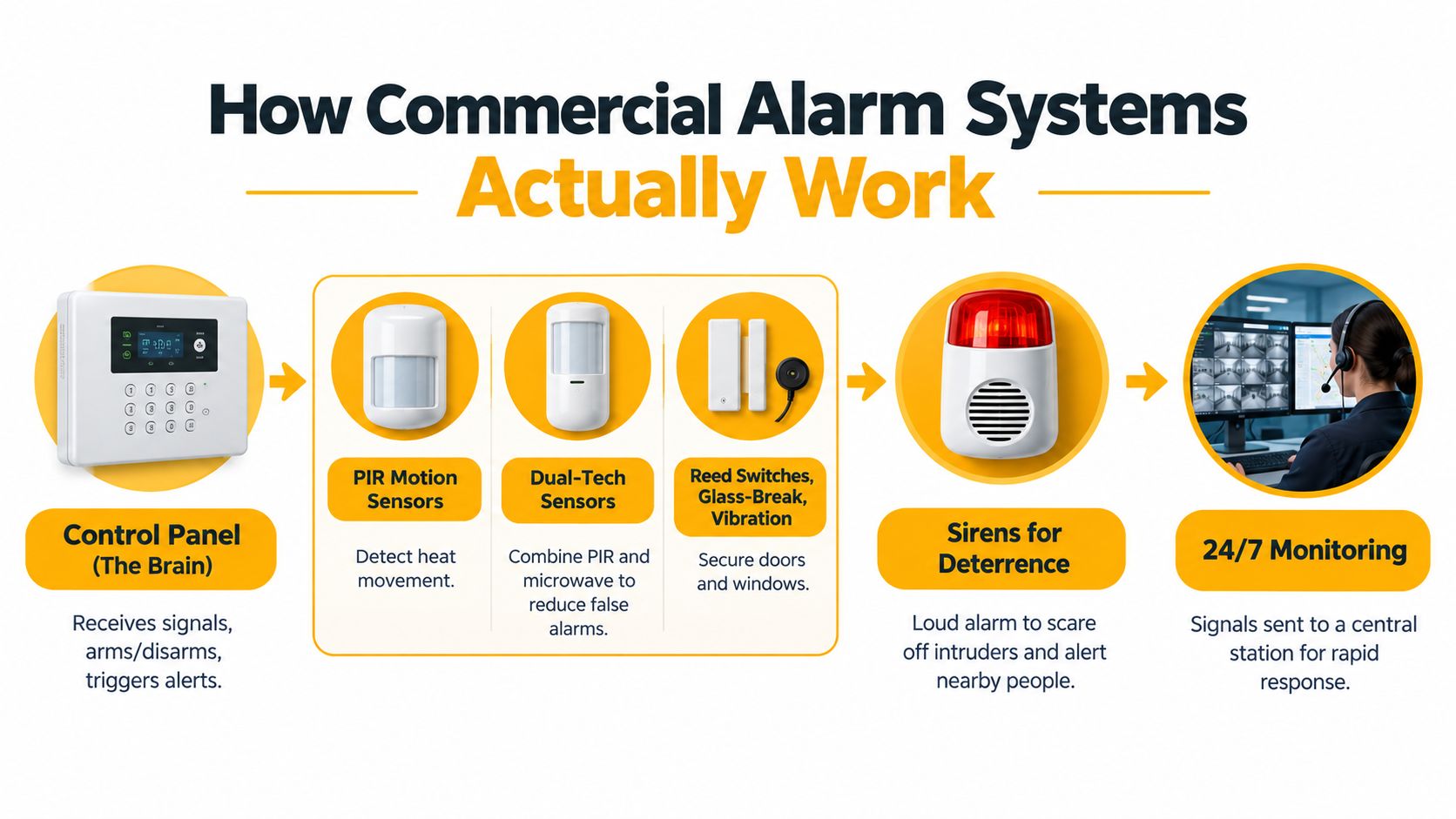
Think of a commercial alarm as a small communications network. The control panel is the switchboard. It receives information from field devices, decides whether the system is armed, disarmed or in alarm, records events, and sends instructions to sirens or a monitoring centre.
The detection devices act like witnesses. A passive infrared, or PIR, sensor detects changes in infrared energy associated with movement. A dual-tech detector combines PIR with another sensing method, commonly microwave, so the panel receives stronger confirmation before treating movement as an intrusion. Reed switches report whether a door or roller door is open, while glass-break and vibration devices protect specific attack points that a room sensor may miss.
A siren is the local announcement. It can deter an intruder, alert neighbours and tell staff that an alarm has activated. It doesn't, by itself, tell a business owner what happened or ensure somebody attends. That job belongs to the signalling path.
Detection is different from notification
A system can detect an event accurately and still fail operationally if the message doesn't reach anyone. Signalling can use an IP connection, a cellular connection, or a combination of paths. A dialler-based setup may also be encountered during upgrades, but Queensland businesses should ask how the system will operate through network changes and service interruptions.
This distinction matters on South East Queensland sites. A PIR in the wrong position creates poor detection. A reliable sensor connected to a weak transmission path creates poor notification. A monitored system needs both.
Where AS/NZS 2201 fits
The AS/NZS 2201 series gives Australian commercial alarms a technical framework. AS/NZS 2201.1 addresses design, installation, commissioning and maintenance at the client premises. AS 2201.2 addresses monitoring centres, while AS/NZS 2201.5 addresses alarm transmission performance, reliability and security characteristics. This Australian compliance guide to the AS/NZS 2201 series explains why a commercial alarm involves more than a panel and sensors.
Grading helps match the system to the site risk. Higher-risk premises generally need more resilient equipment, supervision and signalling. The installer should explain the proposed grade and show how the detection layout and communication path support it, rather than using “commercial grade” as a vague sales label.
Main Alarm System Types for Small Business
Small businesses usually encounter four approaches. They differ less in how loudly they sound than in who receives the event, who responds, and how much operational responsibility remains with the owner.
| System Type | How It Alerts | Typical Monthly Cost (AUD) | Best Fit For |
|---|---|---|---|
| Audible-only bells | Local siren or bell alerts people nearby | Not applicable | Very low-risk premises with strong physical security |
| Self-monitored system | App, push notification, text or phone alert to nominated users | Varies by provider | Owners who can reliably assess and attend alerts |
| Professionally monitored back-to-base | Signal goes to a staffed monitoring centre with an agreed response process | Varies by grade and service | Retail, hospitality, warehouses and sites holding stock, cash or sensitive equipment |
| Hybrid setup | Local siren plus app notifications and optional professional monitoring | Varies by configuration | Businesses wanting staged protection across one or several sites |
Audible-only systems
An audible-only alarm is simple and can be appropriate where the premises has low exposure, good lighting, strong locks and nearby people likely to notice an activation. Its weakness is obvious: the system can't confirm whether anyone heard it, and a siren doesn't create a documented response pathway.
Queensland Government business-security guidance recommends alarms alongside measures such as security roller shutters on windows and doors. The Queensland business-security advice supports the practical view that an alarm should sit inside a broader physical-security arrangement.
Self-monitoring
Self-monitoring reduces recurring service involvement, but it transfers responsibility to the owner. The owner needs reliable phone coverage, access to the app, current contact details and a realistic plan for a late-night activation. If an alert arrives while the owner is travelling, unwell or unable to enter the site safely, the apparent saving may come with a serious response gap.
Back-to-base monitoring
Professionally monitored systems cost more each month, but a staffed centre can receive signals, apply the agreed alarm protocol and contact nominated people or emergency services where the event and procedures support that response. Queensland Police advises businesses to use systems that meet Australian standards and decide in advance who will attend when an alarm activates. Queensland Police electronic security guidance also recommends regular testing to reduce false alarms and maintain reliability.
On a Brisbane warehouse, dual-path signalling is usually more sensible than relying on one communication route. NBN migration and connection changes can affect older dialler-based arrangements, so the installer should explain the current path and its backup.
Key Features That Drive Real-World Performance
Coverage determines whether an alarm helps during an actual incident. A sensor protects only the area within its detection pattern, and only against the event it was selected to identify. A passive PIR can suit a stable office. A dual-technology detector may be more appropriate in a warehouse exposed to temperature changes, air movement or stored materials that could create nuisance alarms.
Roller doors need their own detection plan. A reed switch reports the door position, while a vibration or inertia sensor can identify attack activity before the door is fully open. Shopfront glass may need glass-break detection. A safe or rear wall may require vibration detection rather than another general room sensor.
Supervision and zoning
Dual end-of-line supervision, usually called DEOL, helps the panel distinguish normal operation from selected tamper and wiring faults. Balanced circuits make it harder for a cut or modified cable to appear healthy. Zone labels should also describe the protected area. “Rear roller door” gives staff and the monitoring centre usable information. “Zone 4” makes response and testing slower.
AS 2201.1 provides a benchmark for intruder alarm installations, including panel location within the alarmed area, outside the entry and exit point, and the use of dual end-of-line supervision. Those details affect tamper resistance and fault detection, so they should be checked during design and commissioning.
| Feature | Marketing Claim | Field Reality for SEQ Sites |
|---|---|---|
| Dual-tech detection | “Fewer false alarms” | Helpful when selected and positioned correctly, but commissioning and environmental checks still matter |
| Roller-door contact | “Protects the warehouse” | Reports opening, but does not replace vibration detection or physical hardening where forced entry is a concern |
| Cloud app | “Control security anywhere” | Useful for status and alerts, but depends on connectivity, user discipline and account security |
| Cellular backup | “Always connected” | Provides another route, but coverage, antenna position and service arrangements need checking |
| Dual-path signalling | “Maximum reliability” | More resilient than one path, provided both paths are supervised and maintained |
| CCTV integration | “Complete visibility” | Helps only when cameras cover the relevant area, record usable footage and display events clearly |
Transmission and integration
IP signalling can carry event information efficiently. Cellular backup provides another communication route if the primary connection fails. Dual-path signalling generally suits sites where an outage would leave a meaningful security gap, provided both paths are tested and maintained.
Integration needs a defined response, not a compatibility claim. Relay outputs, dry contacts and supported links such as RS-485 may connect alarm events with CCTV, access control or building systems. The installer should document what happens after an alarm, which camera view appears, whether access is restricted, and who receives the event.
The AS/NZS 2201 framework provides the benchmark for treating the panel, detectors, power supply, signalling and monitoring arrangement as one graded system. Confirm those parts together during commissioning. A collection of individually capable accessories can still leave blind spots, unclear events or an unreliable response if the design is not tested as a whole.
Compliance, Monitoring, and Cost Considerations
A compliant installation involves more than selecting hardware. In Queensland, ask which business and security licences apply to the provider, who will install and configure the system, what documentation you'll receive, and whether the monitoring centre operates to the relevant Australian requirements.
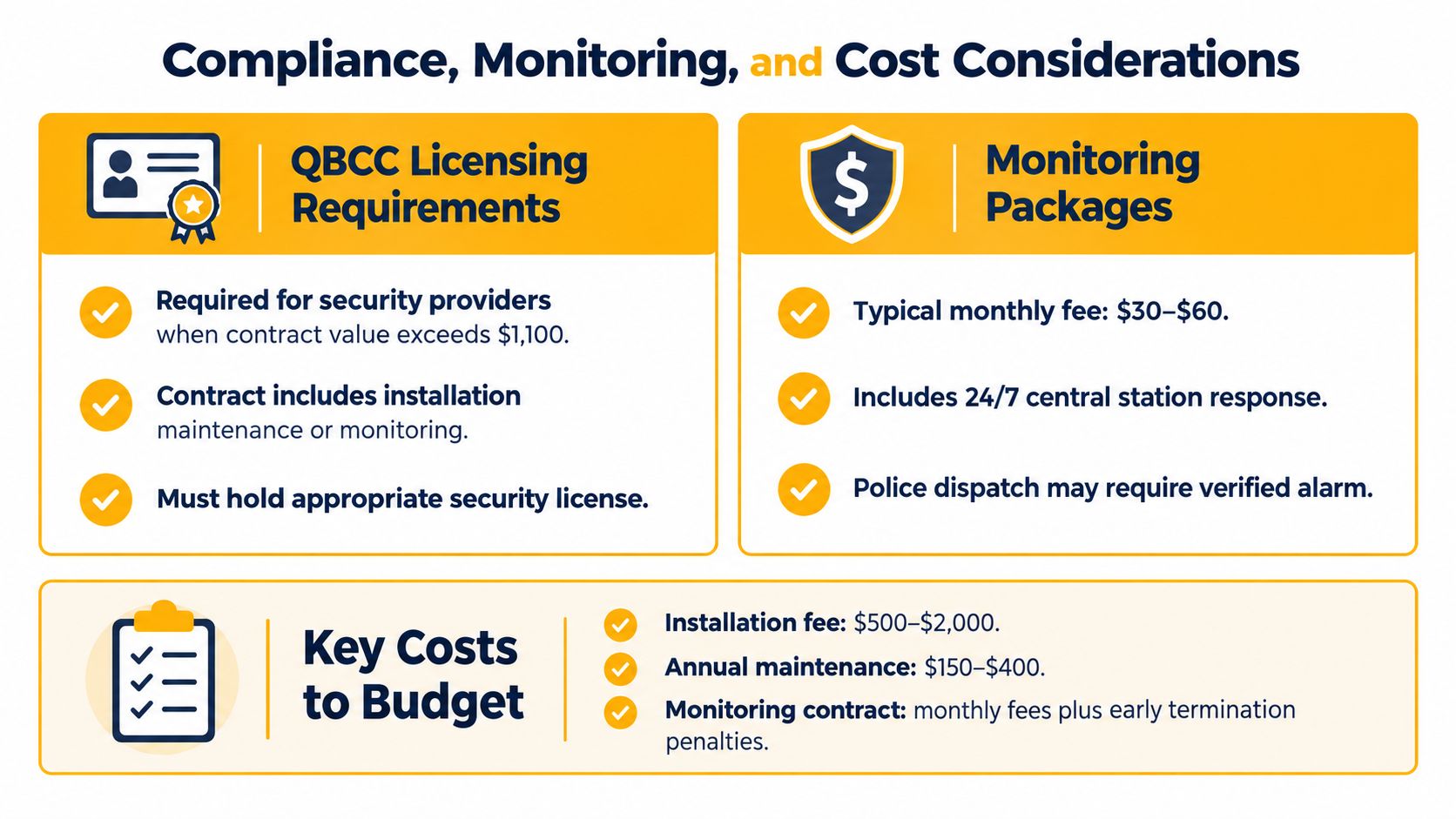
The supplied project information identifies QBCC licensing requirements for security providers where the contract value exceeds $1,100, and refers to Class 1 operator and Class 2 installer licensing under the Security Providers Act 1993. Confirm the current licensing position directly with the provider and Queensland regulators before signing, particularly where installation, maintenance and monitoring sit in one contract.
What monitoring actually means
AS 2201.2:2022 specifies requirements for the construction, equipment, staff and operation of centres used to monitor client alarm and security systems. That means “24/7 monitoring” should lead to specific questions:
- Centre operation: Who receives the signal, and is the monitoring centre operating to the applicable Australian standard?
- Alarm verification: What event information is assessed before escalation?
- Response contacts: Who attends if the alarm activates, and are their details kept current?
- Testing: How will the system be tested without creating unnecessary false alarms?
- Records: What reports or certificates will support insurer or lease requirements?
The Queensland Police guidance cited earlier makes the response responsibility explicit. A monitoring contract without current contacts, access instructions and a tested procedure is incomplete.
Budgeting without false precision
The plan supplied for this guide specifies typical Queensland project bands of $1,200 to $4,500 for Grade 2 hardware, $400 to $1,200 for installation, $35 to $90 per month for Grade 2 monitoring, and $90 to $160 per month for Grade 3 monitoring. Treat these as planning ranges, not quotes. Building access, cabling, detector count, communication paths, integration and commissioning can move the final price.
The cheapest quote often excludes the work that matters most, such as detector relocation, dual-path signalling, staff training or a documented test. Ask for an itemised proposal that separates equipment, installation, monitoring, maintenance, communications and contract termination conditions. For a detailed breakdown of the installation component, review security alarm installation cost considerations.
False-alarm management also belongs in the budget. The plan for this article identifies Queensland Police false-alarm management fees applying from 1 July 2024, so nuisance activations can create more than staff frustration. Insurers may also distinguish between monitored and unmonitored systems, but the owner should confirm any premium treatment directly with the insurer rather than assuming a discount.
Integrating Alarms With CCTV, Access Control, and Fire Systems
A Brisbane light-industrial unit shows why an alarm shouldn't be designed in isolation. At closing time, the access-control system can confirm the last authorised exit, the alarm panel can arm the relevant zones, door contacts can report the roller doors, and CCTV can move into an event-focused recording mode.
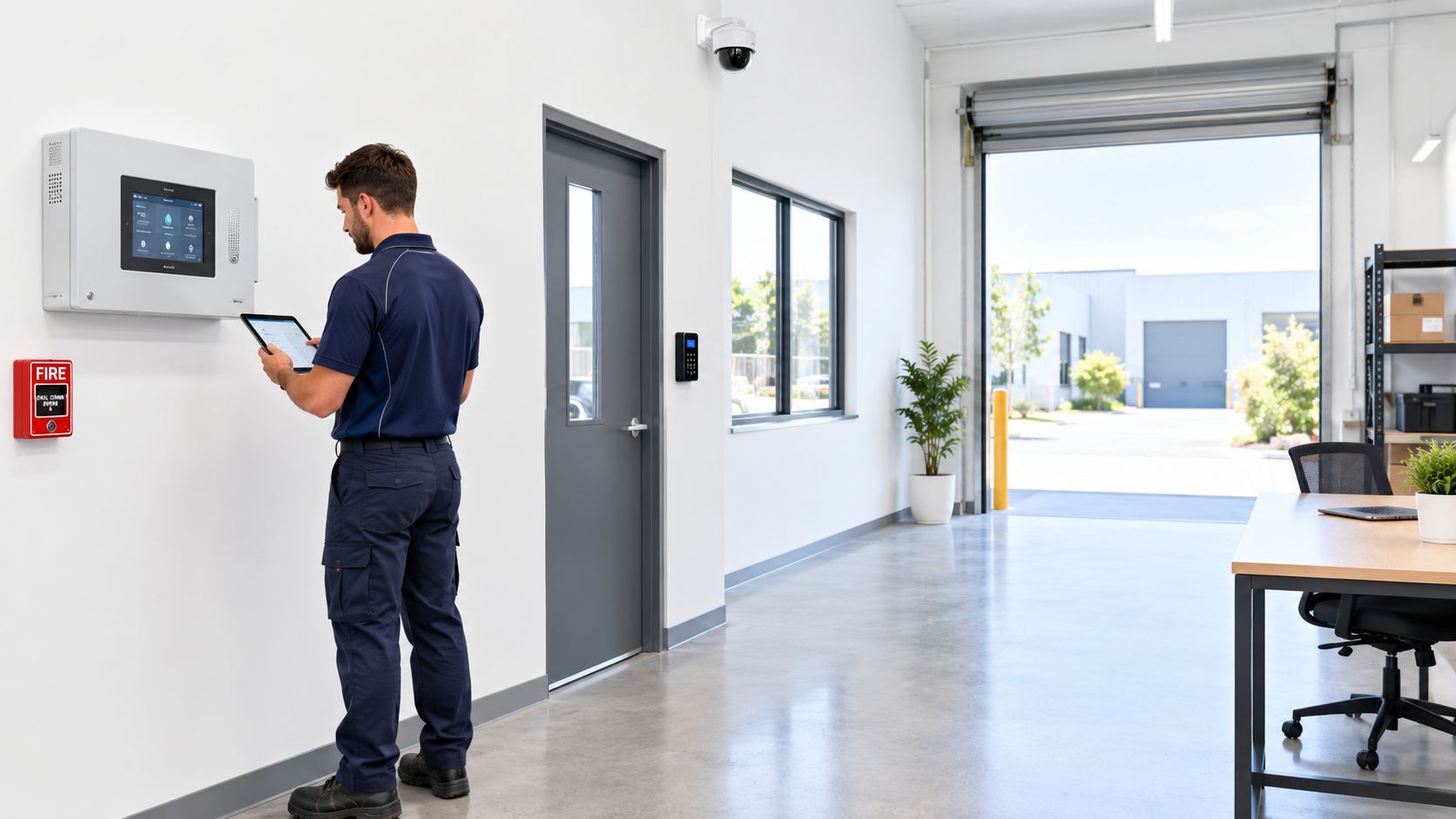
A valid card or mobile credential can disarm a programmed area when an authorised worker enters. On exit, the system can re-arm after the access event, reducing dependence on shared keypad codes. Wiegand and OSDP readers are common integration points, although the installer should confirm the panel, reader and access-control platform can exchange the required events securely.
CCTV adds verification. An alarm from the rear entry can trigger a camera view for the monitoring operator, bring up the relevant video popup and identify whether the event appears to be a person, a delivery issue or an environmental nuisance. That only works if the camera covers the door, the recording quality is usable and the alarm zones match the camera names.
For a separate discussion of commercial video coverage and system design, see commercial CCTV camera planning.
Fire integration requires more care than joining two systems with a cable. Fire panels designed to the relevant fire-system requirements, including AS 1670.1 and AS 7240 where applicable, must take priority over intruder functions. Depending on the design, fire events may need to override intrusion arming, operate evacuation functions and release controlled doors.
Use an appropriate relay interface and a documented cause-and-effect schedule. Never allow an intruder alarm to prevent a fire response or hold a required exit secure.
The same architecture can support lighting control, mobile-patrol requests and duress pendants. Those functions should be mapped during design so an event produces a clear action, rather than sending multiple disconnected notifications to different people.
Fire equipment follows its own Australian requirements. Queensland Fire and Emergency Services states that extinguishers must comply with AS/NZS 1841.1:2007 and identifies Australian fire classes including Class A for carbonaceous solids, Class B for flammable and combustible liquids, Class C for combustible gases, Class D for combustible metals, and Class F for cooking oils and fats. QFES guidance on using fire extinguishers reinforces that an office, switchboard, server area and commercial kitchen may require different fire controls.
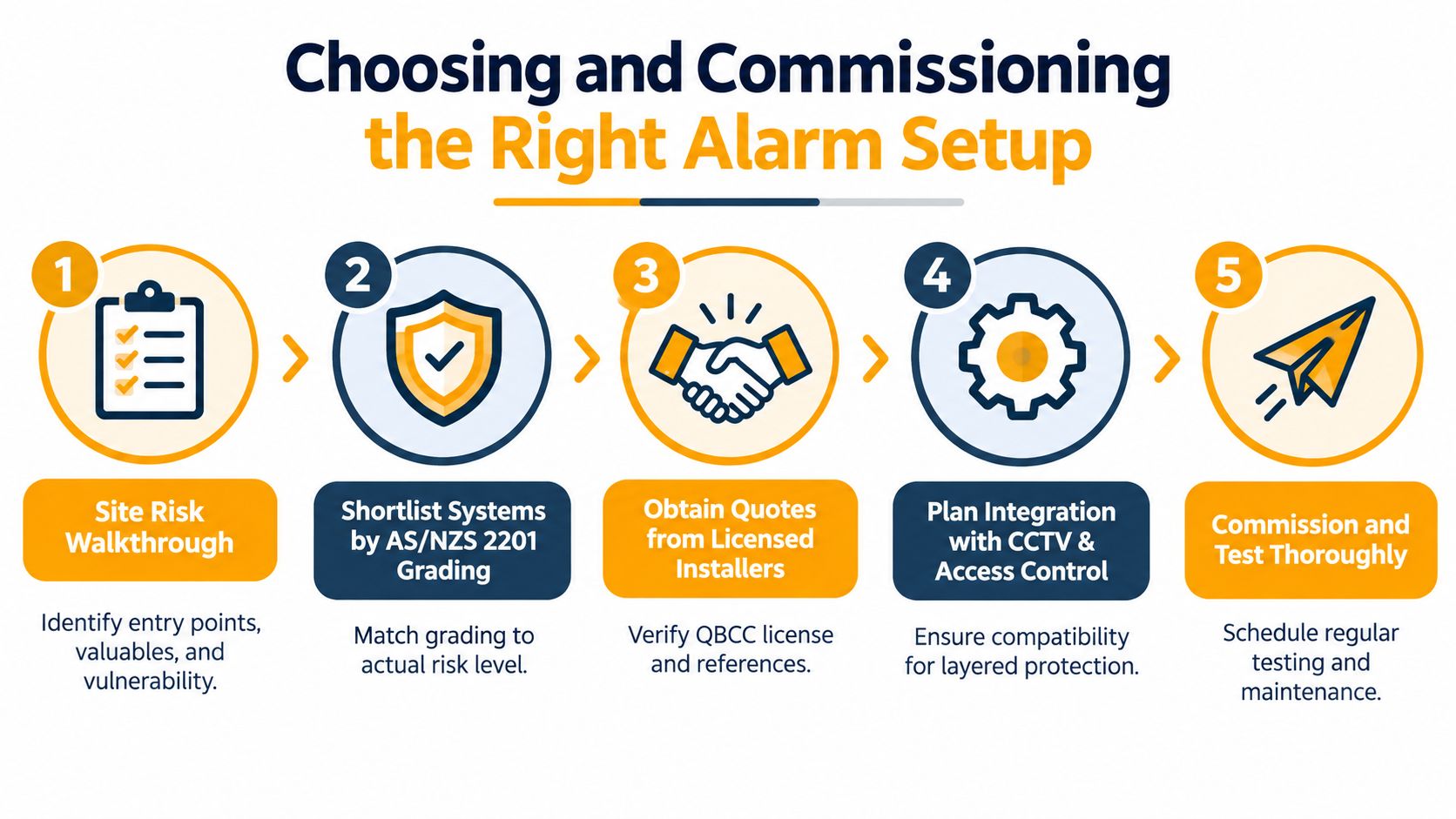
Choosing and Commissioning the Right Alarm Setup
The decision should finish with a site-specific commissioning plan, not a box delivered to the counter. A practical walkthrough starts at the public frontage and follows every route an intruder could use, including rear doors, roof access, roller doors, storerooms, safes, plant areas and shared tenancy spaces.
Five checks before approval
Walk the site with the installer. Identify entry points, valuable assets, staff routines, environmental conditions and areas that need separate arming. Ask what happens if power, internet or cellular service fails.
Match the grade to the risk. Request the proposed AS/NZS 2201 grading in writing and ask how the detector layout, panel location, power supply and signalling path support it. Higher-risk stock, sensitive information and isolated premises may need a more resilient design than a low-risk office.
Verify the provider. Check the relevant Queensland security licences and QBCC position where the contract requires it. Confirm who installs, who monitors, who services the system and what compliance documents will be issued.
Test the integration. Arm and disarm through the actual access-control process. Trigger each zone, confirm the camera response, test the sirens, check power-failure behaviour and confirm that the monitoring centre receives the correct location and event description.
Document the handover. Staff should receive training on codes, app access, opening and closing procedures, duress functions and false-alarm prevention. Set a maintenance window, nominate response contacts and record the test results.
Commissioning standard: If the owner can't explain what happens after a rear-door alarm at 3am, the system isn't fully handed over.
Common mistakes include choosing a brand before defining the risk, under-covering rear entries and storerooms, accepting generic zone names, and assuming CCTV replaces detection. Another is ignoring physical protection. A properly selected triple-lock security door solution may strengthen an entry, but it still needs to work with the alarm, access-control and emergency-egress design.
For very low-risk premises with strong locks, shutters, lighting and reliable nearby response, audible-only protection may be reasonable. A business holding stock, cash, sensitive data or expensive equipment should generally assess professionally monitored protection, resilient signalling and layered verification rather than relying on an owner's phone alone.
Queensland fire-safety management also demonstrates why ongoing service matters. Guidance references extinguisher maintenance to AS 1851 and a Level 1, 6-monthly interval in the Queensland fire-safety standard example, showing that commercial safety equipment is managed through scheduled inspection rather than one-time installation. Queensland business-security assessment guidance supports the broader need for planned checks, records and active maintenance across occupied premises.
Celtic Fire & Security supplies, installs, tests and services commercial alarms and CCTV, with capability across North Brisbane, Moreton Bay, the Sunshine Coast, Somerset and Ipswich. For a site-specific assessment that connects alarm design with fire protection, access control, CCTV and maintenance, visit Celtic Fire & Security and arrange a practical review before you commit to a system.
No responses yet