
A systematic preventive maintenance plan covering AS 1851 intervals is the fastest way to close the documentation gap behind most first-inspection compliance failures in Queensland. In 2023-24, only 55.5% of inspected building premises were compliant at first inspection, rising to 57% in 2024-25, which shows how often records, overdue work, and defect closure undermine otherwise serviceable equipment.
The familiar South East Queensland scenario is a facility manager with a current contractor, a maintenance budget, and fire equipment that appears operational. Then an auditor asks for the asset register, service history, defect close-out evidence, test results, and proof that each prescribed installation was maintained at the correct interval. The equipment may be present, but the files don't tell a complete story.
A preventive maintenance plan must therefore control both the work and the evidence. The five components are a complete asset register, standards-based frequencies, assigned responsibilities, a defect and rectification workflow, and an organised record trail that can be produced without reconstructing the past from emails and invoices.
Table of Contents
- The Hidden Risk Behind Most Fire Safety Failures
- Understanding AS 1851 Maintenance Cycles
- Building Your Asset Register
- Scheduling Frequency and Task Allocation
- Managing Defects and Rectification Timelines
- Evidence of Compliance and Enforcement Pressure
- Putting Your Plan Into Practice
The Hidden Risk Behind Most Fire Safety Failures
Most first-inspection failures are documentation failures before they're equipment failures. A missing test record, an unexplained overdue task, or a defect with no closure note can make a functioning installation difficult to defend. Queensland's regulatory framework expects owners and occupiers to demonstrate that prescribed fire safety installations are maintained, inspected, tested, and restored to their required performance level.

Treat evidence as part of the maintenance task
A service visit isn't complete when the technician leaves the site. It is complete when the responsible person can answer five questions:
- What asset was inspected? Identify the location, asset tag, model, and serial number.
- What standard and interval applied? Record the relevant Australian Standard or Queensland requirement.
- What did the technician find? Capture readings, pass or fail results, photographs where useful, and specific observations.
- What defect was raised? Give it an owner, priority, target date, and work order reference.
- How was the issue closed? Record the rectification, re-inspection, final result, and date.
Queensland guidance requires owners of prescribed buildings to keep a fire safety management plan, maintain a separate maintenance schedule for each fire safety installation, record testing and maintenance, and retain those records for two years. The occupier must also submit a yearly occupier's statement. Those obligations are set out in the Queensland fire safety management guidance for building owners and occupiers.
Practical rule: If a contractor's report doesn't identify the asset, result, defect status, and next action, it isn't a reliable compliance record.
A calendar full of appointments won't solve this problem. A closed-loop plan will. The schedule creates the task, the technician produces the result, the defect log controls the exception, and the record system preserves evidence. That structure gives an auditor a traceable sequence instead of a pile of disconnected certificates.
Understanding AS 1851 Maintenance Cycles
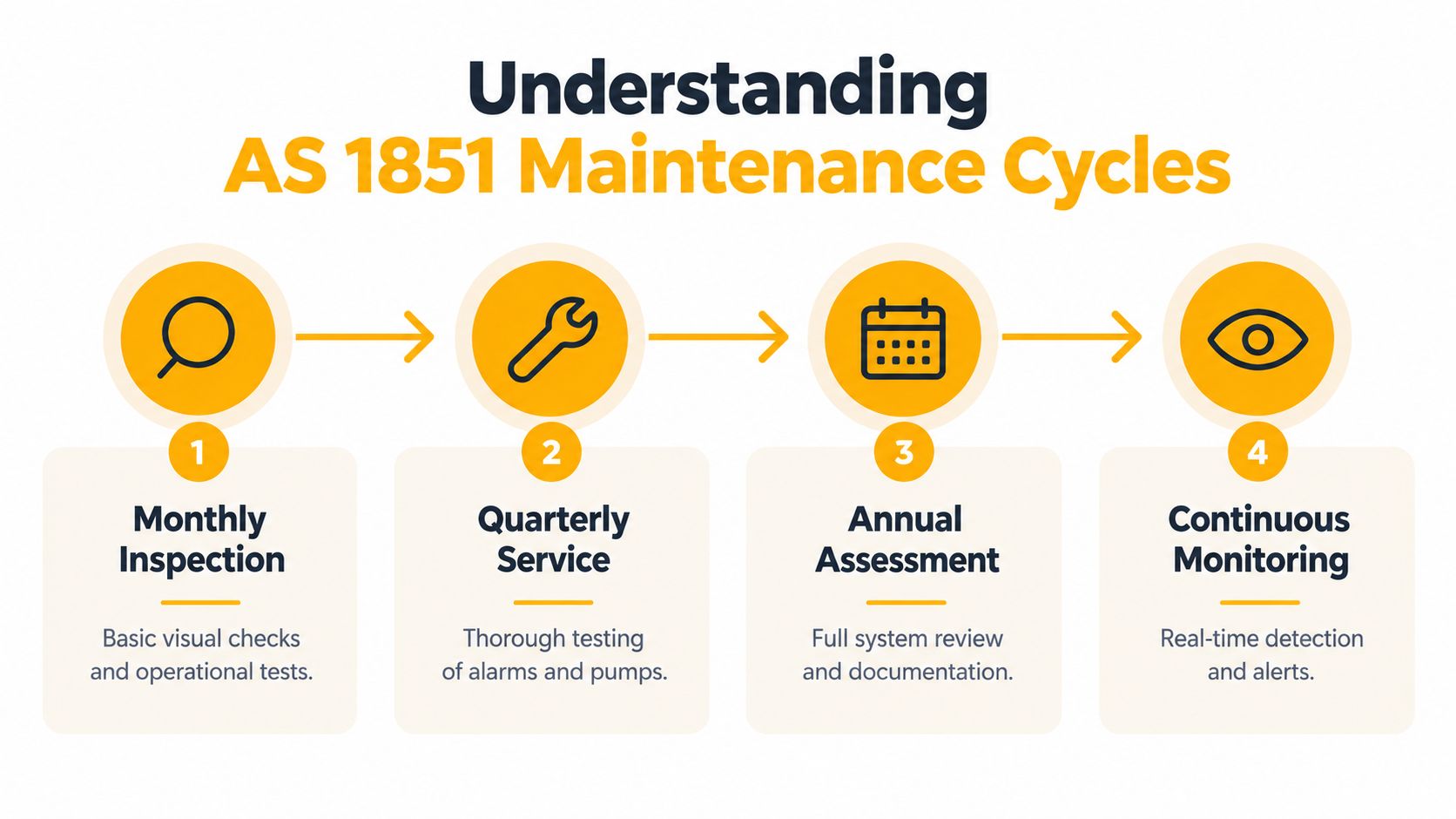
AS 1851 should be treated as a systematic maintenance framework, not a generic checklist. It brings inspection, testing, preventive maintenance, survey activity, and record-keeping into a defined operating rhythm for fire protection systems and equipment. NSW Government material describes AS 1851-2012 as governing routine servicing and requiring building owners to keep systems operational by addressing defects promptly, while ACT guidance recognises AS 1851 and AS/NZS 2293.2 as applicable maintenance standards for fire protection and emergency evacuation lighting.
Match the task to the asset
The correct frequency depends on the installation, its risk, and the applicable standard. A useful schedule separates routine actions from milestone work rather than placing every task under an annual heading.
| Maintenance layer | What the plan must control |
|---|---|
| Routine inspections | Visual condition, access, damage, signage, indicator status, and basic operational checks |
| Periodic servicing | Functional tests, equipment operation, readings, alarm functions, pumps, doors, lighting, and related systems |
| Annual review | Complete service history, outstanding defects, documentation, responsible parties, and system performance |
| Long-term milestones | Additional tasks at 2, 5, 10, 25, and 30 years for applicable fire equipment items |
NSW Health's 2026 AS 1851 maintenance update confirms that the standard includes actions beyond the first 12 months, as well as these longer-term milestones. That matters for commercial sites with equipment installed across different fit-outs. A plan that only shows this year's appointments can easily overlook the long-term obligations.
Queensland Development Code MP 6.1 gives the statutory framework for inspection and testing intervals. Queensland's Building Fire Safety Regulation 2008 requires the occupier to ensure prescribed installations are maintained by an appropriately qualified person and inspected and tested at intervals complying with MP 6.1. The regulation defines maintenance as inspection, testing, or repair needed to keep the installation at its original performance level and aligned with relevant Australian Standards. The Queensland legislation should be read alongside the service requirements for each asset class.
For extinguisher-specific planning, use the Australian standards guidance for fire extinguisher testing. Don't replace prescribed inspections with sensor alerts or informal checks. Digital monitoring can help identify changing conditions, but it complements rather than replaces compliance-driven service intervals.
Building Your Asset Register
You can't schedule what you haven't identified. The asset register is the foundation of a preventive maintenance plan because it connects each physical installation to its standard, contractor, service history, defects, and next due date.
Start with a room-by-room survey, not an old spreadsheet. Walk the site and record fire alarms, smoke and heat alarms, emergency and exit lighting, extinguishers, fire doors, hose reels, hydrants, pumps, access-control equipment, security alarms, cameras, and associated panels. Include assets that are easy to miss, such as fire dampers, backup batteries, interfaces, and equipment in plant rooms or roof spaces.
Record enough detail to identify the asset
At minimum, capture:
- Asset identity: Asset type, unique tag, manufacturer, model, serial number, and exact location.
- Installation information: Installation date where known, commissioning information, warranty details, and system or zone reference.
- Compliance information: Applicable standard, required service interval, test method, acceptance criteria, and responsible qualified person.
- Service history: Last service date, last result, readings, attached certificates, photographs, and outstanding recommendations.
- Ownership and responsibility: Building owner, occupier, facility manager, contractor, escalation contact, and access requirements.
- Next action: Next due date, planned work order, current defect status, and evidence location.
The register should be a living document. Every relocation, replacement, panel change, new tenancy, and contractor visit should update it. If a technician reports “alarm panel serviced” without identifying the panel or affected zones, the record won't reliably prove coverage.
Use a spreadsheet when the site is small and the fields are controlled. Use a maintenance platform or CMMS when multiple contractors, buildings, systems, or approval steps make version control difficult. The tool matters less than the discipline. A neat system containing incomplete assets is still a compliance risk.
The commercial fire safety inspection service should result in records that flow back into this register. The asset list, service report, defect log, and schedule must refer to the same identifiers. That consistency is what lets an auditor trace a result from a certificate to a device in a plant room.
Scheduling Frequency and Task Allocation
A good schedule balances task intensity against risk coverage. Monthly checks provide regular visibility, quarterly work adds functional depth, and annual servicing tests the condition of the whole system and its records. The mistake is to treat all three as interchangeable.
Use a layered schedule
| Frequency | Typical focus | Planning decision |
|---|---|---|
| Monthly | Visual condition, access, damage, indicators, logbook entries, emergency lighting observations, and obvious obstruction | Keep these checks simple enough to complete consistently |
| Quarterly | Functional testing, alarm interfaces, pumps, batteries, doors, communications, and selected equipment performance | Allocate qualified personnel and capture measurable results |
| Annual | Comprehensive service, system review, certificate production, defect review, and plan update | Reserve time for documentation and unresolved issue escalation |
| Longer interval | Milestone tasks tied to the relevant equipment and standard | Add future obligations to the asset record when equipment is installed |
Assign work by asset class, not merely by contractor availability. Fire alarms need personnel competent in the installed system. Emergency lighting requires the correct testing and reporting process. Hydrants and pumps require appropriate functional testing. Fire doors need inspection of leaf, frame, hardware, signage, clearances, and closing performance. Security alarms and CCTV need separate operational checks, recording verification, and access to configuration information.
Queensland provides concrete examples of asset-specific cadence. Fire doors in Class 5, 6, 9a, and 9c buildings must be inspected at 6-month intervals, while Queensland extinguisher guidance identifies six-monthly inspection, tagging, and punching as a minimum under AS 1851 and AS 1851.1-based regimes. The same guidance states that extinguishers should be professionally pressure tested every five years. These requirements are described in the Queensland fire extinguisher guidance.
Don't overload the calendar with low-value repeats while deeper tests fall behind. A recurring task is useful only when it has a defined purpose, competent owner, acceptance result, and retained evidence. Review completion by asset class and ask which tasks are late, which defects recur, and which installations receive superficial checks without meaningful functional testing.
Managing Defects and Rectification Timelines
Finding a defect is only the first control. Leaving it open without ownership, a deadline, or proof of repair turns a service report into an unresolved liability.
Queensland legislation requires corrective action or repairs for prescribed fire safety installations to be completed no later than one month after maintenance is carried out, unless the occupier has a reasonable excuse. The occupier must also keep maintenance records for each prescribed installation, as set out in the current Queensland regulation.
Run every defect through the same workflow
- Identify the asset and condition. Record the location, asset tag, observed failure, test result, and immediate safety impact.
- Classify the response. Separate critical impairments from routine repairs. Escalate anything affecting system availability or life safety.
- Assign responsibility. Name the contractor, technician, internal owner, and person approving access or expenditure.
- Set the due date. Apply the statutory timeframe and any shorter internal escalation period required by the risk.
- Complete the repair. Attach invoices, replacement details, readings, photographs, and relevant certificates.
- Re-inspect and close. Confirm the installation has returned to its specified performance level. Record the final result and closure date.
A defect log should show the full history, not just the final status. Include the original finding, date raised, priority, temporary controls, quotation, approval, work order, rectification date, verification result, and person who closed it. If a part is unavailable, record the reasonable excuse and interim protection rather than silently moving the task into the next cycle.
A closed defect has evidence behind it. “Fixed” is a status, not proof.
Trend the log by asset, contractor, location, and failure type. Repeated faults on one alarm zone or door may indicate an installation, environment, or usage problem rather than a sequence of unrelated service calls. That analysis helps the responsible manager decide whether to repair, redesign, replace, or increase oversight.
Evidence of Compliance and Enforcement Pressure
Regulatory activity makes weak records harder to hide. QBCC completed 128 proactive fire-safety site visits in the first half of 2025, compared with 38 in the previous six-month period. Reported compliance moved only from 71% to 72%, which indicates that more visits alone won't repair weak maintenance governance. The figures appear in the QBCC regulatory report for January to June 2025.
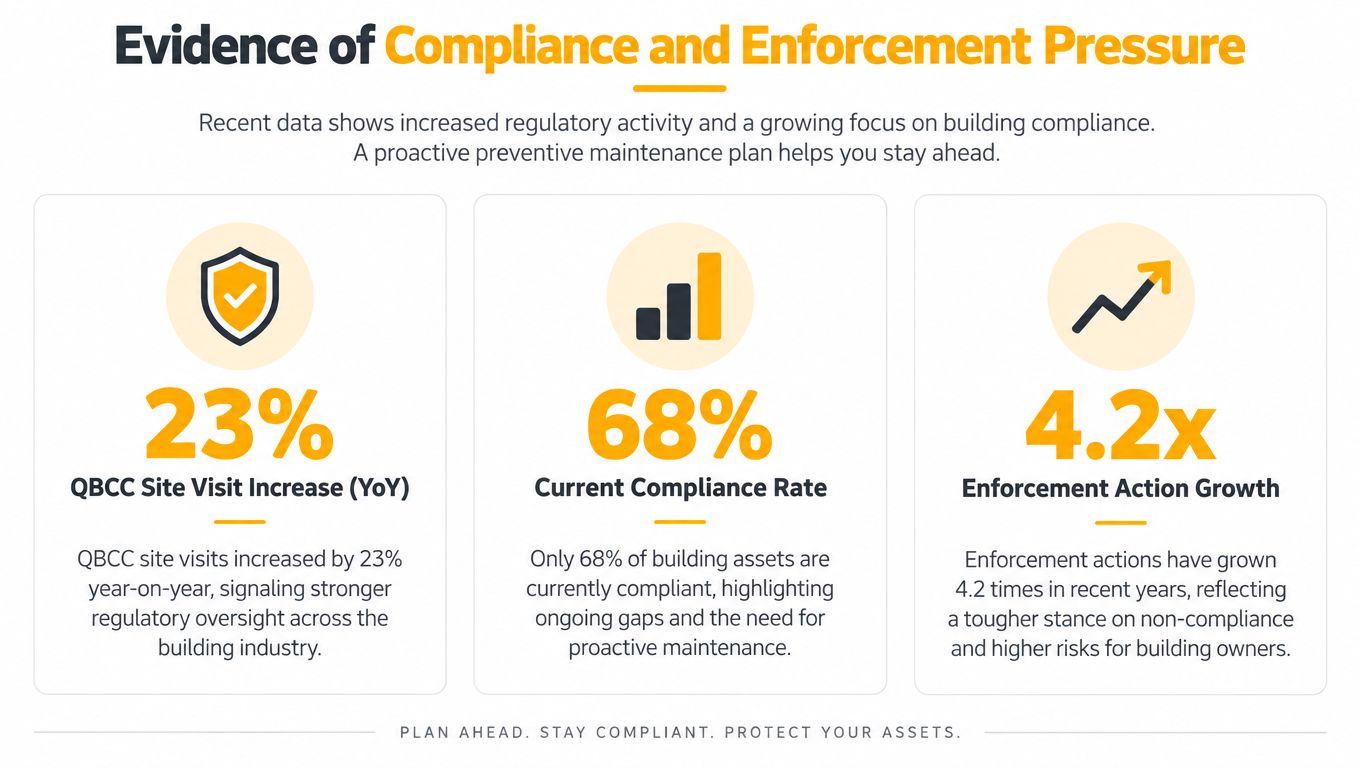
The broader first-inspection results point in the same direction. Queensland regulator reporting recorded 55.5% first-inspection compliance in 2023-24 and 57% in 2024-25. Those results don't prove that every failure is administrative, but they do show why a site should treat overdue servicing, incomplete records, and unresolved defects as operational risks rather than clerical inconveniences.
Measure execution, not attendance
A contractor arriving onsite is not the same as a completed maintenance task. Track:
- On-time task completion: Whether each scheduled activity was completed within its required window.
- Defect closure: Whether findings were rectified and verified within the applicable timeframe.
- Evidence completeness: Whether each work order includes asset identity, result, readings, attachments, and sign-off.
- Repeat defects: Whether the same asset or fault returns after servicing.
- Outstanding impairments: Which systems remain unavailable, restricted, or under temporary control.
A high completion rate with poor evidence is not a strong result. Neither is a neat folder containing certificates for only the easy assets. The useful benchmark is complete, timely, traceable work across the full asset register.
For commercial managers, this approach also supports budget conversations. A documented backlog shows why a repair, replacement, additional contractor visit, or access arrangement is needed. Reactive requests appear as surprises. A controlled defect register turns them into visible, prioritised work.
Putting Your Plan Into Practice
At a North Brisbane commercial site, the equipment may be in place while the compliance file remains difficult to defend. Extinguishers, exit lighting, alarms, access control, and CCTV are visible, but the records may sit under different building names. Invoices may not match the asset list, and defects may be marked “noted” without any evidence that someone assigned, repaired, or verified them.
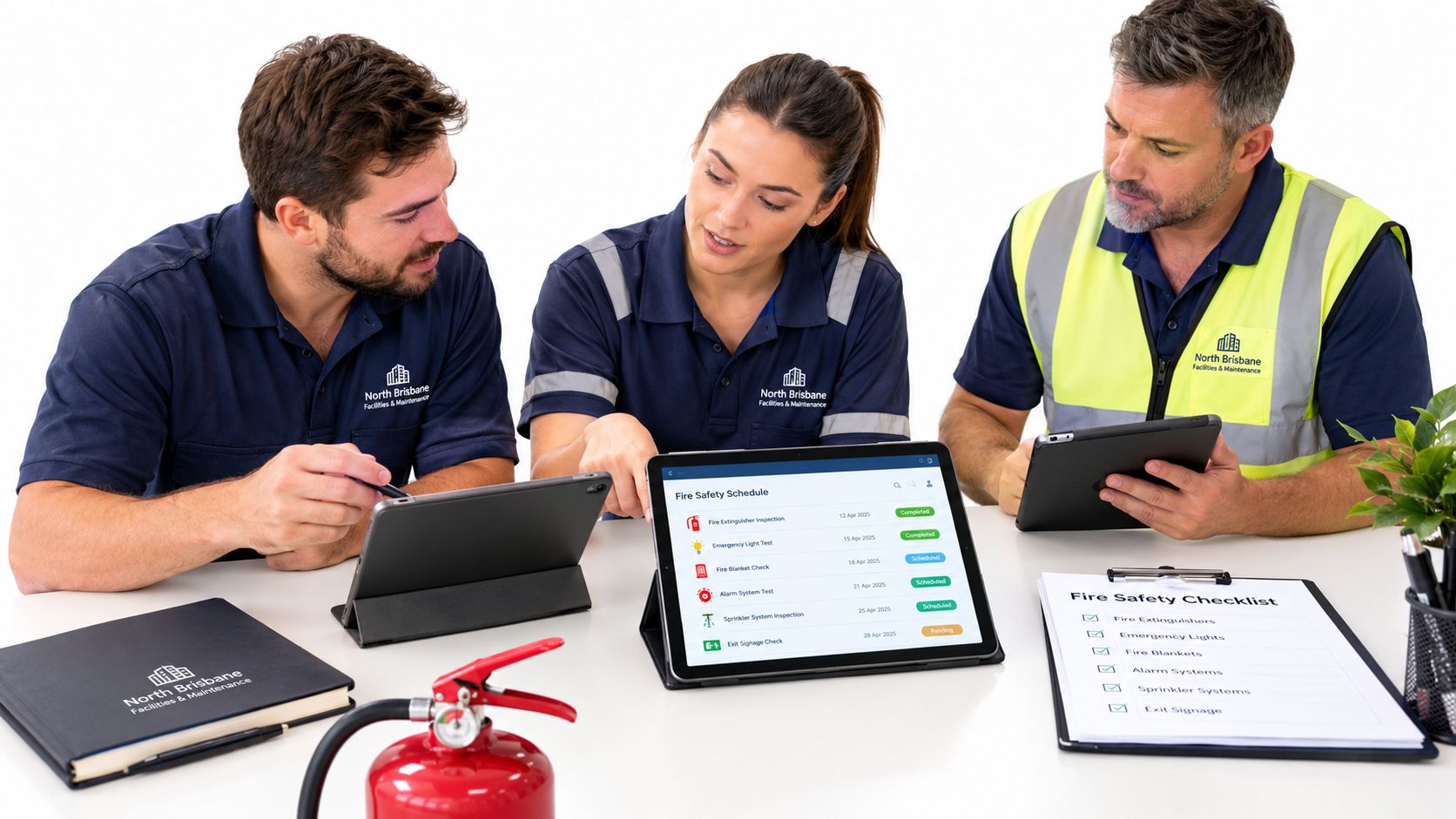
Start with a physical verification of every installation. Create one asset register, assign a consistent identifier to each item, confirm its location and service interval, and check the applicable standard or Queensland requirement. Keep current defects separate from historical recommendations. A contractor's report should record a result against a known asset, not make a broad statement about the building.
The file should allow an auditor to select an asset and follow its history without relying on staff memory. Store the register, work order, service result, photographs or readings where relevant, defect correspondence, repair record, and closure verification under the same asset reference. This structure takes more discipline at the start, but it reduces disputes when contractors, invoices, and site records do not align.
Celtic Fire & Security provides scheduled fire protection, electronic security, and locksmith services, including extinguisher maintenance, alarm and CCTV servicing, emergency lighting, hydrant testing, fire doors, and planned maintenance for commercial sites across North Brisbane, Moreton Bay, the Sunshine Coast, Somerset, and Ipswich.
Make the system easy to follow
Assign ownership before the first service cycle. The building owner controls resources and statutory oversight. The occupier supplies access and operational information. The facility manager maintains the register, reviews evidence, and follows up open defects. The contractor supplies qualified personnel, accurate results, and supporting records. Tenants report damage, obstruction, alarm events, and changes that could affect system performance.
Agree on the data standard before selecting software. Define the required report fields, storage location, review responsibility, and escalation path for overdue work. A shared spreadsheet may suit a small site. A CMMS or integrated maintenance platform may be more practical for a portfolio using several contractors across multiple locations.
Use this implementation checklist:
- Confirm scope: List every fire, security, emergency lighting, access, and related safety installation.
- Verify assets: Match tags, locations, models, serial numbers, and system references to the physical site.
- Map obligations: Assign each asset its Australian Standard, Queensland requirement, service interval, and qualified service responsibility.
- Build work orders: Schedule routine, periodic, annual, and long-term milestone tasks.
- Standardise reports: Require results, readings, defects, relevant photographs, recommendations, and sign-off.
- Control defects: Give every finding an owner, deadline, interim control, rectification record, and verification result.
- Review performance: Check overdue work, incomplete evidence, repeat faults, and open impairments at a regular management meeting.
- Test the file: Trace a selected asset from the register to the service result, defect history, repair, and closure evidence.
The target is a working record, not a folder assembled before an audit. It should show what was due, what was completed, what failed, who acted, and how the result was confirmed.
Before the next service cycle, ask a contractor to reconcile the physical site with the asset register and defect log. Visit Celtic Fire & Security or review the fire protection service page to discuss documented preventive maintenance for commercial fire protection, emergency lighting, alarms, security systems, hydrants, extinguishers, fire doors, and locksmith requirements across South East Queensland. A properly structured plan gives the team clear due dates, qualified service support, and evidence traceable to each asset.
No responses yet