
If you own or manage a commercial premises, there is a good chance you already know you are supposed to have emergency lighting. The harder questions are the ones that keep new business owners awake: how much do I need, where does it have to go, and how do I prove it is actually working when someone asks?
This beginner’s guide walks through the emergency lighting requirements that apply to most Australian commercial premises, in plain English, so you can ask the right questions before you sign anything.
What emergency lighting and exit signs actually are
Emergency lighting is the lighting that takes over when your normal power supply fails. It is not there to make a room comfortable – it is there to get people out safely.
There are two types you will hear about:
Escape lighting illuminates the path people take to leave, including corridors, stairwells, passageways and the final exit door.
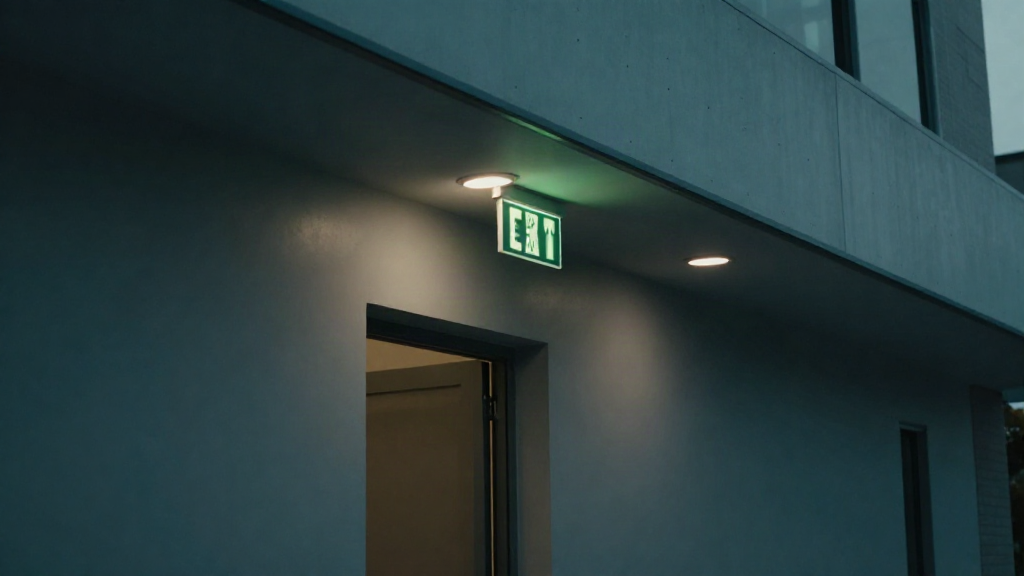
Exit signage is the illuminated “running person” sign that identifies where the exits are. In most premises the exit sign is part of the emergency lighting system and is wired to the same backup supply.
Both run on a battery or a central battery system, so when mains power drops – during a fire, a fault, or a scheduled outage – they stay lit for a defined period.
When your premises legally needs it
Emergency lighting is not optional decoration that you can add later if the budget allows. It is a compliance requirement tied to the safety of occupants.
In short, you are likely to need emergency lighting and exit signage when:
- Your premises is a commercial, industrial or retail building.
- The building has a public area, a corridor, a stairwell or an exit path that people use to evacuate.
- Staff or members of the public occupy the space, even if only during business hours.
- The building is a multi-tenancy or body corporate site, where common property is shared.
The Building Code of Australia and Australian Standard AS/NZS 2293 set out how emergency lighting and exit signs must be designed, installed and maintained. AS/NZS 2293.1 covers the system design and installation, while AS/NZS 2293.2 covers the ongoing maintenance regime.
The practical answer for most business owners is simple: if people need to find their way out of your building in the dark, you need an approved solution. That includes smaller tenancies that assume “the building handles it” – often the responsibility sits with the tenant for their own fit-out.
How often emergency lighting must be tested
Installing a compliant system is only half the job. Emergency lighting that fails during a real evacuation is worse than useless, because people have already trusted it.
AS/NZS 2293.2 sets out the routine maintenance and testing requirements. The key intervals most premises work to are:
- A routine inspection and functional check. Fittings, signs and indicators are checked for damage, obstruction and correct operation.
- A six-monthly discharge test. Each emergency light and exit sign is run on battery for the required duration – commonly 90 minutes – to confirm it still delivers the design period after the mains supply is isolated.
Records matter as much as the test itself. Regulators and insurers increasingly ask for documented evidence that testing has been done, with dates, results and any faults noted. A folder of signed test reports is what turns “we think it is fine” into proof.
This is also the point where ageing batteries and failing fittings are found. A well-run maintenance program catches those problems at a scheduled visit rather than on the night of a blackout.
Common mistakes to avoid
Most compliance problems we see on commercial sites come from a handful of avoidable mistakes.
Assuming the landlord covers everything. In many leases, the base building system is the owner’s responsibility, but the tenancy fit-out – including any new rooms, partitions or changed exit paths – is the tenant’s. Changes to your layout can make an existing system non-compliant overnight.
Installing without a design. Emergency lighting is a designed system, not a set of fittings bought from a catalogue. Spacing, mounting height, light output and the position of exit signs are specified for a reason. A generic install can leave dark spots on the very path people are meant to follow.
Skipping or delaying testing. Six-monthly testing is easy to push down the list until an audit, an insurance review or a fire safety inspection arrives. Late testing is still non-compliance.
Forgetting about the exit signs themselves. Exit signs need to remain visible and unobstructed. New signage, shelving, fittings or even a repaint can obscure them.
Never keeping records. If you cannot produce test documentation, most inspectors will treat the system as untested regardless of how well it works.
Using whoever is cheapest. Emergency lighting sits at the intersection of electrical work and life safety. Unaccredited installers leave you with a system that may look right but fails a discharge test – or a design that never complied in the first place.
How Celtic Fire & Security helps
Celtic Fire & Security specialises in commercial fire protection and security systems across Brisbane, the Sunshine Coast and surrounding regions, and emergency lighting and exit signage are core to what we do.
Our team handles the whole job – supply, installation, testing and maintenance – so nothing falls between an electrician, a signage supplier and a maintenance contractor. Everything is installed to strict Australian Standards, documented properly, and kept on a testing schedule you can rely on.
For business owners and facility managers, that means one accredited partner, a compliant system and the paperwork to prove it – peace of mind that the job is done once and done right.
Next steps
If you are unsure whether your premises meets its emergency lighting requirements, the safest move is to have the existing system inspected and tested before you rely on it.
Talk to Celtic Fire & Security about an inspection, a compliance check or a complete installation for your site. We will tell you exactly where you stand and what is needed – and then handle it for you.
No responses yet