
Commercial Smoke Alarm Requirements in Queensland: A Beginner’s Guide
Taking on a commercial lease or buying your first business premises comes with a long list of obligations, and fire safety sits near the top of it. For many new business owners in Brisbane, the Sunshine Coast and surrounding regions, the first question is simple: what are the actual commercial smoke alarm requirements in Queensland, and how do I know my building meets them?
This guide walks through the basics in plain language. It explains what Queensland expects of commercial premises, why smoke alarms and smoke detection systems are not the same thing, and how to keep your compliance position defensible year after year.
What Queensland expects from commercial premises
Commercial buildings in Queensland are governed by a layered set of rules rather than a single document. The Building Code of Australia sets the benchmark for how fire detection and warning equipment must be designed and installed. The Building Fire Safety Regulation 2008 then places ongoing duties on the person in control of the building – typically the owner or occupier – to maintain the fire safety measures installed and to keep records that prove it.
In practice, that means three things sit on your shoulders as an occupier:
-
The right equipment must be installed for your building’s classification, size and use.
-
That equipment must be maintained, inspected and tested on a schedule – generally annual testing with monthly checks depending on the system.
-
Records must be kept, because compliance is judged on evidence, not memory.
Queensland’s residential smoke alarm reforms, which phased in interconnected photoelectric alarms for homes and rental properties, are widely discussed and sometimes confused with commercial duties. They are separate regimes. If you operate a shop, office, warehouse, medical suite or workshop, your obligations flow from the commercial provisions rather than the residential alarm rules.
Smoke alarms versus smoke detection systems
This is where new owners most often lose their footing, so it is worth drawing a clear line.
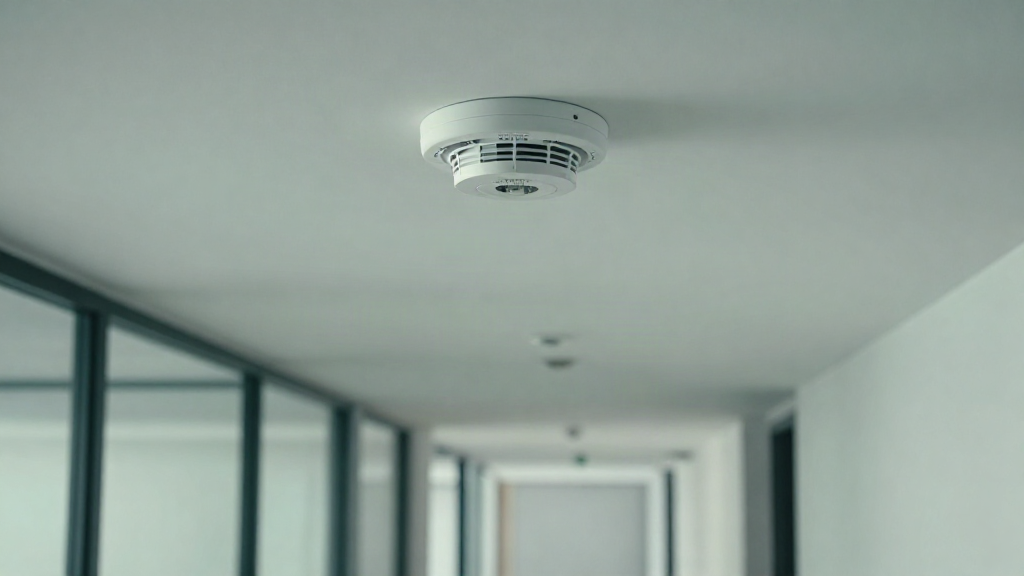
A smoke alarm is a self-contained unit. It senses smoke, sounds its own siren, and usually runs on mains power with a battery backup. It is the familiar round device on a ceiling, and it is what most people picture when they hear the word ‘smoke alarm’.
A smoke detection system is a networked installation. Individual detectors report back to a fire indicator panel, which can trigger building-wide alarms, alert monitoring services, release door holds, shut down air handling and notify emergency services. It is designed, installed and certified as a system rather than assembled unit by unit.
Most commercial premises require the second category, or a hybrid of both. Small tenancies such as a low-risk office or retail space may only need compliant smoke alarms and evacuation lighting. Larger or higher-risk buildings – warehouses with storage loads, kitchens, workshops, multi-tenancy complexes, accommodation and licensed venues – typically require a full detection system to Australian Standards. Getting this wrong is expensive, because retrofitting a system after a fit-out is far costlier than specifying it correctly at the start.
The Australian Standards that do the heavy lifting
Three standards come up repeatedly in Queensland commercial fire work, and knowing their names helps you ask better questions of any contractor.
-
AS 3786 covers smoke alarms – the self-contained type – including their performance and marking requirements.
-
AS 1670.1 covers fire detection and alarm systems, including how detectors, panels and warning devices are designed, installed and commissioned.
-
AS 1851 covers routine service and maintenance of fire protection systems, and it is the standard your testing records are measured against.
When a contractor tells you a job is ‘done to Australian Standards’, those are the documents you want named. A credible installer will reference them without prompting and provide documentation that ties your specific installation back to them.
How to check where your premises stand
You do not need to be a fire engineer to assess your baseline position. Start with these practical steps.
Read the documentation you inherited. Ask the vendor or landlord for the existing fire safety documentation, the most recent maintenance and testing reports, and any certification issued when detection equipment was installed. If those documents do not exist, treat that as a red flag rather than a relief.
Walk the property with a torch and a critical eye. Count the smoke alarms and detectors you can see, check whether they have a visible indicator light, and note any obviously missing coverage in plant rooms, storage areas and corridors.
Look at what the panel says. If there is a fire indicator panel, check whether it is showing faults or isolated zones. A panel in fault is not a compliant system, even if every detector is physically present.
Confirm the maintenance history is current. Testing dates should be recent and traceable. Gaps in the record are the most common compliance failure found at audit.
Ask about evacuation planning. Detection is only half the job. Occupiers also need an evacuation plan, trained wardens where required, and clearly identified exits and evacuation routes.
Common mistakes that cost business owners money
A few patterns come up again and again across South East Queensland premises.
The first is assuming a residential-grade alarm is sufficient because the tenancy is small. Building classification, not floor area alone, drives the requirement.
The second is buying equipment online and having a general electrician fit it. Detection systems need correct spacing, correct zoning and commissioning documentation, and unaccredited work often has to be pulled out and redone.
The third is letting maintenance lapse during a quiet period or a fit-out. Insurance assessments and due diligence checks look for continuity in the record, and a twelve-month gap is difficult to explain after an incident.
The fourth is treating a passed inspection as permanent. Requirements change with tenancy use, adding a kitchen or a storage load can alter what your building needs, and records must keep pace.
Who to call for supply, installation and testing
The most straightforward way to handle all of this is to work with one accredited provider who supplies, installs, tests and maintains your fire protection and security equipment under a single accountable relationship. That avoids the finger-pointing that happens when an installer and a maintenance contractor each believe the other is responsible for a fault.
Celtic Fire & Security works with commercial business owners, facility managers and body corporates across Brisbane, the Sunshine Coast and surrounding regions, installing smoke alarms, fire detection and alarm systems, emergency lighting, extinguishers, hose reels and exit doors to strict Australian Standards. The team handles supply through to ongoing testing, so your documentation stays current and your obligations stay met.
If you are new to your premises and unsure where you sit, the sensible first move is a straightforward assessment. Book a site review, get your current position documented in plain language, and fix any gaps before they become a problem at audit, at settlement or at the worst possible moment.
No responses yet