
You're in a busy shift, someone smells hot plastic near the prep bench, and the coffee machine is still humming beside the toaster. In a Queensland workplace, that's the moment a fire training extinguisher program stops being paperwork and becomes a decision you have to make fast. If the right people have been trained, they know whether to act, which extinguisher to grab, and when to get out.
Table of Contents
- What Happens When a Fire Breaks Out on Your Shift
- Should Staff Fight the Fire or Evacuate First
- How the PASS Technique Works Under Real Pressure
- Matching Extinguisher Classes to Your Site Hazards
- What a Quality Training Course Actually Covers
- Certification Records and Compliance Evidence
- Why Trained Staff Save Money and Reduce Risk
- Preparing Your Site and Choosing the Right Provider
What Happens When a Fire Breaks Out on Your Shift
A small electrical fire in a Moreton Bay cafe rarely starts as a dramatic event. More often, it begins with a flicker near a power point, a smell that turns sharp, and one person freezing while another starts calling out for help. The difference between a quick stop and a full evacuation is usually decided in the first moments, not after anyone has had time to think things through.

A fire training extinguisher program exists for that exact moment. It gives staff a rehearsed response before adrenaline takes over, so they're not guessing whether the fire is still small enough to tackle or whether they need to leave immediately.
Why the first minute matters
People often assume fire decisions are technical. In practice, they're behavioural. If staff have never handled an extinguisher, they hesitate. If they've only watched a video, they may recognise the equipment but still not move with confidence.
That gap matters because portable extinguishers are meant for a fire that's still small and manageable. In a cafe, office, or retail back-of-house area, the question is rarely whether a fire could spread. It's whether your team can stop it before smoke, heat, and panic make the room unsafe.
A good training session doesn't just teach a motion. It teaches judgement. Staff learn who is expected to act, who raises the alarm, and who starts clearing the area. That role clarity is what turns a chaotic scene into a controlled response.
Practical rule: if the person holding the extinguisher can't immediately tell whether the fire is still controllable, the safer choice is usually evacuation.
The benefit of training is simple. People stop treating a fire as an abstract emergency and start recognising it as a sequence of choices. That's exactly what facility managers want in a real shift, when there isn't time for debate.
Should Staff Fight the Fire or Evacuate First
The hardest part isn't learning how to use an extinguisher, it's knowing whether to use one at all. Too many workplace inductions reduce fire response to a single gesture, but the decision is conditional. The extinguisher is only worth using when the fire is still in its earliest stage, the route out is clear, and the person using it can leave safely if the situation changes.
The decision comes before the discharge
Staff need a simple rule set. Can they see the base of the fire? Is the extinguisher the right type for the hazard? Is there a clear escape path behind them? Do they have another person nearby who's aware of what's happening? If any of those answers are shaky, they should be moving away instead of moving in.
That approach fits Australian workplace expectations because extinguisher use is part of site emergency procedures, not a spontaneous act of bravery. The workers who are assigned to use firefighting equipment should be trained for that role, while everyone else needs clear direction on raising the alarm and evacuating. Under OSHA 29 CFR 1910.157(g), employers that provide portable fire extinguishers for employee use must give workers education on the general principles of extinguisher use and the hazards of incipient-stage fires, and that education must be provided upon initial employment and at least annually thereafter, which is a useful benchmark for structured training practice (training requirement summary).
A simple site rule helps people decide faster
Managers can remove the guesswork by making the decision in advance. In a kitchen, that might mean only the shift supervisor and one trained backup are designated to use an extinguisher. In an office, it might mean no one tries to fight a fire if smoke is already filling the room or if the fire is near the exit path.
The point is not to make staff timid. It's to make them consistent. A worker who has been told, “If you can't see a clear way out, you do not stay,” makes a better decision than someone trying to improvise under stress.
If the fire grows, the extinguisher is no longer the answer, the exit is.
That's the difference between training and hope. Training gives people a threshold they can apply under pressure, and that threshold should be written into the emergency plan before anyone reaches for the handle.
How the PASS Technique Works Under Real Pressure
The PASS sequence is easy to say and easy to forget when the room is hot and noisy. That's why practical training needs to turn the steps into muscle memory, not just words on a slide. Portable extinguishers don't give you long to hesitate, and they don't reward wild spraying.
Pull, aim, squeeze, sweep
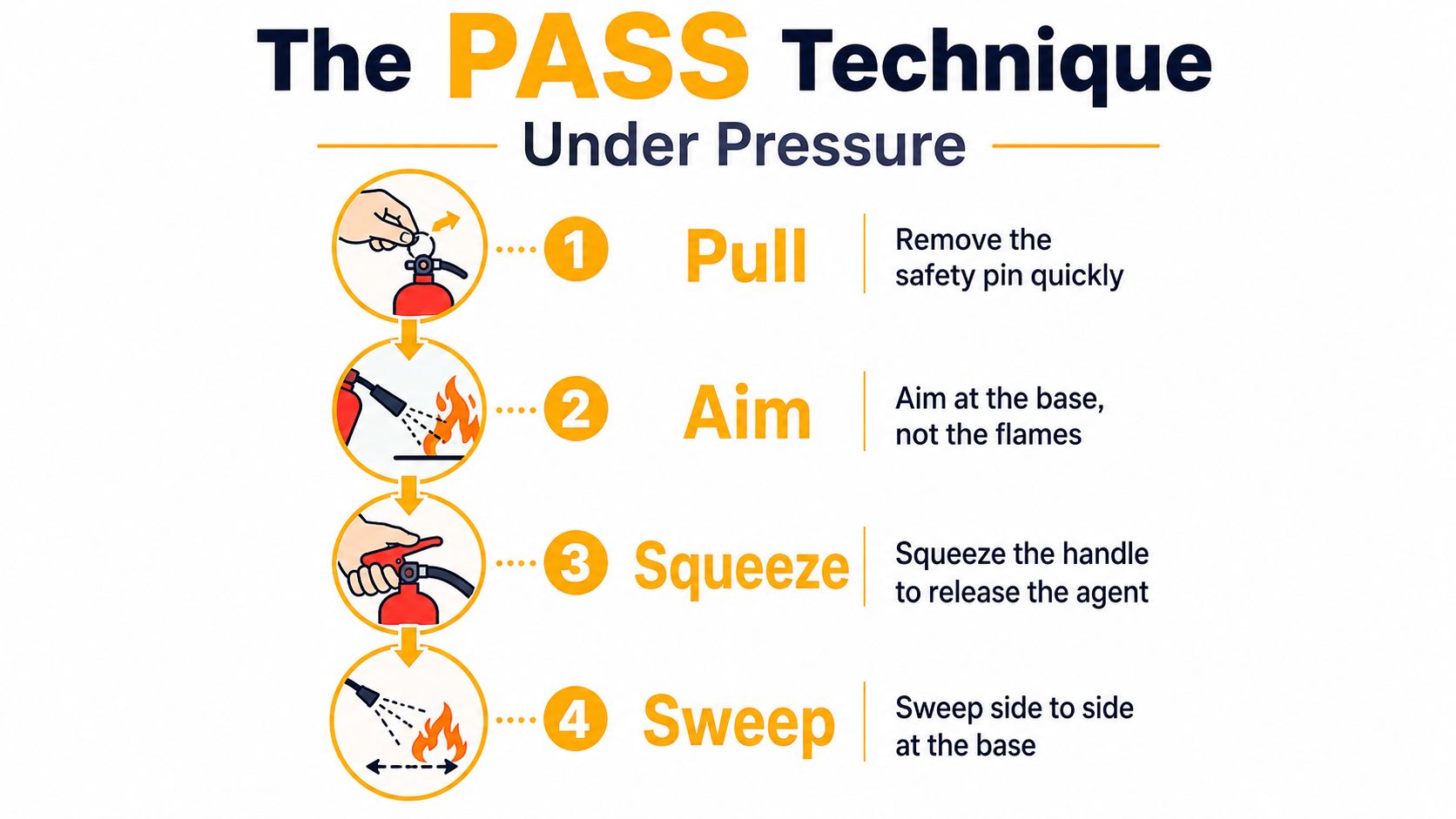
PASS means this, exactly:
Pull the safety pin.
Aim at the base of the fire, not the flames.
Squeeze the handle to discharge the agent.
Sweep side to side across the fuel source.
The order matters because the discharge window is short. Common portable extinguishers only work for about 12 to 20 seconds, with throw distances around 2 to 6 metres depending on agent and size (discharge and range reference). That means hesitation eats into the only time you've got, and backing away too far can leave the agent short of the fire.
The aim point matters too. People naturally want to spray flames because flames are what they can see. The problem is that the visible flame is only the top of the fire. The agent needs to reach the burning material at the base, or the fire can flare straight back up.
What pressure does to technique
A controlled practice session teaches a few habits that classroom talk misses. People learn how heavy the extinguisher feels, how far the nozzle reaches, and how quickly the agent disappears once the handle is squeezed. They also learn that the best response is usually a short, direct attack, not a long, nervous blast.
That's why realistic drills matter. The user needs to close the distance only as far as the discharge pattern and heat allow, then keep the sweeping motion tight and deliberate. In a real workplace, the person who knows the equipment well enough to act without overthinking is the one most likely to stop a small fire before it becomes a building problem.
Matching Extinguisher Classes to Your Site Hazards
Training falls apart if staff are taught how to discharge an extinguisher but not how to choose one. A Queensland workplace doesn't have one generic fire risk, it has several, and the right agent depends on what's burning. That's why AS 2444 sits at the centre of extinguisher selection and placement, the equipment has to match the hazard and be located for quick access, rather than being present on the wall (AS 2444 framework reference).
The numeric rating matters too. A higher A or B rating means greater suppression capacity on Class A or Class B fires, which is why two extinguishers of the same agent aren't always equivalent in the field. Site managers should read the label as part of the training, not as a maintenance afterthought.
Common Queensland hazards and the right class
| Extinguisher Class | Fire Type | Common QLD Commercial Hazard | Typical Agent |
|---|---|---|---|
| A | Ordinary combustibles | Office paper, cardboard stock, shopfront waste | Water, foam, or dry chemical |
| B | Flammable liquids | Workshop solvents, fuel spills, cleaning chemicals | Foam, CO2, or dry chemical |
| C | Energised electrical | Switchboards, office servers, appliances, café equipment | CO2 or dry chemical |
| D | Combustible metals | Industrial machining areas, specialist plant | Specialist metal agent |
| F | Cooking oils and fats | Commercial kitchens, fryers, deep-fat cooklines | Wet chemical |
| E | Specialist risks | Controlled environments with unusual hazards | Site-specific specialist agent |
For hospitality, the main concern is cooking oil and fat, so wet chemical is the relevant class. For an office, the issue is more often energised electrical gear, which means staff need to recognise that water is the wrong choice. In workshops, dry chemical or foam is often more appropriate because flammable liquids can be part of daily operations.
Match the agent to the room, not the habit
The easiest mistake is buying what feels familiar. A manager sees an extinguisher on a bracket and assumes it will handle anything nearby. That's a bad assumption, because the wrong agent can be ineffective or create a secondary hazard.
Rule of thumb: training should teach staff to read the label and link it to the hazard in front of them, not to grab the nearest cylinder and hope.
A proper fire training extinguisher session earns its keep. It connects the wall sign, the class label, and the risk in the building. When staff can do that, the equipment stops being decoration and starts being part of the response plan.
What a Quality Training Course Actually Covers
A decent course doesn't start and end with a pin pull. It begins with basic recognition, moves through safe decision-making, and then gives people supervised practice with the actual gear they'll see on site. That's the difference between general awareness and designated-user competence, which is why annual education for all workers is only the starting point, not the whole answer (annual education benchmark).
From classroom to practical use
A solid course usually includes a short explanation of fire classes, extinguisher labels, alarm activation, and the site's evacuation flow. After that, staff should handle real units or realistic training equipment so they understand weight, nozzle control, and discharge behaviour before they're assessed.
Designated users need more depth than a general induction. If someone is assigned to use firefighting equipment as part of the emergency plan, they should be trained on the specific extinguisher types that match the site's hazards, not just given a general safety talk. That's the difference between being “aware of fire safety” and being capable of acting under pressure.
What to ask before you book
- Hands-on practice: ask whether the course includes live discharge or a credible simulated unit, not just slides.
- Site relevance: ask whether the trainer covers the actual hazards in your premises, such as kitchen oils, switchboards, or workshop liquids.
- Assessment: ask how competency is checked, because a certificate should follow demonstration, not attendance alone.
- Equipment condition: ask whether the extinguishers used in training are maintained and suitable for practical demonstration.
- Role clarity: ask whether the course distinguishes between all-staff awareness and designated-user instruction.
A provider should be able to explain the course structure in plain language and show how it fits the workplace emergency plan. If they can't do that, the training may be convenient, but it won't be useful when a shift supervisor is standing in front of a live fire.
For businesses that want training bundled with equipment work, Celtic Fire & Security's service overview shows how fire protection services can sit alongside maintenance and compliance tasks instead of being treated as separate jobs.
Certification Records and Compliance Evidence
Training means little if nobody can prove it happened. When an insurer, landlord, or Queensland WHS auditor asks for evidence, the conversation turns to dates, names, trainer credentials, and whether the training tied back to current equipment and emergency procedures. That's where a clean register matters more than a certificate in a drawer.
What good records need to show
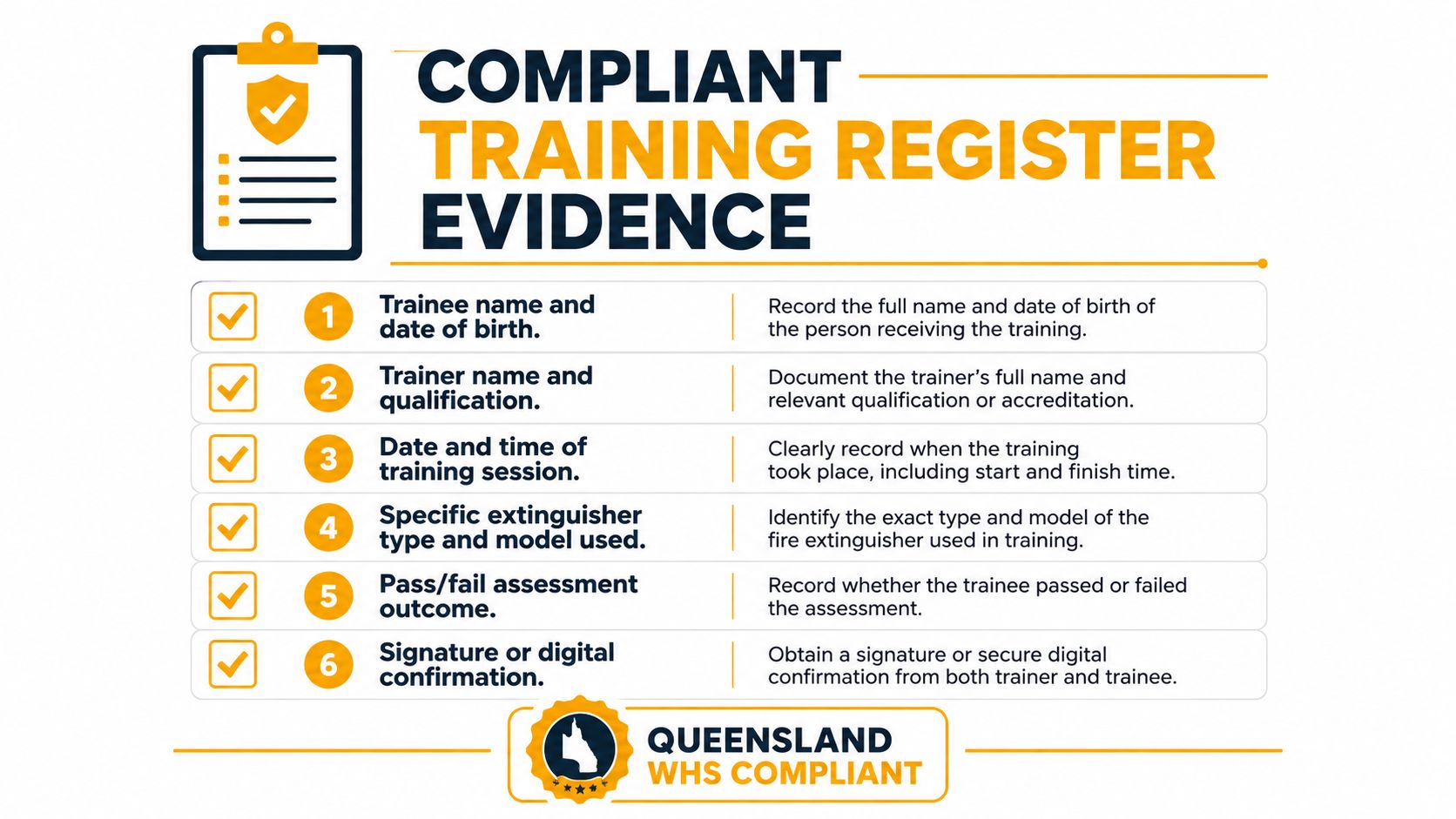
A proper training file should capture who attended, who trained them, what equipment was used, and whether they passed the assessment. It also helps to keep the course date, the type of extinguisher demonstrated, and the trainer's qualification on the same record so the evidence is easy to produce later.
The reason this matters is practical. A training certificate on its own doesn't tell an auditor whether the session matched the site's hazards or whether the extinguishers on the wall were accessible and current. Under OSHA's extinguisher rules, equipment must be mounted, located, and identified so it's readily accessible without exposing employees to injury, which reinforces the broader compliance idea that access and placement are part of the control, not just the hardware (placement and access requirement).
Keep training tied to the maintenance trail
Training works best when it sits alongside the rest of the fire protection record set. That means current inspection tags, maintenance records, emergency plan documents, and proof that the extinguishers match the hazard profile of the building. The register should sit in the same compliance folder as service records, not in a separate inbox where nobody can find it.
The other reason to keep records tight is turnover. New supervisors, casual staff, and shift changes make it easy for a site to lose track of who's trained. A current register fixes that by showing who can be assigned as a designated user and who still needs the annual education component.
For businesses that maintain extinguishers on a schedule, the broader maintenance trail can be kept with the service documentation published under AS 1851 related resources. That way, the training evidence and the equipment evidence live in the same compliance story.
Why Trained Staff Save Money and Reduce Risk
A trained employee is cheaper than a damaged fit-out, but the savings come from more than one place. Faster recognition, correct extinguisher choice, and a confident first response all reduce the chance that a small incident turns into a shutdown, an insurance issue, or a safety investigation. That's why managers should treat training as a risk control, not a nice-to-have.
The performance gap is real
A fire-safety study summarised in the training literature tested 276 ordinary people and found that 98% could safely use a fire extinguisher with no training, while 100% succeeded after brief instruction. Proper technique improved from 74% to 96% (WPI/EKU study summary). That matters because the first attempt is usually the only one that counts.
Those numbers don't mean training is unnecessary without it, they mean training makes the response cleaner and more reliable. In a real workplace, that extra margin can be the difference between a quick knockdown and a failed attempt that leaves the person needing to evacuate through smoke.
Why owners and managers should care
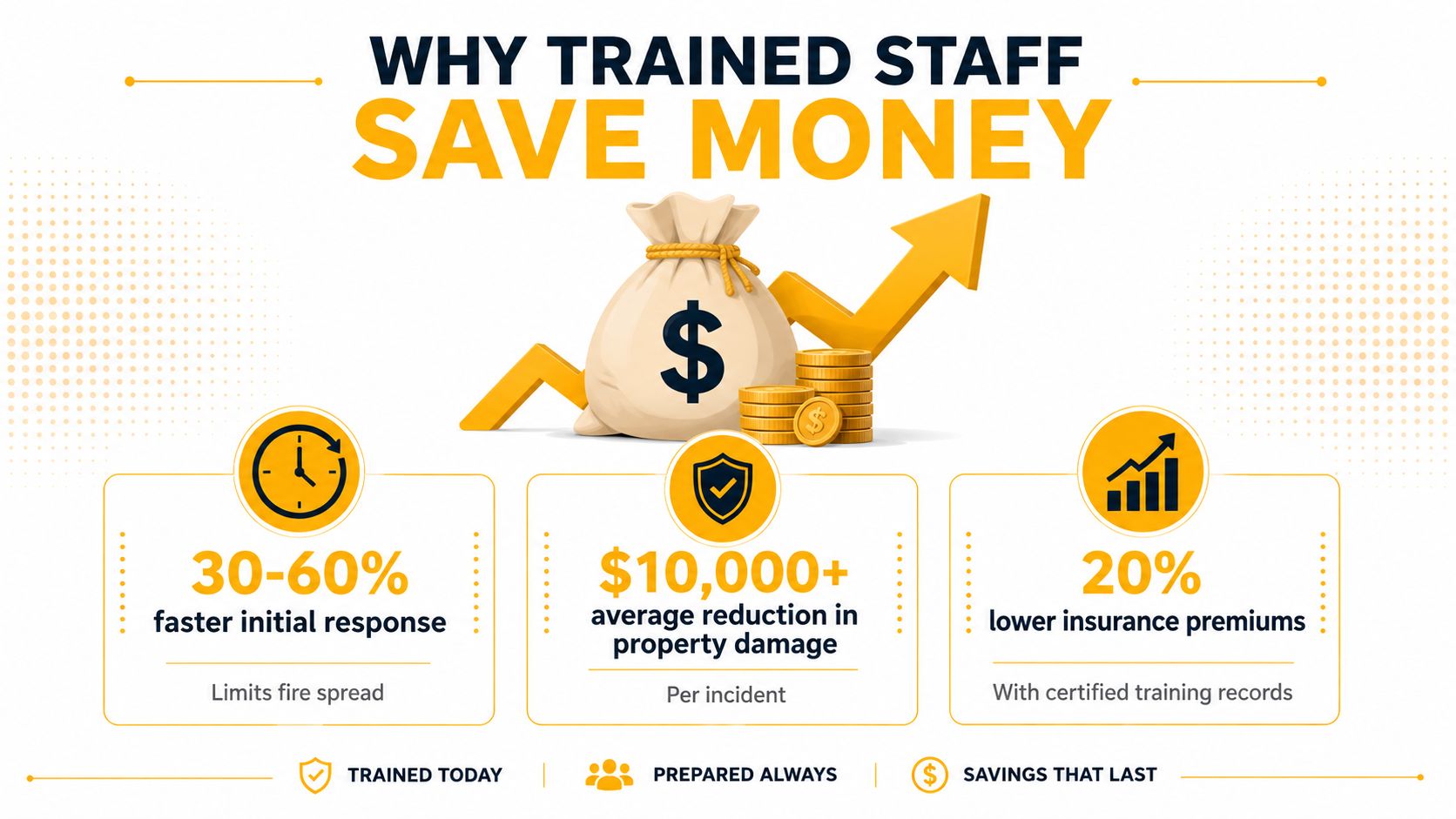
The financial case is straightforward. Trained staff are more likely to act correctly, which can reduce property damage and limit business interruption. Better records also make audits smoother and can strengthen the business's position during insurance conversations, because the company can show that it isn't relying on luck.
A training cohort also helps with staffing. If only one person knows what to do, a shift change becomes a weakness. If several designated users are trained and documented, the site becomes more resilient, especially in hospitality, retail, and light industrial settings where multiple people may be present but only a few are assigned suppression duties.
Bottom line: a short, well-run training program costs less than the disruption caused by a preventable fire response failure.
For directors and operations managers, that's the argument in one sentence. Safety improves, compliance gets easier, and the business has a better chance of staying open after a small incident.
Preparing Your Site and Choosing the Right Provider
A good programme starts before the trainer walks in. The site needs the right number of designated users, the right extinguishers in the right places, and a schedule that lets staff train without weakening a shift. If those pieces aren't in place, even strong practical training won't stick.
What to line up before booking
- Designated users: decide who is expected to use a fire extinguisher, not just who attends for awareness.
- Shift coverage: plan sessions around trading hours, delivery windows, and peak activity so the right people can attend.
- Current equipment: check that extinguishers are installed, labelled, and positioned where staff can reach them quickly.
- Documentation: gather maintenance records, inspection tags, and the emergency plan so the provider can align the session with the site.
- Course format: ask whether the provider trains on site, uses live discharge, and covers the hazards specific to your premises.
- Maintenance capability: ask whether the same provider can service the equipment after training, so selection, placement, and upkeep stay consistent.
For businesses that want training to connect directly with equipment selection and servicing, the cabinet and placement details in this extinguisher cabinet guide are a useful reminder that mounting and access are part of the compliance picture, not just a storage choice.
Choose a provider that thinks like a site manager
A Queensland provider should be able to talk about practical risk, not just training theory. They should ask what hazards are on your floor, where the extinguishers are located, and whether the staff they're training are general workers or designated users. If they also handle installation and maintenance, the handover from training to compliance is cleaner.
That matters for North Brisbane, Moreton Bay, the Sunshine Coast, the Somerset Region, and Ipswich, where businesses often need one local contact who understands both the training side and the equipment side. A fire training extinguisher program works best when the provider sees the whole site, not just the classroom.
If you want your staff trained on the right extinguisher types and your equipment checked against current compliance needs, contact Celtic Fire & Security for practical fire protection support across Queensland. They can help connect training, placement, and maintenance into one workable plan for your site.
No responses yet