
You're on site, the logbook's open, and the same question keeps coming up while the maintenance manager checks the wall assets, does this fire hose reel still do its job, or is it just taking up space and paperwork? In Queensland, that's never a throwaway question. A reel isn't a decorative fitting, it's part of the building's first-response fire protection, and if it's there, it needs to be compliant, accessible, and maintained like it matters.
For commercial buildings across Queensland, the practical issue is usually not whether the reel looks tidy. It's whether the reel meets AS/NZS 1221:1997, sits within the installation tolerances that make it usable under stress, and appears correctly in the building's fire safety records under the Queensland Building Fire Safety Regulation 2008. If you manage a warehouse, office block, tenancy fit-out, retail site, or strata property, the reel is only one part of the picture. The paperwork, the inspection rhythm, and the decision about whether you need a reel, extinguishers, or both all sit together.
Table of Contents
- A Day on Site With a QLD Facility Manager
- What a Fire Hose Reel Is
- Fixed Swing-Arm and Booster Reel Configurations
- AS 2441 Installation Rules That Actually Matter
- Where QLD Sites Are Required to Put Them
- The Six-Monthly and Annual Testing Rhythm
- When a Hose Reel Is the Wrong Asset
- Tying It All Together for Your QLD Site
A Day on Site With a QLD Facility Manager
Tuesday morning, North Brisbane. The maintenance manager has a fire compliance log under one arm and a radio on the belt, and the walk starts the same way it does on a lot of commercial sites, extinguishers first, exit lights second, then a pause at the fire hose reel by the loading dock. That pause is where the questions live. Is the reel still easy to find? Does the valve sit where it should? Has anyone checked flow, or has everyone assumed it's fine because the drum still turns?
A good site walk isn't about ticking boxes for the sake of it. It's about finding the gear that will be used when someone is under pressure, in smoke, and trying to make a decision in seconds. A hose reel has a very specific role in that moment, it gives an occupant a controlled water supply for a developing fire before it grows beyond first attack, and it only works properly if the equipment, the access, and the records all line up.
What the manager is really checking
The reel itself tells a story before anyone opens the logbook.
Practical rule: If the reel looks hard to reach, hard to unwind, or hard to identify, it's probably hard to use when it counts.
On a live site, the check is usually visual first. Is the hose kinked, is the nozzle intact, is the valve accessible, and is there obvious damage around the drum or guide arm? Then comes the paperwork check, because Queensland fire safety compliance isn't satisfied by ownership alone. The reel has to sit inside a documented maintenance regime, with servicing and testing that can be shown to an auditor, owner, body corporate committee, or insurer.
For a facility manager, that's the core value of a walkthrough. It separates the assets that are ready from the ones that are only present. The rest of this guide stays in that same lane, practical, Queensland-based, and focused on the difference between equipment that exists on the wall and equipment that's ready to be used.
What a Fire Hose Reel Is
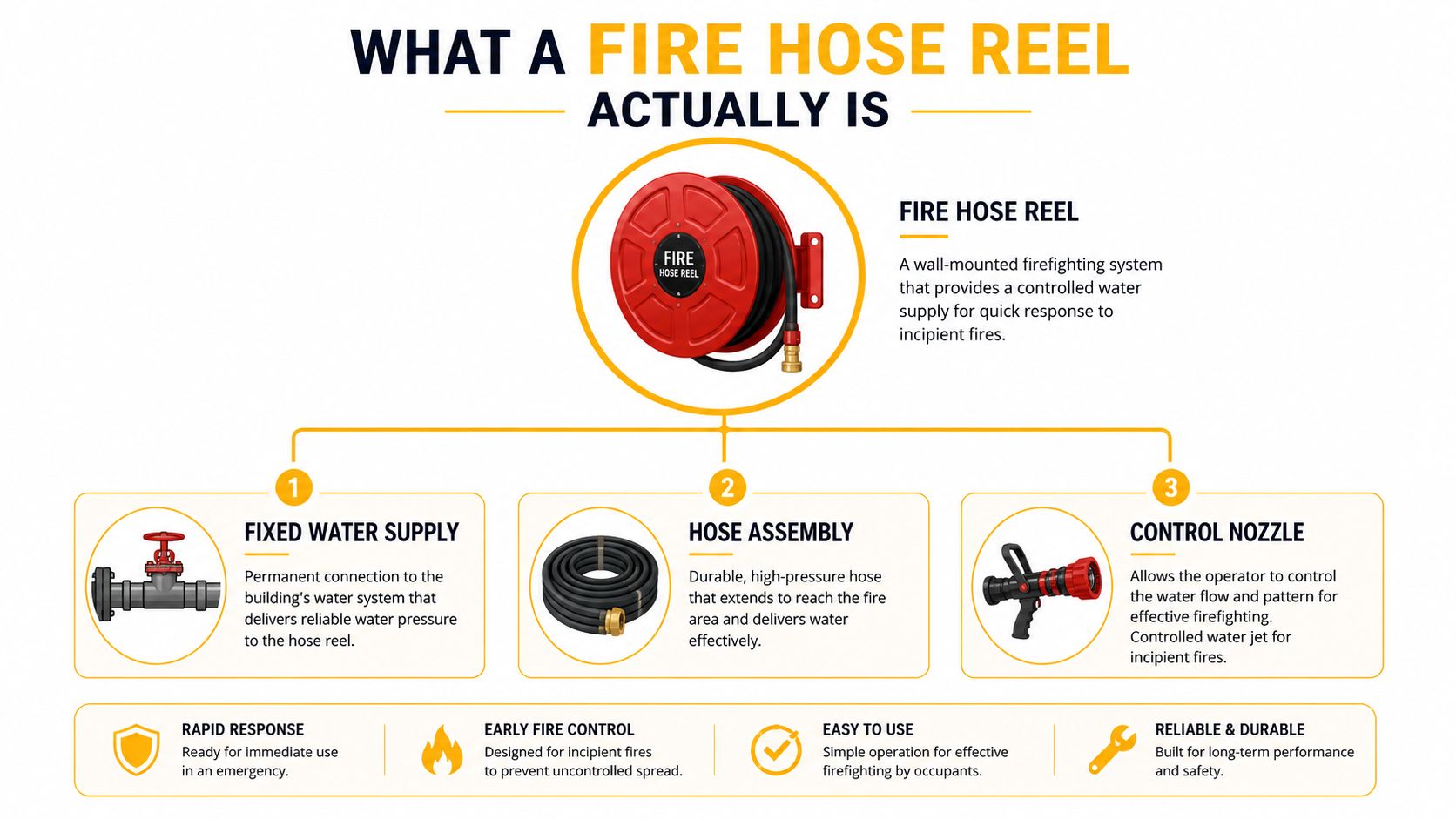
A fire hose reel is a fixed water delivery point designed for one operator to apply a controlled jet of water to an incipient fire. In Australian terms, the relevant benchmark is AS/NZS 1221:1997, which covers the design, construction, and performance requirements for fixed and swing-arm type hose reels. That standard matters because it turns a wall-mounted hose into a defined safety asset with a clear job and a known performance expectation.
The practical minimum benchmark you're buying is 0.45 L/s at 220 kPa (Dixon technical data sheet). That number sounds technical, but the meaning is simple. The reel has to deliver enough water, at enough pressure, for a first-response attack to be useful. If pressure drops because of long pipe runs, a restricted valve, or poor maintenance, the reel may still uncoil, but it won't perform to the standard expected in service.
The four parts that matter on site
A facility manager doesn't need to memorise the engineering, but they should recognise the moving parts.
- The drum: This stores the hose and allows it to be withdrawn smoothly when the reel is mounted and maintained correctly.
- The hose: Standard commercial reels commonly use 36 m of 19 mm ID hose.
- The nozzle: This shapes the water into a controllable jet, which is what makes the reel useful for incipient fire attack.
- The isolation valve: This sits close enough to be opened quickly, and it's part of what separates a compliant reel from a compromised one.
The assembly is also tested to a stated pressure level, with reel systems tested to 1.7 MPa and hose tested to AS 1180.5. That's why a “looks okay” inspection isn't enough. A hose can look tidy while still hiding issues at the swivel, nozzle, or valve that only show up in testing. For a site manager, the key question is not whether the reel is on the wall, but whether it will deliver water at the right pressure and in a condition that stands up to compliance checks.
Fixed Swing-Arm and Booster Reel Configurations
Not every reel suits every floor plate, and that's where a lot of poor decisions start. A small tenancy with a straightforward plan doesn't need the same layout as a warehouse with long aisles, rack storage, or awkward plant placement. In Queensland commercial work, the common choices are the fixed wall-mounted swing-arm reel, recessed or cabinet-mounted units, and booster reel arrangements.
Match the configuration to the job
The swing-arm reel is the everyday option because it's direct and familiar. It suits office floors, back-of-house corridors, and many warehouse walls where quick access matters more than visual concealment. A recessed or cabinet-mounted reel is useful where the owner wants protection from vandalism, forklift contact, or a cluttered service area, but it can add friction if the access panel or surrounding space is poorly managed.
Booster reels sit in a different category. They're used where the site needs a more powerful attack line, usually because the floor plate is larger, the hose path is longer, or the water supply behind the wall needs to support a more demanding use case. In practice, that means a reel in a small office tenancy and a booster reel in an industrial space are not interchangeable, even if they look similar at a glance.
A reel that's easy to deploy and easy to see will usually get used. A reel that's tucked away for aesthetics often gets ignored until there's smoke in the room.
| Configuration | Typical Use Case | Operator Profile | Key Trade-Off |
|---|---|---|---|
| Fixed swing-arm reel | Offices, retail back-of-house, many warehouses | Single trained occupant or warden | Fast to access, but exposed if the area is busy |
| Recessed or cabinet-mounted reel | Corridors, public-facing areas, vandal-prone sites | Single occupant who can open and deploy quickly | Cleaner appearance, but access can be slowed by cabinet or fit-out issues |
| Booster reel | Larger industrial tenancies, long hose paths, bigger floor plates | Single operator, often with site response procedures | Better reach and performance potential, but higher dependence on supply and correct selection |
The right choice comes down to reach, deployment speed, and supply pressure. If the hose has to fight around corners, obstructions, or cramped plant, the reel may technically exist but still be a poor operational fit. The best installations are the ones the operator can find, open, and use without hesitation.
AS 2441 Installation Rules That Actually Matter
Installation is where compliant equipment becomes usable equipment. A reel can be the right model and still fail in practice if it's mounted badly, blocked by fit-out, or positioned so awkwardly that the first person on scene loses precious seconds trying to get water on the fire. For Queensland sites, the placement logic sits alongside AS 2441:2005, the Australian standard that has anchored hose reel design and servicing expectations for decades.
Mounting height and clearance are performance controls
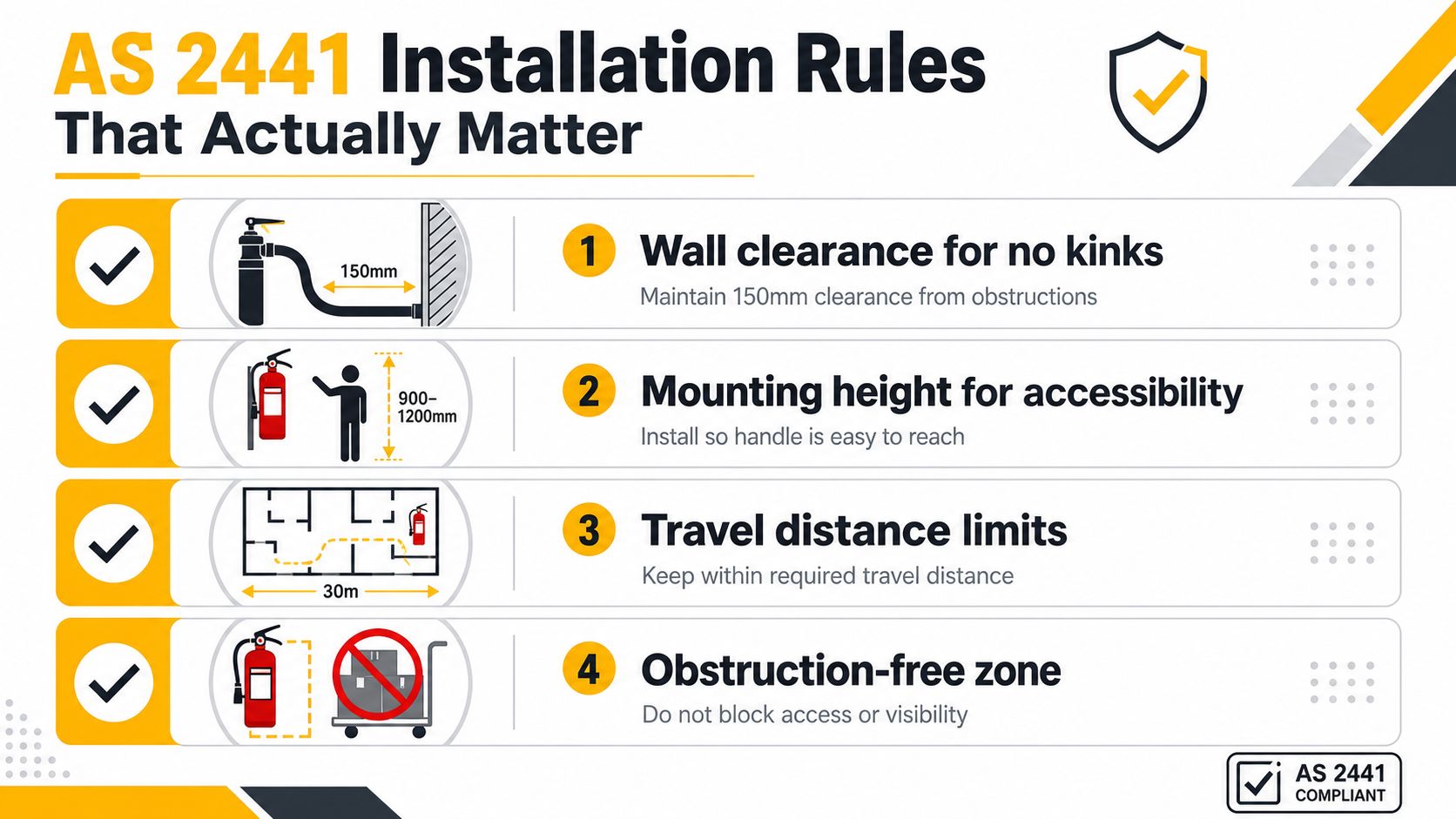
One technical sheet specifies the reel drum centre should sit between 1400 mm and 2400 mm, the isolation valve centre between 900 mm and 1100 mm, and there should be at least 100 mm of radial clearance around the reel plates and valve (installation data sheet). Those figures aren't just about neatness. They prevent the common failure modes that turn a compliant asset into a frustrating one, missed valves, tight hose bends, and dragging against obstructions.
If the valve sits too high or too low, the operator can waste time searching for it in the first seconds of an incident. If the clearance is too tight, the hose can bind as it comes off the drum or rub hard at the guide arm, which increases wear and makes deployment clumsy. That's why installers pay attention to the wall space around the reel, not just the wall space behind it.
What a site manager should look for
- Valve reach: The isolation valve should be obvious and reachable without awkward bending or stretching.
- Free unwind path: The hose should leave the drum cleanly, without kinking on door hardware, signage, or stored items.
- Clear approach: A reel blocked by trolleys, pallets, or tenancy furniture is already compromised.
- Surface condition: Corrosion, damaged brackets, or loose wall fixing points usually mean the reel has had a harder life than the paperwork suggests.
A quick visual inspection can catch a lot, but only if the manager knows what to look for. A good mount supports use under pressure, while a bad one makes the first attack slower and more tiring than it should be.
Where QLD Sites Are Required to Put Them
A fire hose reel is not just a wall fitting in Queensland. The Queensland Building Fire Safety Regulation 2008 sets the fire safety framework for buildings in Queensland, including required fire safety measures, fire safety records, and scheduled maintenance obligations for equipment such as fire hose reels. That means the critical question is whether the reel is part of the building's documented fire safety system, not whether it happens to be mounted somewhere convenient.
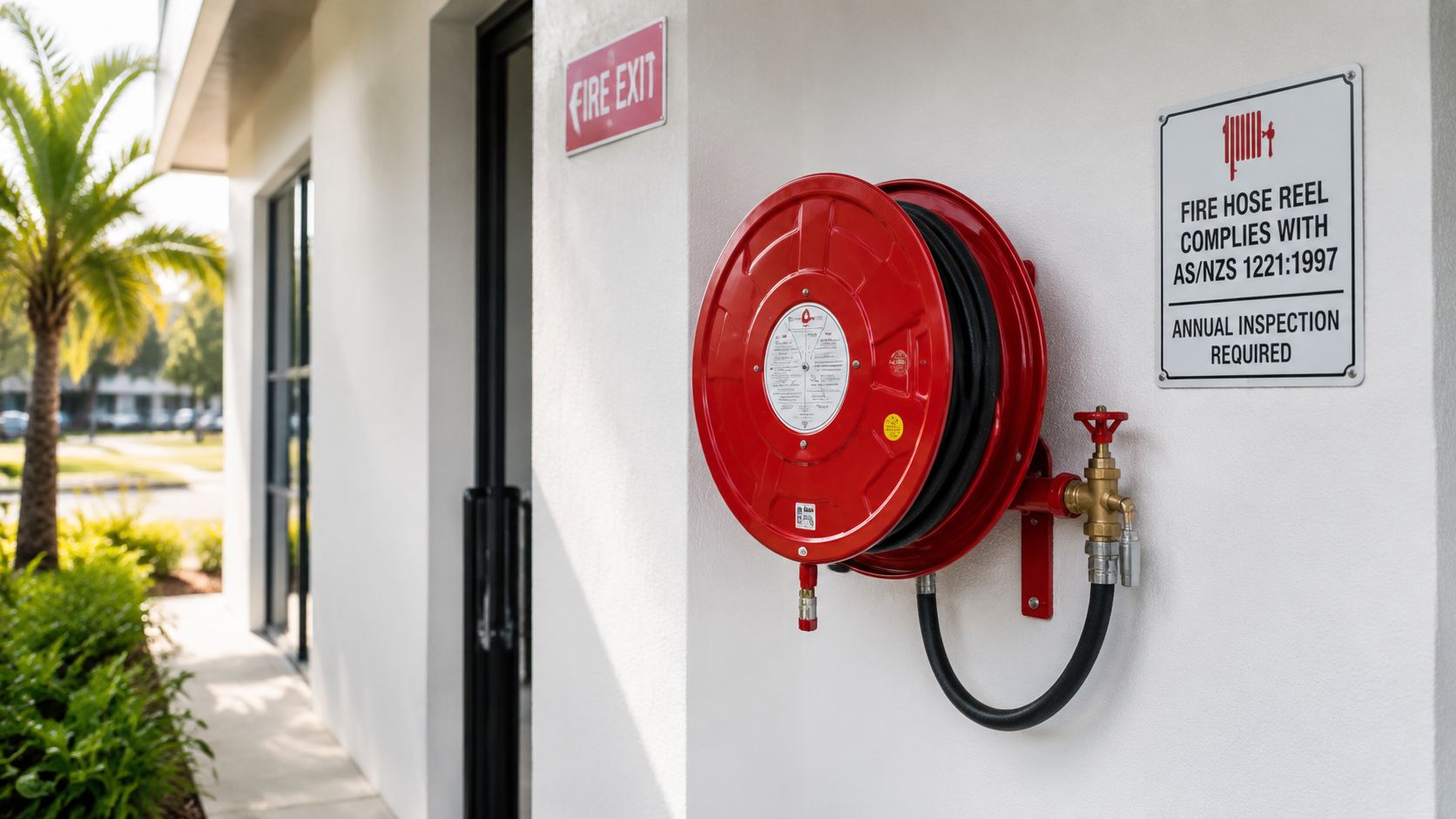
On commercial sites, placement follows coverage and access. Occupants need to reach the reel along normal travel paths, and the reel has to cover the area it is meant to protect without being trapped behind tenancy changes, stored stock, or awkward fit-out decisions. Body corporates and facility managers should read the fire safety schedule, not only the asset list, because the schedule shows how the building's fire safety measures are intended to work together. The same practical approach applies to Australian fire door obligations, where the hardware only counts if it sits inside a maintained and documented system.
What the paperwork should show
The compliance trail should be easy to follow. It should not rely on old invoices and someone's memory from the last inspection. A proper file identifies the installed equipment, keeps the maintenance record, and shows the servicing dates that prove the reel is being managed, not merely owned.
Practical rule: If the reel is in the building but not on the fire safety schedule, treat that as a paperwork gap, not a minor admin issue.
For Queensland managers, the test is straightforward. Can you point to the reel on the plan, show the last inspection, and explain how it is maintained as part of the building's fire safety arrangement? If you cannot, the equipment may be physically present and still fail the compliance story.
The Six-Monthly and Annual Testing Rhythm
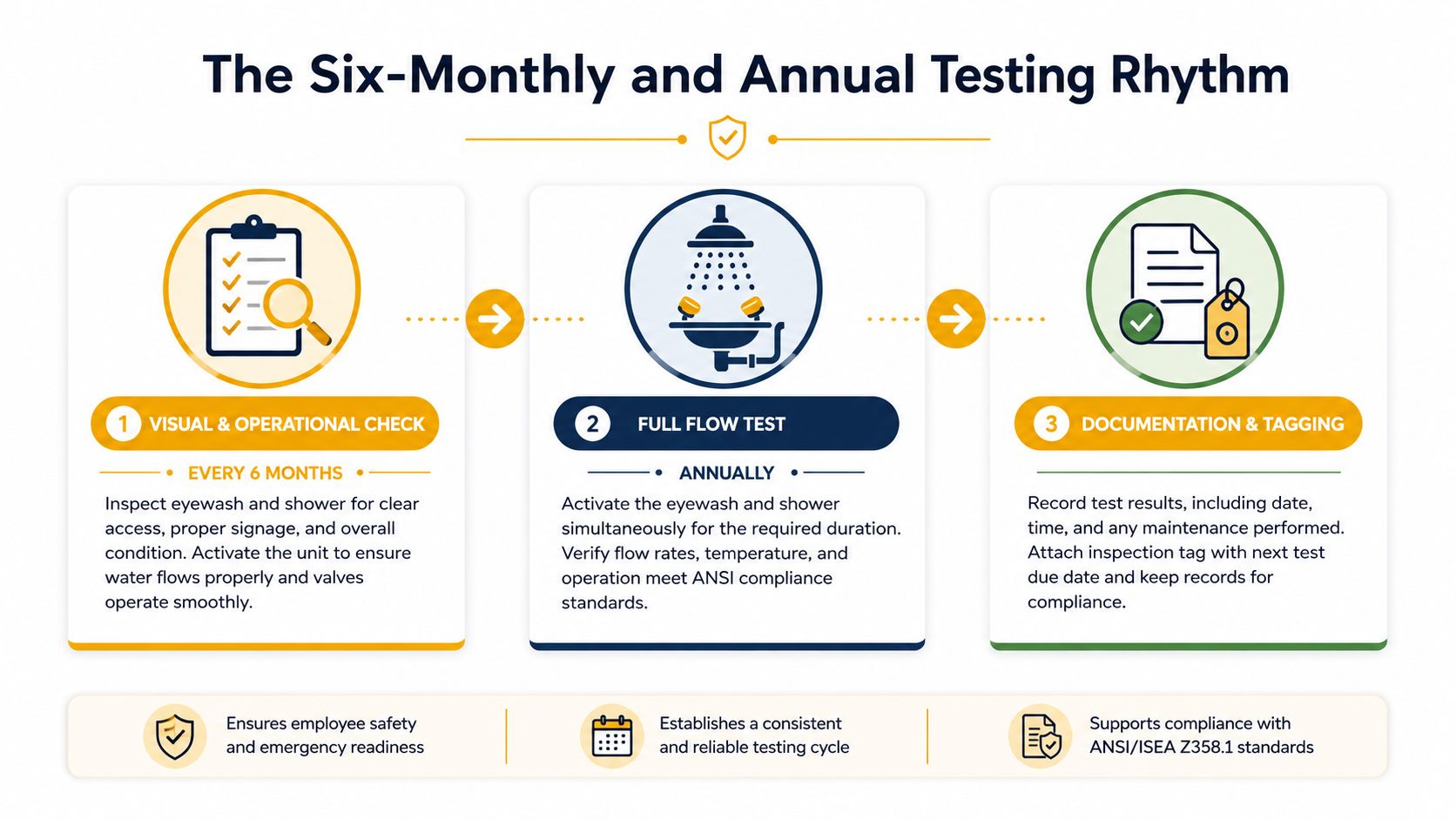
A hose reel that hasn't been tested is a risk sitting on the wall. Queensland sites need a maintenance rhythm that proves the reel still works, not just that it still looks complete. The practical cadence is straightforward, a six-monthly visual and operational check, an annual flow test, and a deeper service cycle that looks for wear, hose condition, seals, and drum operation.
What each visit is trying to catch
The six-monthly check is where the technician looks for obvious issues, damaged hose, seized nozzle, missing signage, leaks, obstruction, and a reel that doesn't unwind cleanly. The annual flow test is where the reel proves it can still deliver the expected discharge and pressure performance. The longer overhaul cycle is where the deeper wear shows up, hose replacement, seal checks, and drum service rather than surface-level housekeeping.
That's why a maintenance label matters. A label or service record shows the reel was not just seen, but assessed against the maintenance rhythm. For the facility manager, the record is what closes the loop between the wall asset and the compliance file.
What failure usually looks like
- Partially closed valve: The reel may open, but the discharge is weaker than expected.
- Leak at the swivel joint: Water loss here undermines pressure and can worsen over time.
- Kinked or perished hose: The reel may deploy badly or fail under load.
- Seized nozzle: The operator loses control at the exact moment they need a clear stream.
AS 1851 service scheduling guidance is often the reference point contractors use when aligning maintenance programs across a building's fire protection assets. In practice, the value is in the discipline, records, follow-up, and a clear sign-off trail that shows the reel has been checked by someone who knows what matters.
Celtic Fire & Security can handle fire hose reel servicing, including flow rate testing, pressure testing, and service labelling on the reel itself, which makes it easier for managers to keep the file and the hardware in step.
When a Hose Reel Is the Wrong Asset
A hose reel isn't automatically the right answer just because a building is commercial. Some sites need it, some sites don't, and some sites need a different first-attack setup altogether. The right decision depends on the fire load, the floor plan, occupant capability, and whether the site can support the reel with water pressure and reach.
A simple decision framework
If the risk is mainly Class A combustibles and the occupants are trained, a hose reel may be appropriate as part of the response set. If the tenancy is small, the egress is straightforward, and the fire risk can be managed with correctly specified extinguishers, a reel can be unnecessary or poorly placed. If the building is large, the hose path is long, or the floor plate is too awkward for effective first attack, a booster arrangement or a different control may be more sensible.
Portable fire extinguisher guidance is worth checking alongside reel planning, because many Queensland sites end up needing both. Extinguishers are often the faster answer for a small, contained fire, while a reel is a different tool for a different task. Mixing them up leads to bad decisions on the wall and poor response on the floor.
A site doesn't earn compliance points for installing more gear than it needs. It earns them by having the right gear, in the right place, with the right maintenance record.
For a body corporate, landlord, or facility manager, the best decision is the one that can be defended in writing. If you choose a reel, document why. If you choose extinguishers instead, document why that is the better fit for the floor plan and the actual risk.
Tying It All Together for Your QLD Site
For Queensland commercial property, the clean way to think about a fire hose reel is this. AS/NZS 1221:1997 defines the hardware, AS 2441:2005 supports the installation and servicing expectations, and the Queensland Building Fire Safety Regulation 2008 anchors the paperwork, records, and maintenance obligations (Queensland fire safety regulation summary). If one of those parts is missing, the system is incomplete.
Pull the building's fire safety schedule, check the last flow test date, and inspect whether the reel is clear, visible, and easy to use. If the site needs a six-monthly inspection or a service record rebuilt, book it with a qualified Queensland fire protection contractor and get the paperwork back in step with the hardware.
Celtic Fire & Security provides fire hose reel servicing, testing, installation support, and compliance documentation for commercial sites across South East Queensland. If your building needs a reel checked, a maintenance record updated, or a practical decision on whether you need a reel, extinguishers, or both, visit Celtic Fire & Security and arrange the next site visit.
No responses yet