

Australian Standard AS/NZS 2293.2 requires emergency and exit lighting to undergo a formal discharge test every six months, with an additional annual test. Monthly visual inspections are recommended, but they aren't the core legal requirement.
That distinction matters when you're managing a commercial building in Queensland. You may have a maintenance calendar showing a monthly button press, an old contractor report referring to annual servicing, or advice from another facility manager who follows a different schedule. The problem usually isn't a lack of care. It's that several different checks are being described as though they're the same test.
For a Queensland site, the practical question is not how often should emergency lighting be tested. You need to know which test applies to your system, who is authorised to perform it, what the test must verify, and how the result is recorded.
Table of Contents
- Emergency Lighting Testing Requirements in Australia
- Understanding the AS/NZS 2293.2 Testing Schedule
- What Each Emergency Lighting Test Involves
- Self-Contained Lights Versus Central Battery Systems
- Queensland Licensing Requirements for Emergency Lighting Tests
- Building Your Emergency Lighting Compliance Calendar
- Common Emergency Lighting Testing Mistakes to Avoid
Emergency Lighting Testing Requirements in Australia
A facility manager in South East Queensland can quickly find conflicting advice. One page says monthly, another says annually, and a third refers to six-monthly servicing without explaining whether it means a visual inspection or a battery discharge test. That confusion can leave a business with a neat-looking maintenance file but an incomplete testing program.
The Australian compliance baseline is built around six-monthly testing. Australian emergency-lighting maintenance guidance summarises AS/NZS 2293.2 as requiring emergency and exit lighting to be tested at intervals not exceeding six months, with separate six-monthly and yearly requirements in the standard's structure.
The hierarchy is more useful than one simple frequency
Think of the program as a set of layers:
- Monthly visual or functional checks, recommended for routine oversight and specifically identified for some self-contained systems.
- Six-monthly discharge testing, the central recurring compliance checkpoint for emergency and exit lighting.
- Annual full-cycle testing, which includes a full-duration assessment and goes beyond a quick functional check.
- Lifecycle checks, including the 10-yearly and end-of-light-source-life obligations identified in the 2019 edition of AS/NZS 2293.2, as summarised by Australian emergency-lighting standards guidance.
A monthly check can confirm that a fitting responds when tested. It doesn't prove that the battery will continue operating for the required period during a genuine power failure. That's why treating a monthly button press as a substitute for the six-monthly discharge test creates a gap.
Practical rule: Keep routine checks and formal discharge testing as separate entries in your maintenance records.
The six-monthly cycle reflects the purpose of emergency lighting. The system must be ready before a failure occurs, not merely repaired after someone notices a dark exit sign. Queensland fire-safety practice also recognises testing at six-monthly and annual intervals, which aligns state administration with the national maintenance model. A site that only books an occasional inspection isn't following the recurring structure expected for life-safety equipment.
Emergency lighting also sits alongside other fire protection duties. A coordinated maintenance plan may include commercial fire-extinguisher servicing, fire alarms, exit doors, hose reels and emergency lighting, but each system still needs its own applicable inspection and testing requirements.
Understanding the AS/NZS 2293.2 Testing Schedule
AS/NZS 2293.2 doesn't operate as one single annual tick-box. It layers checks according to the type of emergency-lighting installation and the risk of a hidden failure. The result is a maintenance schedule that moves from routine confirmation of operation to deeper battery and system verification.
The clearest distinction concerns self-contained emergency lights and central battery systems. Guidance on AS/NZS 2293 emergency and exit-lighting requirements states that self-contained emergency lights require monthly testing, while central battery systems require six-monthly testing. It also identifies a yearly 90-minute duration test for both system types.
Self-contained system checkpoints
A self-contained fitting contains its own battery and charging components. For that arrangement, the maintenance program includes a monthly functional check, the six-monthly discharge checkpoint, and the annual duration test.
The monthly check is useful because it catches obvious failures early. A fitting may fail to illuminate, show a fault indication, or operate inconsistently even though no one has reported a problem. The check should be documented rather than treated as an informal walk-through.
The six-monthly test examines battery operation under a longer simulated mains failure. It is the point many online explanations miss when they say only “test monthly”.
Central battery system checkpoints
A central battery installation supplies multiple emergency luminaires from a shared source. The testing pattern is different because the batteries, charger and distribution arrangements sit together rather than inside every fitting.
The guidance identifies six-monthly testing for central battery systems and a yearly 90-minute duration test for both types of installation. A central system therefore needs careful attention to the shared power source, connected circuits and any individual fitting that fails to operate correctly.
The 2019 edition also introduced 10-yearly and end-of-light-source-life requirements, which means replacement and lifecycle planning belongs in the compliance program, not just fault response. Queensland government fire-safety guidance reinforces six-monthly and 12-monthly testing intervals, so local practice supports the broader Australian schedule.
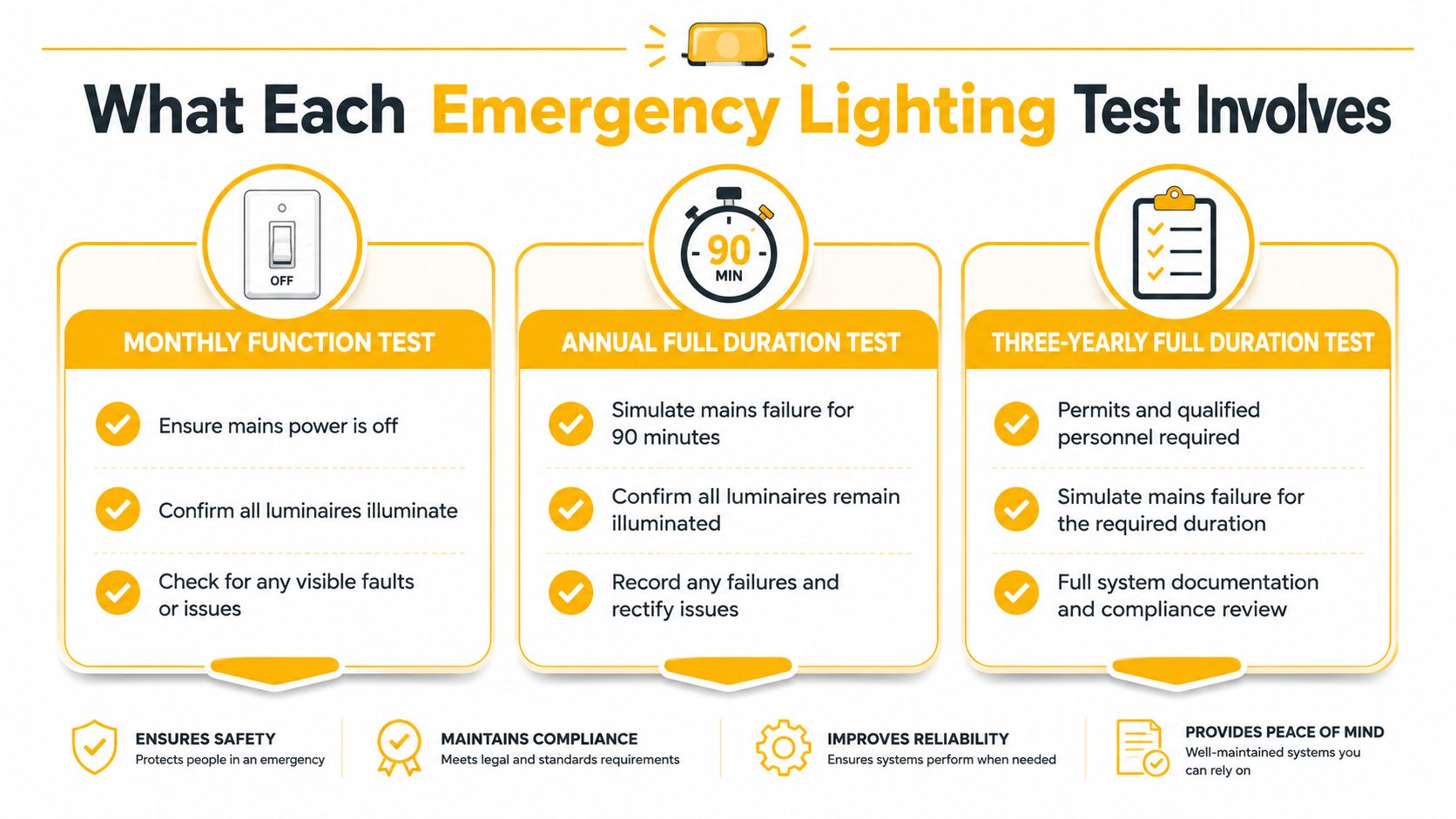
The infographic uses a three-yearly label, but the Queensland and Australian requirements set out in the cited guidance here are the monthly, six-monthly, annual and lifecycle checkpoints described above. Your contractor should confirm the schedule against the installed system, the current standard and the site's fire-safety obligations.
A useful maintenance report should identify the system type, test interval, fittings checked, failures found and corrective work required. Without those details, a calendar entry saying “emergency lights tested” gives limited evidence of what happened.
What Each Emergency Lighting Test Involves
Frequency alone doesn't tell you whether the work was adequate. A technician needs to carry out the correct test for the installation and leave a record that another person can understand later.
A routine check starts with the visible condition of the equipment. The technician or authorised tester looks for damaged fittings, blocked exit signs, poor visibility and obvious fault indications. The light is then operated through its test function or the relevant system control to confirm that it changes from normal supply to emergency operation.
That short check has a limited purpose. It confirms response and basic operation, but it doesn't establish how long the battery will sustain illumination.
The six-monthly discharge test
The six-monthly discharge test simulates a mains-power failure and checks the emergency system while it operates on battery supply. For self-contained fittings, this means assessing individual units. For central battery installations, the technician must consider the shared source, connected circuits and the luminaires supplied by it.
A competent service visit should also identify fittings that don't illuminate, batteries that don't perform as expected, damaged wiring or components, and signs that a unit has reached the end of its serviceable life. Faults should be recorded with enough detail for a manager to arrange repair, replacement or further investigation.
The annual 90-minute test
The annual test is the more demanding benchmark. Australian guidance identifies a 90-minute duration test for both self-contained and central battery systems. The technician simulates a sustained mains failure and monitors whether the emergency luminaires continue operating for the required period.
This test matters because batteries can appear healthy during a short functional check and still lose capacity under extended discharge. A fitting that illuminates initially but fails during the duration test can't be treated as ready for a real evacuation.
Records should show the date, installation or fittings assessed, test result, failures and remedial recommendations. After a discharge test, the system also needs to return to normal charging and operating condition.
A report that only says “passed” doesn't tell a facility manager which fittings were tested or whether the test was functional, discharge or full duration.
The same discipline applies after repairs, battery replacement, fitting replacement or electrical work. The system should be tested again so the record reflects the condition of the installation after the work, not just before it.
If your premises also uses smoke and heat alarms, keep those activities distinct in the maintenance record. A provider may coordinate smoke alarm testing services, but an alarm test doesn't replace an emergency-lighting discharge test.
Self-Contained Lights Versus Central Battery Systems
The quickest way to clarify your testing schedule is to identify how the emergency lights receive backup power.
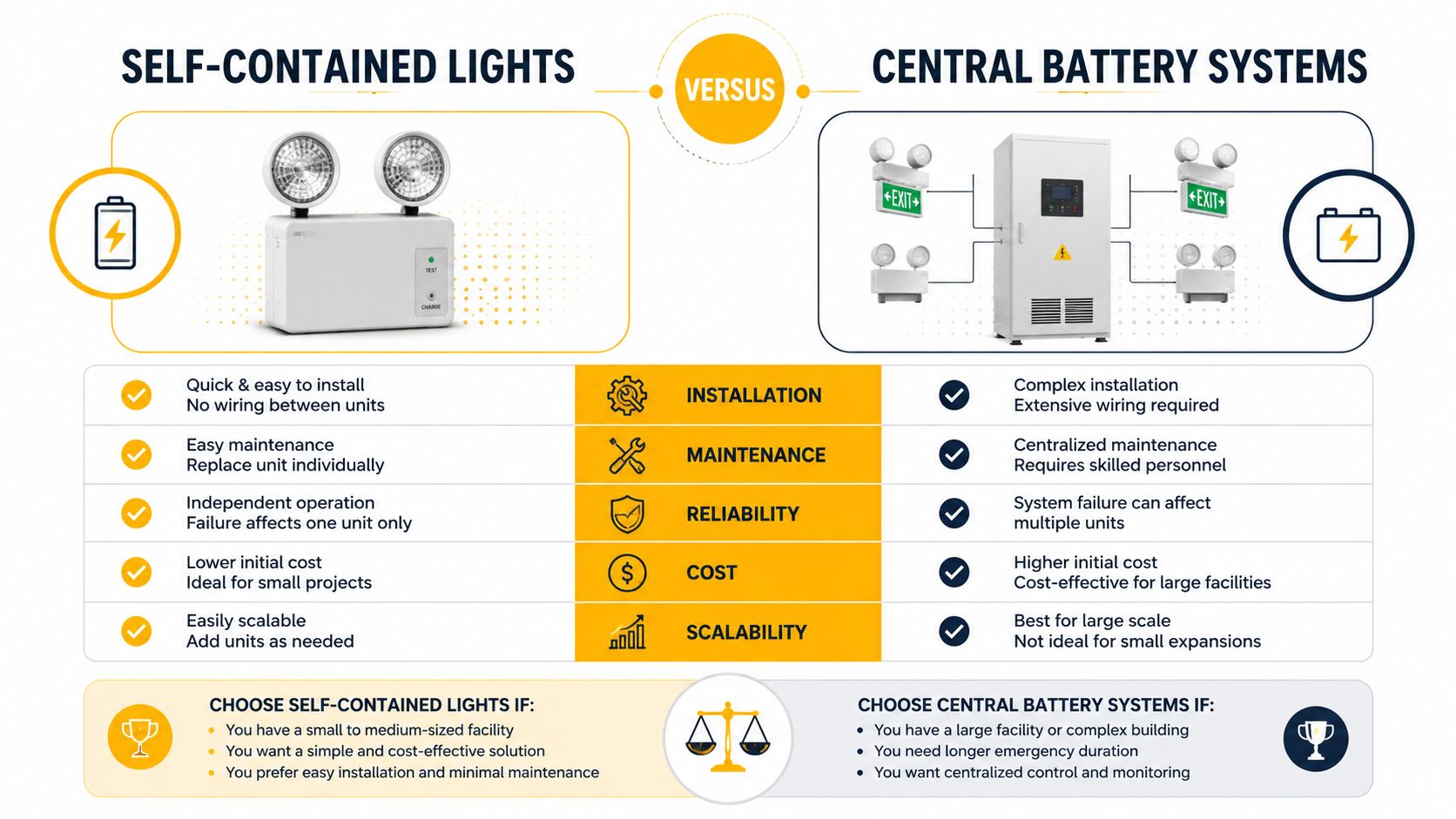
A self-contained system places a battery and charging arrangement inside each emergency luminaire or exit sign. A fitting may look like an ordinary light from floor level, but its battery is local to that unit. If one battery fails, that fitting can fail independently of the others.
A central battery system uses a shared battery installation to supply multiple emergency luminaires. The battery room, charger, distribution equipment and connected circuits become critical parts of the overall system. A failure at the central source can affect many fittings at once, while a fault at an individual luminaire may affect only that location.
Why the distinction changes the calendar
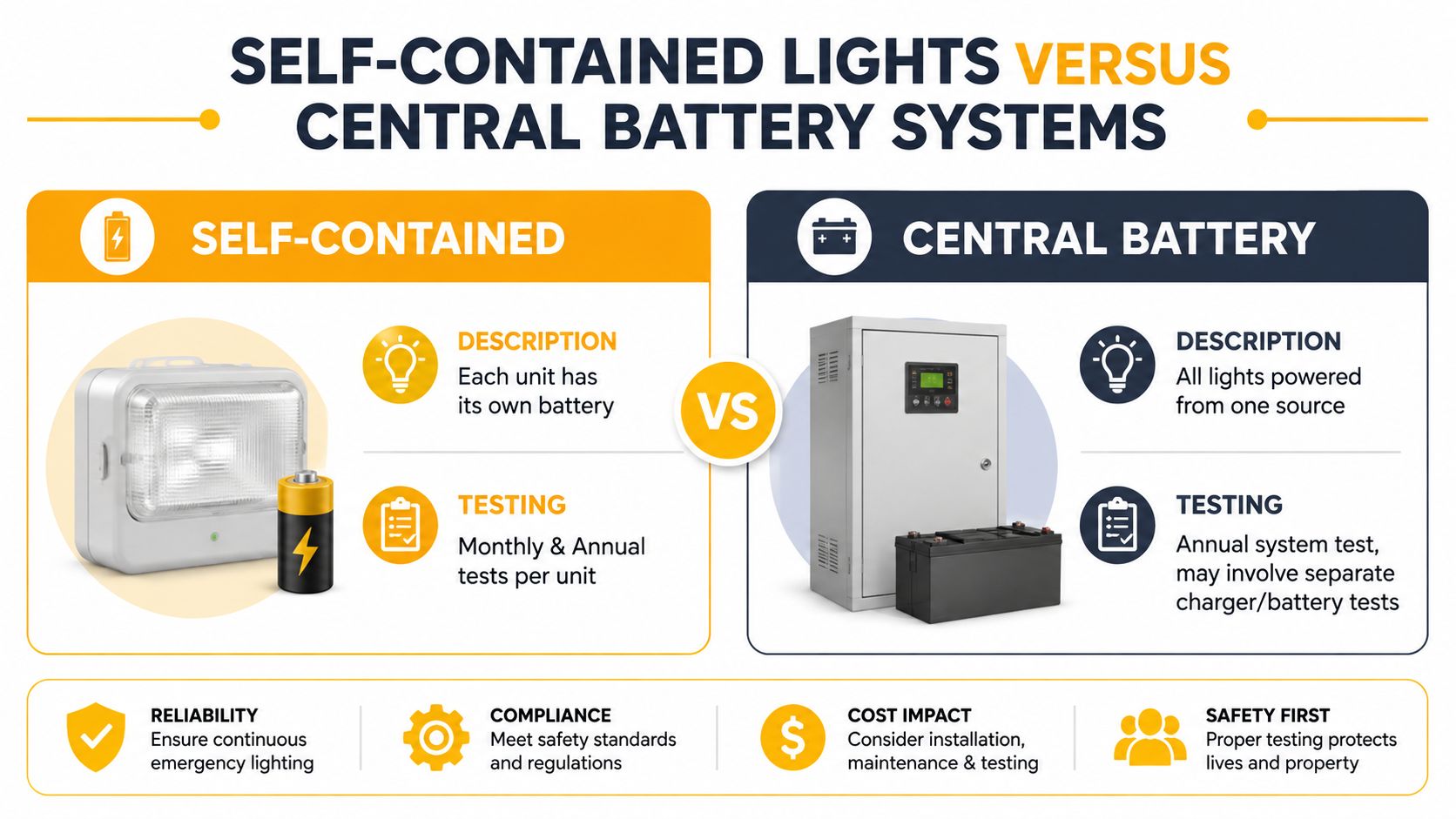
For self-contained systems, the Australian guidance identifies a monthly testing requirement, alongside the six-monthly discharge test and yearly 90-minute duration test. This creates more frequent routine oversight at fitting level.
For central battery systems, the guidance identifies six-monthly testing, with the annual 90-minute duration test applying to both system types. The testing focus shifts towards the central source and distribution system, as well as confirming that connected emergency fittings operate correctly.
| System type | Main characteristic | Schedule implication |
|---|---|---|
| Self-contained | Each fitting has its own battery | Monthly functional checks, six-monthly discharge testing and annual duration testing |
| Central battery | Multiple fittings draw backup power from a shared source | Six-monthly system testing and annual duration testing, with attention to the central equipment |
If you're unsure which arrangement is installed, inspect the maintenance documentation or ask a qualified electrical contractor to identify the equipment. Don't assume that a central battery system exists because several fittings operate together, and don't assume every fitting is self-contained because you can see a small test button.
System identification comes first. The wrong schedule can look organised while still missing the test your installation requires.
This distinction is especially important in buildings that have been extended or refurbished. An office, retail tenancy or strata complex may contain older and newer fittings, with separate circuits or different battery arrangements. The contractor's asset register should record those differences so the site isn't managed under one generic label.
Queensland Licensing Requirements for Emergency Lighting Tests
In Queensland, the person performing the work matters as much as the interval. Queensland legislation explicitly recognises inspecting or testing emergency lighting systems as electrical work when it is performed by an electrical mechanic licence holder, as set out in the Queensland electrical safety regulation.
That classification means emergency-lighting testing shouldn't automatically be handed to an unlicensed maintenance worker because the task appears simple. Pressing a test button may look straightforward, but formal testing can involve electrical circuits, battery systems, isolation procedures, discharge testing and post-test restoration.
What to check before booking
Ask the service provider for clear information about:
- The electrical mechanic licence supporting the work.
- Experience with the installed emergency-lighting system.
- The standard and test method used for the inspection.
- The format of the condition report or certificate of inspection.
- How faults, failed fittings and remedial recommendations will be recorded.
A fire-protection contractor may offer useful system knowledge, but Queensland licensing requirements still apply where the work falls within electrical work. The responsible facility manager should confirm that the person carrying out the test is appropriately licensed, rather than relying only on the contractor's business name or a generic statement that technicians are qualified.
The reason is practical as well as legal. An incomplete test can leave a building with unverified emergency coverage, while poor records can make it difficult to demonstrate what happened during an audit, fire-safety review or insurance assessment. A proper report should connect the result to the site, the equipment and the tester.
For a commercial premises, keep the licence details and service report with the building's fire-safety records. If a contractor subcontracts the electrical component, ask who will attend site and which licence covers that work. Verbal reassurance isn't a substitute for documented responsibility.
Queensland businesses should also arrange testing at a time that protects occupants and avoids unsafe disruption. The technician needs access to fittings, electrical equipment and any central battery room, while the facility manager needs a plan for faults found during the visit.
Building Your Emergency Lighting Compliance Calendar
A workable calendar turns the standard into tasks people can complete. Start by listing every emergency luminaire and exit sign, then mark whether each belongs to a self-contained or central battery system. Mixed buildings should keep those assets identifiable rather than placing every fitting under one undifferentiated “emergency lighting” line.
For self-contained fittings, schedule the monthly functional checks throughout the year. Set the six-monthly discharge test at fixed points that are easy to remember, then book the annual 90-minute duration test as a separate service event. Central battery systems still need their six-monthly and annual checkpoints, with the central source included in the scope.
A practical schedule by system type
| Test Type | Self-Contained Systems | Central Battery Systems | What It Involves |
|---|---|---|---|
| Monthly functional check | Applies according to Australian guidance | Confirm the applicable site program with the licensed contractor | Briefly check emergency operation, visible condition and fault indications |
| Six-monthly discharge test | Required recurring discharge checkpoint | Required recurring discharge checkpoint | Simulate mains failure and assess battery-backed operation |
| Annual duration test | Yearly 90-minute test | Yearly 90-minute test | Run the system for the required duration and record failures |
| Lifecycle review | 10-yearly and end-of-light-source-life obligations | 10-yearly and end-of-light-source-life obligations | Review age, condition, replacement needs and system documentation |
The table reflects the intervals described in Australian emergency-lighting testing guidance, while the exact work program should be confirmed against the installation and current compliance obligations.
Make records easy to retrieve
Use one asset register and one service history for the site. Each entry should identify the date, test type, fittings or circuits checked, result, faults and action taken. Store reports with the fire-safety logbook or the building's controlled compliance records, not in an individual technician's inbox.
Schedule the annual duration test as its own booking. If it disappears inside a generic service visit, nobody can tell whether the required test actually occurred.
Stagger access-sensitive work around tenants, trading hours and strata common areas. A clear fire-safety schedule can coordinate emergency lighting with alarms, extinguishers, hydrants and doors without confusing one system's test with another's.
Use calendar reminders for the next due date as soon as each service is completed. When a fitting fails, create a separate corrective-work item and close it only after the repair and post-repair test are recorded.
Common Emergency Lighting Testing Mistakes to Avoid
The most common mistake is treating a monthly button press as the whole compliance program. It may confirm that a fitting responds, but it doesn't replace the recurring six-monthly discharge test or the annual 90-minute duration assessment.
Other failures usually come from poor separation of responsibilities:
- Using the wrong system schedule: Self-contained and central battery installations don't have identical monthly obligations.
- Skipping post-repair testing: Replacing a battery or fitting should lead to a recorded check of the affected system.
- Ignoring lifecycle requirements: The 2019 edition identifies 10-yearly and end-of-light-source-life obligations, so old fittings need planned review rather than indefinite operation.
- Keeping vague records: “Emergency lights checked” doesn't show which test was performed, what failed or what action followed.
- Booking unlicensed work: Queensland legislation treats relevant emergency-lighting inspection and testing as electrical work when performed by an electrical mechanic licence holder.
A provider that only offers a quick visual check may not be delivering the complete program your site needs. Ask for the test type, system coverage, duration result, fault list and licence details before accepting the report.
Celtic Fire & Security provides emergency and exit-lighting testing, maintenance and compliance reporting for commercial sites across North Brisbane, Moreton Bay, the Sunshine Coast, Somerset and Ipswich. Visit Celtic Fire & Security to arrange a licensed assessment of your system, confirm the correct testing calendar and obtain clear records for your facility.
No responses yet