
In Queensland, a smoke alarm compliance certificate is documented proof issued by a licensed technician that a property's interconnected, photoelectric alarms meet AS 3786:2014 and current QFD rules, and it's required for sales, leasing, and handover before the 1 January 2027 deadline. If you're managing a sale, signing a new tenancy, or handing over a build, the certificate is what shows the alarms don't just exist, but comply.
That's usually the moment the phone rings. A property manager has a lease starting next week, a seller is about to go under contract, or a builder needs handover documents tied up properly. The alarms might look fine on the ceiling, but that's not what gets a matter across the line in Queensland.
What matters is whether the system is the right type, in the right places, interconnected properly, within service life, and signed off by someone who can stand behind the document. That's where a lot of owners get caught. They've had alarms “checked”, but they don't have a certificate that will satisfy an agent, conveyancer, buyer, or incoming tenant.
Table of Contents
- Why Queensland Property Owners Need This Certificate
- What a Smoke Alarm Compliance Certificate Actually Is
- The Queensland Legal Timeline Driving Demand
- Who Is Licensed to Issue the Certificate
- What Happens During a Compliance Inspection
- Required Documentation and What Appears on the Certificate
- A Real Property Scenario From Inspection to Settlement
- Practical Next Steps and Common Questions
Why Queensland Property Owners Need This Certificate
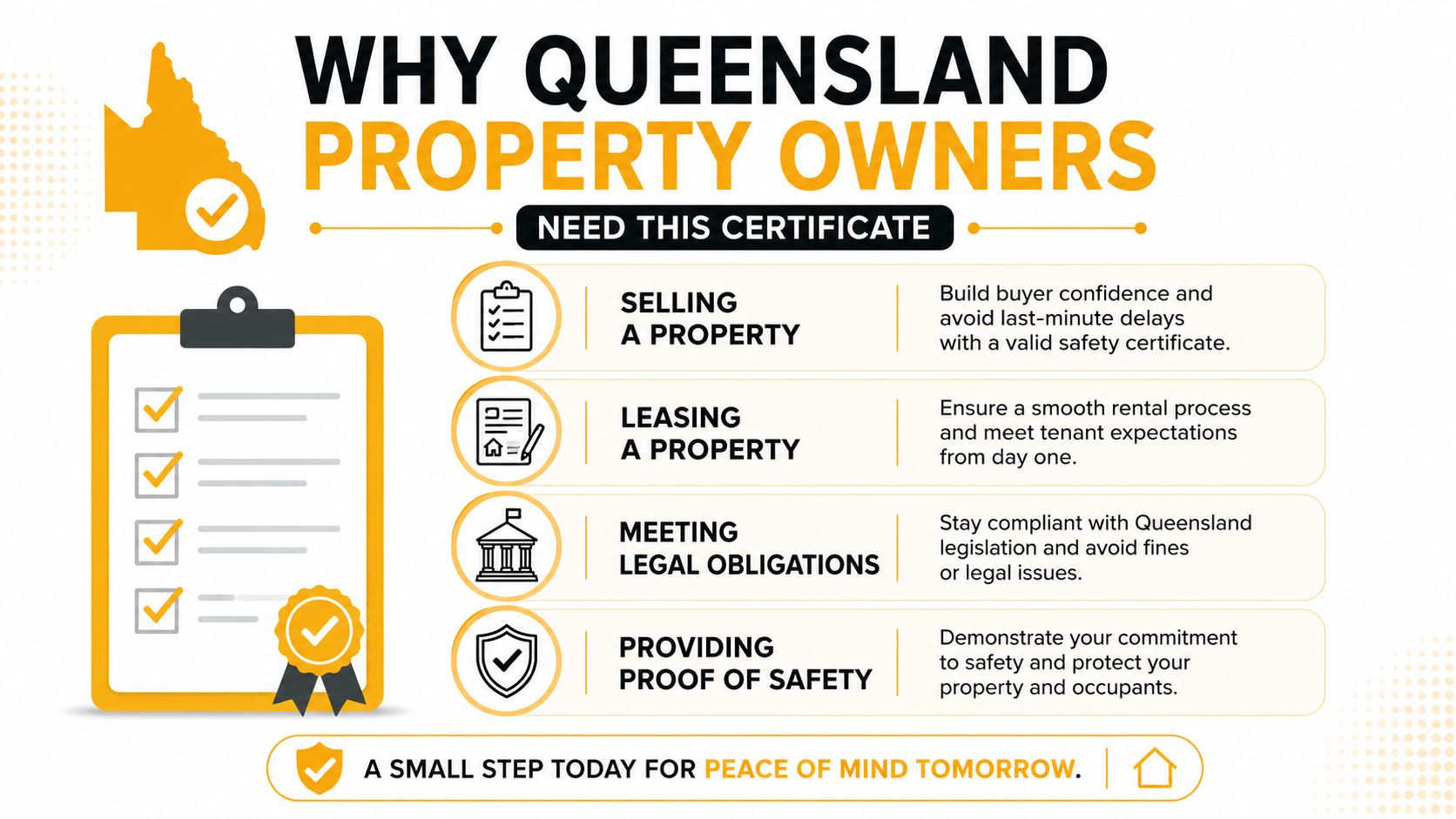
The certificate matters because it turns a ceiling full of alarms into evidence. In practice, that's what owners, agents, and property managers need when a property is sold, leased, or handed over. Without it, everyone starts asking the same questions. Are the alarms photoelectric? Are they interconnected? Do they comply with AS 3786:2014? Who inspected them?
Where the pressure usually starts
A Brisbane property manager with several rentals doesn't usually book certificates for the fun of paperwork. They do it because a lease renewal, new tenant, or sale campaign puts the property under a microscope. Once that happens, “the alarms were replaced a few years ago” isn't enough.
The Queensland framework is specific. The Queensland Fire Department states that alarms in affected dwellings must be photoelectric, interconnected, and compliant with AS 3786:2014, and all alarms must activate together when one goes off, which is the technical core of compliance proof in the first place (Queensland smoke alarm requirements).
What one certificate actually covers
A proper smoke alarm compliance certificate bundles several obligations into one record:
- Product compliance: the installed alarms need to meet AS 3786:2014.
- Functional interconnection: if one alarm sounds, they all sound.
- Placement and suitability: the layout has to match current Queensland residential requirements.
- Sign-off accountability: the technician issuing it must be appropriately licensed for the work involved.
Practical rule: A test button alone doesn't prove compliance. It only proves that one button worked at one moment.
This is why the certificate isn't just administrative garnish. It closes the gap between what's installed and what can be proven. Queensland has tracked smoke alarm compliance for years. A Queensland Parliamentary Research Brief recorded that 72% of Queensland homes had operational smoke alarms in 2005, against a target range of 73% to 80%, showing that compliance has long been treated as a measurable safety benchmark rather than a paper exercise (Queensland smoke alarm requirements).
What happens if you skip it
Skipping the certificate usually creates friction, not convenience. The common outcomes are:
- Sale delays: a buyer's side asks for proof before settlement progresses.
- Lease disputes: a tenant queries whether the dwelling was compliant at handover.
- Handover issues: a builder or owner can't show that the installed alarms meet the current standard.
A missing certificate doesn't make the alarms non-compliant by itself. But in a transaction, if you can't prove the system complies, that distinction rarely helps.
What a Smoke Alarm Compliance Certificate Actually Is
A smoke alarm compliance certificate is a formal signed document issued after a physical inspection. It confirms that the alarms in the dwelling, as inspected on that date, meet the applicable Queensland standard and rule set. That's very different from a service tag, a maintenance note, or a quick email saying “all tested OK”.
The simplest analogy is a roadworthy. The certificate is the pink slip. The technician's notes are the job sheet. Both can be useful, but only one carries the compliance statement that other parties rely on.
What the document should contain
A proper certificate should identify the installed system, the property, and the licence holder who inspected it. In practical terms, that usually includes:
- Alarm details such as make or model
- Manufacture date or age position within service life
- Location of each alarm in the dwelling
- Interconnection status
- Power source, especially where mains supply is involved
- Technician or contractor licence details
- Inspection date and certificate reference
That's what gives the document weight. Anyone reviewing it can see what was checked and who is responsible for the sign-off.
Compliance certificate versus a service record
| Feature | Compliance Certificate | Standard Service Report |
|---|---|---|
| Primary purpose | Confirms the dwelling met compliance requirements on the inspection date | Records maintenance activity or observations |
| Legal weight in a sale or lease | Used as formal evidence | Usually supportive only |
| Licence holder identification | Expected to be shown clearly | May appear, but not always tied to a compliance declaration |
| Alarm-by-alarm record | Typically included | May be brief or incomplete |
| Interconnection confirmation | Specifically relevant | May only note testing occurred |
| Use at handover or conveyancing | Commonly requested | Usually not enough on its own |
If a document doesn't clearly state compliance and who certified it, treat it as a service record, not a certificate.
Why owners confuse the two
The confusion usually starts because both documents can come from the same visit. A technician may inspect, test, replace units, and leave both a work record and a compliance certificate. The work record tells you what was done. The certificate tells third parties the property complied when the inspection finished.
That distinction matters most when someone external reviews the file. Conveyancers, real estate agents, and handover inspectors don't want a vague service note. They want a clear compliance document that stands on its own.
The Queensland Legal Timeline Driving Demand
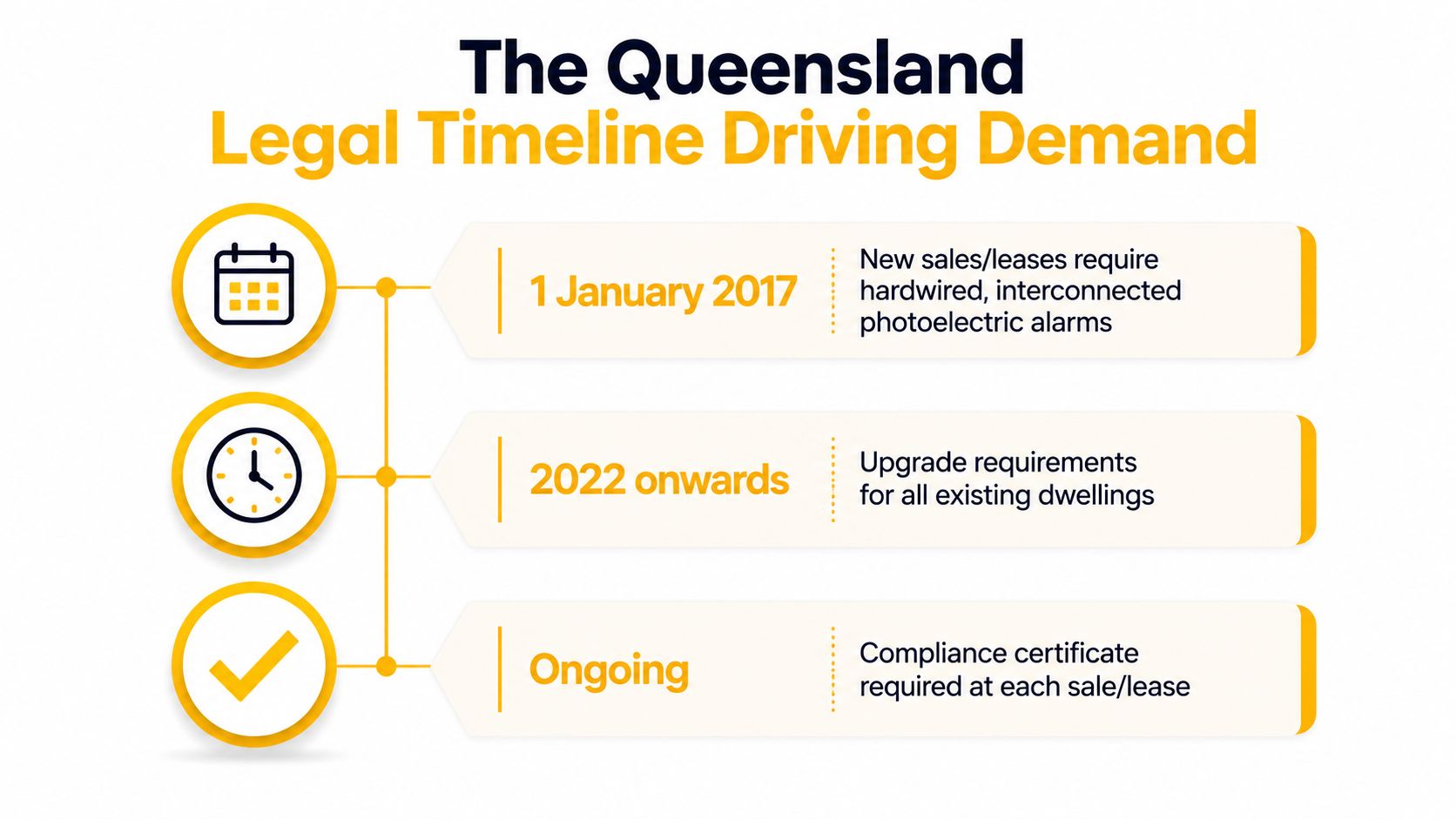
A property can pass a routine service visit and still fail a sale or lease review if its alarms do not match the staged Queensland requirements. The rollout is why compliance certificates are now tied to contract dates, upgrade planning, and the 1 January 2027 deadline.
For contracts dated 1 January 2022 or later, residential properties generally need alarms that are photoelectric, under 10 years old, interconnected, correctly powered, and correctly located. The alarms must also comply with AS 3786:2014 and sound together when one activates, as outlined in the Queensland smoke alarm legal timeline.
Contract date matters more than guesswork
The relevant date is the sale or tenancy contract date, not the date an owner planned to upgrade the property. That distinction affects whether the dwelling needed to meet the current standard when the agreement was made.
A certificate records the inspection date and the condition confirmed at that visit. If a buyer, solicitor, agent, or property manager asks whether the alarms complied at the relevant point, a dated certificate provides a clearer answer than an undated invoice or general service note.
Why the market is getting busier
Queensland Fire Department guidance sets the final residential compliance deadline for 1 January 2027, ahead of full enforcement milestones (QFD smoke alarm FAQ). Owners who need upgrades, interconnection work, or replacement alarms are therefore competing for inspection and electrical work before that date.
Industry reporting connected with the Queensland framework found substantial variation in installation levels between locations, with Innisfail reported at 43% and Rockhampton at 61%. The same reporting estimated 52% installation across its sample, leaving 48% of surveyed dwellings non-compliant. It also referred to 2,100 respondents and roughly 2.2 million private dwellings statewide, indicating a large volume of work still required (Queensland smoke alarm legal timeline).
The staged rollout also creates a practical inspection issue. A technician must confirm the alarm product standard, age, location, power supply, and interconnection, while fixed electrical work must be handled under the appropriate electrical licensing requirements. One inspection can therefore produce evidence for both AS 3786:2014 product compliance and the property file used in a transaction.
What this means in practice
Demand usually gathers around:
- Sale campaigns, when owners want fewer settlement delays
- Portfolio upgrades, where several dwellings need coordinated works
- Tenancy changes, when managers require current handover evidence
- Pre-2027 bulk works, before scheduling becomes tighter
Early booking gives the owner more control over inspection timing and replacement options. Waiting can leave fewer appointment slots and less flexibility if wiring, interconnection, or alarm replacement is needed.
Who Is Licensed to Issue the Certificate
This is the part people often oversimplify. Not everyone who can replace an alarm can issue a smoke alarm compliance certificate that holds up properly. In Queensland, the licence behind the paperwork matters just as much as the alarm on the ceiling.
The licence has to match the work
Where a property has mains-powered alarms, interconnection wiring, or any fixed electrical work, an electrical licence needs to be part of the picture because fixed wiring falls under electrical safety obligations. If someone touches 240-volt wiring without the right authority, the problem isn't just technical. It goes straight to legality and liability.
For broader fire safety sign-off, owners will commonly deal with technicians or contractors operating under the relevant QBCC, fire protection, security, or electrical licensing pathway that matches the scope of work. The key point is simple. The person issuing the certificate must be licensed for what they inspected, tested, installed, or altered.
What to check on the paperwork
When you receive the certificate, check for these basics:
- Licence number
- Licence class or trade authority
- Business or licence holder identity
- Inspection date
- Property address
- Statement of compliance tied to the inspected alarms
If those details are missing, the document is weak before anyone even reads the rest of it.
For owners comparing providers, a practical reference point is whether the contractor also performs standards-based inspection and documentation work such as smoke detector service. That doesn't replace checking the actual licence. It tells you the provider works in this compliance space rather than treating alarms as an afterthought.
What doesn't work
A few things regularly fail under scrutiny:
- Handwritten “all OK” notes with no licence reference
- Retail purchase receipts for alarms with no inspection record
- DIY declarations where the owner certifies their own installation
- Electrical-only paperwork that records wiring work but makes no compliance statement for the overall alarm system
A worthless certificate usually looks official at first glance. The gap only shows when someone asks who was licensed to sign it.
What Happens During a Compliance Inspection
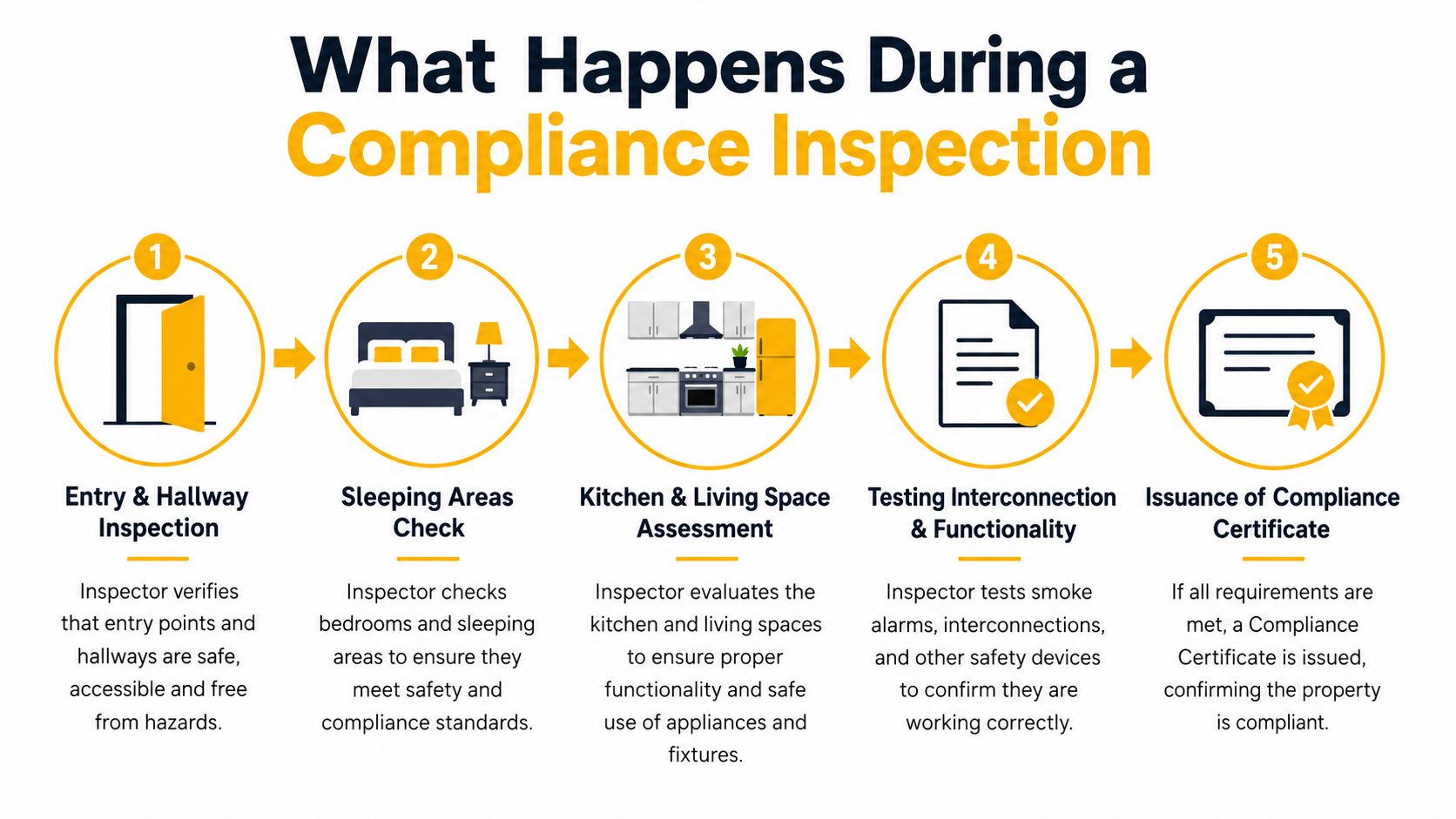
A proper inspection is methodical. The technician doesn't walk in, press one test button, and call it compliant. They go room by room, because the certificate has to match the actual dwelling layout and the current Queensland requirements.
The inspection sequence on site
Most inspections start with the areas that matter first under the rules. Hallways and spaces connected to bedrooms are usually the first checkpoints, then sleeping areas, then the rest of the dwelling where alarm coverage and interconnection need to be verified.
A typical on-site sequence looks like this:
- Locate every alarm in the dwelling. Missing units are often found before failed units.
- Confirm the sensor type. The unit needs to be photoelectric for the current Queensland framework.
- Check the date stamp. The manufacture date tells you whether the alarm is still within its service life.
- Test interconnection. One alarm is activated, then the technician confirms the others sound as a linked system.
- Check power arrangements. Mains-powered units are checked as mains-powered units, not assumed to be so because they look newer.
Common defects inspectors find
The faults that cause trouble are usually ordinary, not exotic:
- Mixed alarm types from old partial upgrades
- Expired units still mounted because they “seem to work”
- No interconnection across additions or renovated areas
- Poor placement too close to corners, fans, bathrooms, or steam sources
- Unclear power source where owners assume hardwired means compliant
For owners wanting a clearer idea of the process before booking, a provider that explains smoke alarm testing services will usually give a more realistic picture of what happens on site than a simple “test and tag” style booking page.
What the technician is really checking
The inspection is not just about whether an alarm makes noise. It's about whether the installed system is compliant as a system. That includes placement, age, interconnection, power source, and the suitability of each alarm for its location.
Pressing one test button proves one speaker works. It doesn't prove the dwelling has a compliant interconnected layout.
Where a unit is non-compliant, the technician should identify it clearly by location and record the defect. In better-run jobs, that also means photographs and notes that support the final certificate file, especially if replacement or rectification is needed before sign-off.
Required Documentation and What Appears on the Certificate
A certificate is only as reliable as the file behind it. For a Queensland property approaching a staged compliance milestone or the 2027 deadline, the paperwork should show how the technician moved from the installed alarms to a defensible compliance record. That connection matters to property managers, owners, buyers, solicitors, and regulators.
How the paperwork connects
The process normally has three linked layers.
The first is the inspection record. It is created on site and captures the evidence used for the assessment, including the dwelling inspected, alarm locations, identification details, test results, interconnection checks, power arrangements, and defects requiring attention. If an alarm is replaced or relocated, the record should show that work rather than leaving the file to rely on memory.
The second is the licensing record. Electrical work and smoke alarm installation must be traceable to the appropriately licensed person or business. Keep the licence holder's details with the job file, along with any work documentation supplied for installation, replacement, or rectification. This is the link between the physical work and the authority under which it was performed.
The third is the property identification record. Use the full address and client or owner details needed to distinguish the dwelling from another property in the same portfolio. For managers handling multiple units, the address alone may not be enough unless the unit, lot, or other relevant identifier is also recorded.
The final certificate is prepared from these layers. It should be possible to follow one clear trail from the property address, to the inspection findings, to the licensed person responsible, and then to the compliance decision against AS 3786:2014 and applicable Queensland requirements.
Record-keeping that prevents disputes
Store the certificate with the inspection report, alarm schedule, photographs, invoices, and rectification records. Keep documents in one property folder rather than scattering them across an email inbox, maintenance platform, and settlement correspondence.
A dated photo set can help establish what was present at inspection, particularly where alarms were replaced or a defect was corrected before issue. It supports the certificate file, but it does not replace the certificate itself.
A service sticker has a narrower purpose. It may identify a test or replacement event, yet it does not connect the whole dwelling to the inspecting licence holder, the applied standard, or the final compliance decision.
Keep this with the sale or tenancy file: the certificate should be retrievable without asking the technician to reconstruct the job later.
For a property manager, that means filing the final certificate and supporting records with the lease or handover documents. For a seller, it means providing the completed file early enough for the agent and buyer's solicitor to use it in the transaction.
A Real Property Scenario From Inspection to Settlement
A common Brisbane scenario starts the same way. The owner is preparing a three-bedroom home for sale. The alarms have been in place for years, and nobody has thought much about them until the pre-sale process starts moving.
The issue shows up before contract goes firm
During sale preparation, the owner or agent books a building and pest inspection. The inspector notes that the home has older alarms and recommends confirming compliance before the contract gets too far along.
A licensed technician is then booked to inspect the smoke alarm system. On site, the technician finds a familiar pattern. Some units are older ionisation alarms, some areas don't communicate properly with the others, and the layout needs updating so the home can be signed off against the current Queensland standard.
The rectification and sign-off stage
The non-compliant units are replaced with interconnected photoelectric alarms suited to the dwelling layout. Once the system is installed and tested properly, the technician records each alarm's location, confirms interconnection, and issues the smoke alarm compliance certificate.
At that point, the owner has something useful. Not a verbal assurance. Not an invoice alone. A dated compliance document that can be handed to the selling agent and then to the buyer's solicitor as part of the settlement file.
Why this prevents friction at settlement
Without that certificate, the conversation usually becomes speculative. The seller says the alarms were upgraded. The buyer wants proof. The solicitor asks when the work was done and whether it met the standard applying to the contract.
With the certificate, the exchange is simpler:
- the property address matches the sale file
- the alarm system inspected is identified
- the licence holder is named
- the compliance date is clear
The new owner then takes on the ordinary obligation to maintain that alarm system and deal with any future modifications properly. If they alter the layout, replace mismatched units, or carry out further electrical work later, the compliance evidence should be updated to match what is installed.
Practical Next Steps and Common Questions
If you own or manage residential property in Queensland, the sensible move is to deal with smoke alarms before the next trigger event. Don't wait for a contract, a lease start date, or a stressed email from conveyancing.
The short action list
Start with the basics inside the dwelling:
- Check the alarm type: they need to be photoelectric under the current framework.
- Check the age: if an alarm is beyond its service life, replacement comes before certification.
- Check interconnection: when one activates, the others should sound.
- Check your records: if you can't find a certificate, assume you may need a fresh inspection.
Then check the contractor, not just the quote.
- Ask for licence details upfront
- Confirm whether mains-powered work is involved
- Ask what the certificate includes
- Make sure the inspection is tied to Queensland compliance, not just a functional test
Battery-only maintenance still matters in between inspections, but it doesn't replace a compliance review. For routine upkeep guidance, owners often look at practical information on smoke alarm battery replacement, especially where nuisance chirping has distracted from the bigger issue of full system compliance.
Questions owners and property managers ask all the time
Do rental properties need a separate certificate?
They need compliance evidence that fits the tenancy situation and the dwelling as inspected. In practice, many property managers want a current certificate on file for leasing and handover because it gives them clear documentary proof if the issue is ever challenged.
How long does a certificate last?
A certificate proves compliance on the inspection date. It isn't a lifetime warranty. If alarms age out, are replaced, stop interconnecting, or the property is altered, the old certificate may no longer reflect the installed system.
Can an owner replace alarms themselves?
Owners can physically replace some alarms, but DIY work doesn't automatically create valid compliance evidence. If the job involves fixed wiring, interconnection changes, or a formal compliance declaration, the right licensed person needs to inspect and sign off.
What if alarms fail between inspections?
Then the defect needs to be addressed promptly. A certificate doesn't excuse later faults. It shows the system complied when inspected. Ongoing maintenance still sits with the owner or responsible manager.
The practical view before 2027
Queensland's final compliance deadline is approaching whether a property is ready or not. The owners who handle this well are the ones who treat the certificate as part of transaction planning and tenancy planning, not as a last-minute patch.
A current smoke alarm compliance certificate is still the strongest single piece of evidence that a dwelling met AS 3786:2014 and the applicable Queensland smoke alarm rules when it mattered.
Celtic Fire & Security provides smoke and heat alarm supply, installation, testing, maintenance, and compliance documentation under current Queensland trade, security, and electrical licences. If you need a residential inspection tied to sale, lease, handover, or upgrade planning ahead of the 2027 deadline, visit Celtic Fire & Security to review their services and arrange the right scope of work.
No responses yet