
You've just taken over a Queensland tenancy and the extinguisher beside the loading door has a current-looking tag. Then you notice the access path is blocked, the gauge face is stained, and the cylinder has corrosion around the valve. On paper, the site may appear serviced. In the field, nobody has yet proved that the unit is accessible, correctly matched to the hazard, properly charged, and capable of discharging when it matters.
That gap is where fire extinguisher maintenance becomes more than a calendar reminder. Queensland businesses need a service process that connects Australian Standards, occupier responsibilities, environmental exposure, technician competence, and records that can withstand scrutiny. The practical question isn't just whether an extinguisher has a tag. It's whether the equipment, its location, its agent, and its documentation all tell the same story.
Table of Contents
- Why Fire Extinguisher Maintenance Matters for Queensland Businesses
- Australian Extinguisher Classes and Equipment Standards
- Inspection Cycles from Daily to Annual Checks
- Five-Year Overhaul and Adverse Environment Tightening
- Who Holds Legal Responsibility for Extinguisher Upkeep
- Recordkeeping, Tagging and Recharge or Replace Triggers
- When to Call a Licensed Technician and Next Steps
Why Fire Extinguisher Maintenance Matters for Queensland Businesses
Taking over a Queensland tenancy means taking responsibility for the condition and service history of its extinguishers. A current-looking tag does not explain whether the unit remained accessible, whether its location still suits the hazard, or whether earlier defects were properly resolved. Those details become the occupier's problem when an inspection, incident, or insurance review exposes a gap.
The main maintenance reference is AS 1851:2012. It sets a routine service cycle of every 6 months, a more detailed annual service, and a 5-year pressure-test and overhaul cycle for many extinguisher types. Extinguishers can deteriorate through use, leakage, corrosion, vibration, contamination, and interference. Australian guidance on the AS 1851 extinguisher service cycle describes servicing as an ongoing compliance process rather than a one-off installation task.
Compliance on paper versus readiness in the field
A current tag can sit on an extinguisher behind stored stock. A gauge may be painted over or unreadable. Units exposed to coastal air, dust, heat, or insect activity can develop corrosion or blocked hoses that a quick visual check misses. These conditions affect whether people can reach the extinguisher and whether it will discharge correctly under load.
A useful service sequence begins before the gauge is assessed. Walk the route to every unit, check that signage is visible, confirm the extinguisher is mounted or positioned as required, and inspect the pin, tamper seal, hose, nozzle, and cylinder body. Then review the hazard and confirm that the installed extinguisher remains suitable for it.
Queensland's legal framework connects essential safety measure upkeep, including portable extinguishers, with Part 5 of the Building Fire Safety Regulation 2008 and the Fire and Emergency Services Act 1990. The Queensland fire safety obligations for portable extinguishers also addresses scheduled maintenance and retained service records.
Practical rule: Treat the tag as evidence of a service event, not as proof that the extinguisher is ready today.
Why the later decisions matter
Before deciding whether to inspect, recharge, overhaul, or remove a unit from service, the technician needs its Australian class, extinguishing medium, age, pressure condition, exposure zone, and service history. A warehouse powder extinguisher, a kitchen wet-chemical unit, and a CO2 extinguisher beside electrical equipment do not share identical maintenance needs.
A reliable programme therefore joins AS 1851 servicing with building compliance duties, environment-based risk assessment, and accurate records. The occupier still holds responsibility for the premises even after appointing a contractor. The contractor must perform competent work and document the result, while the person in control must ensure defects are corrected and equipment remains available for use.
Australian Extinguisher Classes and Equipment Standards
Choosing the correct extinguisher is the first maintenance decision. A service technician shouldn't treat every red cylinder as interchangeable, because the agent that controls one fire can be ineffective or dangerous on another.
Australia's relevant classification set under AS 2444 is Class A, B, C, D, E, and F. Class A covers carbonaceous solids such as paper, timber, and textiles. Class B covers flammable and combustible liquids, Class C covers flammable gases, Class D covers combustible metals, Class E covers energised electrical equipment, and Class F covers cooking oils and fats. The Australian AS 2444 classification framework sets out this local system.
Match the agent to the hazard
A water extinguisher may suit a Class A risk, while foam can address certain Class A and B applications. Dry chemical powder is used across particular flammable liquid, gas, and electrical risks, but the exact suitability depends on the product and hazard. CO2 is commonly selected around energised electrical equipment because it doesn't leave the same powder residue, while wet chemical is associated with cooking oil and fat hazards. Water mist may be appropriate for defined applications where the equipment is approved and installed for that risk.
The cylinder's colour and label help identification, but they don't replace reading the rating and application information. A kitchen, workshop, plant room, warehouse, and office may require different combinations.
All extinguishers used in Queensland should meet the applicable Australian product requirements. Queensland fire safety guidance states that portable extinguishers must comply with AS/NZS 1841.1:2007 general requirements, providing the product baseline for equipment used in homes and commercial premises. Queensland guidance on compliant fire extinguishers is a useful reference when reviewing installed equipment.
| Extinguisher Class | Fire Type / Hazard | Typical Media | Relevant Standard |
|---|---|---|---|
| Class A | Carbonaceous solids | Water, foam, water mist | AS 2444 and applicable AS/NZS 1841 requirements |
| Class B | Flammable and combustible liquids | Foam, dry chemical powder, CO2 for defined applications | AS 2444 and applicable AS/NZS 1841 requirements |
| Class C | Flammable gases | Dry chemical powder | AS 2444 and applicable AS/NZS 1841 requirements |
| Class D | Combustible metals | Specialised dry powder | AS 2444 and applicable AS/NZS 1841 requirements |
| Class E | Energised electrical equipment | CO2, dry chemical powder, approved water mist applications | AS 2444 and applicable AS/NZS 1841 requirements |
| Class F | Cooking oils and fats | Wet chemical | AS 2444 and applicable AS/NZS 1841 requirements |
For a practical Australian overview of the equipment choices, see this guide to fire extinguisher types used in Australia. During maintenance, the technician should confirm that the installed unit still matches the current hazard, especially after a fit-out, machinery change, kitchen upgrade, or storage reconfiguration.
Inspection Cycles from Daily to Annual Checks
At a combined warehouse-and-office site in South East Queensland, the service run starts at the front entry and ends at the loading dock. The office units usually look clean. The warehouse units tell the fuller story, with dust, pallet movement, forklift traffic, and occasional obstruction from stock.
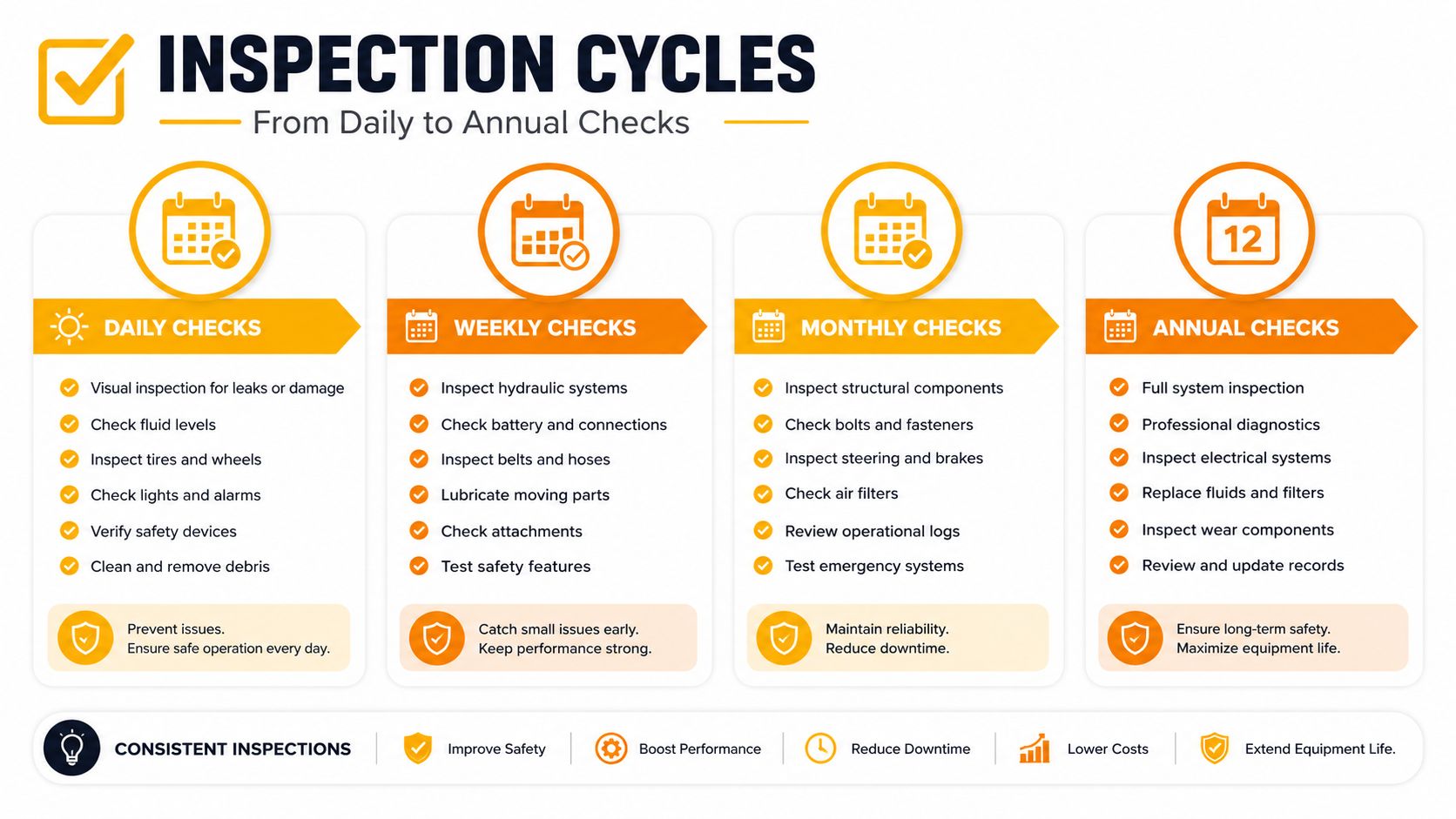
Staff can perform simple visual checks between formal services. They should confirm that the extinguisher is visible and accessible, the gauge is in the green where a gauge is fitted, the pin and tamper seal are intact, and the body, hose, nozzle, bracket, and signage show no obvious damage or corrosion. Those checks don't replace servicing, but they can identify a problem before the scheduled visit.
The six-monthly service sequence
At the 6-monthly AS 1851 service, the technician works through the unit rather than merely looking at its tag. The practical sequence includes:
- Access and identification: Confirm location, signage, extinguisher class, rating, mounting, and hazard suitability.
- Security and condition: Check the pin, tamper seal, handle, hose, nozzle, cylinder, bracket, and labels.
- Pressure or weight: Verify the gauge where fitted. Extinguishers without gauges may need weighing, because loss of agent can occur without an obvious visual warning. Australian service guidance on gauge and weight checks explains this practical control.
- Service record: Update the tag with the service date, technician identification, and next due date, while recording defects and corrective action in the site register.
A gauge in the green is useful evidence, but it isn't the whole inspection. A blocked nozzle, damaged hose, corroded valve, wrong agent, or inaccessible mounting can still leave the unit unready.
What the annual visit adds
The annual service provides a more detailed review and includes internal inspection points where the equipment and procedure require access. The technician considers the condition of the agent, valve assembly, seals, hose, and discharge path. CO2 extinguishers need particular attention to weight, because pressure indication isn't the same control used for stored-pressure units.
The difference between a compliant tag and a working extinguisher becomes clearest when the unit has been exposed to impact, contamination, or partial discharge. A tag can be current because a scheduled visit occurred. Readiness depends on whether the technician found and corrected the conditions that affect discharge under load.
For a service-focused explanation of the visit sequence, see servicing of fire extinguishers. The site manager should also keep a simple local register so staff can report missing, moved, damaged, or obstructed units between contractor visits.
Five-Year Overhaul and Adverse Environment Tightening
The 5-year pressure-test and overhaul milestone is where a routine service programme becomes more invasive. Under the AS 1851 framework, many rechargeable stored-pressure water, foam, wet-chemical, and dry-chemical extinguishers require emptying, examination, pressure testing, and refilling at this stage. The work isn't limited to checking the outside of the cylinder.
The cylinder and valve head need separate consideration. The cylinder must be assessed for corrosion, dents, pitting, markings, and pressure-test status. The valve head, seals, hose connection, operating mechanism, and internal components must also be checked, cleaned, renewed, or replaced as required by the equipment and procedure. A sound cylinder doesn't automatically mean the valve assembly is fit for service.
Why South East Queensland sites need a risk lens
A standard calendar interval is a baseline, not a promise that every site experiences the same deterioration. Salt-laden air around exposed coastal locations such as Wynnum and Redcliffe can attack metal and seals. Chemical atmospheres in production areas can accelerate degradation, while vibration near rail corridors or heavy plant can loosen components and stress mountings.
Queensland-relevant guidance indicates that extinguishers in adverse environments should move to monthly inspections and that hydrostatic testing can shorten from 5-yearly to 3-yearly for exposed units. Guidance on adverse environments and extinguisher intervals explains why exposure, rather than the calendar alone, should drive the maintenance plan.
| Environment | Standard AS 1851 Interval | Tightened SEQ Interval | Trigger Reason |
|---|---|---|---|
| Normal office or sheltered commercial area | 6-monthly inspection, with applicable annual and 5-year work | Apply the site risk assessment | Lower exposure, assuming access and condition remain satisfactory |
| Coastal air near exposed SEQ locations | 6-monthly baseline | Monthly visual inspections, with a 3-year hydrostatic interval where applicable | Salt, corrosion, and seal degradation |
| Chemical production or storage atmosphere | 6-monthly baseline | Tighten inspection frequency according to exposure assessment | Chemical attack on cylinders, valves, and seals |
| High-vibration site near rail or heavy plant | 6-monthly baseline | More frequent visual checks where justified | Loosening, impact, vibration, and mounting stress |
Dry chemical powder deserves attention beyond the outside of the cylinder. Moisture can contaminate powder, and vibration or long storage can encourage compaction. The Australian environmental health extinguisher guidance notes practical differences between extinguisher types, including weighing CO2 units and addressing powder condition.
Document the reason for tightening
Classify exposure zones on the site plan, record the environmental reason, and ensure tags and registers reflect the applicable programme. AS 1851 and related fire safety guidance allow maintenance controls to respond to adverse conditions, because minimum intervals aren't maximum intervals when the environment is actively damaging the equipment.
Who Holds Legal Responsibility for Extinguisher Upkeep
The contractor services the extinguisher. The occupier remains responsible for the premises' fire safety arrangements. That distinction is easy to lose in a lease, especially where a tenant, landlord, facilities manager, and body corporate each control different areas.
Queensland guidance places responsibility on the occupier under the Building Fire Safety Regulation 2008. The legal framework also connects essential safety measure commissioning and maintenance with QDC MP 6.1, so the responsible person needs evidence that systems have been maintained, not only an invoice showing that someone attended. Queensland guidance on responsibility for fire extinguisher maintenance addresses the occupier duty directly.
Apply the duty to the area under control
For a tenant-only warehouse, the operating business normally needs to identify and maintain the extinguishers serving its leased space. In a commercial building with a shared foyer, basement, plant area, or loading zone, the body corporate or building management structure may control common-area equipment, while the individual tenant controls equipment inside its lot.
A landlord also needs a handover position. If the landlord supplies a fit-out and the tenancy ends, the lease should state whether the tenant returns equipment in serviceable condition, whether the landlord resumes control, and who owns the resulting service records. Without that allocation, both parties can assume the other is arranging the visit.
Separate the roles clearly
A building manager can perform visual checks and coordinate access. They shouldn't dismantle, recharge, pressure-test, or re-tag an extinguisher unless they hold the required competence and authority for that work. A qualified fire equipment servicing contractor performs the technical service, identifies defects, and supplies records that support the occupier's compliance position.
The chain should be written into the tenancy and facilities documentation:
- Tenant-controlled areas: List each extinguisher ID, location, class, and responsible business.
- Shared areas: Assign the body corporate, landlord, or facilities manager as the coordinating party.
- Contractor duties: Specify service scope, defect reporting, tag completion, and evidence handover.
- Landlord handover: Record the condition and service status of equipment at commencement and lease end.
A contractor can provide competent work, but they can't remove the occupier's need to monitor the premises, act on defects, and retain evidence. The person in control needs to know which units belong to which risk area and who has authority to approve replacement or remedial work.
Recordkeeping, Tagging and Recharge or Replace Triggers
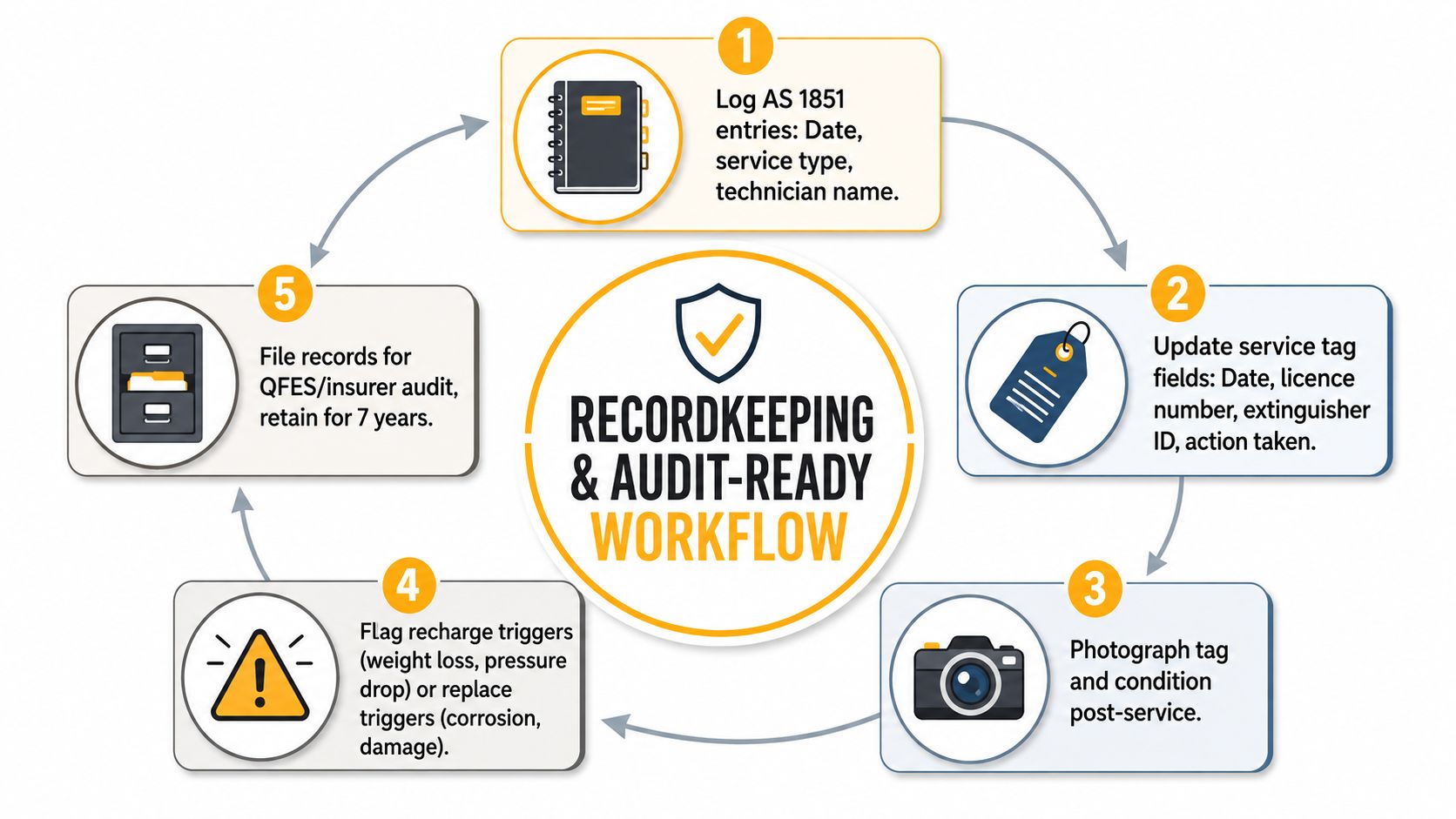
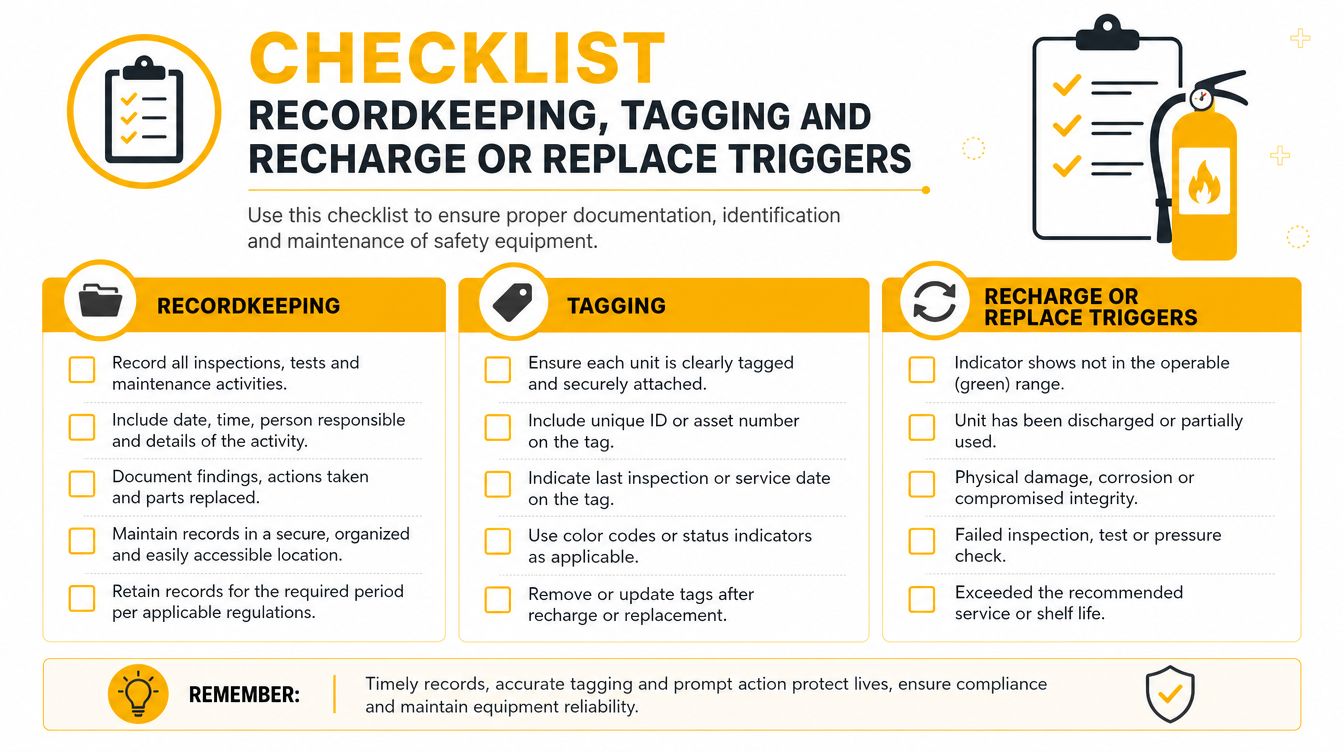
A service record should allow another person to reconstruct the visit without calling the technician. The AS 1851 logbook entry should identify the service date, service type, technician name or identification, extinguisher ID, findings, and action taken. The tag fitted to the unit should match that record closely enough for site staff to confirm its status at a glance.
Industry guidance recommends retaining service records and tags for at least 7 years. Keep the register as an ongoing compliance trail, not a temporary filing task. It becomes particularly useful when a property changes hands, a contractor changes, or a defect remains open across several visits.
Build an audit-ready pack
For every visit, the site manager should receive and file:
- Service register: Asset ID, location, class, rating, service date, service type, technician identification, defects, and close-out status.
- Tag evidence: A completed service tag showing the relevant date fields and the technician or licence information required by the service process.
- Condition evidence: Photographs of the extinguisher, mounting, signage, and completed tag where the contractor's reporting system supports images.
- Defect list: Separate items corrected during the visit from items awaiting quotation, approval, replacement, or access.
- Replacement record: The reason a unit was condemned or removed, together with the replacement class and location.
A plastic disc tag designed for service identification provides stronger evidence than an informal handwritten sticker that omits the technician, extinguisher ID, or action taken. Colour-coded month or quarter ring systems can help technicians and site staff identify service periods quickly. The colour still needs the written record behind it.
Tagging also has an operational limit. A unit can carry a current tag and still be unsuitable for service if pressure has fallen, the agent has degraded, or a valve or cylinder defect has been missed. The register should therefore record findings and actions, not just the fact that a tag was fitted.
Know when servicing becomes recharge or condemnation
A gauge in the red band indicates a pressure problem requiring qualified assessment. For a no-gauge unit, weight provides an important check. The Australian extinguisher inspection guidance explains why gauge or weight status should be checked rather than judged from appearance alone.
Recharge or replacement depends on the equipment and the defect:
- Pressure loss: Remove the unit from reliance and investigate leakage, valve condition, and agent status.
- Agent loss: Weigh and assess the unit where reduced weight suggests leakage or discharge.
- Dry chemical condition: Address powder compaction or moisture contamination before returning the cylinder to service.
- Foam condition: Investigate separated or degraded concentrate.
- CO2 weight loss: Treat reduced weight as evidence requiring assessment, even where the cylinder appears intact.
- Physical damage: Corrosion, pitting, unacceptable dents, damaged valves, or expired test markings may require condemnation rather than recharge.
The decision must remain traceable. “Serviced” should mean the technician assessed the relevant controls and either returned the unit to service or clearly removed it from the site's protection plan.
When to Call a Licensed Technician and Next Steps
Call a qualified technician as soon as an extinguisher has lost pressure, shows corrosion pitting, has a damaged valve, carries an expired pressure-test date, or has been discharged. A post-discharge extinguisher may look nearly full while lacking the correct pressure or agent quantity, so putting it back on the bracket without professional assessment creates false confidence.
DIY work also creates avoidable risks. Over-pressurising a cylinder, mixing incompatible agents, fitting the wrong valve component, or attaching a new tag to a condemned unit can turn a simple defect into a safety and compliance failure. The occupier needs a technician who can identify the extinguisher class, apply the relevant Australian Standard procedure, and provide documentation that matches the work completed.
Check the contractor before booking
Queensland businesses should verify the contractor's QBCC licensing position and relevant security provider licensing before engaging them. The licences serve different regulatory purposes, so a business should confirm that the contractor's scope and personnel cover the work being offered, rather than relying on a generic statement that the company is licensed.
Ask for the service scope in writing. It should state whether the visit covers inspection, testing, fitting, recharge, replacement, five-year work, defect rectification, tagging, and reporting. A compliant visit should leave the extinguisher correctly tagged, provide a defect or replacement quote where required, and supply a certificate or service report suitable for the site register and insurer enquiries.
Run this checklist this week
- Walk every location: Check visibility, access, signage, body condition, gauge or weight indicators, pin, seal, hose, and nozzle.
- Compare the register: Confirm each listed unit exists and record any moved, missing, damaged, or unlisted extinguisher.
- Check service dates: Identify overdue 6-monthly services and units approaching annual or five-year work.
- Classify exposure: Mark coastal, chemical, vibration, heat, dust, and other adverse zones for review.
- Confirm responsibility: Match each tenant, shared-area, and landlord-controlled extinguisher to a named responsible party.
- Verify licences: Check QBCC and security provider licensing before approving technical work.
- Close defects: Obtain a written recommendation for recharge, replacement, hydrostatic testing, or condemnation.
- File evidence: Store the register, completed tags, photographs, certificates, quotations, and close-out records together.
No verified pricing data is available here to support a reliable cost range for South East Queensland commercial premises, so budgeting should be based on the actual number and types of extinguishers, access conditions, service cycle, environmental exposure, and any recharge, replacement, or five-year testing required. A fixed-fee inspection may suit a straightforward site, while a more extensive maintenance package is more appropriate where the visit includes testing, fitting, extended service work, or substantial documentation.
Celtic Fire & Security supplies, installs, tests, and maintains commercial fire extinguishers, with scheduled maintenance and compliance documentation for businesses across North Brisbane, Moreton Bay, the Sunshine Coast, Somerset, and Ipswich. If your register, tags, or service intervals need attention, contact Celtic Fire & Security to arrange a site review and a maintenance plan matched to your Queensland premises.
No responses yet