
For commercial premises in South East Queensland, fire extinguisher testing typically costs A$15 to A$50 per extinguisher for each six-monthly visit, with a practical midpoint near A$25 per unit. Site minimums commonly fall between A$40 and A$120, and AS 1851 also brings six-monthly servicing plus five-yearly pressure testing, so the budget is more than a single per-unit rate.
A small office in North Brisbane can receive a quote that looks reasonable until the minimum call-out, travel and documentation are added. A retail centre in Moreton Bay may pay a much lower effective rate because the technician can service many extinguishers during the same visit. The difference isn't usually the extinguisher itself. It's the way labour, travel, equipment condition and recurring compliance work are priced.
Table of Contents
- Introduction to Fire Extinguisher Testing Cost in SE Queensland
- How Australian Standards Shape Testing Frequency and Cost
- Key Factors That Influence Your Testing Price
- Typical Price Ranges and Site Size Cost Models
- What Is Included in a Compliant Testing Service
- How to Budget and Compare Quotes Across SE Queensland
- Planning Your Next Compliant Service With Confidence
Introduction to Fire Extinguisher Testing Cost in SE Queensland
A three-extinguisher office in Ipswich might see a headline price of A$11 plus GST per item and assume the visit will cost only a little more than A$30. The invoice may be higher once a provider's minimum charge, travel and service records are included. That same headline rate can work very differently for a 30-unit retail or industrial site, where the fixed site cost is spread across more assets.
This is why fire extinguisher testing cost needs to be assessed as a landed site cost, not just a price multiplied by the number of cylinders. Australian market listings show rates from about A$11 plus GST per extinguisher, minimum charges around A$120 plus GST, and bulk pricing of about A$6 to A$15 plus GST depending on job size and region, as shown in Australian portable extinguisher inspection guidance.
Why the expense keeps returning
Commercial landlords, facility managers and business owners aren't buying a one-off check. Portable extinguishers are generally maintained on a six-monthly cycle under AS 1851, with additional yearly servicing and a more intensive five-yearly hydrostatic or pressure test. That recurring schedule makes maintenance an operating expense which needs to sit in the facilities budget every year.
The service may involve Australian extinguisher classes covering hazards such as ordinary combustibles, flammable liquids, cooking oils and energised electrical equipment. The exact work varies with the extinguisher type, its condition and the service interval due at the time.
Practical rule: Ask for the total cost per visit, the annualised cost and any five-year service allowance. A low unit rate doesn't tell you what the site will actually spend.
The rest of the decision comes down to three questions: how often the equipment must be serviced, what the provider includes, and how the number of assets changes the average cost. That approach helps a café, strata building, warehouse or office in North Brisbane, Moreton Bay, the Sunshine Coast, Somerset or Ipswich compare quotes on equal terms.
How Australian Standards Shape Testing Frequency and Cost
A three-extinguisher café and a 30-extinguisher warehouse may receive very different effective prices, even when a provider quotes a per-unit rate. The first site still carries the technician's visit, travel, setup and administration across only a few assets. The larger site spreads those costs across more units, so the average price per extinguisher can fall.
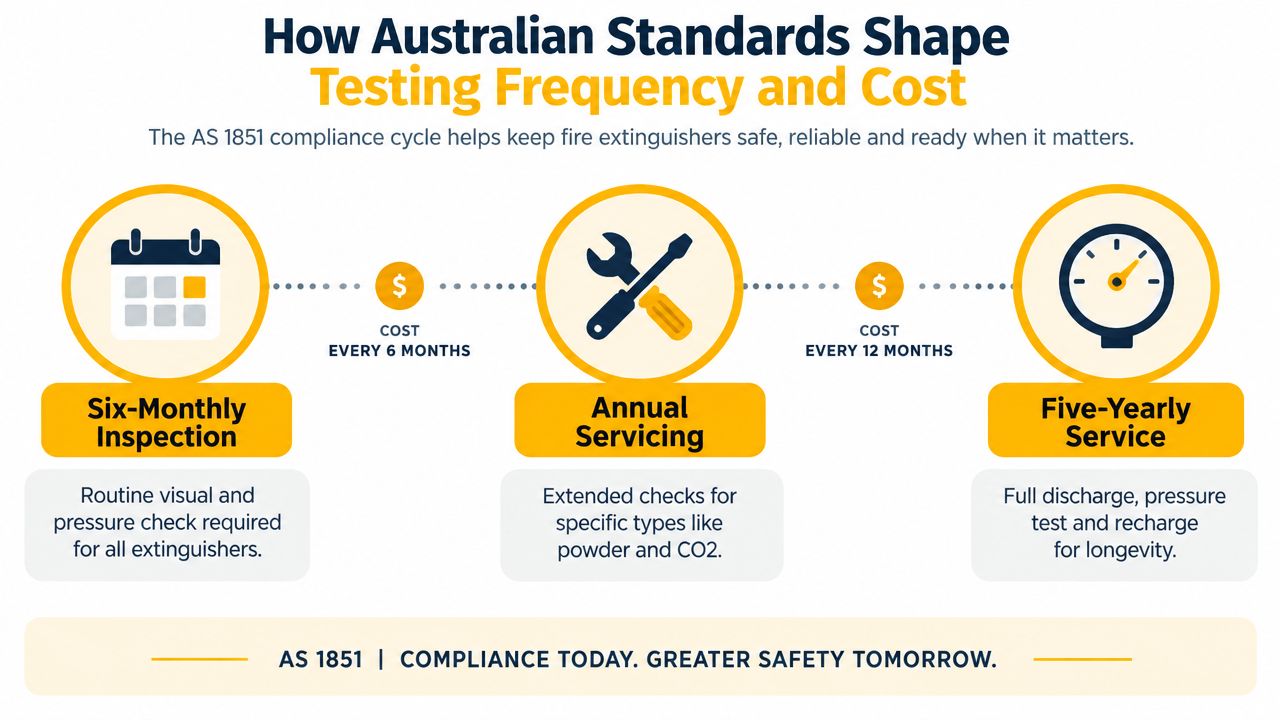
The maintenance cycle sets the timing behind those visits. Portable extinguishers are generally inspected every six months, with additional annual tasks for some types and a more intensive service every five years. Environmental Health Australia's extinguisher guidance describes the six-monthly interval, extra annual work for some extinguisher types, and the requirement to empty, pressure test and refill extinguishers every five years.
A service cycle similar to vehicle maintenance
Vehicle ownership combines routine checks, scheduled servicing and larger repair events. Extinguisher maintenance follows the same practical pattern:
- Six-monthly inspection: The technician checks visible condition, accessibility, pressure indication where fitted and service status.
- Annual servicing: Powder and CO2 units, among others, may require checks beyond the routine inspection.
- Five-yearly pressure service: The extinguisher is emptied, pressure tested and refilled. This takes more work than a standard inspection and can raise the cost in the year it is due.
A properly managed asset register should identify the five-year service before the quotation is accepted. That lets a facility manager budget for the higher-cost year instead of treating it as an unexpected charge. Australian commercial fire compliance guidance also explains that pressure testing and replacement work can make annual spending uneven.
Records affect the value of the visit
Queensland workplaces must maintain portable extinguishers under the Work Health and Safety framework and retain maintenance records. Safe Work Queensland's guide to portable fire extinguisher servicing says the maintenance tag or label and hard-copy summary should record the service date, work completed, and missing or defective items.
The tag, asset register and service report should match. That record supports an audit, handover or property inspection and confirms what happened to each unit, not merely that a technician attended.
For a plain-English explanation of the maintenance framework, read this guide to fire extinguisher testing under Australian Standards.
For budgeting, separate the regular baseline from annual variation and the five-year pressure-service allowance. Ask for the visit total, annualised cost and any site minimum or travel charge. That gives a North Brisbane, Moreton Bay, Sunshine Coast, Somerset or Ipswich business a more useful landed cost than a headline per-extinguisher figure.
Key Factors That Influence Your Testing Price
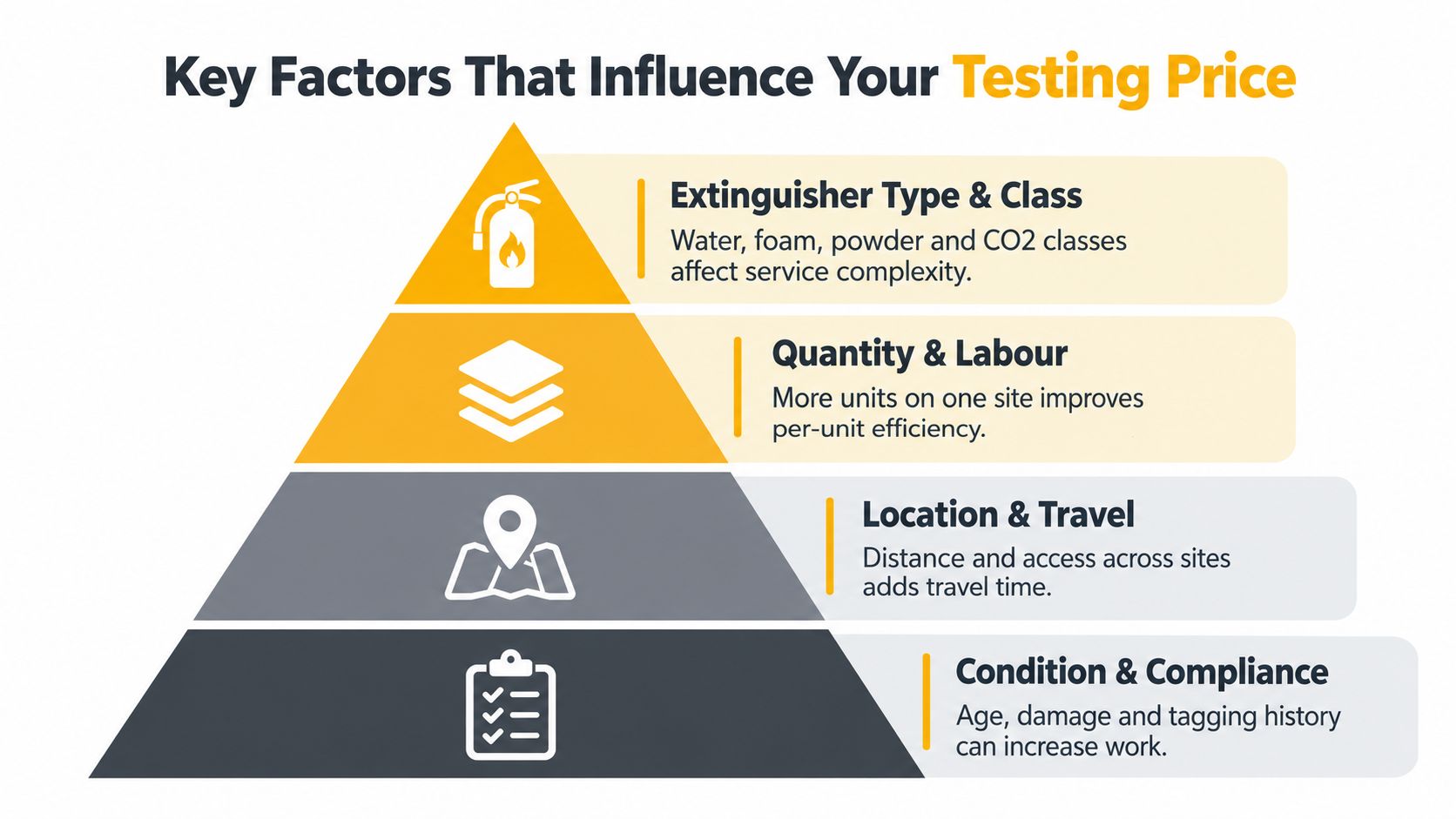
Once the maintenance cycle is understood, the next question is why two businesses receive different quotes. The answer usually sits in five practical variables: extinguisher type, quantity, location, service history and documentation.
Extinguisher type and Australian class
Water, foam, dry chemical powder and CO2 extinguishers aren't serviced in exactly the same way. A CO2 unit, for example, needs attention to its cylinder condition, hose and discharge components, while a powder extinguisher has different inspection considerations. Australian classes and the hazard they protect influence the technician's work, replacement decisions and the parts that may be needed.
A commercial kitchen, workshop and office can therefore have different service requirements even if each location has a similar number of units. Avoid comparing a powder-only quote with a mixed-asset quote without checking the scope.
Quantity changes labour efficiency
A site minimum covers the technician's travel, setup, administration and initial labour. Once that minimum has been absorbed, additional extinguishers can usually be serviced during the same visit with less extra time per asset.
That's why a small shop with three units often has a higher average cost per extinguisher than a warehouse with 30. The larger site doesn't automatically receive a cheaper headline rate, but it can achieve a lower effective unit cost because the fixed work is distributed across more equipment.
Businesses planning new equipment can review commercial fire extinguisher sales and selection before adding units. The correct number and type should be determined by the site's hazards and applicable requirements, not by trying to minimise the service bill.
Location and travel across SE Queensland
Travel affects the landed cost, particularly when a provider visits a single remote site or several buildings on different days. A North Brisbane office, a Sunshine Coast retail site and an Ipswich warehouse can each attract different travel arrangements.
Access also matters. A technician may need to work through a multi-level building, coordinate with a concierge, enter restricted areas or locate assets spread across separate tenancies. These conditions can increase labour time even when the asset count appears modest.
Condition and compliance history
A damaged hose, unreadable label, missing bracket or obstructed extinguisher can turn a routine visit into corrective work. Older equipment may also require replacement rather than another inspection if it no longer meets the required condition.
A site with a clear asset register and consistent service tags is easier to process than one with missing records. Good records don't guarantee a low quote, but they help the technician identify what is due and reduce uncertainty.
Documentation quality
A compliant service includes more than a visual glance. Tags, reports and defect records support audit readiness, property management and maintenance planning. If one provider includes detailed records and another provides only a basic sticker, the prices aren't comparable.
Typical Price Ranges and Site Size Cost Models
Australian pricing examples show several models rather than one universal tariff. Some providers advertise testing from about A$11 per item plus GST with a A$120 minimum, while other listings show annual bundles such as A$165 per year plus GST or A$120 per service. A Queensland-relevant example from Aegis Safe's extinguisher testing service advertises testing from A$120 per service, while the same provider states portable fire equipment testing from A$165 per year plus GST with an additional A$20 per asset per year.
Those figures aren't contradictory. They represent different pricing structures, asset assumptions and service scopes. The headline rate becomes useful only after you apply the site minimum and divide the total by the number of extinguishers.
A simple landed-cost model
The table below uses the verified market examples to show how a fixed minimum changes the average. It isn't a quote for a particular business, and GST treatment should be confirmed with the provider.
| Site Size | Typical Extinguishers | Headline Rate Example | Effective Cost Per Unit |
|---|---|---|---|
| Small office | 3 | A$11 each, subject to a A$120 minimum | About A$40 each before any additional charges |
| Medium site | 12 | A$11 each, with a A$120 minimum | About A$10 each if the minimum covers the visit |
| Large centre | 30 | A$11 each, with a A$120 minimum | About A$4 each if the minimum covers the visit |
The three-unit example shows why a headline price can mislead. At the minimum, the site pays A$120 for the visit, which produces an effective A$40 per extinguisher before travel or extra work. The 30-unit example spreads the same minimum across many assets, making the average much lower.
Compare service models, not just unit rates
A provider charging A$15 to A$50 per unit for a six-monthly visit may be more expensive than an A$11 listing for a small site once minimum charges are applied. Conversely, a fixed annual bundle may offer easier budgeting for a business that wants predictable invoicing.
Commercial cost guidance for Australian premises places routine servicing commonly within A$15 to A$50 per unit per six-monthly visit, with a practical midpoint near A$25 per unit and site minimums around A$40 to A$120. Facilities with six or more extinguishers can often achieve a lower average unit cost than a small office because the site minimum is absorbed across more assets.
Ask each provider to state the visit total, asset total, GST, travel, defects and five-yearly work separately. That gives you a usable comparison instead of a number that only works in an advertisement.
What Is Included in a Compliant Testing Service
A low per-extinguisher rate can hide a narrow scope. Before comparing quotes, check whether the service covers the extinguisher's condition, location, suitability and records. A routine visit should confirm that each unit is present, accessible, correctly mounted and appropriate for the hazard it protects.
The six-monthly visit
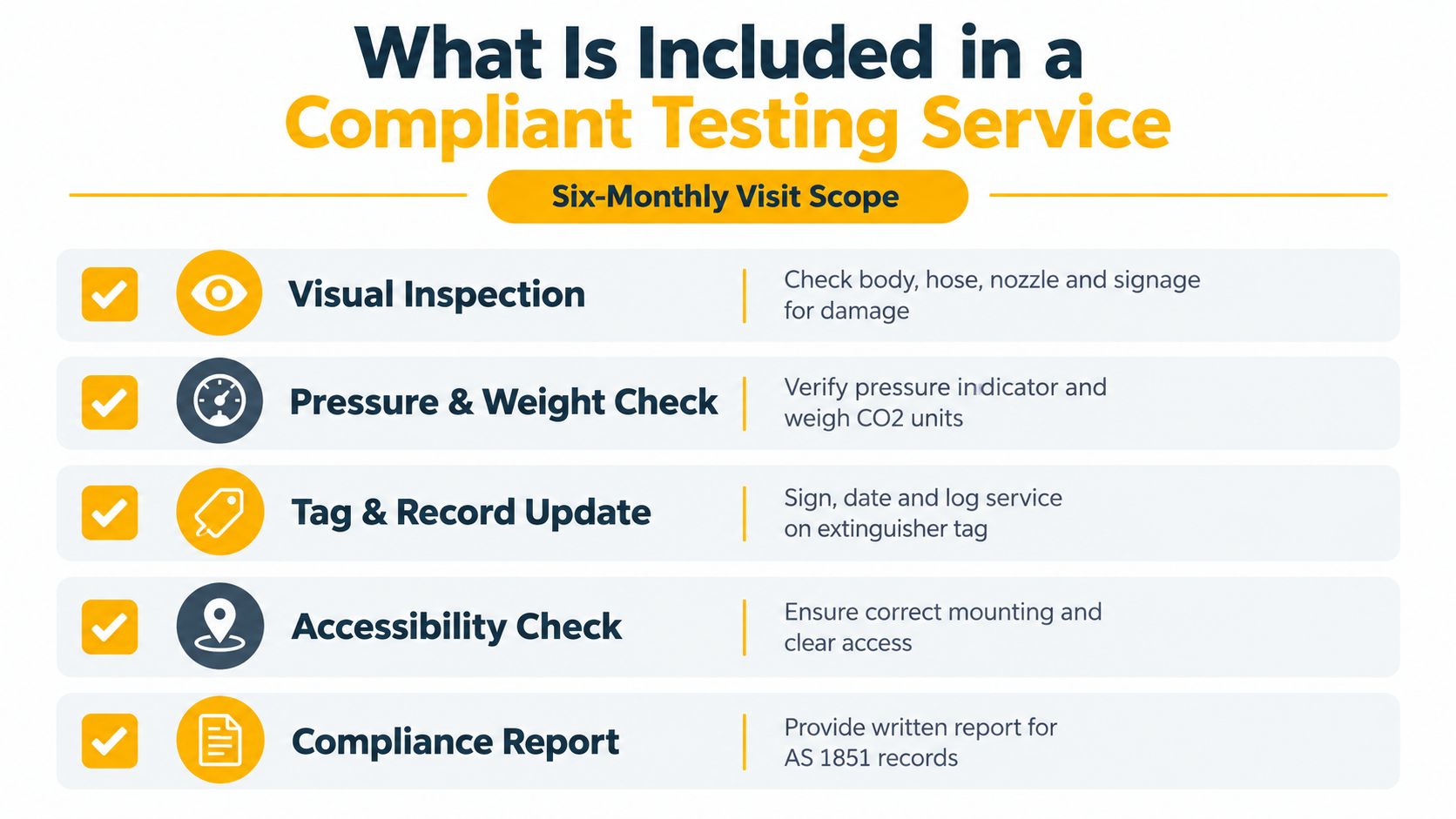
A technician should assess the asset itself, not apply a new sticker. The practical scope generally includes:
- Visual inspection: Check the cylinder, hose, nozzle, pin, tamper seal, mounting and signage for damage, corrosion or deterioration.
- Pressure and weight checks: Confirm the pressure indicator where fitted, and weigh CO2 units as required by the inspection process.
- Accessibility check: Confirm that the extinguisher is visible, properly mounted and clear of stock, furniture and stored materials.
- Identification check: Verify that the extinguisher type suits the hazard and that the unit matches the site asset record.
- Tag and report update: Record the service date, work completed and missing or defective items on the maintenance tag or label and in the written site record.
The record should let a facility manager identify every serviced unit, the work performed and any unresolved defect. Routine inspections, annual tasks and five-yearly work have different scopes, so the quote should show which interval each charge covers.
What the five-year service adds
The five-yearly service normally involves emptying the extinguisher, pressure testing it and refilling it. Because this process can identify faults that an external inspection cannot, it should appear as a separate line or as a clearly defined part of a scheduled maintenance package.
Ask whether the quoted amount includes replacement parts, recharge materials, damaged brackets, missing signage and units that fail inspection. These costs may sit outside the base service price. The provider should explain how approval works before chargeable corrective work begins.
Related fire equipment
Some businesses arrange extinguisher servicing alongside fire blankets and hose reels. Combining visits may reduce coordination for a facility manager, but the invoice should still separate each equipment category and its cost.
For a practical explanation of servicing fire extinguishers on commercial premises, review the linked guide. A usable invoice should show the asset count, service interval, defects, parts, travel and records supplied. That detail helps you compare the true visit cost for a small site with the cost spread across a larger asset register.
How to Budget and Compare Quotes Across SE Queensland
A three-extinguisher office and a 30-extinguisher centre can receive the same per-unit rate but pay very different landed costs. Site minimums, travel, administration and the number of assets sharing the visit all change the effective price. Compare quotes on the cost of servicing the whole site, not only the number printed beside each extinguisher.
Build an annual allowance
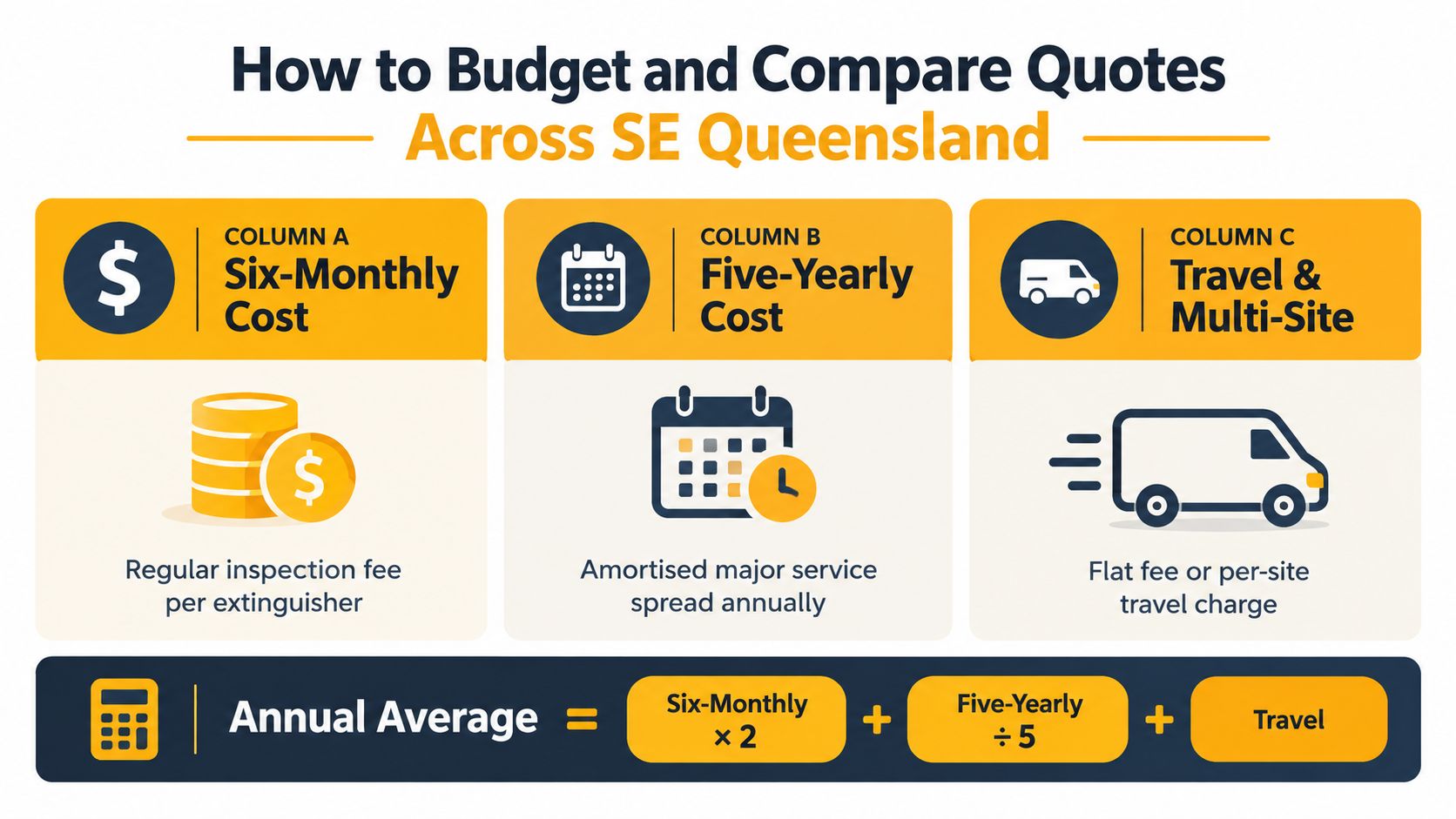
Start with the recurring six-monthly visits. If the provider quotes per visit, allow for two routine visits during the year because the Australian maintenance cycle is six-monthly. Then add annual tasks for the extinguisher types onsite and spread the expected five-yearly pressure-test cost across the relevant years.
Annual average = (six-monthly cost × 2) + (five-yearly cost ÷ 5) + travel and site charges
This smooths uneven spending, since a year containing five-yearly work will cost more than a routine year. Keep the actual due dates in the asset register. The annual figure supports budgeting, but it does not replace scheduling or approval of the work.
Normalise each quotation
Ask every provider the same questions, then compare the total for your site.
| Quote check | What to confirm |
|---|---|
| Six-monthly cost | Is the price per extinguisher, per visit or subject to a site minimum? |
| Five-yearly cost | Is pressure testing, emptying and refilling included or charged separately? |
| Travel | Is travel included, charged as a flat fee or calculated per site? |
| Defects | Are parts, recharge work and replacement units excluded? |
| Records | Will you receive updated tags and a written summary of service and defects? |
| Coverage | Can the provider service North Brisbane, Moreton Bay, Sunshine Coast, Somerset and Ipswich as required? |
| Credentials | Can the provider confirm relevant Australian Standards compliance and current QBCC, security and electrical licensing where applicable? |
For three extinguishers, a site minimum or travel charge may dominate the invoice. With 30 extinguishers, those fixed costs are shared across more assets, so the effective per-unit price may fall even when the provider's base rate is unchanged. Request both the total visit price and the calculated per-extinguisher equivalent.
Multi-site operators should ask whether nearby visits can be grouped by region. Grouping may reduce repeated travel and administration, but the quotation should show how any saving is calculated and which premises it covers.
Quote test: If you cannot see what the site will pay across a full maintenance year, the quotation needs more detail.
A fixed annual bundle can support predictable cash flow, while a per-asset model may suit a larger portfolio. Neither structure is automatically cheaper. Choose the option that defines the service scope, identifies exclusions and shows chargeable extras before approval.
Planning Your Next Compliant Service With Confidence
The most reliable way to control fire extinguisher testing cost is to manage the site as an asset portfolio. Record each extinguisher's type, location, service history and next due date, then budget for routine visits, annual tasks and the five-yearly pressure service rather than reacting to an expired tag.
Use the site-size table to challenge headline rates. A three-unit office and a 30-unit centre won't have the same effective cost per extinguisher, particularly where a minimum charge or travel fee applies. Request an itemised quotation that separates servicing, pressure testing, defects, replacement equipment, travel and documentation.
Preventative maintenance plans can also make scheduling easier when a business has extinguishers, blankets, hose reels, alarms or emergency lighting across several buildings. Before appointment, verify that the provider can cover your SE Queensland locations and confirm relevant QBCC, security and electrical licensing for the work being performed.
Cost control isn't about choosing the lowest number on a rate card. It comes from knowing what is due, grouping suitable work, keeping records organised and choosing a service scope that leaves the premises audit-ready and the equipment dependable.
Celtic Fire & Security supplies, installs, tests and maintains commercial fire extinguishers and related fire protection equipment across North Brisbane, Moreton Bay, the Sunshine Coast, Somerset and Ipswich. Request an itemised site quotation through Celtic Fire & Security to review your extinguisher count, service cycle, travel requirements and documentation needs.
No responses yet