

For an electrical fire in Australia, use a Class E-rated extinguisher, specifically CO₂, ABE dry chemical powder, or vaporising liquid, and never use water-based units on energised equipment. At a switchboard, the nearest suitable appliance should be a 5.0 kg CO₂ extinguisher, or an equivalent with a minimum 1A:E classification and a hose, positioned within 2 to 20 m of the hazard.
A staff member sees smoke curling from a server rack, hears a sharp electrical crackle, and reaches for the extinguisher mounted near the office exit. That first choice matters. The wrong appliance can expose the operator to electric shock, spread the fire, or leave a dangerous residue across sensitive equipment.
Table of Contents
- Understanding Electrical Fires and the Right Extinguisher Response
- How Australian Extinguisher Classifications Work for Electrical Fires
- Comparing CO2 and ABE Dry Powder for Electrical Equipment
- Isolating Power Before Attacking the Fire
- The Growing Risk of Lithium-Ion Battery Fires
- Building a Compliant Electrical Fire Safety Plan
Understanding Electrical Fires and the Right Extinguisher Response
In Australia, an electrical fire involving live equipment is treated as a Class E fire. The appropriate first-response extinguishing agents are CO₂, ABE dry chemical powder, and vaporising liquid, because they're non-conductive when electricity may still be present. Fire and Rescue NSW guidance for workplace extinguishers identifies BE and ABE powder, carbon dioxide, and vaporising liquid as suitable for Class E incidents.
Water-based extinguishers are the wrong choice for energised equipment. Water can conduct electricity back to the person holding the appliance, creating a severe shock hazard. It can also spread the fire across connected components or allow arcing to continue through the equipment.
Make the first check before touching the extinguisher
Read the extinguisher label, not just the colour of the cylinder. Look for the E marking, which confirms suitability for electrically energised equipment. A water, foam, or other appliance without an appropriate E classification shouldn't be used while the power source may still be live.
Then assess the incident itself:
- Small and contained: Extinguishers are intended for an early-stage fire that remains limited to a manageable area.
- Power status uncertain: Treat the equipment as energised and choose only a non-conductive Class E-capable appliance.
- Smoke spreading or visibility falling: Evacuate and call 000 rather than attempting first attack.
- Escape route compromised: Leave immediately. Never position yourself between the fire and your only exit.
Practical rule: If you can't confirm that the power is isolated, treat the fire as live and use only a correctly labelled Class E extinguisher.
A Class E label doesn't make every fire safe to fight. It only confirms that the extinguishing medium is suitable for the electrical hazard. The operator still needs a clear escape route, enough visibility to work safely, and a fire small enough to attack without entering an unsafe area.
How Australian Extinguisher Classifications Work for Electrical Fires
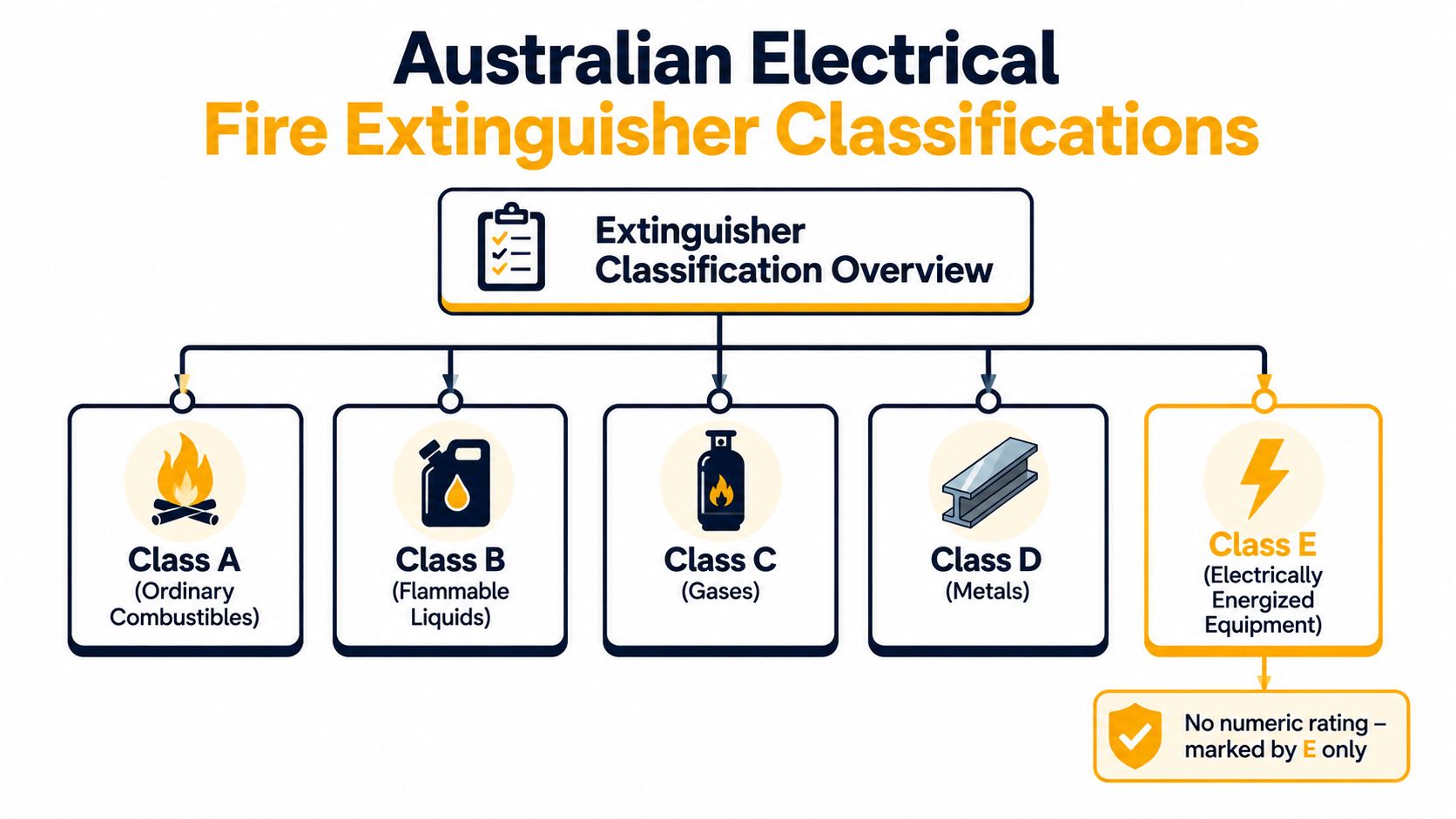
Australian extinguisher labels use letters to identify the fire hazards an appliance can address. Class A relates to ordinary combustibles, Class B to flammable liquids, Class C to combustible gases, and Class E to electrically energised equipment. Class E is a common source of confusion because it doesn't use a numeric test rating.
For Australian ratings, the letter E appears without a number, unlike A, B, or F ratings, which use test numbers. Class C means combustible gases in Australia, so it shouldn't be used as the electrical classification when checking a commercial extinguisher. Australian extinguisher rating guidance explains this distinction and the way E is marked.
Read the label and the colour band together
ABE dry chemical powder extinguishers are commonly identified by a white colour band and are suitable for Class A, Class B, and Class E fires. Australian extinguisher colour-band guidance identifies ABE powder as suitable for electrically energised equipment, while also noting that it isn't suitable for Class F fires.
CO₂ extinguishers are commonly identified by a black colour band. The band helps with quick visual identification, but it doesn't replace checking the full rating and service condition. A cylinder can look like the right type while still being out of service, damaged, incorrectly located, or unsuitable for the specific hazard mix.
The standards determine the placement decision
AS 2444 provides the Australian framework for selecting and locating portable extinguishers and fire blankets. It ties the choice to the hazard type, the number of appliances, and their placement rather than allowing a business to install whichever extinguisher is most convenient.
AS/NZS 1841.1:2007 governs extinguisher compliance requirements. Queensland Fire and Emergency materials state that extinguishers must comply with this standard. Together, these references give facility managers a defensible basis for checking whether an appliance is correctly selected, labelled, installed, and maintained.
For a broader explanation of Australian extinguisher categories, see this guide to fire extinguisher types in Australia. The practical check is simple. Stand beside each appliance, identify the agent, find the E marking, confirm the service tag, and compare its location with the electrical equipment it is meant to protect.
Comparing CO2 and ABE Dry Powder for Electrical Equipment
CO₂ and ABE dry powder are both practical choices for commercial electrical hazards, but they solve different problems. CO₂ is clean and well suited to equipment where residue creates a secondary risk. ABE powder offers broader coverage when the surrounding area contains ordinary combustibles or flammable liquids as well as live electrical equipment.
CO₂ doesn't leave powder behind, so it suits server rooms, communications cabinets, switchboards, photocopiers, and other areas where cleanup could interfere with equipment. Its limitation is coverage. It isn't a Class A extinguisher, so it won't address an adjoining fire involving materials such as paper, furnishings, or other ordinary combustibles.
ABE powder is more versatile across mixed commercial risks. Australian product listings commonly show ratings such as 2A:10B:E and 10A:60B:E for dry powder extinguishers sold for electrical fires. The E appears without a numeric rating, and the A and B figures describe the appliance's tested performance for those other hazards.
| Feature | CO₂ extinguisher | ABE dry powder |
|---|---|---|
| Electrical suitability | Class E capable when correctly labelled | Class E capable when correctly labelled |
| Common band | Black | White |
| Main strength | Clean discharge near electronics | Combined Class A, B, and E coverage |
| Typical locations | Servers, switchboards, communications equipment | Workshops, offices, plant areas, mixed-risk commercial spaces |
| Main limitation | No Class A coverage and requires suitable access to the fire | Powder residue can contaminate equipment and requires cleanup |
| Commercial decision | Choose where residue is unacceptable | Choose where several hazard types exist together |
The choice shouldn't be made by asking which extinguisher is universally better. It should be made by mapping the equipment and surrounding fuel. A clean agent near a server rack may reduce post-incident contamination, while powder may provide more practical coverage in a workshop with electrical panels, packaging, and combustible materials.
Facility managers should also consider access. An appliance buried behind stored stock isn't a useful appliance, regardless of its rating. Portable fire extinguisher selection and maintenance information provides useful context for keeping commercial units available and serviceable.
Isolating Power Before Attacking the Fire
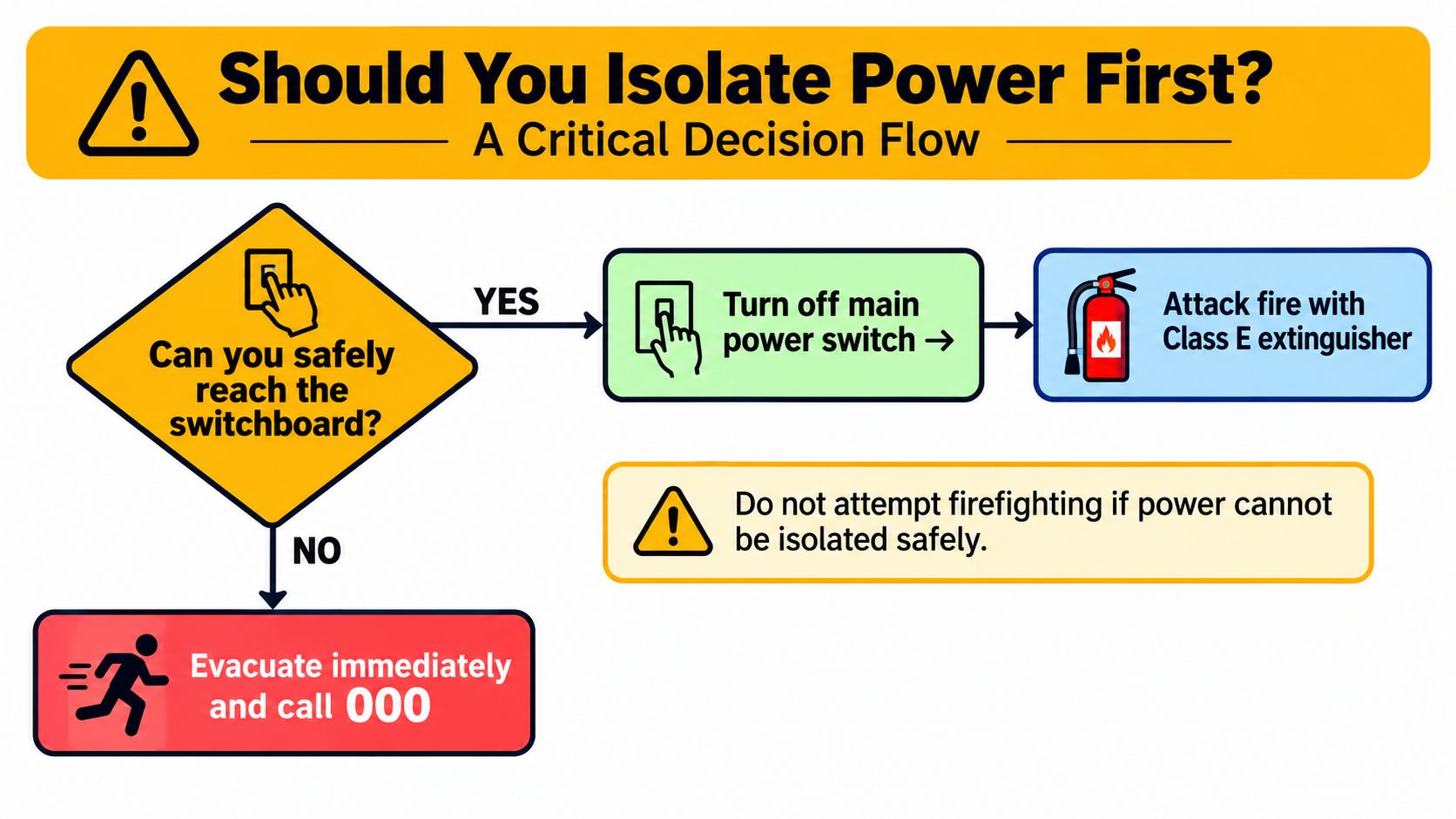
The right decision depends on whether the power can be isolated without approaching the fire. If the main switch or affected circuit can be reached safely, isolate it first. If reaching the switchboard means moving through smoke, passing the flames, opening a burning enclosure, or standing where the fire can trap you, don't attempt it.
Turning off the supply removes the electrical energy from the equipment, but it doesn't instantly remove heat, hot components, or burning materials. Keep treating the incident as dangerous. Call 000, alert people nearby, and use an extinguisher only if the fire remains small, contained, and accessible with a clear route behind you.
Use the switchboard location as a practical test
Australian benchmark guidance recommends a 5.0 kg CO₂ extinguisher, or another appliance with a minimum 1A:E classification and a hose, as the nearest extinguisher to a switchboard. It should be located within 2 to 20 m of the hazard, giving facility managers a practical reference point when reviewing an existing installation. Switchboard extinguisher spacing guidance sets out this benchmark and highlights common errors such as using water, standing too close, or selecting a unit without the correct class marking.
The decision sequence is:
- Raise the alarm and call 000. Don't delay emergency notification while looking for an appliance.
- Check the escape route. If you can't leave safely, don't start an attack.
- Isolate power if immediately safe. Use the main switch or affected circuit only when you can reach it without exposure.
- Select the labelled Class E extinguisher. Confirm the E marking before discharge.
- Attack from a safe position. Aim at the base of the fire and keep the exit behind you.
- Stop if conditions worsen. Smoke, spreading flames, heat, or re-ignition means evacuate.
Apply PASS without losing the exit
Use the PASS sequence: Pull the pin, Aim at the base of the flames, Squeeze the handle, and Sweep across the base. Don't chase smoke or discharge into an inaccessible enclosure. The appliance is for a small, contained fire, not for entering a room that is filling with smoke.
The Growing Risk of Lithium-Ion Battery Fires
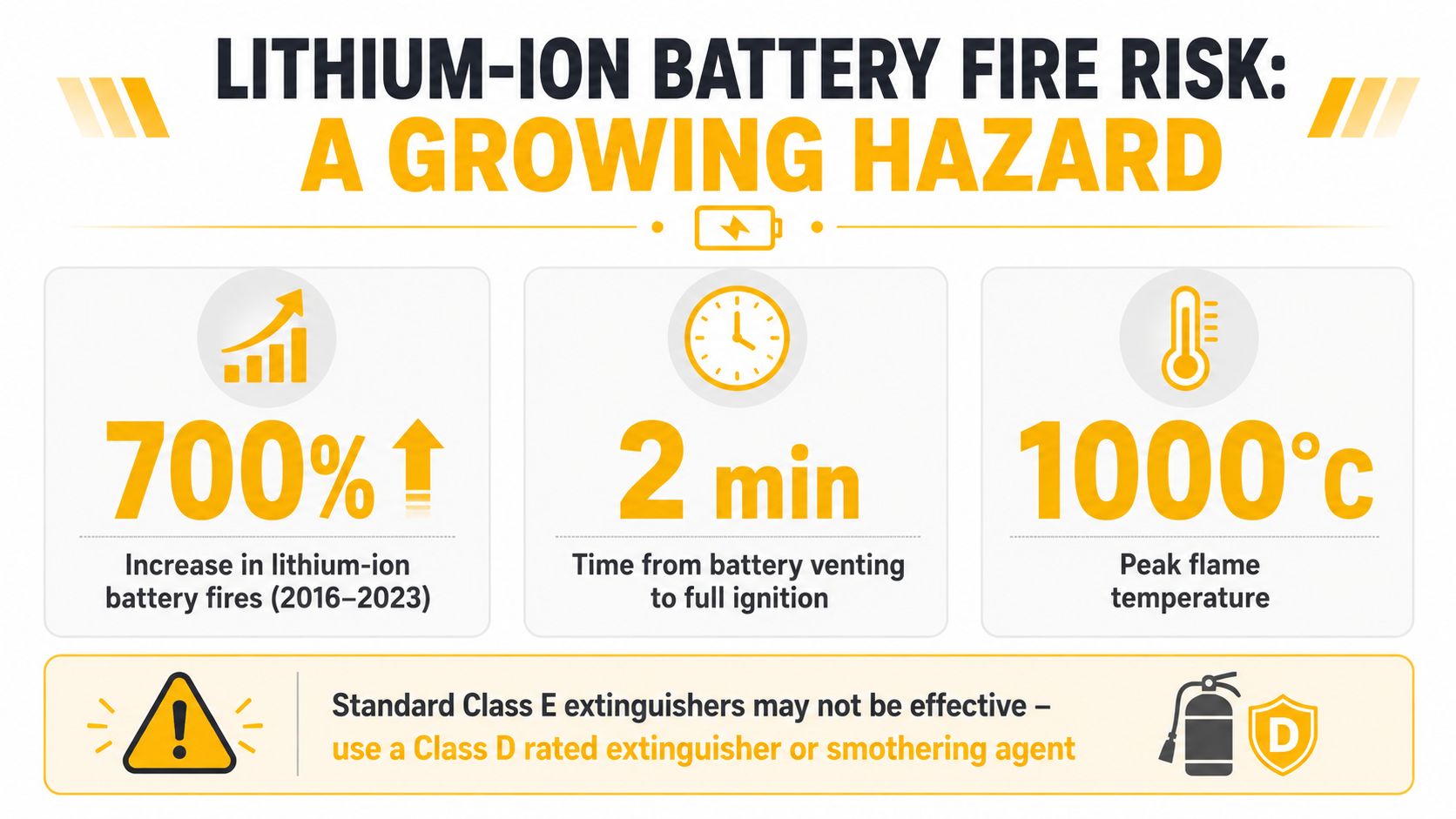
A laptop, power tool, e-scooter, battery storage system, or charging device can turn a routine electrical fault into a different fire problem from a burning photocopier or switchboard. Lithium-ion batteries can enter thermal runaway, release hazardous gases, produce intense heat in enclosed spaces, and reignite after visible flames have disappeared.
Queensland parliamentary material recorded 417 lithium-ion battery-related fires in Queensland to 30 June 2025, compared with 382 as at 30 April 2025. The Queensland Fire Department material provides that state context. Recent NSW coverage also reported 315 lithium-ion battery fires attended in 2024/25, with none involving electric vehicles, according to NSW fire incident coverage.
Those figures do not make every battery incident identical, and they do not make CO₂ or dry powder a complete battery-fire solution. A standard Class E extinguisher can help control a small fire involving a device's external electrical components while power remains energised. It may not cool the battery cells enough to prevent continued heating, re-ignition, or fire spread.
Change the response when a battery is involved
A swollen, hissing, smoking, venting, unusually hot, or strong-smelling battery requires immediate escalation. Do not handle, move, unplug, or contain it unless emergency responders or a competent specialist directs that action. Evacuate and call 000 when conditions are worsening.
Charging rooms, storage cages, and battery cabinets need controls suited to the installed technology, including ventilation, separation, detection, emergency access, and arrangements for re-ignition.
The working assumption should be clear: battery incidents need specialist guidance, rather than a switchboard procedure copied across without adjustment.
Building a Compliant Electrical Fire Safety Plan
A compliant plan starts with a site walk-through, not a catalogue order. Mark every switchboard, server rack, communications cabinet, appliance charging area, workshop panel, and battery storage location. Then confirm that each area has an extinguisher whose label matches the actual hazard.
Use a working checklist
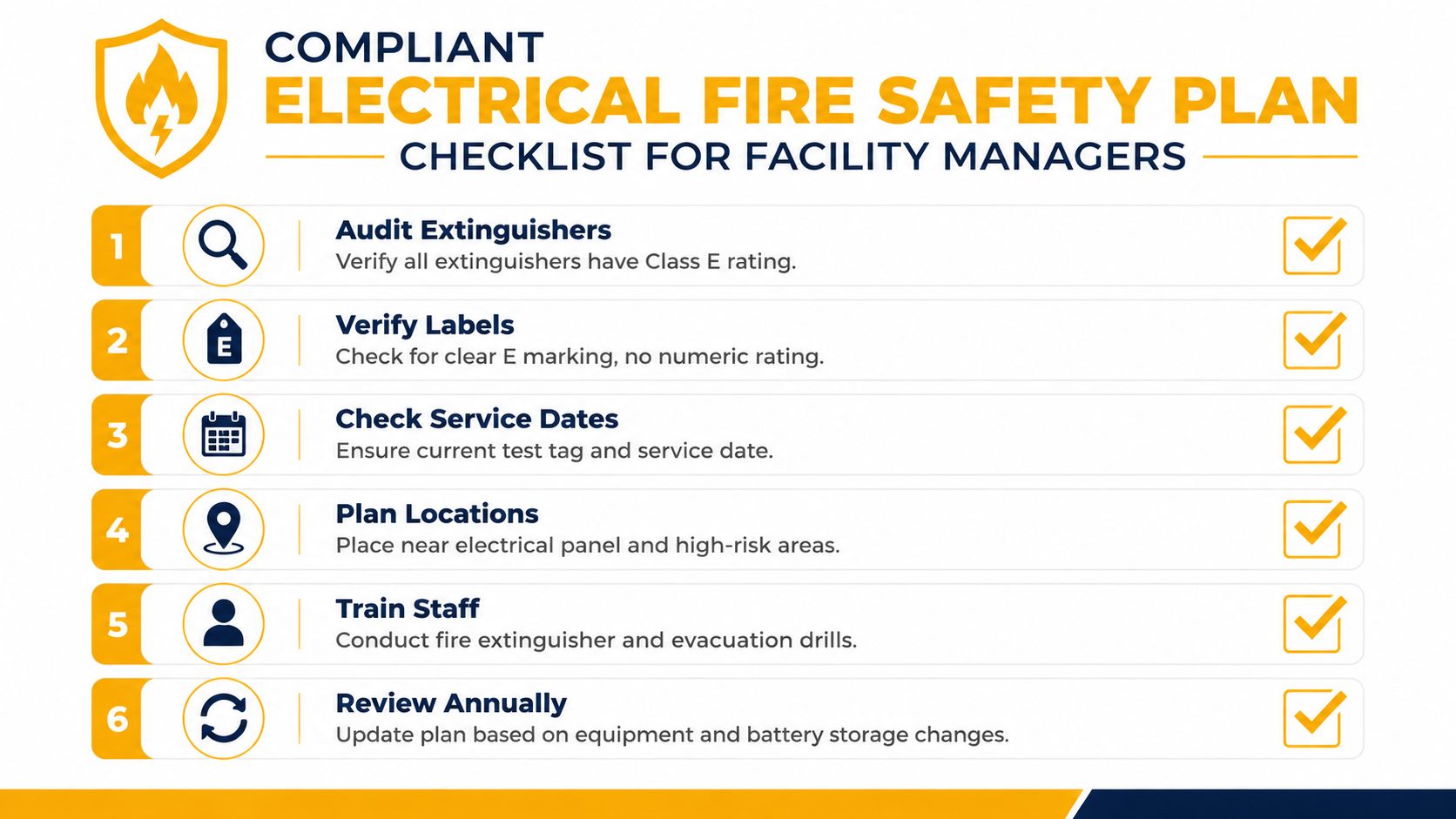
- Audit extinguishers: Verify that each appliance intended for live electrical equipment carries a Class E marking.
- Check the agent: Use CO₂, ABE dry powder, or vaporising liquid where electricity may remain energised.
- Review placement: Apply AS 2444 selection and location principles, including the switchboard benchmark described earlier.
- Inspect service status: Check the test tag, service date, physical condition, accessibility, and mounting.
- Train staff: Practise alarm raising, safe power isolation, PASS, evacuation, and the decision to stop.
- Separate battery planning: Add charging, storage, damaged-device handling, re-ignition, and emergency access controls to the site risk assessment.
- Record changes: Review the plan when equipment, tenancy layouts, switchboards, or battery storage changes.
Inspection and servicing shouldn't be treated as a paperwork exercise. A blocked appliance, unreadable label, damaged hose, missing pin, or overdue service can turn a compliant selection into an unusable response. Businesses can use commercial extinguisher servicing to organise testing, maintenance, records, and site-specific checks.
Australian Standards and workplace obligations should guide the final schedule, with competent personnel confirming the required service intervals and installation details for the premises. Celtic Fire & Security supplies, installs, tests, and maintains commercial extinguishers across South East Queensland, including North Brisbane, Moreton Bay, the Sunshine Coast, Somerset, and Ipswich.
Arrange a site assessment with Celtic Fire & Security to review Class E extinguisher selection, switchboard placement, service status, and battery-related risks. Their team can supply, install, test, and maintain the equipment your Queensland workplace needs for a practical, standards-aligned electrical fire response.
No responses yet