
The most popular smoke alarm advice is also the least useful advice for many Queensland businesses. “Press the test button, change the battery, and replace the alarm when it gets old” may help a homeowner manage a standalone residential alarm, but it doesn't address a commercial fire detection system connected to a fire indicator panel, an addressable loop, an aspirating detector, or a building's broader fire safety obligations.
Commercial smoke detector service is about more than proving that a sounder operates. It involves checking whether the right equipment is installed in the right location, whether signals reach the panel, whether contamination has affected detection performance, and whether the maintenance record can demonstrate ongoing attention. Queensland's move towards photoelectric, interconnected alarms in homes also adds confusion, because residential compliance advice is often presented as though it applies to shops, offices, warehouses, and mixed-use buildings. It doesn't.
For facility managers, the practical question is simple: will the detection system operate when required, and can the organisation prove that it has been properly maintained? The answer depends on a structured programme aligned with Australian standards, the building's classification, the system design, and the site's risk profile.
Table of Contents
- Why Residential Advice Does Not Apply to Commercial Premises
- Australian Standards and Queensland Legislation for Smoke Detectors
- What Professional Smoke Detector Service Actually Includes
- The Reliability Gap Between Installed and Maintained Alarms
- Scheduled Maintenance Plans Versus Reactive Servicing
- Choosing a Licensed Service Provider in South East Queensland
- Your Compliance Action Plan and Next Steps
Why Residential Advice Does Not Apply to Commercial Premises
Residential smoke alarm guidance usually focuses on a few familiar actions, such as pressing a test button, checking batteries, cleaning the casing, and replacing an alarm at the end of its manufacturer-specified service life. Those actions still matter for a simple dwelling, but they don't represent a commercial maintenance programme.
A business premises may contain interconnected detectors, a fire indicator panel, manual call points, sounder circuits, monitored interfaces, addressable devices, or aspirating smoke detection. A detector can appear intact at ceiling level while the panel shows an isolation, communication fault, contamination warning, or power-supply problem. Pressing the button on the detector won't prove that every part of that chain is working.
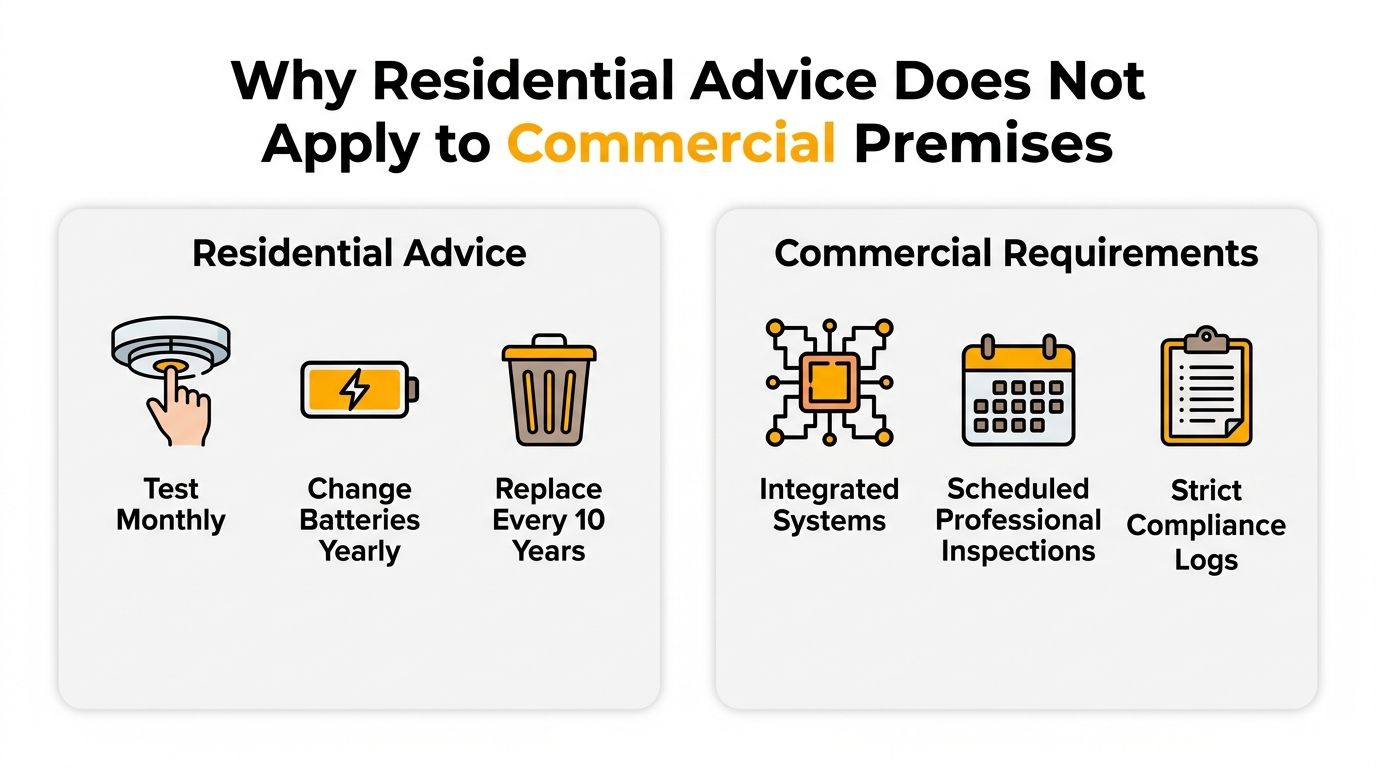
The accountability is different
A homeowner generally manages a limited number of devices. A facility manager may coordinate several tenancies, contractors, landlords, body corporate representatives, tenants, and emergency procedures. That creates a wider chain of responsibility and a stronger need for traceable records.
Commercial servicing must account for:
- System architecture: Confirm that detectors, circuits, panels, interfaces, and alarms communicate correctly.
- Building use: Consider occupancy, sleeping risks, plant areas, storage, kitchens, workshops, and other conditions that affect detection.
- Coverage changes: Check whether partitions, refurbishments, ceiling works, or tenancy alterations have changed detector coverage.
- Documentation: Record tests, defects, isolations, repairs, replacements, and recommendations in a form that can be reviewed later.
- Operational controls: Coordinate testing so occupants aren't placed at risk and critical systems aren't left isolated without suitable controls.
Practical rule: A commercial smoke detector service should leave an auditable trail, not just a working sounder.
Queensland's residential framework requires alarms in homes to meet specific product and installation requirements, including photoelectric sensing and AS 3786:2014 compliance, as outlined by Queensland smoke alarm guidance. Commercial sites instead rely on the building's fire safety obligations, the NCC, applicable standards, system documentation, and the maintenance schedule established for the installation.
For a practical explanation of battery replacement in residential and standalone systems, see smoke alarm battery replacement guidance. Don't use that routine as a substitute for commercial fire detection servicing.
Australian Standards and Queensland Legislation for Smoke Detectors
Queensland commercial smoke detector compliance sits within a layered framework. No single document answers every servicing question, because design, installation, maintenance, building use, and responsibility are addressed through different instruments.
AS 1851-2012 is the central maintenance reference for routine servicing of fire protection systems and equipment. Its scope includes inspection, testing, preventive maintenance, and survey activities. For smoke detection, that means a service visit should be planned around more than a basic alarm activation. The technician needs to assess the condition and operation of the equipment, identify defects, and document the work.
The AS 1851-2012 standard listing is the appropriate reference point for organisations confirming the standard's scope and maintenance role.
How the framework fits together
| Regulation / Standard | Scope | Key Requirement |
|---|---|---|
| AS 1851-2012 | Routine maintenance of fire protection systems and equipment | Inspection, testing, preventive maintenance, survey activities, and records |
| National Construction Code | Building fire safety design and performance | Detection and warning arrangements must suit the building and its use |
| AS 3786:2014 | Smoke alarms used under Queensland residential requirements | Photoelectric smoke alarms that meet the specified standard |
| Queensland fire safety obligations | Ongoing management of prescribed fire safety installations | Owners and responsible parties must keep systems maintained and operational |
| Site fire safety schedule and system documentation | Building-specific compliance controls | Defines relevant installations, interfaces, and inspection expectations |
The NCC also affects service outcomes because detector placement influences how quickly smoke reaches the sensing chamber. NCC guidance specifies that ceiling-mounted alarms should be at least 300 mm from the wall-ceiling corner junction, while sloped-ceiling placement should be 500 mm to 1500 mm from the high point and apex. Where ceiling mounting isn't possible, wall mounting is permitted 300 mm to 500 mm below the ceiling at the wall junction, according to NCC smoke alarm placement guidance.
Those measurements aren't cosmetic. Smoke can collect in dead-air spaces near corners or apexes, delaying entry into the detector. A service provider should therefore report unsuitable positioning, not test a device in an unsuitable location.
Queensland product requirements also specify that smoke alarms must comply with AS 3786:2014, use a photoelectric sensor, and not contain an ionisation sensor. Queensland WorkSafe's smoke alarm information reinforces those requirements for homes subject to the law. Commercial premises require a separate assessment against their fire safety design and obligations.
Property owners, occupiers, building managers, and contractors each have responsibilities. A facility manager should keep the building fire safety schedule, system drawings, previous reports, defect records, and isolation history available to the service provider. The fire safety schedule resource can help clarify why building-specific documentation matters.
What Professional Smoke Detector Service Actually Includes
A professional visit starts before the technician reaches the ceiling. Building management should identify access restrictions, occupied areas, sensitive operations, known faults, recent refurbishments, and any devices that have been isolated. The technician then reviews available drawings, panel history, previous defects, and manufacturer information so the work reflects the installed system rather than a generic checklist.
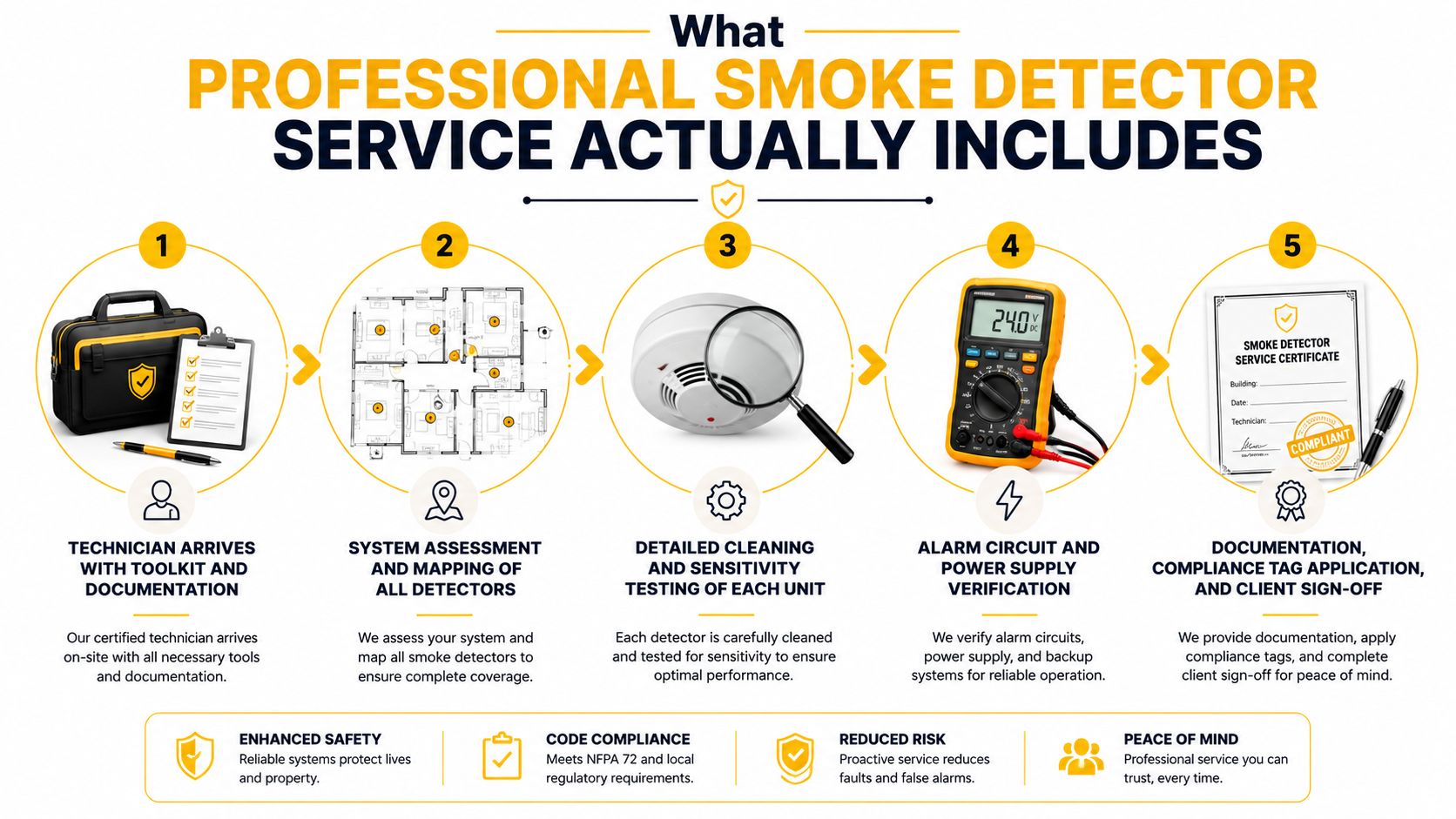
The site sequence
Confirm the system condition. The technician checks the fire indicator panel for alarm, fault, isolate, and supervisory indications before testing begins. Any required notification or temporary isolation should be controlled and recorded.
Inspect the physical installation. Detector housings, bases, covers, labels, mounting, cabling, and surrounding conditions are examined. Dust, paint, impact damage, water ingress, insect contamination, and obstructions can all affect reliability.
Test each relevant device. Functional testing uses an appropriate smoke simulation method, such as calibrated aerosol equipment where suitable for the detector and manufacturer's instructions. The test should confirm that the detector responds and that the expected indication appears at the panel.
Verify transmission and interfaces. Addressable identification, zone or loop response, sounders, relays, monitoring interfaces, and power supplies need to be checked as applicable. For wireless or standalone units, the technician may assess battery condition and replacement requirements rather than relying only on a push-button test.
Restore and document. The system is returned to normal operation, isolations are cleared, defects are explained, and records are completed. A useful report identifies the device or location, the test performed, the outcome, and any action required.
The useful result isn't “all alarms tested”. It's a clear record showing what was tested, what failed, what was isolated, and what the responsible person must do next.
Cleaning can be essential where dust has entered optical chambers or accumulated around sensing openings. It should be performed using methods suitable for the equipment. A unit that remains contaminated, unstable, physically damaged, or beyond its manufacturer-specified service life may require replacement rather than repeated cleaning.
Specialist systems demand additional competence. Aspirating systems may require filter inspection or replacement and assessment of sampling pipe arrangements. Addressable systems may require device identification checks, sensitivity verification, loop fault investigation, and manufacturer-specific programming knowledge. Those tasks shouldn't be assigned to a technician who only works on basic domestic alarms.
A typical service record may include an AS 1851-aligned service entry, service tag information, defect reports, isolation details, replacement recommendations, and client sign-off. Commercial smoke alarm testing services should be assessed by the work scope and evidence supplied, not by the number of devices listed on a quote.
A visual overview of the workflow is provided below.
The Reliability Gap Between Installed and Maintained Alarms
An installed detector can create false confidence. The NSW Fire Research report found that, in household fires where a smoke alarm was recorded as present, 65% operated and 43% alerted occupants. The figures are from household fire investigations rather than a direct commercial failure-rate study, but they illustrate an important service principle: presence alone doesn't prove reliable warning. See the NSW smoke alarm fire research report for the underlying analysis.
The difference between “installed” and “maintained” comes from failure modes that aren't always visible during a casual inspection. Dust can contaminate an optical chamber. Battery capacity can decline even when a unit still produces a brief test sound. Sensors and electronics can drift, while insects or debris can trigger false alarms or interfere with sensing.
What a service visit catches
A maintained system gives the responsible person an opportunity to identify:
- Contamination: Cleaning or replacement can address conditions that a button test won't reveal.
- Power weakness: Battery and supply checks can expose an alarm that sounds locally but may not remain dependable.
- Communication faults: Panel testing can show whether the system receives and identifies the detector signal.
- Physical damage: Cracked housings, loose bases, painted devices, and blocked areas need corrective action.
- Obsolete equipment: Replacement planning is safer than waiting for an aged unit to fail during an incident.
Queensland safety evidence reinforces the practical stakes. The state experiences more than 1,600 residential house fires each year, roughly one every five hours, and has averaged 10 fire-related deaths annually over the past 25 years, according to a Queensland-focused review of Queensland smoke alarm laws and safety data. The same source reports that more than one-third of fatal home fires occur in houses without smoke alarms, 44% of fire deaths involve people who were resting or sleeping, and the risk of death in a home fire is reduced by half when working smoke alarms are present.
Those figures don't establish a commercial failure percentage, and they shouldn't be presented as one. They do show why facility managers should treat testing, cleaning, replacement, and records as separate controls. A detector that passes one simple test may still need investigation, servicing, or replacement.
Scheduled Maintenance Plans Versus Reactive Servicing
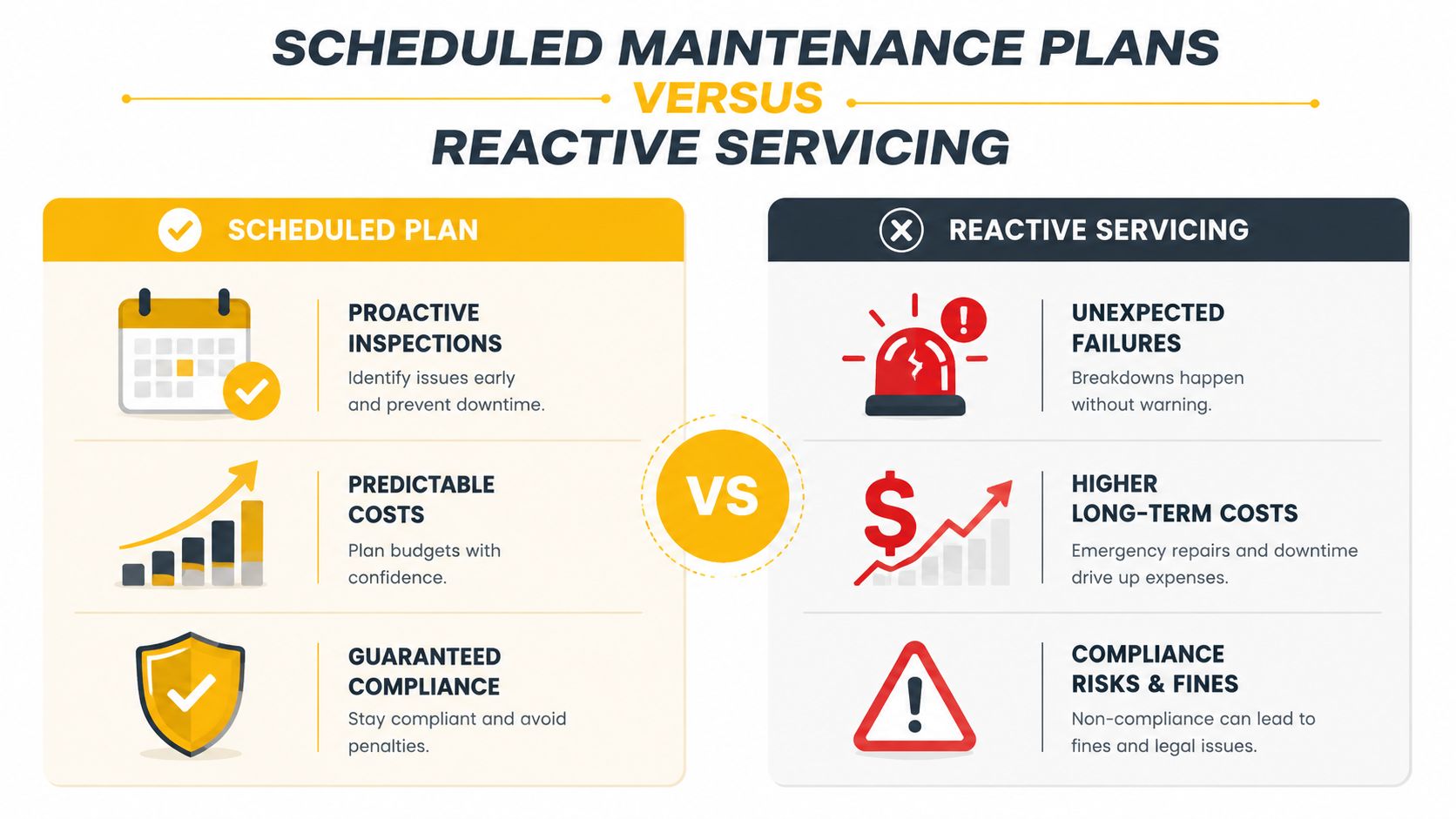
Reactive servicing begins with a fault, a tenant complaint, a false alarm, or an audit request. That approach feels economical when nothing appears wrong, but it leaves the facility manager dependent on luck and memory. It also makes it harder to coordinate access, source compatible equipment, manage isolations, and produce a coherent history.
A scheduled plan treats the fire detection system as operational infrastructure. The provider and site team agree on access arrangements, inspection activities, reporting formats, escalation contacts, and follow-up responsibilities before a problem occurs.
The practical comparison
| Area | Scheduled maintenance | Reactive servicing |
|---|---|---|
| Compliance | Records are created as work occurs | Evidence may be incomplete when requested |
| Fault management | Defects are identified before they become urgent | Faults often appear during disruption or an incident |
| Budget control | Planned work and replacement needs are easier to forecast | Emergency attendance and rushed parts can be difficult to predict |
| Site access | Visits can be coordinated around occupants and operations | Access is arranged under pressure |
| Administration | Recurring reports support a central register | Staff chase separate invoices, notes, and contractor messages |
AS 1851-2012 requires inspection, testing, preventive maintenance, and survey activities for relevant fire protection systems. The exact programme must reflect the system, standard, manufacturer information, and site obligations. A provider shouldn't promise a generic interval without first reviewing the installation and its documentation.
Scheduled work doesn't eliminate defects. It gives the site a controlled way to find, prioritise, record, and close them.
A useful maintenance agreement defines what happens after a failed detector, a repeated false alarm, an isolation, or a panel fault. It should state who receives the report, how urgent defects are escalated, whether replacement parts require approval, and how the system is confirmed as normal after work.
Digital reporting can reduce diary-based administration, but technology isn't a substitute for competent inspection. A polished PDF that says “pass” without device-level detail is weak evidence. Facility managers should seek reports that identify locations, outcomes, defects, recommended actions, and completion status.
The strongest plans also support replacement forecasting. Manufacturer dates, detector condition, contamination, compatibility, and building changes should inform a renewal schedule. That is more reliable than replacing equipment only after occupants complain about false alarms or a panel begins reporting faults.
Choosing a Licensed Service Provider in South East Queensland
A technician who can install a domestic alarm isn't automatically equipped to service a commercial detection system. Selection should start with licensing, competency, system experience, and the quality of the documentation supplied after each visit.
Ask prospective providers to confirm their current QBCC licensing, relevant electrical licensing, and FPAS accreditation where applicable to the work. Celtic Fire & Security operates with QBCC licence 1183612, electrical licence 89015, and provides commercial fire protection services across North Brisbane, Moreton Bay, the Sunshine Coast, Somerset, and Ipswich.
Questions worth asking before approval
- System experience: Have they serviced the same panel, detector family, addressable protocol, or aspirating system installed at your site?
- Service scope: Does the price include functional testing, cleaning, panel verification, defect reporting, and restoration of isolations?
- Records: Will you receive device-level results, logbook entries, service tags, defect reports, and follow-up recommendations?
- Fault response: What happens when a critical fault appears outside normal hours?
- Replacement controls: How will the provider manage temporary isolation, occupant notification, compatible parts, and final reinstatement?
- Insurance and competency: Can the provider supply evidence of suitable insurance and trained personnel for the proposed work?
Suspiciously low per-unit pricing deserves scrutiny. It may reflect a narrow test that doesn't include cleaning, panel checks, access time, reporting, or defect investigation. A detailed quote should separate routine servicing from repairs, replacement equipment, access equipment, programming, and out-of-hours attendance.
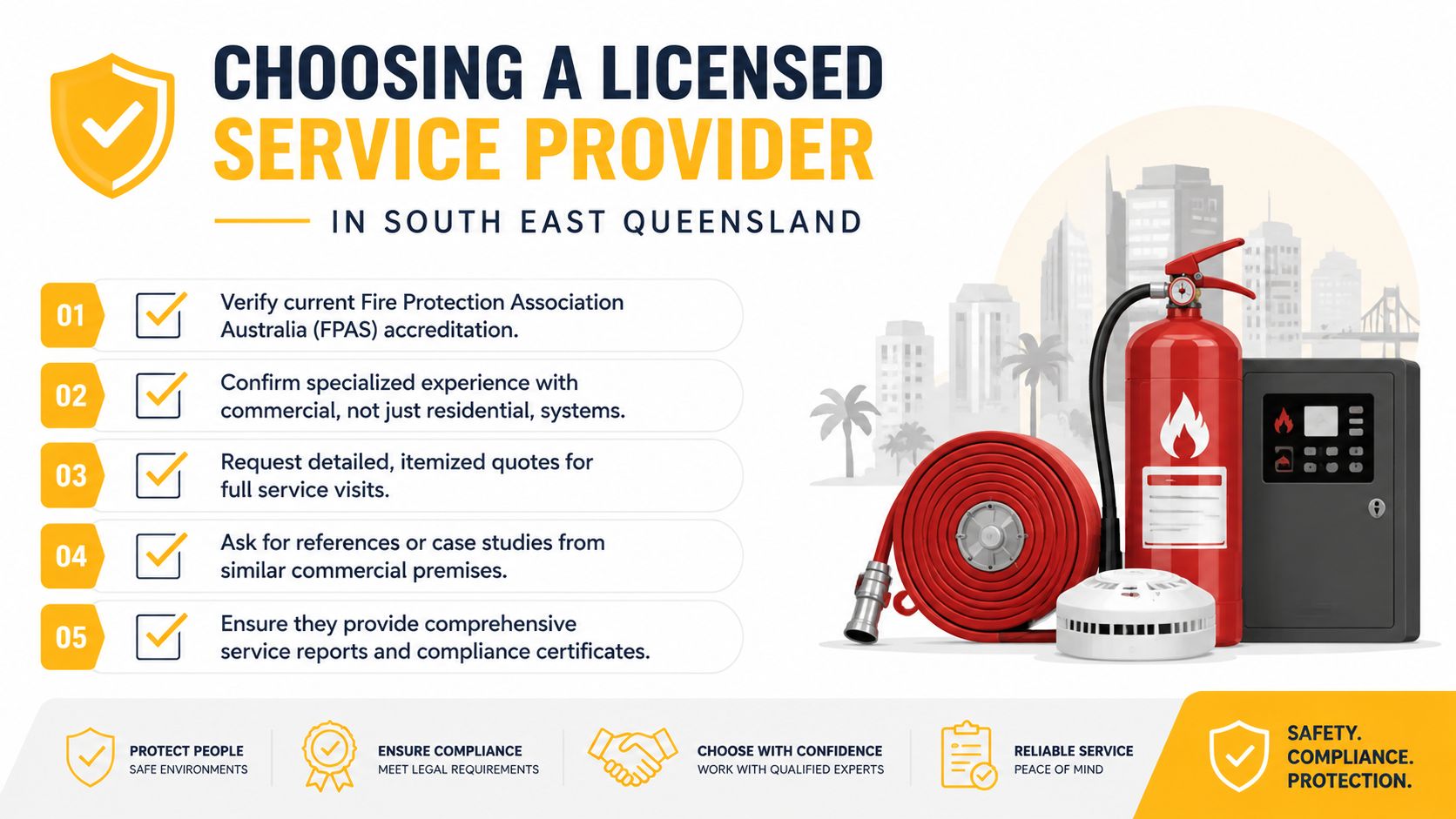
The service provider should also understand the difference between a residential alarm and a commercial fire detection system. Ask for a sample report before signing. If the sample doesn't show what was tested and what remains unresolved, it won't give the facility manager strong evidence during an audit, insurer review, or handover.
Your Compliance Action Plan and Next Steps
Start with the records, not the equipment. Check the current service history against the site's AS 1851 maintenance requirements, fire safety schedule, system documentation, defect register, and isolation history. List every missing report, overdue action, unidentified device, and unresolved fault.
Then complete these actions in order:
- Build the asset register: Record each detector, panel, loop, zone, location, model, condition, and manufacturer information available.
- Review coverage: Compare current floor plans with partitions, refurbishments, storage changes, and tenancy alterations.
- Vet the provider: Confirm licensing, relevant system competency, insurance, reporting standards, and escalation arrangements.
- Schedule the programme: Establish recurring inspections and planned follow-up work rather than waiting for faults.
- Track replacement needs: Use manufacturer specifications, equipment condition, contamination, compatibility, and service history to plan replacements.
- Control documentation: Keep logbook entries, reports, defect closures, isolation records, certificates, and approvals together in a retrievable system.
Immediate professional intervention is warranted for repeated false alarms, damaged detectors, failed functional tests, unexplained panel faults, persistent isolations, or building layout changes that may affect coverage. A service visit should finish with the system restored to normal, or with clearly documented interim controls and an assigned corrective action.
Celtic Fire & Security supplies, installs, tests, and maintains commercial smoke and heat alarm systems, with documented service reporting for businesses and property managers across South East Queensland. Review your current records, identify unresolved defects, and contact Celtic Fire & Security to arrange a compliance-focused smoke detector service.
No responses yet