
A routine inspection in a North Brisbane warehouse often starts with a simple question: is the extinguisher present, accessible and in service? Then a technician finds an older foam unit beside the flammable liquids store. The gauge looks acceptable, the cylinder is mounted correctly, and the label still appears readable. The problem may be hidden in the foam charge, its chemical history, and what happens to the unit after removal.
Fire extinguisher foam is no longer just a choice between water and powder. In Queensland, a facility manager must consider the Australian fire class, electrical exposure, product chemistry, documentation, servicing and disposal pathway. The extinguisher still needs to work during an emergency, but the site also needs evidence that the product and its end-of-life handling fit the current regulatory environment.
Table of Contents
- Why Foam Extinguishers Demand a Second Look in 2026
- How Fire Extinguisher Foam Actually Works
- Australian Fire Classes and Where Foam Fits
- The PFAS Phase-Out and What It Means for Your Site
- A Procurement Checklist for Compliant Foam Extinguishers
- Disposal Obligations Most Guides Overlook
- Ongoing Maintenance and Compliance Documentation
Why Foam Extinguishers Demand a Second Look in 2026
The North Brisbane manager in this situation isn't unusual. Older equipment can remain on commercial premises long after procurement practices have changed, particularly where extinguishers are inspected on schedule but their foam chemistry isn't recorded in the asset register.
Queensland's firefighting foam policy is dated 7 July 2016 and was later updated to require fluorinated foams, including AFFF, FP and FFFP, to be phased out by 7 July 2019, except where an approved interim extension applied in a special case. The Queensland firefighting foam policy also records that the state stopped purchasing fluorinated firefighting foams in 2003 and had switched remaining stocks to non-fluorinated foams. That put Queensland among the earliest Australian jurisdictions to begin a formal transition away from PFAS-related foam use.

The label isn't enough
A red cylinder and a valid-looking inspection tag don't establish that the charge is suitable for current procurement or environmental requirements. The provider should identify the foam type, confirm whether it contains fluorinated compounds, check the Safety Data Sheet, and record the proposed disposal route before replacing the unit.
Queensland guidance applies to anyone who handles, stores, uses, disposes of or releases firefighting foam. The Queensland foam policy FAQ says long-chain fluorinated compounds such as PFOA and related precursors must be replaced as soon as practicable with fluorine-free or C6-compliant foam.
That changes the procurement conversation. A facility manager should ask:
- What is in the charge? Obtain the product name, formulation information and current SDS.
- What fire risk is being protected? Confirm whether the unit is intended for Class A, Class B, or both.
- What happens to the old unit? Require a documented waste pathway rather than an informal handover.
Practical rule: Treat foam chemistry and disposal evidence as part of the extinguisher specification, not as paperwork to chase after installation.
How Fire Extinguisher Foam Actually Works
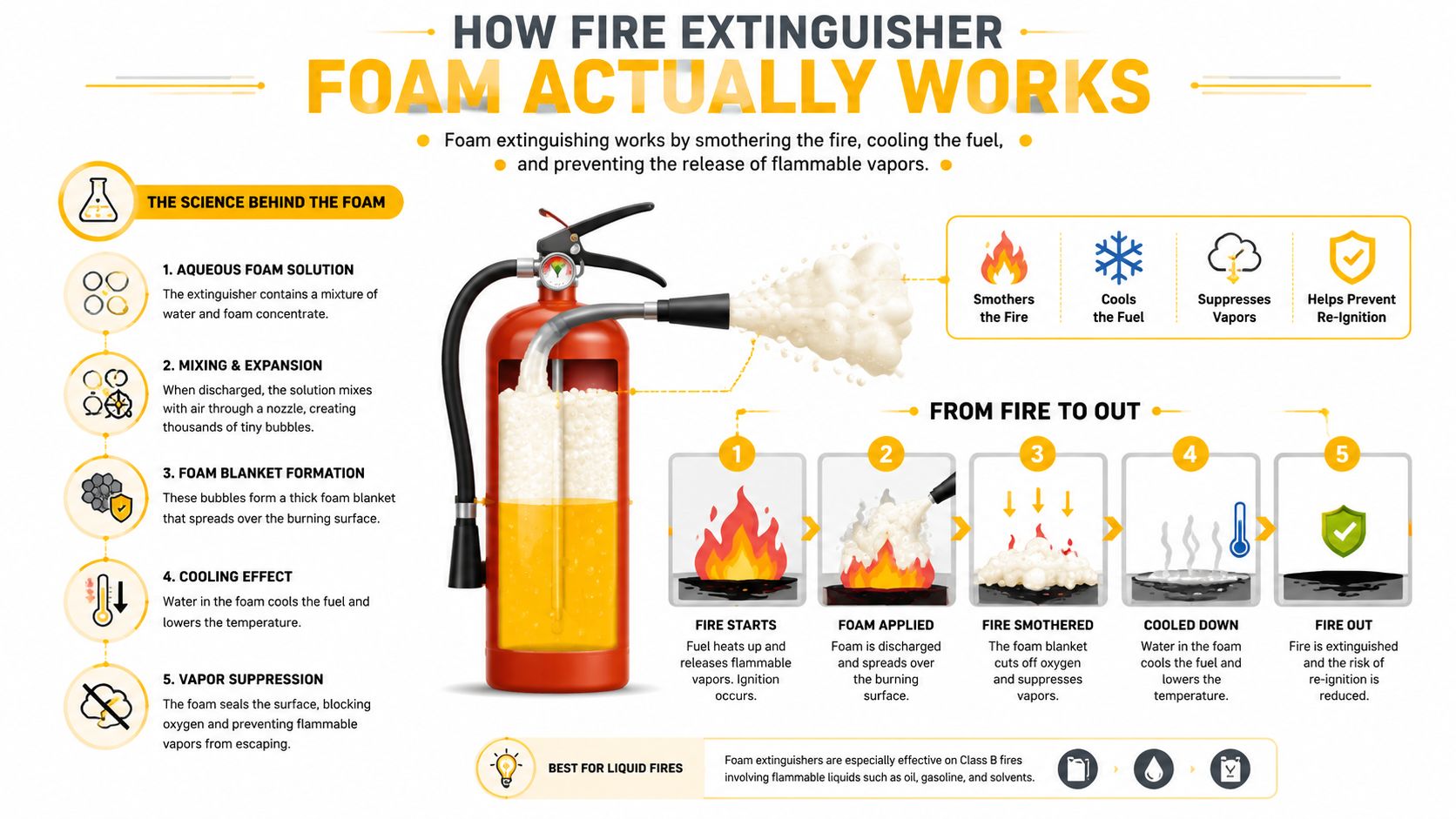
Foam works by changing the conditions at the fuel surface. On a flammable liquid fire, an aspirating nozzle draws air into the discharged solution and produces a stable blanket. That blanket spreads across the liquid, cools the surface and restricts the release of flammable vapours.
A useful comparison is a wet, fire-resistant blanket over a campfire. It doesn't merely cover the flame. It also removes heat from the burning surface and limits the vapour or oxygen conditions that allow the fire to continue. Foam performs a similar job over a pool of fuel, provided the operator applies it gently and allows the blanket to form.
The mechanism has three practical parts:
- Cooling: Water in the foam solution removes heat from the burning surface.
- Vapour suppression: The blanket limits the movement of flammable vapours from the liquid to the flame zone.
- Surface coverage: A stable layer helps prevent immediate re-ignition while the fuel remains hot.
Why the nozzle matters
A straight stream can disturb a liquid fuel surface, spread burning fuel or break apart the blanket before it becomes effective. An aspirating nozzle is designed to generate the foam structure needed for a stable layer, so the appliance and its discharge arrangement matter as much as the liquid inside the cylinder.
On Class A materials such as timber, paper and other ordinary combustibles, foam provides cooling and surface coverage. It can wet the material and help reduce the chance of re-ignition, although the operator still needs to check for hidden heat and deep-seated burning.
Australian field specifications for a typical 9 L foam extinguisher show working pressure around 700 kPa at 23°C, discharge time of about 60 seconds, and a 3A 20B fire rating, as published in FPA Australia's selection and use bulletin for firefighting foams. Those figures help a technician compare equipment, but they don't remove the need to match the unit to the hazard and site layout.
Foam isn't powder, CO2 or water with a colour change. Powder interrupts combustion rapidly but leaves residue and may obscure visibility. CO2 leaves little residue but offers no cooling and can be ineffective where vapours continue to escape. Foam's advantage is its combined cooling and vapour-suppression action on suitable Class A and Class B hazards.
Australian Fire Classes and Where Foam Fits
Placement begins by matching the extinguisher to the Australian fire class of the hazard. Queensland guidance identifies foam extinguishers as suitable for Class A and Class B fires, but not for energised electrical equipment, as set out in Queensland Maritime Safety Queensland fire safety guidance.
| Extinguisher Type | Class A | Class B | Energised Electrical | Class F | Typical Placement |
|---|---|---|---|---|---|
| Foam | Suitable where rated | Suitable where rated | Do not use | Not the usual selection | Workshops, fuel-handling areas, mixed-risk commercial premises |
| Water | Suitable | Not suitable | Do not use | Not suitable | Offices, storage areas and locations containing ordinary combustibles |
| Carbon dioxide | Limited suitability | Suitable for some risks | Suitable where the appliance is appropriately rated | Not suitable | Electrical and electronic equipment areas |
| Dry chemical powder | Suitable where rated | Suitable where rated | Suitable where the appliance is appropriately rated | Not the usual selection | Mixed-risk areas and some vehicle or industrial environments |
| Wet chemical | Not the usual selection | Not the usual selection | Do not use | Suitable where rated | Commercial kitchens and cooking-oil hazards |
Use this matrix to shortlist equipment, then confirm the choice against the site assessment and extinguisher rating. Australian Standard AS/NZS 1850 tests portable extinguishers across Classes A, B, C, D and F, and assesses suitability for energised electrical equipment, as described in the AS/NZS 1850 preview. The selected appliance must match the actual fuel, remain accessible, and be positioned so a person does not need to move through smoke or heat to reach it.
Where foam earns its place
Foam suits work areas containing ordinary combustibles and flammable liquids. A vehicle workshop, fuel-handling zone or mixed commercial premises may use a dual-purpose unit where the appliance has the required rating and electrical equipment has separate protection.
Foam does not cover every risk. A kitchen using cooking oils requires a Class F solution. A switchboard area requires an appliance specifically suitable for energised electrical equipment. For a broader comparison of Australian fire extinguisher types, check the agent selection against the hazards in each room.
For procurement, record the fire class, extinguisher rating, location and any incompatible equipment before ordering. That record also makes later inspections easier, particularly where a foam unit may need replacement because its agent or disposal pathway no longer meets site requirements.
The PASS method remains useful for trained users: pull the pin, aim at the base of the fire, squeeze the operating handle and sweep across the burning area. Staff must know when to stop. If the fire is growing, smoke reduces visibility or the exit route is threatened, evacuation and emergency services take priority over extinguisher use.
The PFAS Phase-Out and What It Means for Your Site
A foam extinguisher can still carry a familiar fire rating while creating a separate compliance problem. In Queensland, the purchase decision now includes the agent chemistry, environmental release risk and the evidence needed to show how the old unit will be removed.
Queensland's transition predates the national restrictions introduced in 2025. The state policy dated 7 July 2016 and the 7 July 2019 phase-out requirement established an earlier direction away from fluorinated foams. Queensland's Fire Department says that since 2021, purchases of firefighting foam, including extinguisher units, have been limited to non-fluorinated products that don't contain PFAS, as stated in its PFAS compliance information.
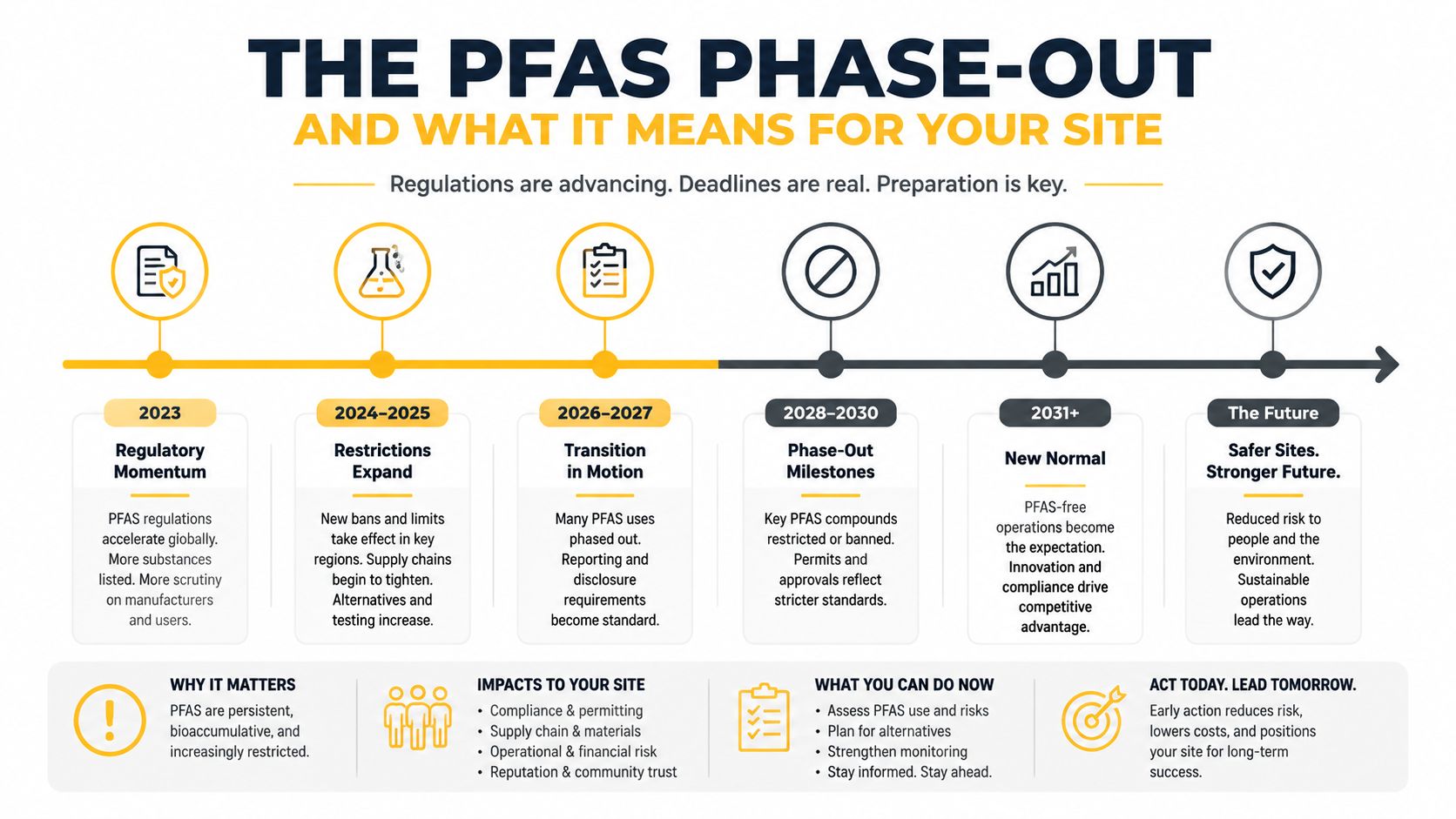
The national position tightened in 2025. The NSW EPA states that its PFAS regulation commenced on 4 July 2025, while national bans prohibited three main PFAS chemicals from import, use, manufacture and export in Australia from 1 July 2025, unless an exemption applied. The NSW EPA guidance on PFAS firefighting foam regulation records transition arrangements for Transport for NSW and 7 high fire-risk facilities. Those arrangements allow continued PFAS firefighting foam use through 1 December 2027, when the transition period concludes.
What the timeline means operationally
Those exemptions are narrow and site-specific. A workshop, retail tenancy, office park or small industrial premises should not assume it can keep buying or installing legacy foam because a critical facility has a transition arrangement.
For a Queensland operator, the practical test is whether the business can demonstrate a compliant transition, prevent environmental release and document the waste outcome. The product's old fire rating is only one part of that decision.
Start with an inventory before the next service visit:
- Record every foam unit: Note location, capacity, manufacturer, model, rating, age and service status.
- Separate known from unknown chemistry: Mark units with missing formulation or SDS information for technical review.
- Ask for a replacement pathway: Confirm the proposed fluorine-free or C6-compliant product and its tested application.
- Retain evidence: Keep supplier documents, service reports, SDS records and disposal certificates with the site's fire safety files.
The replacement is not automatically the cheapest fluorine-free cylinder. It must provide the required Australian fire performance, suit the hazard, fit the mounting arrangement and come with a credible servicing and disposal process. That paperwork is part of managing the extinguisher, not an administrative extra.
A Procurement Checklist for Compliant Foam Extinguishers
Procurement should finish with a file that another manager or auditor can understand without calling the salesperson. Start by defining the hazard, then verify performance, chemistry and ongoing support in that order.
A practical buying workflow
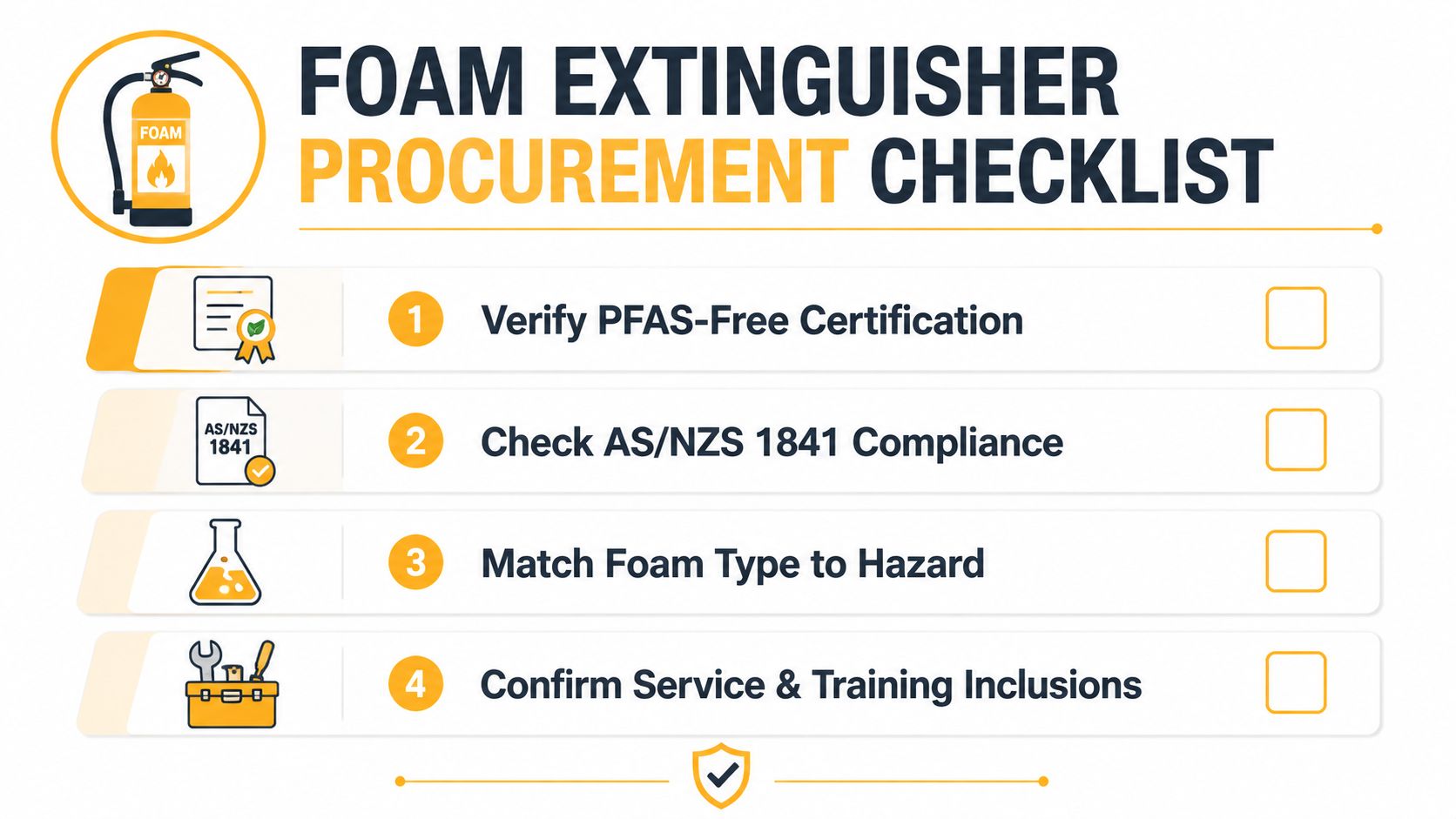
1. Map the risk. Walk the premises and identify ordinary combustibles, flammable liquid storage, vehicle servicing, charging equipment, switchboards and kitchens. Confirm whether the proposed foam unit protects Class A, Class B, or both, and identify any energised electrical exposure that requires another agent.
2. Verify the Australian performance system. Portable foam extinguishers must be verified against AS/NZS 1850 fire-test protocols and the portable extinguisher requirements in the AS/NZS 1841 series, as explained in FPA Australia's foam selection bulletin. Check the rating, appliance marking, manufacturer information and test documentation. Don't accept a generic statement that a product is “compliant” without identifying the applicable Australian requirements.
3. Confirm the chemistry. Ask whether the foam is fluorine-free or C6-compliant. Request the current SDS and product technical data, and have the supplier identify any limitations, such as the fire class or fuel type for which the product has been tested.
Questions that expose weak specifications
Ask who will service the unit, what inspection regime applies, whether the extinguisher can be integrated into the existing signage and mounting plan, and how a discharged or damaged appliance will be managed. A supplier should be able to explain the charging agent, discharge method, fire rating, installation location and waste pathway in plain language.
Document the decision in the asset register. Include the reason foam was selected, the hazard assessment, the product identity, SDS version, compliance evidence, installation date, service provider and disposal instructions. This record protects continuity when staff change and prevents a future contractor from treating an unidentified cylinder as a routine refill.
Procurement test: If the supplier can't explain both the foam's tested fire application and its end-of-life pathway, the order isn't ready for approval.
Training belongs in the purchase decision as well. Staff need to recognise the Australian fire class, understand the electrical exclusion, operate the extinguisher using PASS and withdraw safely. A technically suitable appliance still fails as a control if employees can't identify when using it is unsafe.
Disposal Obligations Most Guides Overlook
Replacing a legacy foam extinguisher creates a waste stream that needs controlled storage, transport, classification and final treatment. Removing the cylinder from its bracket is only the first step.
Queensland guidance treats foam containing fluorinated organics as regulated waste. It must go to a licensed regulated waste facility for destruction by high-temperature incineration. Sites also need a PFAS foam waste disposal plan and environmental controls, such as bunding to prevent releases. Confirm the current requirements before arranging removal, particularly if the product chemistry is unclear.
Why a normal scrap handover is risky
An old cylinder can retain foam in the body, valve assembly or hose. A contractor who removes it without identifying the waste classification and licensed destination has not closed the compliance issue. Your business may still face incomplete records, an uncontrolled release or an unsuitable disposal method.
Before the replacement visit, confirm:
- Temporary storage: Keep removed units secure, labelled and protected from damage or leaks.
- Containment: Use bunding or another suitable control where a release could reach soil, drains or stormwater.
- Licensed destination: Obtain the receiving facility's details and confirm it accepts the relevant regulated waste.
- Transport arrangements: Confirm who is responsible for lawful transport and which documents accompany the load.
- Completion evidence: Retain disposal documentation with the extinguisher service report and site environmental records.
Build these steps into the replacement schedule. A technician may install a compliant fluorine-free unit quickly, while the old cylinder still requires controlled handling after it leaves the bracket.
For practical guidance on fire extinguisher disposal, ensure the process covers both the appliance and its contents. A clean replacement program can still leave an undocumented waste problem behind the loading dock.
Ongoing Maintenance and Compliance Documentation
A compliant foam extinguisher needs more than a suitable label. It must remain accessible, charged, correctly mounted, visibly identified and capable of performing when required. Queensland's building fire safety framework remains in force through 31 August 2026, so commercial premises must continue meeting the state's requirements when selecting, installing and maintaining fire safety equipment, as shown in the current Queensland legislation.
Portable extinguishers are commonly checked during scheduled six-monthly inspection and testing programs. The service provider should examine the cylinder, hose, nozzle, pin, tamper seal, gauge, bracket, signage and general condition, while applying the relevant Australian Standard procedures to the appliance type.
Records that stand up to scrutiny
A useful service record identifies the exact extinguisher, its location, fire rating, inspection result, defects, corrective action and next due service. For foam units, the record should also retain the product identity and chemistry information, particularly where a site is transitioning away from legacy PFAS-related products.
Good documentation answers practical questions:
- Was the correct extinguisher installed for the hazard?
- Was access clear and the signage visible?
- Did the technician identify leakage, corrosion or damage?
- Was an unserviceable unit removed through an approved waste pathway?
- Does the asset register match the equipment physically installed?
A planned maintenance arrangement reduces the chance that a failed gauge, damaged hose or missing extinguisher remains unnoticed. It also gives multi-site operators one consistent evidence trail across inspections, replacements and disposal activities.
The servicing of fire extinguishers should be coordinated with the rest of the site's fire protection program, including alarms, emergency lighting, hose reels and other equipment where applicable. Review the foam inventory now, flag unknown chemistry, obtain SDS records, and ask your provider for a written replacement and disposal plan rather than waiting for a compliance issue to force the decision.
Celtic Fire & Security supplies, installs, tests and maintains commercial fire extinguishers, including foam units, across North Brisbane, Moreton Bay, the Sunshine Coast, Somerset and Ipswich. For a site review covering hazard matching, PFAS transition records, servicing and disposal coordination, visit Celtic Fire & Security and arrange a practical assessment.
No responses yet