
By Tuesday morning, most facility managers already know whether their fire protection program is under control. The signs are practical: service tags are current, defects have owners, the logbook matches the asset register, and the next test is booked before the last one becomes overdue. When those basics are missing, a fire safety statement renewal can turn into a scramble involving contractors, tenants, electricians, hydraulic specialists, and an assessor who needs evidence, not reassurance.
Queensland's compliance environment rewards first-pass readiness. QFES recorded first-inspection compliance at 55.5% in 2023–24, following 52.9% in 2022–23 and 57.5% in 2021–22. The figures show that many premises require corrective work after the first inspection, so service fire protection needs to be managed as a recurring operational program, not a last-minute equipment check. Queensland Fire and Emergency Services' 2023–24 annual report documents this pattern and the associated enforcement activity.
Table of Contents
- A Facility Manager's Tuesday Morning in Brisbane
- What Service Fire Protection Actually Covers in Queensland
- Extinguishers, Hydrants, Alarms, and Lighting in Practice
- How AS 1851 Schedules Routine Service
- Reactive Callouts Versus a Preventative Maintenance Plan
- Why Having the Equipment Is Not the Same as Compliance
- Building a Preventative Maintenance Plan for South East Queensland
- Pulling It Together and Your Next 30 Days
A Facility Manager's Tuesday Morning in Brisbane
It's a Tuesday in mid-2026, and a facility manager at a Bulimba warehouse complex is working through a backlog of inbox messages. The Brisbane City Council fire safety statement renewal is due in 14 days. A hydraulic contractor wants to book the annual flow test for the booster and hydrant system. Two exit lights above the loading dock are showing red fault indicators after the long weekend, and an extinguisher tag on Level 2 has expired.
None of these messages is dramatic on its own. Together, they create the familiar pressure of a site where maintenance has been handled as separate reminders rather than one controlled schedule. The manager needs to know whether the lighting fault is a failed battery, a charger issue, or a fitting that won't complete its test. They need the hydraulic contractor to attend while access is available, and they need current records that an assessor can follow without reconstructing the building's maintenance history.
Practical rule: A service visit isn't complete until the defect, test result, responsible contractor, and next action are visible in the site records.
The manager opens the fire logbook and finds entries from different contractors using different descriptions. One asset number doesn't match the register. A previous defect says “repair required”, but there's no attached completion record. The equipment exists, yet the evidence is fragmented. That's the point at which a building can feel protected while still presenting an avoidable compliance problem.
This guide reframes service fire protection around audit survival, interval scheduling, and documentary traceability. It explains how Queensland's 13 February 2025 changeover to AS 1851-2012 affects maintenance planning, how to separate reactive work from preventative servicing, and how to build a routine that works across a busy South East Queensland site.
The manager closes the laptop and rings the fire service provider. The better outcome is for that call to confirm a scheduled program, not to begin an emergency search for someone who can attend before the statement is due.
What Service Fire Protection Actually Covers in Queensland
Service fire protection is the ongoing inspection, testing, repair, and certification of fire safety measures already installed in a building. It isn't the initial design or fit-out. It's the work that proves the installed systems remain available, accessible, correctly identified, and capable of performing their intended function.
Queensland owners and managers need to understand the legislative frame before choosing a servicing model. QFES annual reporting links building fire safety compliance to the Fire and Emergency Services Act 1990, the Building Act 1975, and the Building Fire Safety Regulation 2008. Fire safety statements sit within that broader responsibility, while QDC MP 6.1 sets requirements relevant to prescribed fire safety measures, including the maintenance of prescribed extinguishers. Queensland guidance says occupiers and owners must ensure those extinguishers are maintained by an appropriately qualified person in accordance with QDC MP 6.1. The QFES advisory notes provide the relevant local reference.
Separate passive and active measures
Passive protection helps contain fire and smoke without needing a detection signal or moving component. It includes fire and smoke doors, fire-rated construction, compartmentation, penetration seals, and protected openings. Service work checks whether later building activity, cabling, plumbing, storage, or door damage has compromised those barriers.
Active systems respond, operate, or provide an intervention when an incident occurs. A practical asset register commonly includes:
- Portable equipment: Extinguishers, fire blankets, and hose reels.
- Hydraulic protection: Hydrants, booster connections, valves, pumpsets, sprinklers, and hydrant block plans.
- Detection and warning: Smoke alarms, heat detectors, aspirating detection, warning devices, and the fire indicator panel.
- Evacuation support: Emergency and exit lighting, illuminated signs, and associated batteries and chargers.
A competent person performs the relevant inspection or test, records the result, identifies defects, and confirms the next action. The logbook is the working evidence. It should connect each entry to an asset identifier, location, test interval, result, defect status, and rectification record. A signed certificate without a usable asset trail leaves the manager answering questions that a well-structured service record should answer immediately.
Extinguishers, Hydrants, Alarms, and Lighting in Practice
A technician's day rarely involves one isolated device. A routine visit moves through the building's fire protection chain, checking whether each measure is present, accessible, correctly marked, serviceable, and recorded.
Portable extinguishers
Australian extinguisher classes are A, B, C, D, E, and F. Class A covers ordinary combustibles, Class B flammable and combustible liquids, Class C flammable gases, Class D combustible metals, Class E energised electrical equipment, and Class F cooking oils and fats. The correct extinguisher depends on the hazard, not on what is easiest to mount on the wall.
Common metric sizes include a 1.0 kg dry chemical extinguisher and a 2.5 kg carbon dioxide extinguisher. Technicians also check location, signage, access, mounting, pressure indication where fitted, hose or horn condition, corrosion, tampering, and the service tag. Placement and selection need to be considered against AS 2444, because an extinguisher that is technically present but hidden behind stock or unsuitable for the local risk isn't a reliable control.
Hydrants and sprinklers
Hydrant servicing includes valves, hose connections, cabinets, signage, access, booster connections, block plans, and flow performance. A booster may look sound from the street while a valve, cap, coupling, or isolation arrangement needs attention. Flow testing demonstrates performance under test conditions rather than assuming that water will be available at the required point.
Sprinkler systems add control valves, alarm valves, pumpsets, water supplies, test facilities, and monitoring arrangements. The asset register must identify what is installed and where isolation points sit. A missing or outdated hydrant block plan can slow response and complicate an otherwise successful inspection.
Detection and warning
Smoke alarms, heat detectors, and aspirating systems feed information into the building's warning and control arrangements. Servicing can involve detector condition, contamination, alarm operation, sound pressure, batteries, power supplies, panel indications, fault history, and interfaces with other systems. Smoke detector servicing guidance is useful background for managers coordinating this work.
Emergency and exit lighting
Emergency and exit lighting must do more than illuminate during a quick functional test. Under AS/NZS 2293, recurring checks include functional or discharge testing and annual duration testing. Australian systems commonly require 90 minutes of emergency operation, so a fitting that lights during a short inspection may still fail the sustained-output test if its battery, charger, or luminaire has degraded. Standards Australia's AS/NZS 2293.1:2018 reference sets out the applicable standard context.
A faulty batten or battery is a common audit defect because the fitting may appear normal in standby. The technician needs to test activation and duration, record the result, and close the defect with evidence of repair.
How AS 1851 Schedules Routine Service
A Brisbane facility can have every required device installed and still fail its first audit if the service calendar cannot show what was checked, when it was checked, and which defects remain open. AS 1851 sets a fixed-interval routine service standard, so maintenance depends on the asset and the required interval. One annual visit cannot replace the full cycle.
Portable extinguishers sit on recurring service intervals, including six-monthly inspection and servicing and a five-yearly pressure test or overhaul. The portable extinguisher servicing requirements should be scheduled against the asset register, not treated as an informal tag check. The Australian fire equipment testing schedule also sets out recurring cycles for hose reels and emergency lighting.
Queensland's changeover on 13 February 2025 affects buildings required to provide an annual or supplementary fire safety statement. From that date, installed essential fire safety measures had to be maintained in accordance with AS 1851-2012, with a preventative maintenance program in place. The FPAA AS 1851 information sheet outlines the practical implications for building owners and managers.
Map intervals to assets
Hydrant systems require six-monthly inspections, yearly flow testing, and a five-yearly fire brigade booster flow test. Sprinkler systems and pumpsets have monthly checks, followed by additional six-monthly, annual, five-yearly, and longer-cycle tasks. Some inspections extend to a 30-year cycle. Exit lighting requires recurring function or discharge checks and annual duration testing, with Australian systems commonly requiring 90 minutes of emergency operation. The AS 1851 maintenance guide provides the interval framework.
Smoke alarm servicing also needs asset-specific planning. Monthly sound-pressure checks form part of the relevant maintenance program, while emergency lighting and hydraulic systems have separate test points. The service provider should identify completed tasks, deferred tasks, reasons for deferral, and any required follow-up.
| Asset | Cycle | What gets checked | Record kept in |
|---|---|---|---|
| Portable extinguishers | Six-monthly, with five-yearly pressure test or overhaul | Condition, accessibility, suitability, service status, and pressure or discharge requirements | AS 1851 logbook and asset register |
| Hydrant system | Six-monthly inspection, annual flow test, five-yearly booster flow test | Valves, access, signage, booster connection, block plan, flow performance | Hydraulic test report and logbook |
| Sprinklers and pumpsets | Monthly and additional interval-specific checks | Valves, pumpset operation, alarms, water supply, and test facilities | System logbook and defect register |
| Emergency and exit lighting | Recurring functional checks and annual duration test | Activation, charger, battery, luminaire, signage, and sustained output | Electrical test record and logbook |
| Detection and warning | Interval-specific inspection and testing | Detectors, panel indications, sound pressure, batteries, and faults | Fire indicator panel record and service report |
Each interval should leave evidence an assessor can follow. A missed task creates a gap between the installed system and the claim that it has been maintained. That gap is a compliance risk, even when the equipment appears to operate during a brief inspection.
Reactive Callouts Versus a Preventative Maintenance Plan
Reactive servicing has a legitimate place. A damaged extinguisher, failed exit light, leaking hydrant valve, or panel fault needs prompt attention. The problem starts when reactive work becomes the entire maintenance strategy. The provider visits when a tenant reports a fault or an inspection exposes one, then leaves without building the next interval into the calendar.
A preventative plan prices the annual scope per asset, reserves visit windows, assigns responsibility for defects, and keeps records together. It doesn't eliminate callouts, but it makes them exceptions rather than the operating model.
| Factor | Reactive callout | Preventative maintenance plan |
|---|---|---|
| Annual cost | Unpredictable, with separate attendance and urgent-work charges | Planned per-asset scope with clearer budgeting |
| Audit risk | Higher, because overdue or incomplete records may surface together | Lower, because intervals and evidence are tracked |
| Documentation quality | Often split across invoices, tags, and separate reports | Structured around the asset register and logbook |
| Downtime risk | Work arrives during tenant activity or operational pressure | Visits can be coordinated around access and occupancy |
| Insurance posture | Harder to demonstrate consistent maintenance | Easier to present a continuous maintenance history |
The trade-off is commitment. A planned program requires access, accurate asset data, and approval to repair defects instead of deferring them indefinitely. It may also reveal that the site has inherited equipment with incomplete history, which is uncomfortable but useful.
The operational test: If the manager can't identify the next service date for each asset class, the site has a collection of contractors, not a preventative maintenance plan.
South East Queensland sites often have mixed tenancy, loading areas, outdoor hydraulic equipment, and contractors working outside normal hours. A scheduled visit window reduces disruption and lets the provider coordinate fire, security, and locksmith tasks where the scopes overlap. Claims about insurance should remain precise. A maintenance file doesn't guarantee an insurance outcome, but it gives the owner a defensible record when an insurer, assessor, or regulator asks how the systems were maintained.
Why Having the Equipment Is Not the Same as Compliance
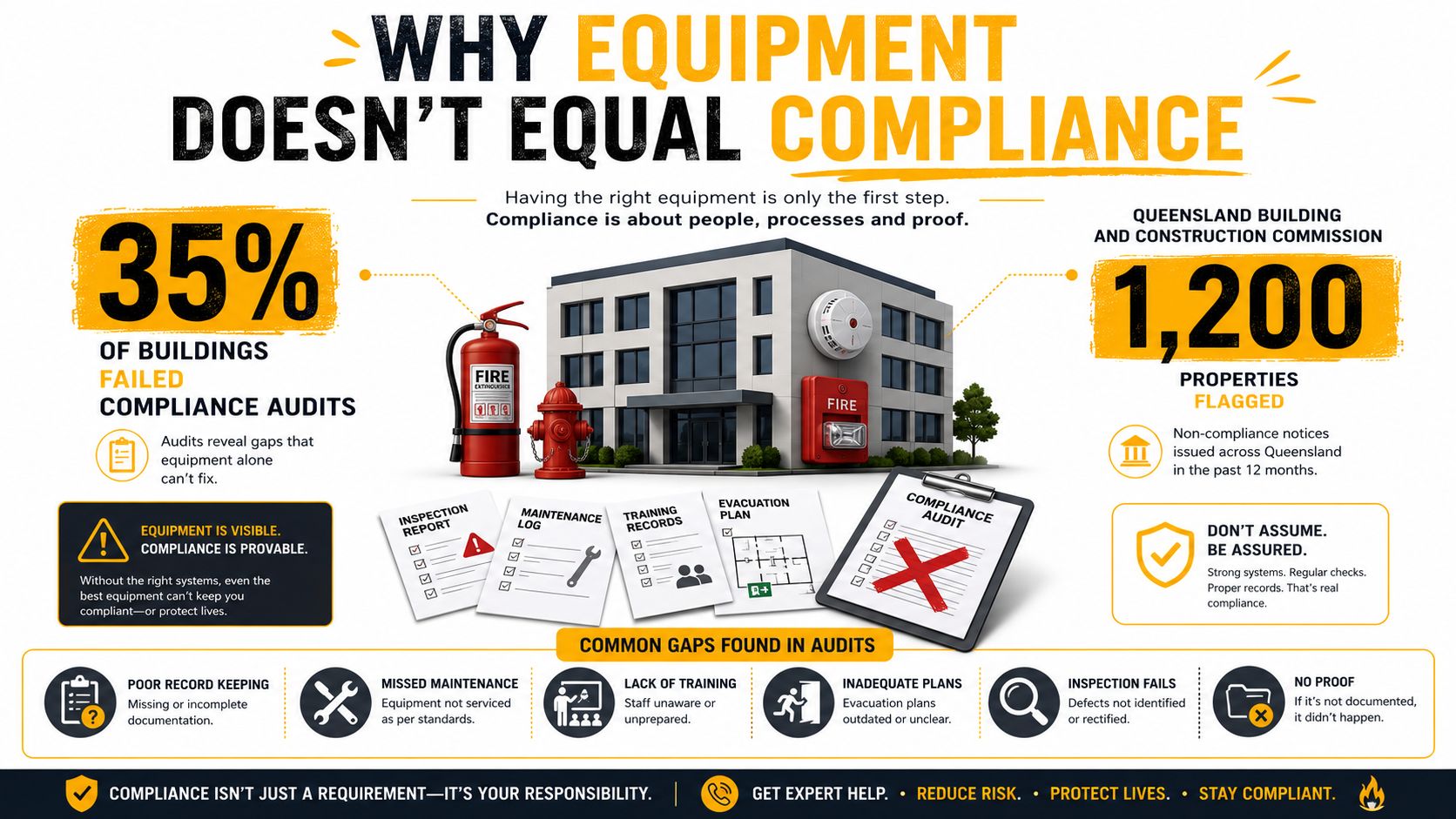
A Brisbane facility can have extinguishers on every required floor and still struggle at a first-pass inspection. Compliance depends on service currency, access, signage, clear egress, accurate records, closed defects, and evidence that each interval-specific test was completed under the applicable AS 1851-2012 schedule.
Queensland's inspection results show why equipment alone is a poor measure of readiness. QFES recorded 55.5% of inspected building premises as compliant at first inspection in 2023–24, compared with 52.9% in 2022–23 and 57.5% in 2021–22. The QFES 2023–24 annual report also records enforcement activity during the reporting period. Those figures do not identify whether failures involved records, signage, testing, access, or another defect. They do show that first-pass readiness remains a practical management issue.
Common failure points
Three routine examples show the gap between installed equipment and defensible maintenance:
- An expired tag: An extinguisher was last serviced 14 months ago. It remains mounted, but its service currency is no longer defensible.
- A short discharge: An exit light operates during a quick check but runs for only 60 minutes during the required 90-minute duration test. It needs rectification, not a note stating that the lamp works.
- An unverified hydrant valve: An isolation valve has no current test tag or supporting record. The valve may be intact, but the manager cannot show that it was checked at the applicable interval.
Compliance is the condition of the system plus the quality of the evidence. “Checked all equipment” does not give a manager an asset-level maintenance history. A defensible report identifies each asset, states the test performed, records the result, separates defects from compliant items, and documents rectification.
QFD reporting for 2024–25 recorded 57% first-inspection building compliance. The QFD 2024–25 regulator performance report reinforces the value of scheduled verification, controlled records, and maintenance evidence that can be produced during an inspection.
Building a Preventative Maintenance Plan for South East Queensland
A workable plan starts with one asset register, one accountable manager, and a logbook that a new contractor can understand without relying on old staff memory. Record the asset ID, location, type, service interval, last result, open defect, responsible party, and due date. Attach relevant test reports, certificates, photographs, and rectification evidence.
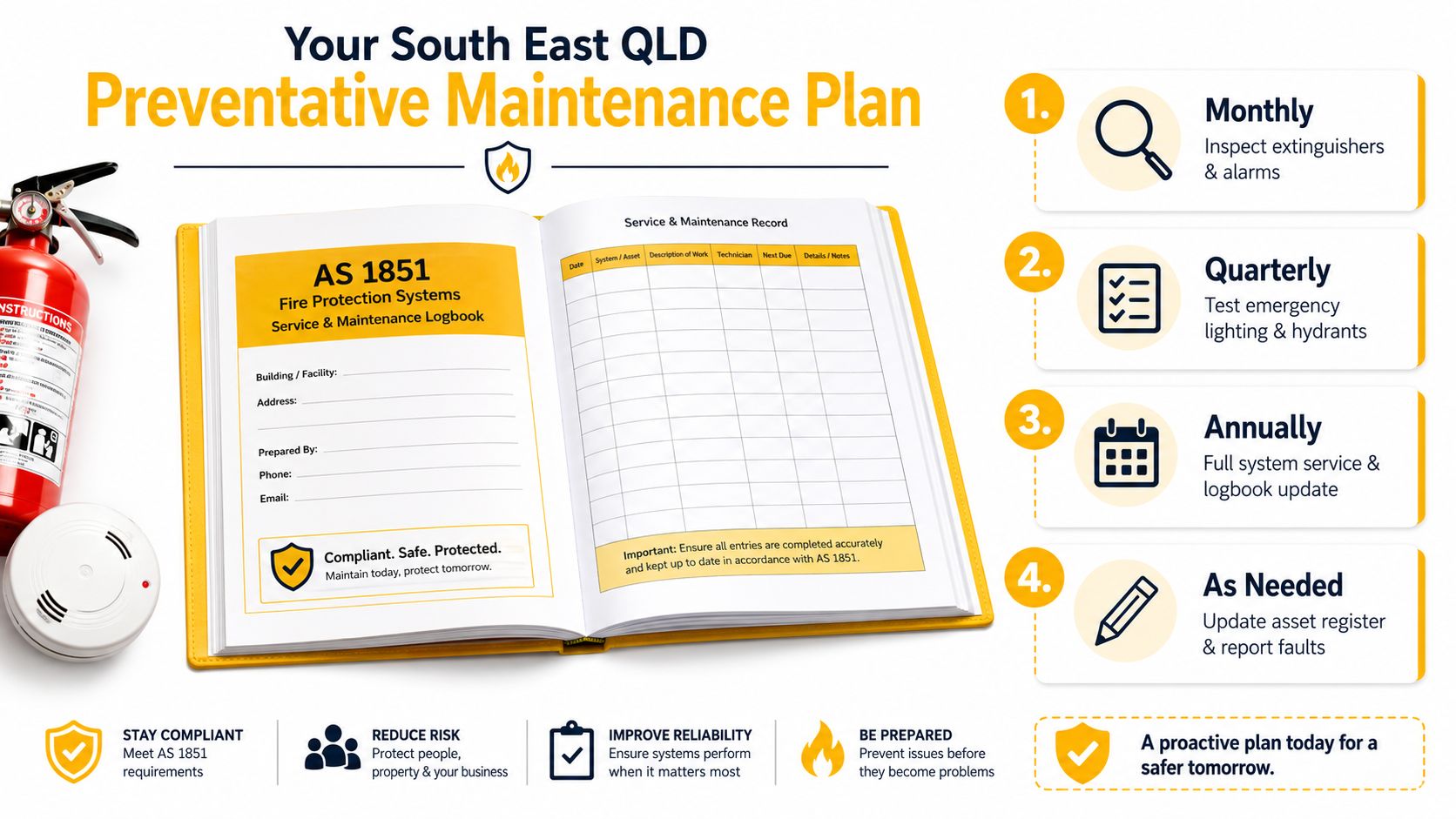
The on-site yellow AS 1851 logbook should cross-reference the asset register rather than duplicate it poorly. Include defect notices, completion records, hydraulic flow results, electrical lighting results, panel fault records, and photographs showing AS 1851-2012 tag changes where those changes apply.
Assign the right person
The person signing an entry must be competent for the work recorded. A QBCC-licensed fire equipment technician may service portable equipment within their authorisation. A hydraulic specialist should complete hydrant, booster, sprinkler, or pumpset work requiring that expertise. An appropriately licensed electrical contractor should handle electrical installation and testing for alarms, emergency lighting, batteries, and related circuits.
The provider's report should name the technician, identify the relevant competency or licence details, list the equipment tested, and separate compliant items from defects. Don't accept a generic attendance note as a substitute for an asset-level record.
From an operating perspective, one coordinated provider can reduce tenant disruption by combining fire, security, and locksmith visits into a planned quarterly access window. That only works when the provider has the appropriate current licences and keeps each trade scope clearly documented. It shouldn't be used to blur who performed or authorised a particular test.
Handle the 2025 transition properly
Existing 2005 logbooks remain valid, but new service entries from 13 February 2025 need to reference AS 1851-2012 for the buildings covered by the Queensland changeover. Tag colours also rotate to the new six-year cycle. Don't discard historical entries. Preserve the old records, mark the transition clearly, and ensure the current register shows which standard governs each new entry.
A practical South East Queensland cadence separates the work instead of forcing every test into one annual visit:
- Monthly: Complete applicable checks for sprinkler systems, pumpsets, smoke alarm sound pressure, and other monthly assets.
- Quarterly: Test applicable exit and emergency lighting functions and schedule site access for recurring checks.
- Six-monthly: Service portable extinguishers and inspect hydrant systems at the required interval.
- Annually: Complete flow testing, duration testing, full system review, and logbook updates.
- 60 days before the statement due date: Run a pre-statement sweep, close defects, reconcile the asset register, and confirm evidence is ready.
A planned program should still allow urgent attendance for a fault or incident. The difference is that the next routine visit is already known, the responsible contractor is identified, and the manager can see whether the defect has been closed.
For managers comparing the lighting intervals with their own site obligations, this emergency lighting testing guide provides a useful reference point.
Pulling It Together and Your Next 30 Days
Structured service fire protection suits strata committees, commercial tenants with floor plates of 200 square metres or larger, aged care operators, and Class 3, 5, 6, 7, 8, or 9 buildings holding a Form 4 annual fire safety statement. The common feature isn't building size alone. It's the need to coordinate multiple systems, tenants, contractors, and records without relying on a last-minute inspection.
Ask every prospective provider five direct questions:
- AS 1851-2012 competency: Can the provider show current training and explain the intervals for the assets on your site?
- QBCC licence class: Which licence covers the proposed fire equipment work?
- Digital logbook access: How will your team view reports, defects, photographs, and due dates?
- Guaranteed visit windows: What access window is reserved for recurring service?
- After-hours pricing: Are emergency callout rates and after-hours charges fixed and documented?
The next 30 days can turn an inherited maintenance backlog into a defensible program.
| Week | Action | Deliverable |
|---|---|---|
| Week one | Audit the current logbook and asset register | Reconciled asset list, open defects, and missing records |
| Week two | Request three comparative quotes | Comparable scope, intervals, exclusions, and pricing |
| Week three | Verify provider QBCC numbers and AS 1851 training records | Licence and competency file |
| Week four | Book the pre-statement sweep and 12-month program | Confirmed service calendar and accountable contacts |
The result isn't a promise that every inspection will pass without a defect. It's a controlled process that finds issues earlier, assigns rectification, and gives the assessor a clear record.
Celtic Fire & Security provides scheduled testing and maintenance for extinguishers, alarms, emergency and exit lighting, hydrants, and related commercial fire systems across South East Queensland, with security and locksmith services available where the scopes can be coordinated. Visit Celtic Fire & Security to discuss an asset-level preventative maintenance program and prepare your site records for the applicable Queensland fire safety statement requirements.
No responses yet