
Commercial CCTV installation in Australia commonly costs AUD 2,500–6,000 for 4–8 IP cameras, while larger commercial systems can reach AUD 8,000–30,000 or more. A small Queensland home setup may sit around AUD 750–2,200, but business pricing rises quickly as camera count, cable runs, storage and commissioning requirements increase.
A business owner in North Brisbane, Moreton Bay or Ipswich often starts with the same assumption: three installers are quoting on the same building, so the prices should be close. Then the proposals arrive. One looks attractively cheap, another costs several thousand dollars more, and the third includes line items nobody expected, such as network equipment, remote access configuration, signage and ongoing servicing.
The difference usually isn't the camera brand alone. CCTV installation cost reflects the whole job, including what the cameras need to see, how far the cabling must travel, how footage will be stored, who configures the system and whether the installation needs to satisfy privacy, body corporate or insurance requirements.
Table of Contents
- Why CCTV Quotes Vary So Much
- The Full Cost Stack Behind Your Quote
- What Actually Drives the Price Up or Down
- Published Price Ranges by System Size
- Queensland Rules That Affect Your Installation
- Sample Budgets for Real South East Queensland Sites
- Smart Ways to Reduce CCTV Installation Cost
Why CCTV Quotes Vary So Much
A retail owner may want four cameras for the entrance, counter, stockroom and rear door. A warehouse may also need four, but those units could sit on long external walls, require difficult roof-space cable runs and identify people or vehicles in poor light. The camera count is the same. The installation, commissioning and maintenance workload is not.
Published Queensland guidance places professionally installed CCTV at about AUD 750–2,200 for a home setup and AUD 2,000–8,500 for a business setup, with commercial pricing affected by camera count, cable runs and storage requirements, as outlined in this Queensland CCTV installation cost guide. Australian guidance also places basic installation around AUD 750–1,270, while more advanced systems start near AUD 1,790. Queensland installation labour has been cited at about AUD 75 per hour, although access, site conditions and system complexity determine the final labour total, according to this Australian CCTV installation pricing guide.
Three quotes can describe three different systems
A low quote may cover visible hardware and a short, straightforward installation. It may leave out sufficient storage, careful camera positioning, remote viewing configuration, privacy signage or a documented handover. On a South East Queensland commercial site, those omissions can appear later as add-on charges.
A higher quote may include better night performance, longer footage retention, managed network equipment, weather protection, commissioning and scheduled servicing. It is not automatically the better choice, but its scope is easier to assess. Check whether monitoring, compliance signage and body corporate approvals are included where the site requires them.
For small businesses, an installed budget of AUD 2,500–6,000 for 4–8 IP cameras is a commonly published range. Per-camera installed pricing is often AUD 400–800, with cable complexity, recorder sizing, night vision and motion analytics driving the spread, as explained by this Australian small-business CCTV cost guide.
Practical rule: Compare coverage, storage, commissioning, compliance items and handover details in each quote, not just the final price.
A commercial quote should show the complete cost stack: cameras, housings, cable, switching, recorders, storage drives, labour, commissioning, remote access, compliance signage, monitoring and maintenance. Separating those items makes a large price difference easier to test and gives body corporate or site managers a clearer record of what they are approving.
The Full Cost Stack Behind Your Quote
Think of the invoice as an iceberg. The cameras are the part above the waterline, but much of the work that determines whether the system performs properly sits underneath.
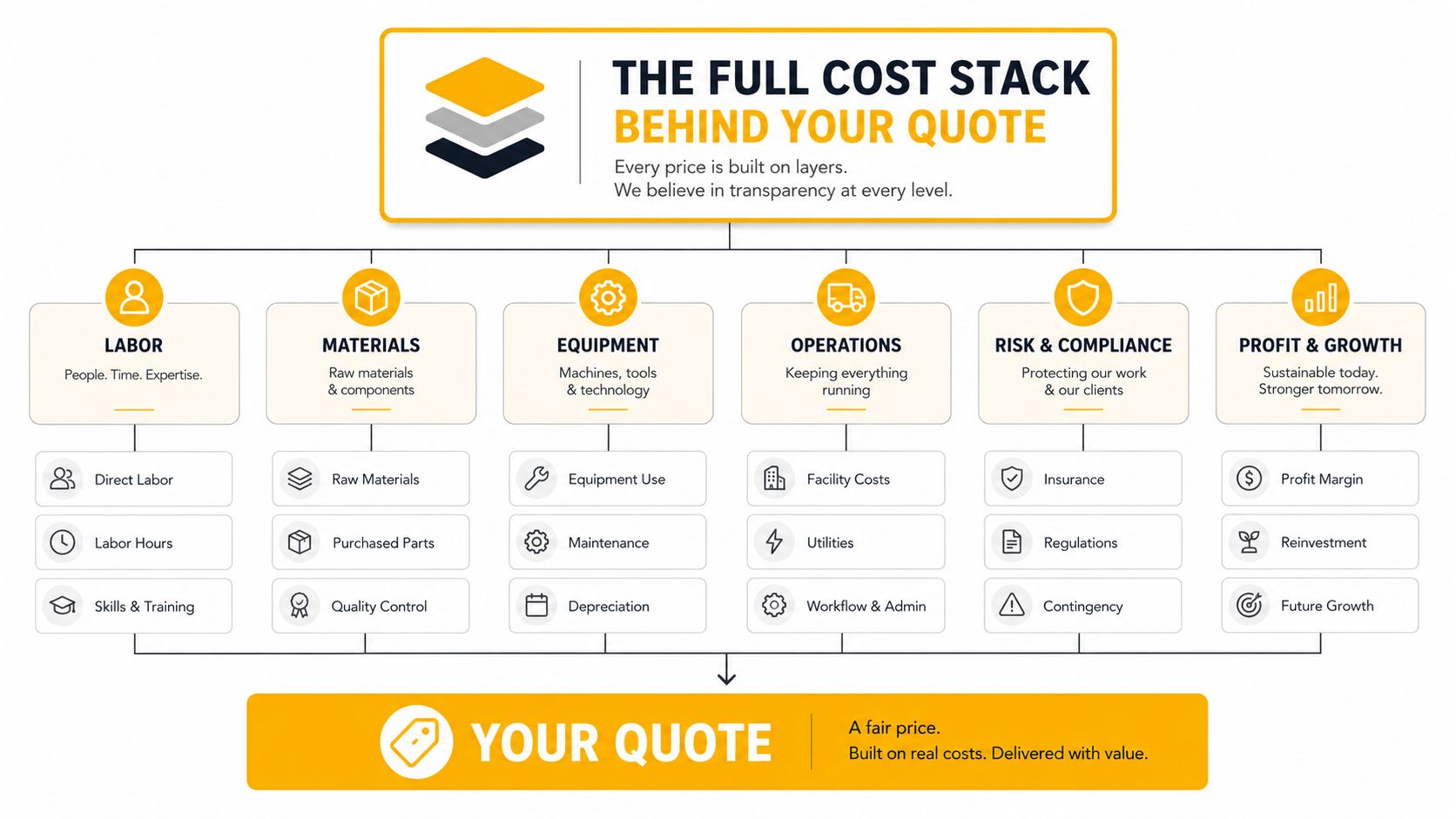
Equipment is only the visible layer
The equipment allowance should identify more than a camera count. Check whether the quote specifies:
- Camera type: Indoor, external, vandal-resistant, varifocal, PTZ or specialist units may suit different locations.
- Image capability: Resolution, low-light performance, infrared or colour-at-night performance affect practical evidence quality.
- Recorder and drives: An NVR must support the proposed IP cameras and the selected storage must suit the required retention period.
- Network hardware: PoE switches, cabinets, patching and surge protection may be needed for a reliable installation.
- Mounting materials: External brackets, junction boxes and weather protection are easy to omit from a simplified equipment list.
A quote that names only “four cameras and recorder” leaves important questions unanswered. You need to know what has been selected for each location and what happens if the existing network isn't suitable.
Cabling and labour sit below the waterline
Cable runs often make a larger difference than business owners expect. A camera near the communications cabinet may be quick to connect, while a camera across a warehouse, separate tenancy or detached building may require more labour, access equipment, penetration sealing and network planning.
Installer labour also covers safe mounting, cable termination, labelling, testing and fault correction. Electrical work and associated testing should be handled under the appropriate current Queensland licences.
Commissioning turns hardware into a working system
Commissioning isn't a token step at the end. The installer needs to set recording schedules, motion zones, image settings, time synchronisation, user permissions, notifications and remote access. The system should then be tested from the operator's point of view.
A badly commissioned system may record empty car parks while missing the doorway, send excessive alerts or provide footage that is difficult to export. That wastes the original investment, regardless of how inexpensive the equipment was.
For businesses that coordinate CCTV with wider site safety work, a provider may also manage related compliance services, such as commercial test and tag services. Monitoring and maintenance should appear as separate quote items, with the service frequency, response arrangements and inclusions stated clearly.
What Actually Drives the Price Up or Down
The biggest pricing mistake is to treat every camera as an interchangeable unit. A camera is part of a chain that includes the view, the lighting, the cable path, the recorder and the person who will review the footage later.

Camera count and image detail
More cameras increase equipment, cable, ports, recorder capacity and commissioning time. Resolution affects both purchase requirements and storage demand. A higher-resolution camera can provide useful detail at a critical entrance, but installing high specification everywhere may spend money on image detail nobody needs.
Night vision and motion analytics add capability, but they also need correct positioning and testing. Analytics are only useful when the scene, lighting and detection zones are configured properly. A camera pointed at moving tree branches can create nuisance alerts rather than useful information.
Cable routes are often the hidden variable
A small entry-point job can remain near the lower end of a published commercial range when the communications equipment is accessible and the routes are short. A single extra camera on a distant wall can cost more than expected if it requires a long cable path, difficult ceiling access or work across multiple buildings.
The same issue appears on body corporate and industrial sites. Shared risers, restricted roof access, external penetrations and separate electrical areas all increase the time needed to install and test the system.
Storage and retention change the equipment load
Storage sizing depends on camera count, resolution, recording method, motion activity and the retention period required by the business. Higher-resolution cameras and longer retention need a larger storage allowance, so the recorder and drives shouldn't be selected after the cameras are chosen.
The practical test is simple. Ask the installer to show how the proposed storage supports the agreed recording settings and retention requirement. If the quote says “standard storage” without explaining the operational result, it isn't specific enough to approve.
A cheaper camera package won't save money if the recorder fills quickly or the footage can't be found when an incident occurs.
Published Price Ranges by System Size
Published Australian ranges are useful for setting a starting budget, but they are not a fixed commercial tariff. Costs change with coverage, access, recording requirements, commissioning and the site's network and electrical conditions.
| System size | Typical installed cost (AUD) | What drives the tier |
|---|---|---|
| Home setup in Queensland | AUD 750–2,200 | Camera count, cable paths, storage and domestic site access |
| Four-camera wired system | AUD 800–2,000 | Basic coverage, recorder, cabling and standard installation |
| Six to eight cameras | AUD 1,500–3,500 | Wider coverage, extra cable runs, recorder capacity and setup |
| Premium four-camera 4K or AI system | AUD 2,500–6,000 or more | Higher-spec cameras, analytics, storage and commissioning |
| Four to eight IP cameras for a small business | AUD 2,500–6,000 | Camera quality, cable complexity, NVR sizing and features |
| Four-camera small-business installation | AUD 2,200–5,300 | Straightforward coverage through to more involved commercial work |
| Eight-camera commercial installation | AUD 5,000–9,000 | Camera count, cabling, recording capacity and commissioning |
| Larger warehouse or body corporate site | AUD 8,000–30,000 or more | Multi-zone coverage, longer routes, multiple NVRs, centralised monitoring and specialist IP, 4K, thermal or PTZ equipment, as outlined in this commercial security cost guide |
A four-camera figure can give the wrong impression for a warehouse. Adding four more cameras may also require extra switching, greater storage, another recorder or more commissioning time. On a body corporate property, shared access arrangements, approval of common-area views and coordination between buildings can affect the final quote even when the camera count appears modest.
Other published guides put larger commercial systems around AUD 3,500–10,000 or more, while Queensland business setups can reach AUD 8,500 depending on scope. Use those figures to set a provisional budget, then obtain a site-specific design before approving the work.
Check the inclusions line by line. A useful quote states whether GST, access equipment, cable containment, network changes, privacy signage, configuration, user training, documentation and future servicing are included. Commissioning and handover matter too. The installer should confirm camera views, recording, remote access, time settings and retrieval of footage, rather than leaving those checks implicit.
A lower equipment price can still produce a higher ownership cost if monitoring, maintenance or replacement storage is excluded. Ask for those ongoing items separately so the initial installation price is not mistaken for the full commercial cost.
Queensland Rules That Affect Your Installation
A commercial CCTV system in Queensland isn't just an electrical and technology purchase. The design must account for how footage is collected, who can access it and whether the property owner or body corporate has approved the proposed camera locations.
AS 4806.2-2006 is the Australian Standard for CCTV application guidelines. It provides recommendations for selecting, planning and installing CCTV systems, including cameras, monitors, recorders, switching, control and ancillary equipment, as described by Standards Australia's AS 4806.2-2006 listing.
Privacy signage belongs in the design
Queensland government privacy guidance treats CCTV footage as personal information when it can identify a person. Agencies using CCTV must comply with Queensland Privacy Principle 3 and QPP 5. For fixed surveillance, the guidance identifies signage near the cameras as the best way to meet QPP 5 notification requirements, according to the Queensland Office of the Information Commissioner camera surveillance guidance.
QPP 5 requires people to be informed about specific matters when personal information is collected. QPP 6 also limits use or disclosure to the original purpose or permitted secondary purposes. A business should therefore decide who can view footage, how exports are handled and how access is removed when staff change.
The Queensland community camera surveillance information sheet also notes that body corporate sites may need approval for exterior camera installation under community management obligations.
Licensing and regional access affect the quote
Use a provider with the relevant Queensland security and electrical licensing for the work being performed. That gives a property manager, insurer or auditor a clearer record of who designed, installed, tested and handed over the system.
Regional travel and site access also affect practical pricing. A project in North Brisbane may have different access conditions from one in Moreton Bay, the Sunshine Coast, Somerset or Ipswich. The quote should identify travel assumptions, access windows and any work that depends on landlord, body corporate or facilities approval.
A cheap quote that ignores signage, approvals, documentation or licensed trade work isn't necessarily a saving. It may just move the cost and risk to the business owner.
Sample Budgets for Real South East Queensland Sites
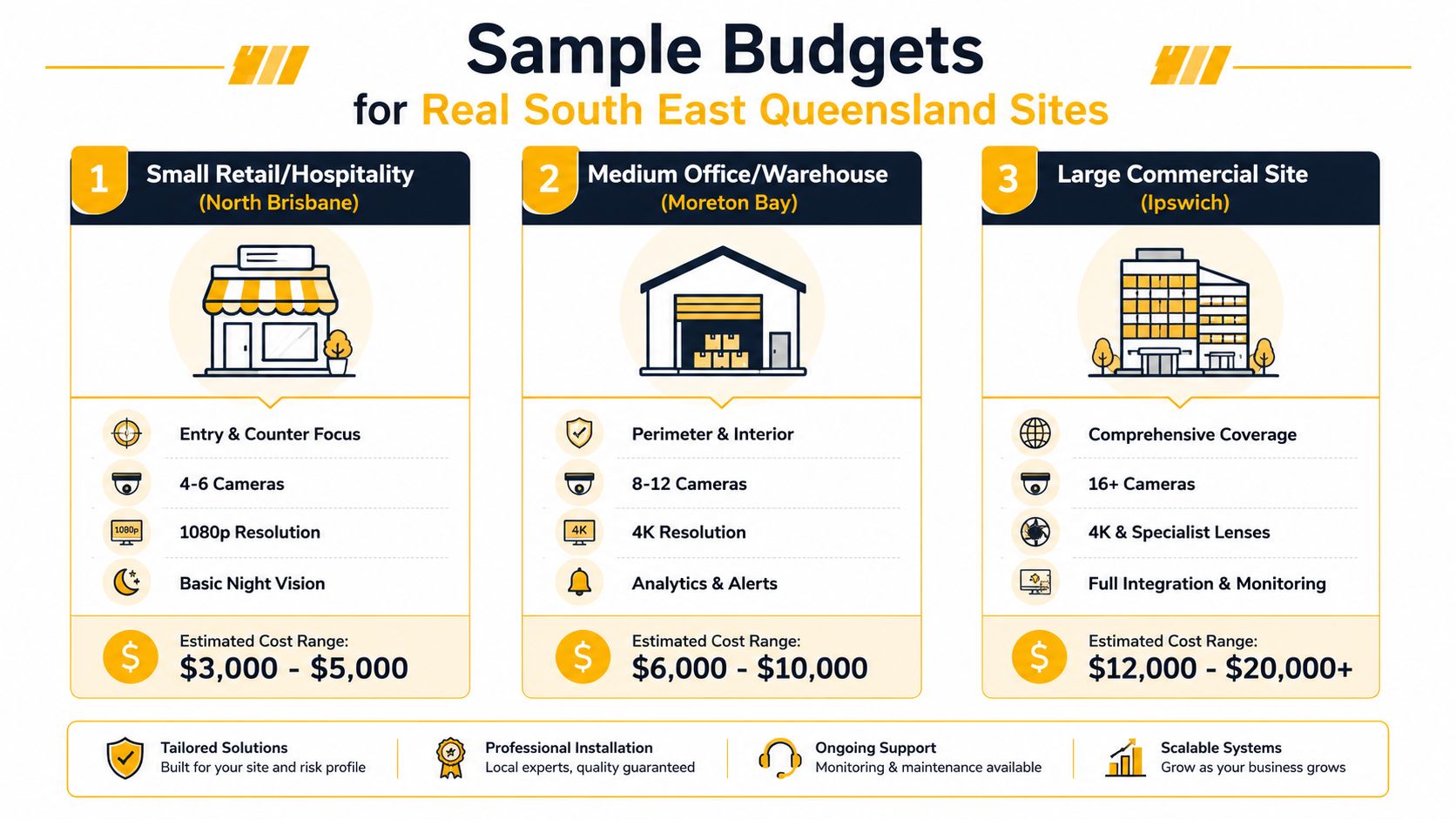
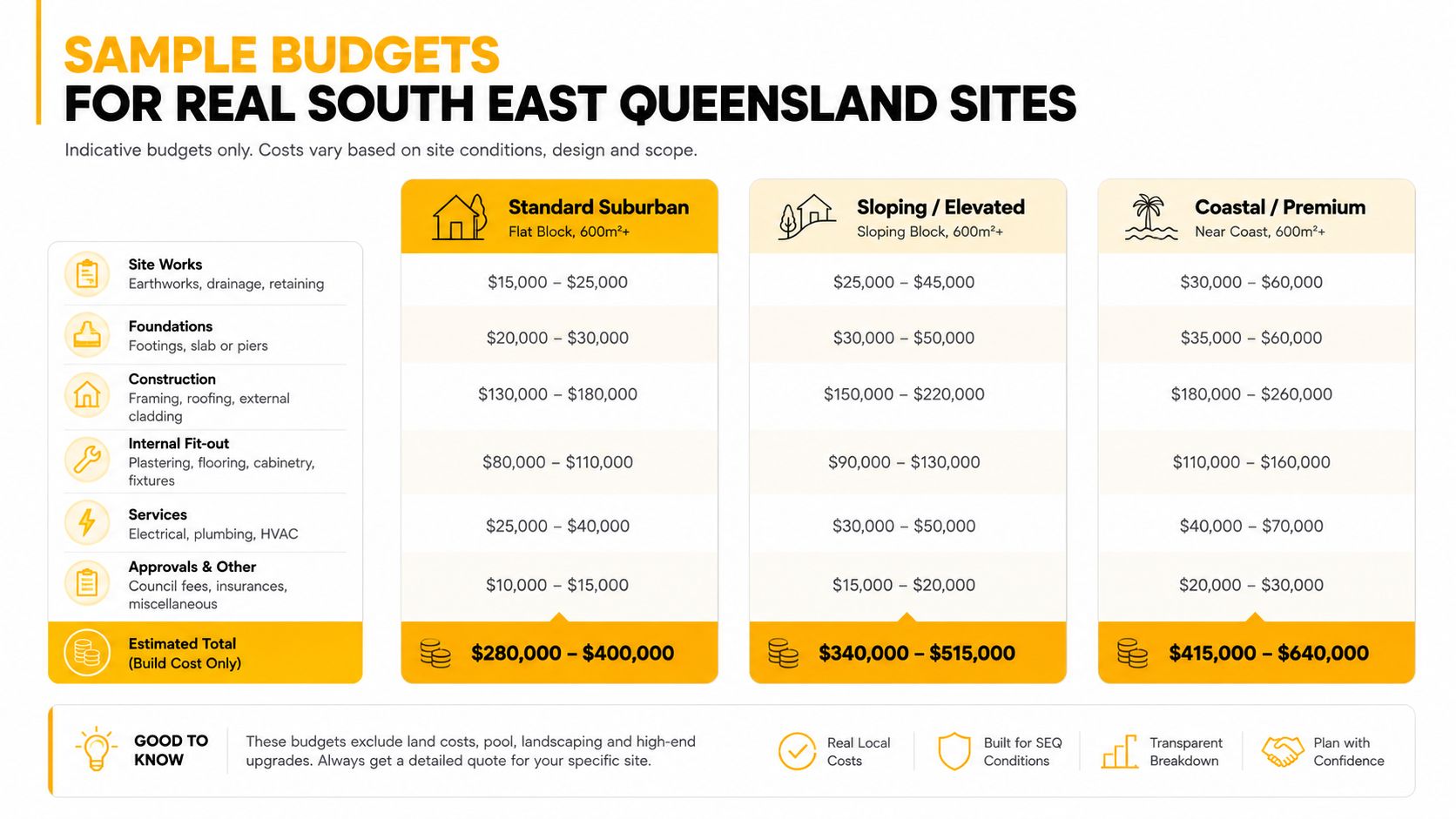
The three examples below are planning scenarios, not fixed quotations. Actual CCTV installation cost depends on the site survey, selected equipment, cable routes, storage requirement and commissioning scope.
Small retail or hospitality site
A North Brisbane or Moreton Bay shop may need coverage at the entrance, point of sale, service counter, stock area and rear access. The cost usually sits toward the lower part of the commercial range when the recorder location is accessible and the camera routes are short.
The common overspend is specifying high resolution across every internal view while leaving the most important external approach poorly positioned. A better design prioritises faces, transactions, doors and movement paths. Basic night vision may be adequate for a well-lit frontage, but the installer should test the view at the time the business operates.
The quote should include remote access configuration, user permissions, signage and a practical handover. Staff need to know how to search footage and export an incident without calling the installer for every request.
Multi-zone office or strata-managed property
A Sunshine Coast or Ipswich office, shared commercial property or strata-managed site often has several different surveillance needs. Shared entries, car parks, corridors, plant areas and loading zones may require different camera types and approval from the body corporate before external installation proceeds.
The cost can move into the middle of the published commercial bands because the design involves more zones, longer routes and additional stakeholders. The main budget risk isn't always the camera count. It can be delayed access, restricted common areas, after-hours work or a requirement to integrate monitoring and user access across multiple occupants.
Property managers should settle ownership of footage, access permissions and maintenance responsibility before installation. A technically sound system still creates operational trouble if no one knows who is authorised to retrieve recordings.
Warehouse or industrial site
A Somerset warehouse may have long cable runs, high ceilings, loading areas, yard approaches and changing light conditions. Higher-specification IP or specialist cameras may be justified at selected locations, but they shouldn't be used as a substitute for a proper coverage plan.
The main cost drivers are access, containment, network design, storage and commissioning. A camera mounted high on a wall may cover a large area, but the useful identification detail may be weak at ground level. Positioning and lens selection matter as much as resolution.
For a commercial project, the commercial CCTV installation service information can help a facilities manager frame the scope before requesting site-specific pricing. Ask each bidder to mark camera locations, cable routes, recorder position and assumptions on the proposal.
Smart Ways to Reduce CCTV Installation Cost
The safest savings come from reducing wasted coverage and avoiding rework. They don't come from deleting the commissioning stage or choosing equipment that can't support the site's real conditions.
Start with the incidents you need to investigate. Prioritise entrances, cash handling points, loading doors, stock areas and vulnerable perimeter sections rather than placing cameras everywhere without a purpose. A smaller, well-positioned system is often more useful than a larger package with blind spots and poor angles.
Practical ways to control the budget
- Plan high-value views first: Use the site layout to identify where a clear face, transaction or vehicle view matters most.
- Phase the work: Install critical entry and internal coverage first, then add lower-priority zones when the budget allows.
- Reuse suitable infrastructure carefully: Existing network or containment may reduce work, but only after it has been checked for capacity, condition and compatibility.
- Coordinate scheduled services: Combining CCTV work with planned security, fire or electrical maintenance may reduce duplicated visits and access arrangements.
- Choose a complete service scope: A provider that supplies, installs, configures and services the system can reduce handover gaps between contractors.
CCTV should also be considered alongside the wider commercial security plan. An alarm system may cover events that cameras only document, so businesses comparing options can review a commercial security alarm system as part of the same risk assessment.
Don't accept false economies. Undersized storage, poor night performance, unlicensed work, missing privacy signage and skipped commissioning can create costs after installation. Before signing, confirm the camera schedule, coverage drawings, cabling assumptions, NVR and storage specification, remote access setup, signage, testing, training, documentation, monitoring and maintenance terms.
Celtic Fire & Security supplies, installs, configures and services commercial CCTV systems for businesses across North Brisbane, Moreton Bay, the Sunshine Coast, Somerset and Ipswich. For a site-specific assessment of your coverage, compliance requirements and ongoing servicing needs, visit Celtic Fire & Security and request a quote.
No responses yet