

A Friday walkthrough in a Brisbane light-industrial tenancy can give a facility manager false confidence. The cabinets are tagged, the paint is fresh, and every green inspection pin appears to show the current month. From the corridor, the site looks compliant.
Then someone removes a unit from the wall. The gauge needle is in the red, the hose crimp has been flattened behind a pallet, and the pull-pin seal is broken because a worker used the extinguisher as a coat hook. A clean service tag didn't reveal any of it.
That's the difference between fire extinguisher testing and paperwork. Under Australia's AS 1851-2012 service framework, testing is a recurring process designed to identify equipment, placement, condition, access and performance problems before an emergency. Queensland sites also need to account for QDC MP 6.1, qualified service personnel and the five-year hydrostatic testing requirement. A practical fire extinguisher check must answer one question: will this specific unit work when a trained person needs it?
Table of Contents
- What a Site Walk Really Tells You
- Inside the Six-Monthly AS 1851 Inspection
- From Six-Monthly to Five-Yearly Service Intervals
- The Failure Risks Testing Is Meant to Catch
- Record-Keeping That Stands Up to an Audit
- Australian Extinguisher Classes and Where They Belong
- When to Call a Licensed Technician
- Putting the Routine Into Practice
What a Site Walk Really Tells You
A site walk tells you what a person can see. A proper service tells you whether the equipment is ready to operate.
The manager in that Brisbane tenancy had done the sensible things. She followed the corridor, checked the tags and looked for obvious damage. The problem was that several failure points sat behind the apparent compliance. The gauge, hose and seal only became clear when the extinguisher was physically removed from its bracket.
That's why I tell Queensland facility managers not to accept a current tag as proof that every risk has been cleared. The tag records a service event. It doesn't replace the technician's inspection of the cylinder, operating hardware, agent condition, mounting and access.
Practical rule: If the unit hasn't been handled, it hasn't been properly assessed.
A useful walk-through should identify:
- Access problems: Pallets, stock, bins and vehicles can block the extinguisher even when the sign remains visible.
- Physical damage: Dents, corrosion, damaged handles, flattened hoses and missing components can prevent operation.
- Pressure concerns: A gauge outside its normal operating band requires investigation, not a new sticker.
- Wrong equipment: Renovations, machinery changes and altered storage can leave an extinguisher unsuitable for the current hazard.
- Tampering: Broken seals, missing pins and disturbed hoses indicate that someone has handled the unit.
The technician's job is to turn those observations into a defensible decision. The result may be continued service, repair, replacement, deeper examination or condemnation. That decision depends on the asset's actual condition, not how tidy the cabinet looks.
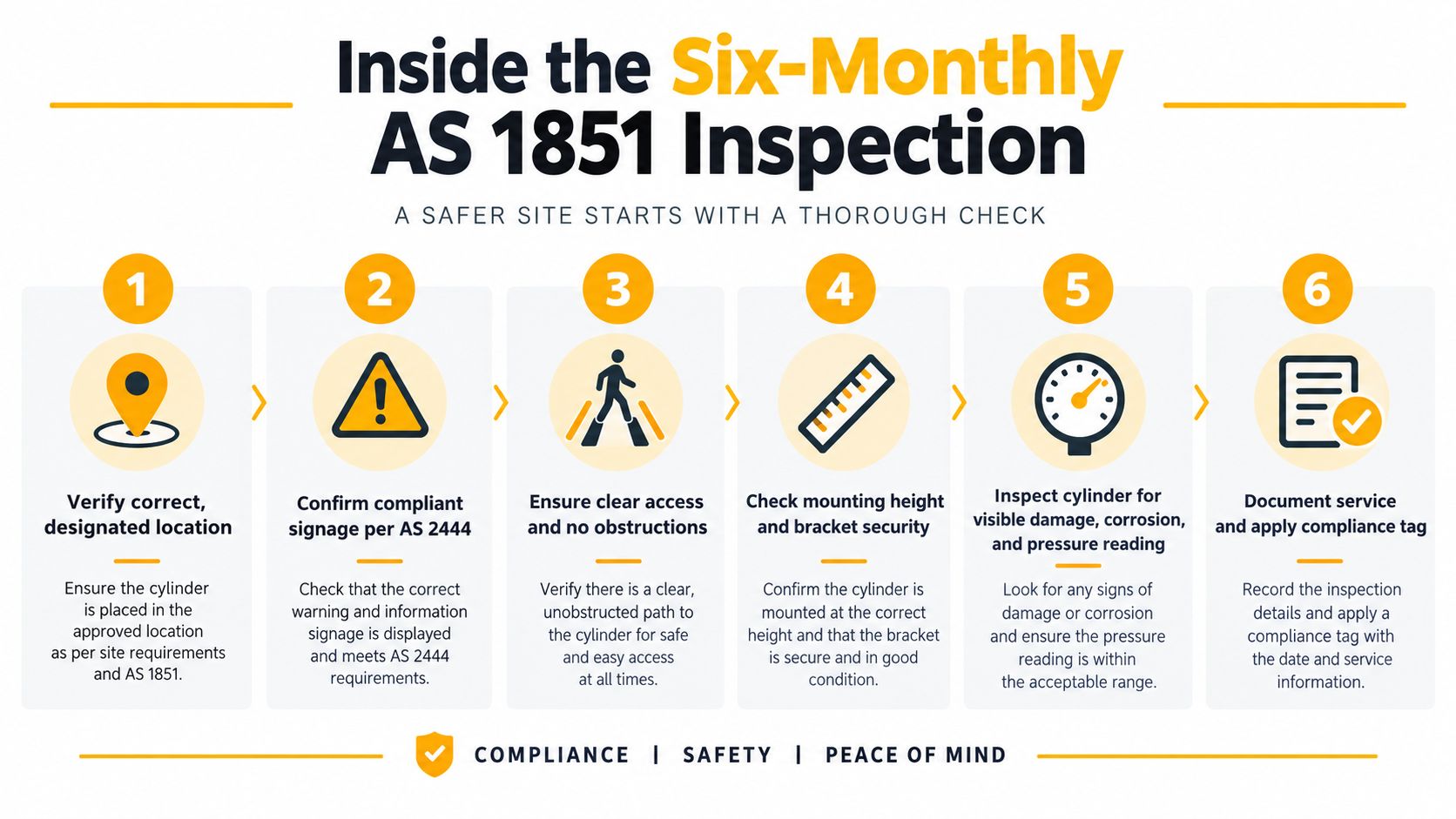
Inside the Six-Monthly AS 1851 Inspection
The six-monthly visit is the core routine checkpoint for portable extinguishers under AS 1851-2012. Standards Australia's listing separates extinguisher servicing into six-monthly, yearly and five-yearly requirements, and Australian maritime guidance also reflects the six-monthly inspection cycle (AS 1851-2012, Australian fire extinguisher guidance).
A competent technician should work through the following checks rather than just replacing a tag.
Start with location and suitability
The extinguisher must be in its designated position, mounted securely and easy to reach. The technician checks that the sign is visible and that the equipment hasn't been hidden by stock, plant or a temporary fit-out change. Signage and placement are considered against the site's fire equipment arrangement and AS 2444 principles.
The unit must also suit the hazard. A water extinguisher beside a flammable-liquid process, or an unsuitable unit near energised electrical equipment, creates a serious operational problem even if the cylinder is mechanically sound.
Check the cylinder and operating parts
The technician examines the cylinder for dents, corrosion, impact damage, coating loss and other signs of deterioration. The handle, valve, hose, horn or nozzle must be intact and unobstructed. Operating instructions need to remain readable.
The pull pin and tamper seal show whether the unit has been disturbed. A broken seal doesn't automatically prove discharge, but it does require investigation. The pressure gauge should sit in the correct operating range, and the extinguisher's weight can be checked against the nameplate where the type and procedure require it.
AS 1851 inspection criteria also address contents and type-specific condition. Dry powder needs to remain capable of free flow, while CO2 units require attention to weight consistency. Stored-pressure units may require a discharge test or pressure-leak check as part of the applicable service procedure. These checks expose problems that a visual glance at the tag won't.
Finish with records, not assumptions
The technician updates the service tag and records the work in the site log book or equivalent digital system. Any defect, corrective action, replacement or follow-up requirement should be clear enough for another responsible person to understand.
The next six-monthly or yearly service slot should be scheduled before the technician leaves. That small administrative step prevents a sound maintenance visit from becoming an isolated event.
The following video gives a visual introduction to the inspection process:
From Six-Monthly to Five-Yearly Service Intervals
AS 1851 uses a staged service rhythm. Each interval goes deeper, so the technician can find failure modes that a shorter inspection cannot expose.
The six-monthly service focuses on condition, charge, pressure, access, mounting, seals, signage, hose and horn. It's the routine opportunity to identify damage, tampering, obstruction and obvious loss of readiness. The yearly service adds more detailed checks for applicable items and may include discharge verification, depending on the extinguisher type and service procedure.
The five-yearly service is the major asset-life checkpoint. The cylinder is emptied, its internal condition is examined, the valve is serviced where applicable, and the unit is refilled and repressurised. The cylinder also undergoes the required hydrostatic pressure testing process. A gauge can appear acceptable while the cylinder has internal corrosion, contaminated agent or another defect that only becomes visible during deeper servicing. The technical overview of AS 1851 fire testing and maintenance sets out the distinction between routine inspection and the deeper five-year service.
| Interval | Key tasks | Risks caught |
|---|---|---|
| Six-monthly | Check condition, access, mounting, signage, seals, pressure and type-specific contents | Obstruction, tampering, visible damage, pressure concerns and unsuitable placement |
| Yearly | Perform more detailed mechanical and service checks, with discharge verification for applicable equipment | Defects not resolved during routine inspection and operational problems requiring closer examination |
| Five-yearly | Empty the unit, inspect internally, service applicable components, hydrostatically test, refill and repressurise | Internal corrosion, compromised cylinder integrity, contaminated or compacted agent and ageing-related defects |
Treat the five-year service as a decision point, not merely another stamp. For some units, replacement will make more sense than refurbishment once labour, parts, certification evidence and the cylinder's condition are considered. A site that keeps an ageing unit in service without examining its internal condition is accepting a risk that the gauge cannot measure.
The Failure Risks Testing Is Meant to Catch
A schedule alone won't protect a site. The technician has to look for the ways equipment becomes unusable.
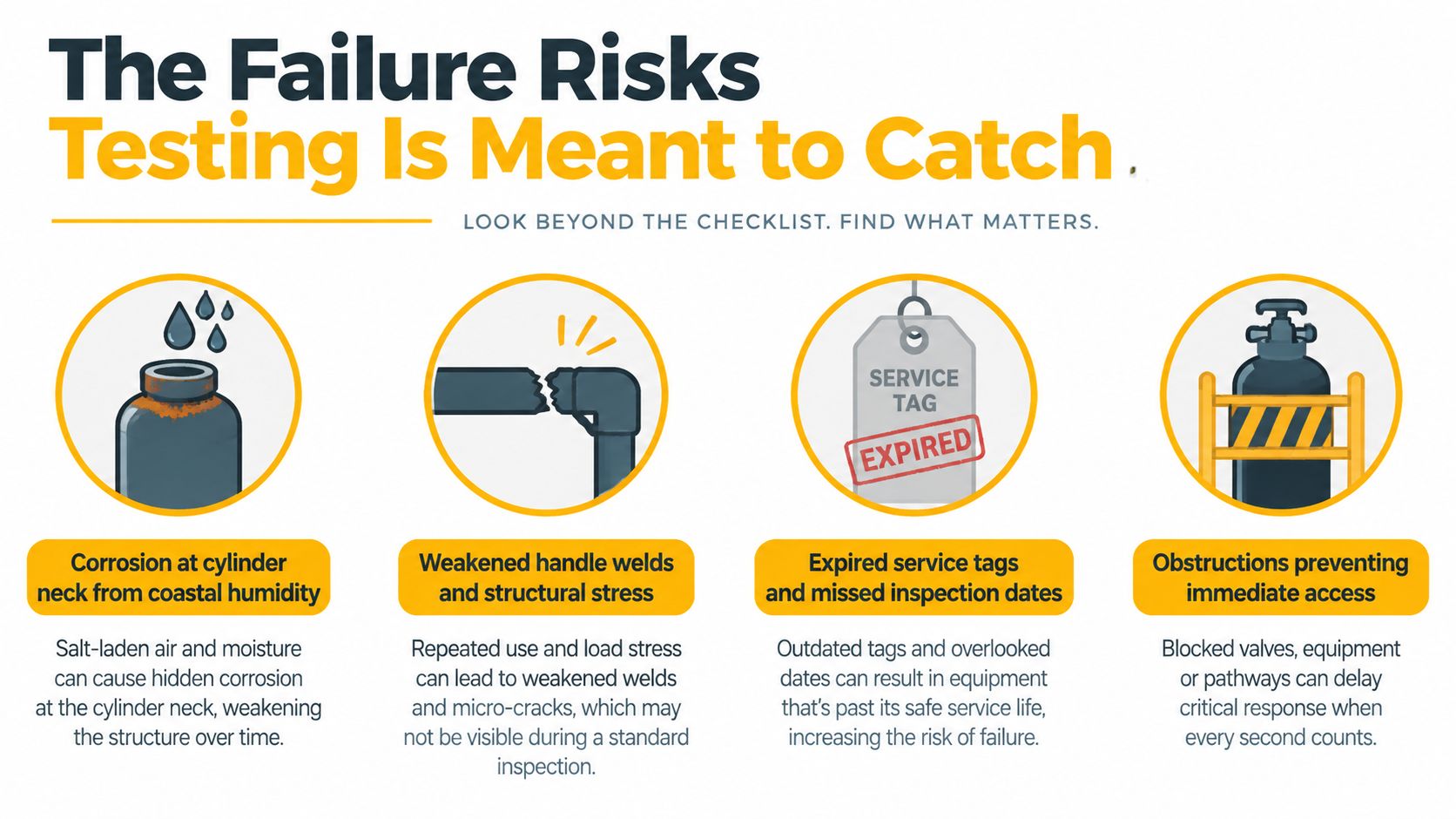
Queensland conditions can be hard on cylinders, particularly around coastal and humid environments. Corrosion may develop around the neck, handle welds or under damaged coating. A painted-over patch can make the cylinder look tidy while hiding deterioration. Pressure can also fall slowly through a valve, O-ring or fitting, leaving the needle outside its normal range or reducing the available charge.
Hoses create another practical failure point. A hose wedged behind a pallet can flatten internally, while age or exposure can make the material brittle. When the operator squeezes the lever, the hose or nozzle may restrict the discharge.
Dry powder needs its own attention. Moisture and storage conditions can cause compaction, which prevents the agent from flowing when the extinguisher is operated. That's why a technician may need to assess weight, condition and agent behaviour rather than relying on the service tag.
Wrong-class selection is the quiet failure. The equipment may be present, tagged and pressurised, but still unsuitable for the hazard. A site with a new cooking process, changed plant room or altered electrical installation needs its extinguisher selection reviewed against the current risk.
The ACCC mandatory standard for portable non-aerosol fire extinguishers strengthens labelling and testing requirements to reduce the risk of products failing to operate correctly, with a 12-month transition period for suppliers (ACCC portable non-aerosol fire extinguishers standard). That product-level change reinforces the point for facility managers: record the specific model and certification evidence, especially when a portfolio contains imported, legacy or mixed equipment.
Testing is valuable only when it exposes a failure risk and produces a clear action.
Record-Keeping That Stands Up to an Audit
Queensland auditors need a traceable maintenance history. A signed tag on a cylinder is useful, but it isn't a complete asset record.
Start with an asset register. Each entry should identify the manufacturer date, capacity, extinguisher class, location and unique asset ID. The register should connect the physical unit to the service record, so a technician or auditor can follow the history without guessing which extinguisher a tag belongs to.
The service record should capture the inspection date, technician identity, findings and action taken. Keep the log book or digital equivalent current, and cross-reference the entry with the service tag fixed to the cylinder. If the technician identifies a defect, the record should show whether the unit was repaired, replaced, removed from service or referred for deeper testing.
Keep the evidence together
| Record | Purpose | Retention |
|---|---|---|
| Asset register | Identifies each extinguisher, its location, class and service history | Maintain for the asset's active life |
| Service tag | Shows the latest service status on the cylinder | Keep attached while the unit remains in service |
| Site log book or digital record | Documents inspection findings, technician details and corrective action | Retain as part of the site's ongoing compliance history |
| Hydrostatic certificate | Demonstrates completion of the deeper pressure-testing process | File with the asset record |
| Discharge and disposal records | Shows what happened to tested, failed or condemned equipment | Retain with the relevant asset history |
Create one controlled folder for service reports, hydrostatic certificates, discharge results, photographs and disposal evidence. Don't leave certificates in a technician's email inbox or split records between an office file and a maintenance contractor's portal.
A well-organised fire safety schedule resource can help managers coordinate extinguisher records with the broader building fire-safety program. The practical test is simple: if an auditor selects one unit from the wall, can you show its identity, service history, defects and current status immediately?
Australian Extinguisher Classes and Where They Belong
Selection starts with the hazard, not the lowest installation price. Under the Australian approach, AS 2444 guides the selection and location of portable fire extinguishers, while the service technician checks that the installed equipment still matches the site's use.
Class A applies to ordinary combustibles such as paper, cardboard, timber and many office or retail materials. Water, foam and suitable wet chemical equipment may be used according to the hazard and product approval.
Class B addresses flammable liquids. Workshops, plant rooms and vehicle maintenance areas may need foam, dry chemical powder or CO2 equipment selected for the specific risk.
Class C covers flammable gases. Hospitality premises using LPG cooking banks need the equipment and placement reviewed around the gas hazard, isolation points and surrounding combustibles.
Class D is specialist equipment for combustible metals. It belongs in operations such as metal machining or other processes where ordinary agents can be ineffective or unsafe.
Class E is used for energised electrical equipment, commonly with CO2 or an approved clean-agent product. Main switchboards, server rooms and electrical plant need a deliberate selection process, especially where sensitive equipment or battery systems are present.
Class F wet chemical extinguishers are intended for cooking oils and fats. Commercial kitchens need them positioned for access to fryers, grills and associated cooking risks.
| Site or hazard | Required class | Typical medium |
|---|---|---|
| Office, retail floor or classroom | Class A | Water, foam or suitable wet chemical |
| Workshop, plant room or vehicle workshop | Class B | Foam, dry chemical powder or CO2 |
| LPG cooking bank or flammable-gas area | Class C | Suitable dry chemical powder |
| Combustible-metal process | Class D | Specialist dry powder |
| Server room or main switchboard | Class E | CO2 or approved clean agent |
| Commercial fryer, grill or cooking canopy | Class F | Wet chemical |
Queensland sites often need a layered arrangement. An office may use water or foam, while the plant room needs powder and CO2, and the kitchen needs wet chemical. The correct combination depends on the current hazards, not the extinguisher types already hanging on the wall. Facility managers can use this guide to Australian fire extinguisher types when reviewing a mixed site, but the final selection should be verified by a competent person.
When to Call a Licensed Technician
Don't wait for a routine appointment if an extinguisher shows a serious defect. Queensland businesses maintaining prescribed fire extinguishers must comply with QDC MP 6.1, and the work must be performed by an appropriately qualified person. Queensland Fire and Emergency Services states that a portable extinguisher with a manufacture stamp older than 5 years must undergo hydrostatic pressure testing by an approved tester (Queensland fire safety maintenance guidance).
Escalate the unit when you find:
- Cylinder corrosion: Corrosion across more than 10 percent of the shell is a technician-level condition under the stated Queensland maintenance guidance.
- Head or valve damage: A seized, damaged or distorted head can stop the extinguisher operating safely.
- Pressure outside the green band: Recheck the reading, then remove the unit from normal reliance if the pressure remains abnormal.
- Any discharge: A unit that has discharged, even partly, needs proper servicing before it returns to the wall.
- Five-year service due: Water, foam and wet chemical units require deeper internal examination and hydrostatic testing at the applicable interval.
- CO2 overhaul point: CO2 cylinders have a 12-year overhaul interval under the service framework described for these units.
Hydrostatic testing isn't a DIY task. It requires appropriate competency, equipment and controlled handling of the cylinder. Repairs, refilling and replacement of parts must be recorded on the compliant service documentation.
Recheck the hazard after site changes
Call a technician when a kitchen gains new cooking equipment, a workshop changes its process, a server room receives new electrical or battery equipment, or a wall is moved. A relocated hazard can make the existing extinguisher class or position unsuitable.
The same applies to imported or legacy stock. Current Australian product standards and certification pathways can affect whether a unit has sufficient supporting evidence. CSIRO's current conformity material indicates that certain older external certifications may no longer be directly accepted for some fire suppression systems, with original test reports and datasheets needed for independent verification (CSIRO fire suppression conformity information).
Routine inspections identify the problem. A licensed technician decides whether the unit can be repaired, tested, replaced or removed.
Putting the Routine Into Practice
A dependable program needs an owner, a register and recurring dates. Start by listing every extinguisher by location, class, capacity, manufacturer date and next service date. Give each unit a unique ID that appears on the physical asset and in the digital record.
Set the service rhythm against AS 1851:
- Six-monthly: Complete the routine inspection of condition, access, mounting, pressure, seals, signage and applicable contents.
- Yearly: Complete the additional detailed checks required for the equipment.
- Five-yearly: Arrange the deeper service, internal examination, refill, repressurisation and hydrostatic testing required for the unit.
- CO2 overhaul: Track the applicable 12-year service point for CO2 equipment.
Put the six-monthly service into a recurring calendar controlled by a named facilities person. Don't rely on a contractor's informal reminder. The responsible person should receive the report, review outstanding defects and confirm that condemned or removed units have been replaced.
Use one practical site checklist
Before each scheduled visit, the facilities team should confirm:
- The asset register matches the extinguishers physically installed.
- Every unit remains accessible and visible.
- Signage is present and readable.
- The class still matches the current hazard.
- No gauge, pin, seal, hose, handle or cylinder shows an obvious problem.
- The technician's report is filed on the day.
- Any repair, replacement or hydrostatic certificate is linked to the correct asset ID.
- The next service date is booked before the current task is closed.
The site walk doesn't replace professional maintenance, and a service tag doesn't replace a working register. Queensland managers who combine the schedule, failure-risk checks and documentation duties give their technicians the information needed to make sound decisions and give auditors a record they can follow.
Celtic Fire & Security supplies, installs, tests and maintains commercial fire extinguishers and scheduled fire-protection systems across North Brisbane, Moreton Bay, the Sunshine Coast, Somerset and Ipswich. Arrange a site review through Celtic Fire & Security to check your extinguisher classes, AS 1851 service dates, hydrostatic requirements and compliance records.
No responses yet