
The power fails during trading hours, the corridor goes dark, and the emergency fittings either respond or they don't. A facility manager can't rely on a quick glance at the exit signs to know which outcome is waiting. A proper emergency light test must show that every relevant fitting activates, maintains its rated output, and has a record that can be traced back to the individual luminaire.
Queensland businesses also need to treat the test as licensed electrical work, not a general maintenance task. The practical standard is moving beyond a simple pass or fail. Facility teams need reliable per-fitting results, clear defect notes, evidence of repairs, and a testing programme that reflects the building's age, layout, and electrical configuration.
Table of Contents
- Understanding Your Compliance Obligations
- Required Testing Frequencies and Durations
- Step-by-Step Discharge Testing Procedure
- Recordkeeping and Logbook Management
- Troubleshooting Common Failure Modes
- Managing Ageing Assets and System Upgrades
Understanding Your Compliance Obligations
Emergency lighting sits within the building safety framework, not outside it. The National Construction Code references AS/NZS 2293.1 for required emergency lighting systems, while AS/NZS 2293.2:2019 sets requirements for periodic inspection and maintenance. Standards Australia describes the maintenance standard as supporting a system that remains ready for operation at all times. You can review the standard's scope through Standards Australia's AS/NZS 2293.2:2019 publication.
For a Queensland commercial premises, the licensing question matters just as much as the test method. Queensland's electrical licensing rules expressly include inspecting or testing emergency lighting systems within work that may be performed by an electrical mechanic licence holder. The Queensland electrical licensing regulation is therefore directly relevant when you appoint a contractor.
Why a visual inspection falls short
A visual walk-through can identify a cracked lens, missing exit legend, damaged housing, or a fitting that's visibly unlit. It can't prove battery endurance. It also can't confirm that the fitting still provides the required illumination along the escape route after the normal supply is interrupted.
The National Construction Code performance framework is concerned with usable emergency illumination, not merely a glowing indicator. Regional guidance commonly specifies 0.2 lux on the centreline of an emergency escape route, with a brightest-to-darkest uniformity ratio of no greater than 40:1, and most systems are expected to operate for about 90 minutes during discharge testing. These benchmarks and the relevant emergency-lighting provisions are set out in the NCC requirements for emergency lighting and exit signs.
Practical rule: A fitting that turns on during a short check has demonstrated activation, not endurance, coverage, or full compliance.
Who owns the maintenance risk
The building owner, managing agent, or facility manager generally controls the maintenance arrangement and must ensure defects are addressed. That responsibility doesn't transfer because a contractor visits the site. The manager still needs to know which fittings were tested, what failed, whether repairs were completed, and whether the repaired fittings were retested.
A documented audit trail protects the site in two ways. It helps an inspector see ongoing maintenance rather than one-off commissioning, and it gives the business a defensible record when investigating a power failure, evacuation issue, or insurance question. A generic certificate with no fitting identifiers leaves too much unresolved.
The safest arrangement is a licensed provider, a defined testing calendar, an accessible logbook, and a defect process that assigns responsibility for repair and retest. That combination is more useful than a contractor who walks through the premises and marks the site as compliant.
Required Testing Frequencies and Durations
The testing calendar under AS/NZS 2293.2 has two important rhythms. The routine programme includes a discharge test every six months and a full-duration test every 12 months, while compliance guidance commonly specifies a 24-hour post-installation check. The purpose is to confirm that emergency luminaires and exit signs remain ready when mains power fails, not merely that they worked when first installed. The testing framework is summarised in this practical guide to how often emergency lighting should be tested.
The schedule at a glance
| Test Type | Frequency | Duration/Benchmark |
|---|---|---|
| Post-installation check | 24 hours after installation, where specified by the applicable guidance | Confirm operation and charging after commissioning |
| Discharge test | Every 6 months | Interrupt normal supply and verify battery operation for the rated duration |
| Full-duration test | Every 12 months | Common benchmark of about 90 minutes for most systems |
| Escape-route performance review | As required by the applicable design and compliance regime | Commonly 0.2 lux centreline illuminance and no greater than 40:1 brightest-to-darkest uniformity ratio |
The wording around the six-month and annual tests needs careful handling. Australian technical guidance describes a six-monthly full-duration discharge test for each emergency luminaire and exit sign, while the broader maintenance rhythm is also commonly expressed as a six-month discharge test followed by a 12-month full-duration test. The practical approach is to follow the applicable edition, asset documentation, certification requirements, and site compliance advice rather than assuming that a shorter functional check is enough.
Duration depends on the governing regime
The 90-minute duration is the common benchmark under AS/NZS 2293.1 for most systems. Older Queensland state fire-safety guidance identifies a 60-minute test duration for systems installed since 1997 under that older regime. The Queensland inspection and maintenance guidance shows why a site manager must verify which requirements apply to the asset's age and governing standard.
The practical sequence remains similar even where the duration differs. The contractor simulates a power failure, checks activation, monitors sustained operation, records failures, restores supply, and confirms recharge. The duration must come from the applicable regime and system documentation, not from convenience.
What the numbers mean on site
0.2 lux is a route-performance benchmark, not a brightness setting on the fitting. It concerns illumination along the escape path, including the centreline, and must be considered with mounting position, obstructions, spacing, and changes made during renovations. A fitting can pass its battery test while the route has become poorly covered after a partition, shelving installation, or altered doorway.
The 40:1 uniformity ratio also matters because a very bright patch doesn't compensate for a dangerously dark section. Facility teams should therefore treat duration, light output, route coverage, and records as connected checks. A calendar reminder alone doesn't prove the system remains suitable.
Step-by-Step Discharge Testing Procedure
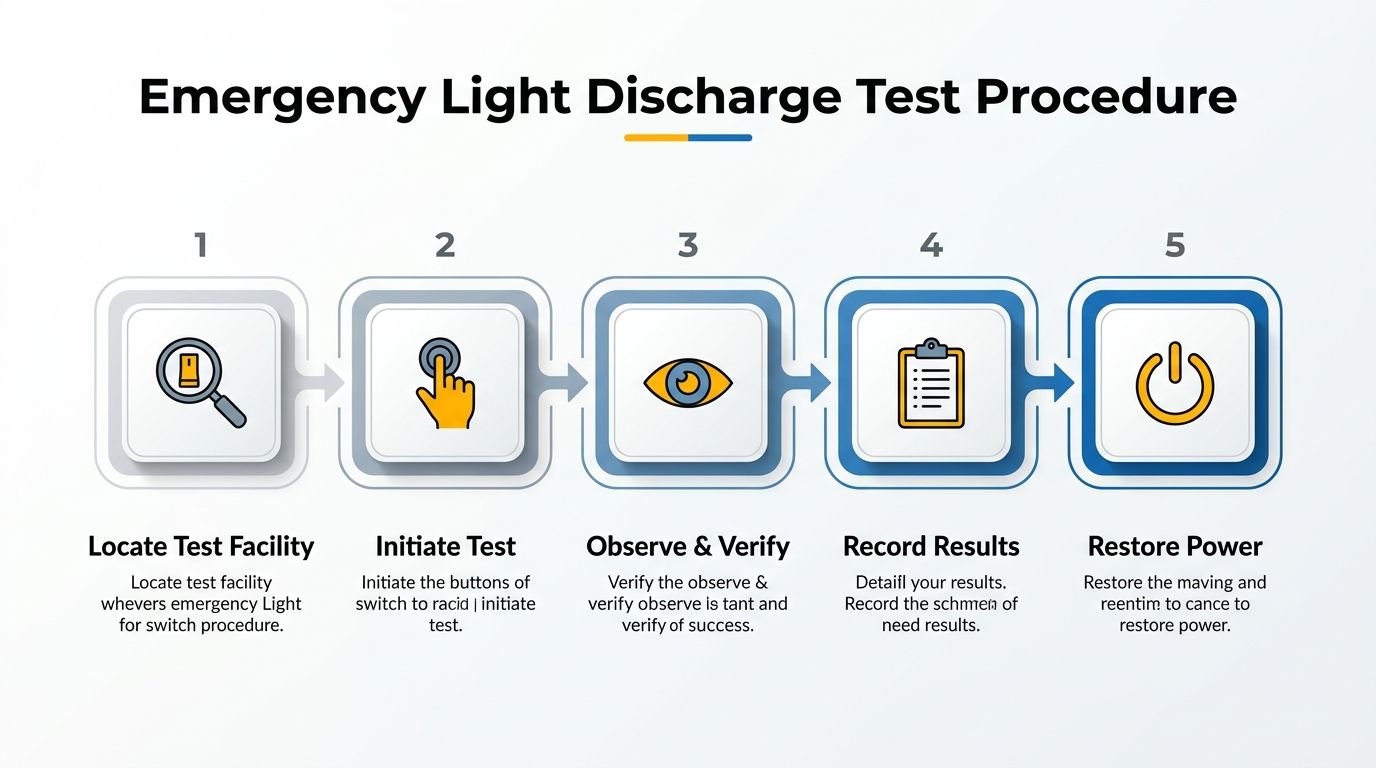
A discharge test should follow a controlled sequence. Before isolating anything, confirm the test facility, identify the affected lighting circuit, review the fitting schedule, and make sure occupants and other site users understand that normal lighting will be interrupted.
Prepare the site before isolation
Start with the marked floor plan or fitting register. It should identify emergency luminaires, exit signs, remote heads where applicable, and the areas covered by each circuit. Without that list, technicians can easily test the visible fittings near the distribution board while missing a remote corridor, storeroom, stair landing, or separately supplied sign.
Check access and operating conditions before starting:
- Confirm the test point: Locate the approved test switch or distribution-board test facility and verify what it controls.
- Protect normal operations: Coordinate the interruption with the responsible site contact, especially in retail, hospitality, medical, industrial, or occupied office areas.
- Inspect the fittings: Look for damaged lenses, blocked heads, poor mounting, missing legends, and visible charge-indicator faults.
- Check the register: Make sure each individual fitting has an identifier or location reference that can be matched to the test record.
Isolate and verify activation
Use the test switch or distribution-board facility to interrupt the normal supply to the emergency lighting circuit. The Australian emergency-lighting testing methodology describes the essential sequence as isolating the circuit, confirming activation, maintaining the discharge for the rated duration, recording failures, restoring power, and verifying recharge.
Walk the entire escape route immediately after isolation. Check each luminaire and exit sign, not just the fittings that are easiest to see. Confirm that the emergency mode activates, that exit legends remain visible, and that no individual fitting has a dark lamp, weak output, damaged head, or failed indicator.
A test is incomplete if the register contains fittings that nobody physically verified.
Monitor the full rated period
Leave the system operating on battery for the full duration required by the applicable standard or asset regime. For most systems, that means monitoring against the 90-minute benchmark referenced in Australian guidance. For an older Queensland installation governed by the relevant older state guidance, the applicable duration may instead be 60 minutes.
During the discharge, record failures by fitting. Note whether a luminaire extinguishes early, dims materially, fails to activate, or has a damaged component. Don't convert a battery failure into a site-wide pass because most fittings stayed lit. The requirement is individual and record-driven.
Restore supply and close the test
At the end of the rated period, restore the normal supply using the approved facility. Check that charge indicators respond correctly and that the units begin recharging. A fitting that survives the discharge but doesn't recharge is still a maintenance concern because it may not be ready for the next outage.
Complete the logbook before leaving the site. Attach defect details, repair recommendations, and retest requirements to the relevant fitting records. If a fitting was repaired during the visit, record the repair and arrange a retest rather than treating the original failed result as resolved.
Recordkeeping and Logbook Management
A pass mark without an identity is weak evidence. AS/NZS 2293.2 is per-fitting and record-driven, so the logbook must show which luminaire or exit sign was tested, what happened during the discharge, and what action followed any failure.
A useful record connects the physical fitting to its location and test result. It should allow another technician, facility manager, or inspector to understand the history without relying on memory or a handwritten note that says only “all good”.
What each entry should capture
Use a fitting register that includes a unique identifier or precise location. For each test, record:
- Test date: Enter the date the test occurred, not the date the invoice was issued.
- Fitting reference: Identify the luminaire, exit sign, remote head, or other tested item.
- Test method: Note the test switch, distribution-board facility, or approved system method used.
- Start and finish: Record the discharge start and the time the fitting failed or the test concluded.
- Observed result: State whether the fitting activated, maintained output, and remained visibly serviceable.
- Defect action: Describe the battery, lamp, driver, housing, signage, mounting, or other issue requiring attention.
- Retest outcome: Record the later verification after repair, rather than deleting the original failure.
A good entry might read: “Exit sign, first-floor eastern stair landing, activated after normal supply interruption, maintained output for the required duration, no visible damage, recharge confirmed.” A failed entry should be equally specific: “Emergency luminaire, loading corridor, activated but output ceased before test completion, battery replacement required, retest pending.” The record should describe the observation, not hide it behind a tick.
Why digital evidence is useful
Digital reporting can improve traceability when it links fitting identifiers, photographs, technician notes, defect status, repair details, and retest results. It doesn't replace the standard or the need for a competent tester, but it reduces the risk of losing loose sheets or confusing one fitting with another.
The fire safety schedule guidance can help facility teams organise recurring maintenance responsibilities alongside emergency lighting records. Keep the current register, previous results, open defects, completed repairs, and relevant installation information together so the compliance history is easy to retrieve.
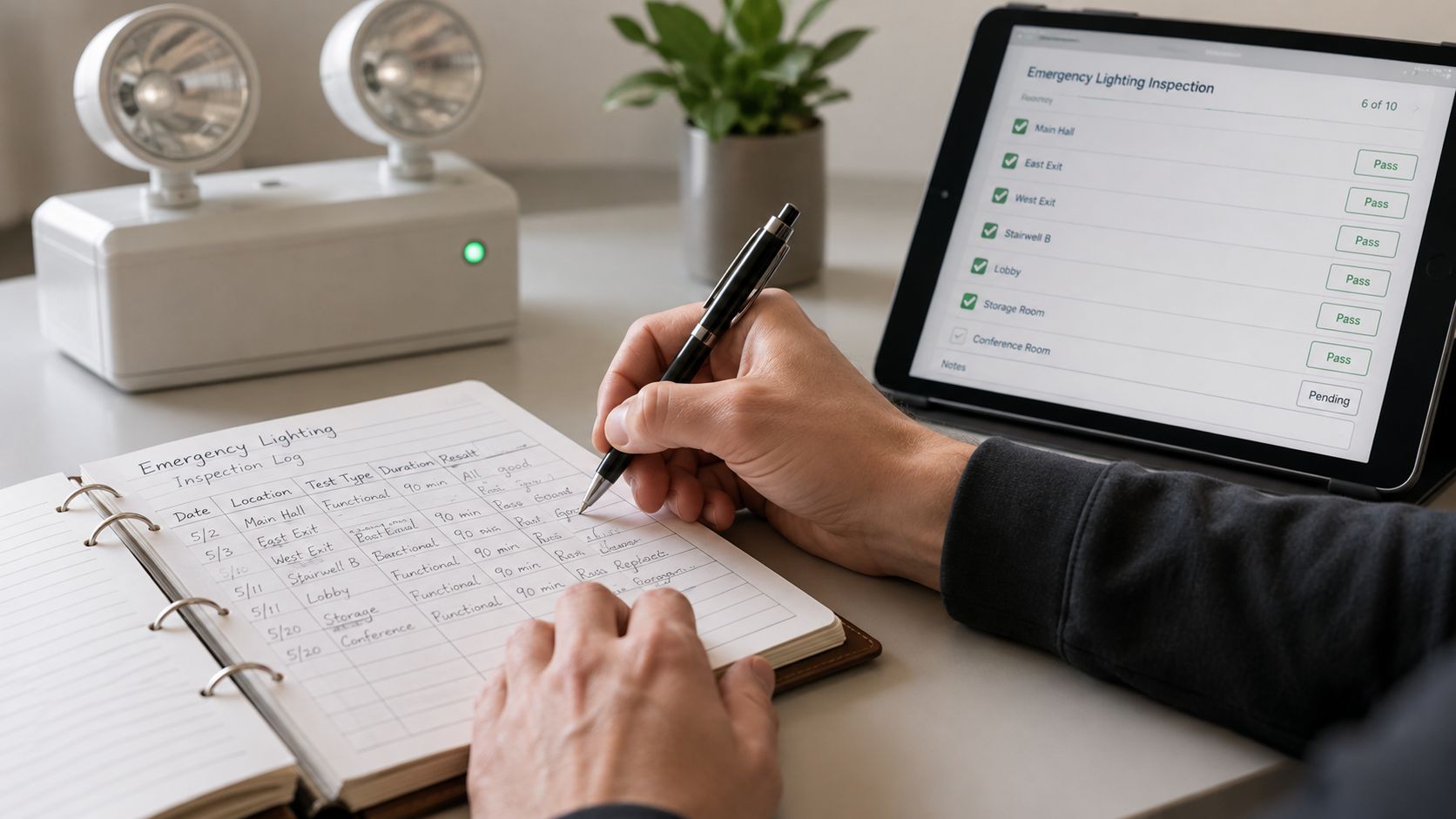
Recordkeeping standard: Don't overwrite a failed result after repair. Preserve the failure, document the corrective action, and add the retest as a separate event.
Troubleshooting Common Failure Modes
A fitting that turns on isn't necessarily a healthy fitting. The most common hidden weakness appears when the battery can support initial activation but can't maintain the emergency load for the full rated period. Battery age, heat, charging faults, incorrect replacement components, and additional remote-head load can all affect endurance.
Start with the failure observed during the test, then investigate the component rather than replacing parts at random.
If the fitting fails during discharge
A unit that activates and then fades or extinguishes early usually needs battery and charging checks. Confirm the battery specification, condition, connections, and recharge behaviour. If the fitting supplies remote heads, verify that the connected load remains suitable for the base unit and that the replacement battery matches the assembly.
A fitting that won't activate at all points to a different group of possibilities, such as a supply-isolation issue, charging circuit fault, failed LED board, driver problem, damaged switch arrangement, or wiring defect. Record the observed behaviour accurately before deciding whether a component replacement is appropriate.
If the light operates but the route remains poor
Light output and route coverage can deteriorate without an obvious electrical failure. Dirt, painted lenses, shifted heads, new shelving, changed partitions, altered mounting positions, and renovated corridors can leave dark areas even when the fitting passes its discharge test.
Review the route after building changes, not only during the scheduled battery test. The Australian guidance on AS/NZS 2293 emergency escape lighting and exit signs highlights the need to consider broader system review, end-of-life issues, and longer-term assessment rather than treating routine testing as the entire compliance strategy.
Battery replacement or luminaire upgrade
A battery replacement may be sensible when the housing, optics, charging circuit, mounting, and product support remain suitable. A complete luminaire upgrade becomes more appropriate when the unit has repeated failures, obsolete components, damaged construction, poor coverage, or an installation that no longer suits the renovated space.
Don't fit an unverified replacement battery just because its physical size appears similar. Confirm voltage, capacity, compatibility, and the effect of any connected load, then complete the required discharge test and record the outcome.
Managing Ageing Assets and System Upgrades
Routine testing finds immediate failures, but it doesn't answer every asset-management question. Australian compliance discussions increasingly refer to 10-yearly assessments, end-of-life review, and broader checks of ageing systems. Those reviews are particularly important after fit-out changes, load growth, altered escape routes, or repeated battery and driver failures.
Self-contained units need individual attention because each fitting carries its own battery and charging arrangement. Central-battery systems require a system-level view, including distribution, connected loads, remote fittings, and the condition of the central supply. A renovated building may also need a fresh review of mounting positions, visibility, route coverage, and illumination rather than a simple continuation of the old register.
For South East Queensland sites, appoint a contractor who can demonstrate the relevant Queensland electrical licensing, understands AS/NZS 2293, records results per fitting, and can manage repairs and retesting. Celtic Fire & Security provides emergency and exit lighting testing, maintenance, and compliance reporting as part of its commercial fire protection services, described through its fire protection service offering.
Celtic Fire & Security can inspect emergency and exit lighting, complete discharge testing, document per-fitting results, and report defects requiring repair or retesting. Visit Celtic Fire & Security to arrange a compliance-focused service for your North Brisbane, Moreton Bay, Sunshine Coast, Somerset, or Ipswich site.
No responses yet