
A strata manager in Brisbane receives a contractor's service report and sees “fire extinguisher testing completed”. The tags are in place, the units look clean, and the maintenance calendar shows an annual visit. Then someone asks when the cylinders were last pressure tested. Nobody can answer immediately.
That confusion is common because fire extinguisher testing under Australian Standards doesn't mean one isolated check. For Queensland commercial premises, compliance involves routine inspections, scheduled servicing, preventive maintenance, pressure testing, tagging and records that show what happened to each unit.
Table of Contents
- Introduction to Fire Extinguisher Compliance
- Overview of Key Australian Standards
- Inspection and Testing Intervals Under AS 1851
- Detailed Maintenance Requirements and Procedures
- Pressure Testing and Requalification Rules
- Documentation and Recordkeeping Obligations
- Signage and Location Requirements
- Practical Compliance Checklist and Quick Reference
- Cross References to Related Regulations and Resources
- Glossary of Key Terms
- Related Resources and Standards Index
Introduction to Fire Extinguisher Compliance
A facilities manager may see an extinguisher mounted correctly, unobstructed and free from obvious damage. That check helps identify immediate problems, but it does not satisfy the structured maintenance obligations under AS 1851.
Queensland guidance requires a portable extinguisher with a manufacture stamp older than 5 years to undergo hydrostatic pressure testing by an approved tester. AS 1851-based practice also requires inspection, tagging and punching every 6 months. Compliance therefore involves routine condition checks, scheduled servicing and periodic pressure testing, not one annual contractor visit.
Practical rule: A current service tag does not confirm that the cylinder is clear of its five-year requalification requirement.
What “tested” should mean on a QLD site
Facility managers should ask for evidence against each asset, not rely on a general statement that the extinguishers were tested:
- Is every unit identified and mapped?
- Was the six-monthly inspection completed and recorded?
- Was the yearly service performed by an appropriately licensed provider?
- Is the manufacture or requalification history recorded for each cylinder?
- Are the tags, service reports and corrective-action records available?
This process applies across offices, retail tenancies, restaurants, warehouses, industrial workshops and strata buildings. A contractor invoice may show that someone attended the site, yet still fail to show what happened to each extinguisher. Asset-level records make defects, overdue testing and unresolved actions visible.
Fixed service intervals address changes that can occur between visits. An extinguisher may become obstructed, damaged, discharged or unsuitable for its location. A planned inspection calendar gives the building owner, body corporate or facility manager a repeatable method for finding those changes and arranging the correct response.
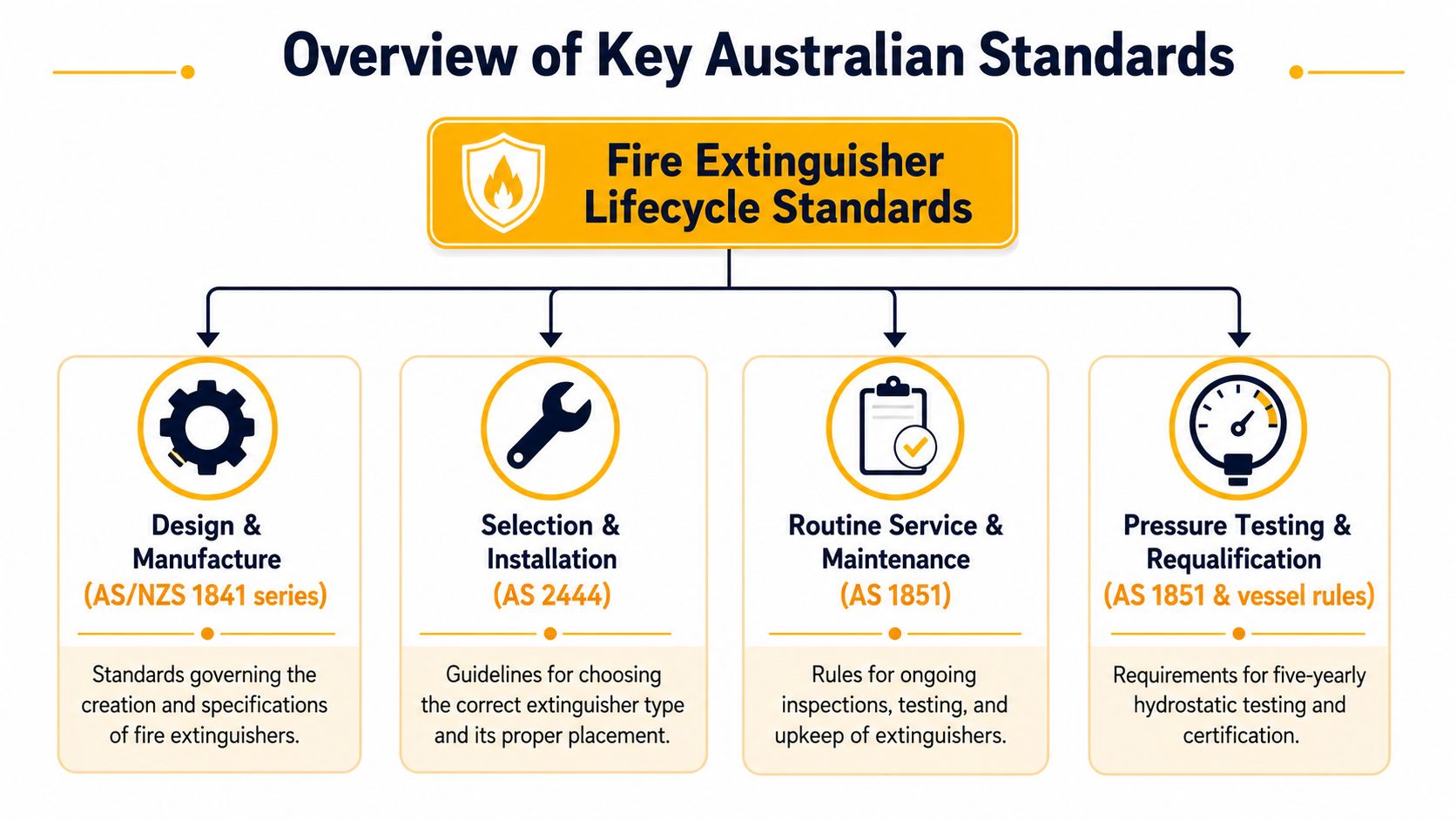
Treat the compliance process as a connected chain. Product standards address manufacture and performance. AS 2444 covers selection and location. AS 1851 governs in-service inspection, testing and preventive maintenance. Tags, reports and corrective-action records connect those duties to evidence that can be checked during an audit or incident review.
Overview of Key Australian Standards
A Queensland facility can have an extinguisher with a current service tag and still carry a compliance gap. The product may be unsuitable for the hazard, positioned incorrectly, or maintained without the evidence required under the applicable standard. Australian compliance works as a connected system, with different standards covering manufacture, selection, location and in-service maintenance.
Manufacture and product performance
The AS/NZS 1841 series sets requirements for the manufacture and specification of portable fire extinguishers. It addresses the equipment as a product, including requirements manufacturers must meet for particular extinguisher types.
The related AS/NZS 1850:1997 standard sets type tests for extinguishers made to AS/NZS 1841. These tests assess the extinguisher's fire-extinguishing capability. The Commonwealth mandatory standard for portable non-aerosol fire extinguishers, updated in 2021, covers materials and construction design, performance requirements, and identification colours before products enter the market.
Product approval is the first control point. It does not confirm that a unit remains suitable after installation, exposure to site conditions, or ongoing use. Those issues fall within the in-service maintenance process.
Inspection and preventive maintenance
AS 1851 provides the main framework for inspection, testing, preventive maintenance and survey of fire protection systems and equipment. For portable extinguishers, it establishes the servicing activities that commercial premises must schedule, assign and record. Its current edition was published on 3 December 2012.
A service tag alone does not show the full compliance position. The facility manager should understand which activity was completed, which defects were found, and whether the provider's report supports the required action. Six-monthly inspections, yearly servicing and five-yearly requalification have different purposes. The relevant work must be assigned to a licensed or accredited provider where the applicable guidance requires that level of competence.
Selection and location
AS 2444 covers the selection and location of portable fire extinguishers. The correct equipment depends on the extinguisher classification and rating, the hazards in the area, and the access routes occupants may need to use.
A Queensland commercial site may include a kitchen, electrical switch room, office and workshop within the same tenancy. These areas should not be treated as identical. The extinguisher type, rating and position must match the risks present, while remaining visible and accessible.
The result is a three-part compliance chain. AS/NZS 1841 and AS/NZS 1850:1997 address product manufacture and testing. AS 2444 addresses selection and location. AS 1851 addresses ongoing inspection and maintenance. Checking only the tag can leave a facility manager unaware of a product, placement or hazard-selection problem.
Inspection and Testing Intervals Under AS 1851
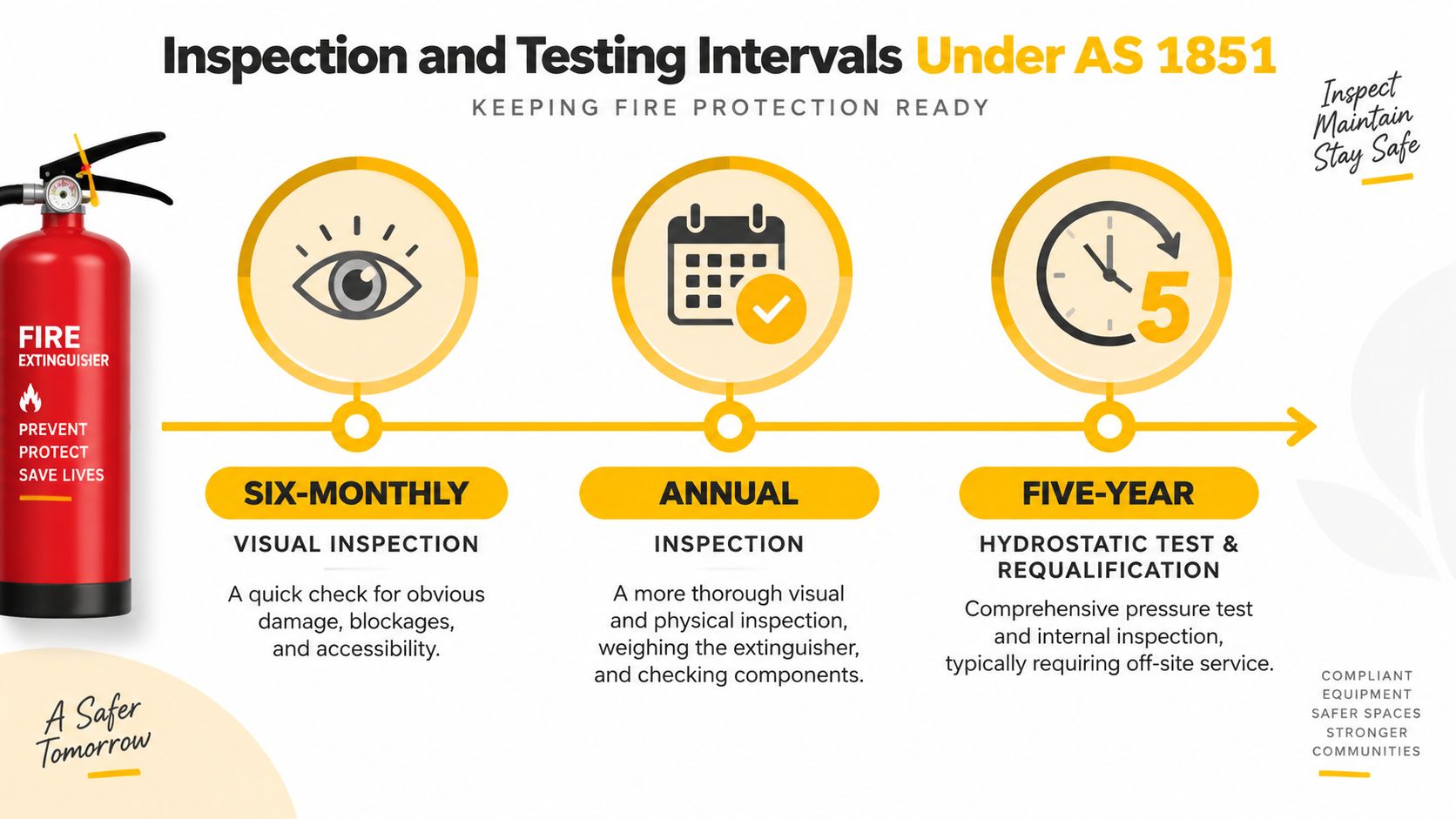
A Queensland facility manager can have a current service tag and still miss a formal AS 1851 obligation. The practical fix is to separate the three service points, assign each task, and retain evidence of the work. A six-monthly inspection does not replace annual servicing, and annual servicing does not replace five-year requalification.
Six-monthly inspection
Portable extinguishers must be inspected, tagged and punched every 6 months as a minimum under Queensland fire safety guidance. The inspection checks for obvious damage, obstruction, tampering, poor access and other visible equipment issues. Record the result in the site register as well as on the extinguisher.
Set the responsible person and due month before the inspection falls due. That person may not be competent to perform technical work, but must be able to identify a problem and escalate it. A unit blocked by stock, missing from its bracket or visibly damaged needs documented corrective action from the building's responsible manager.
Yearly service
The yearly service requires a more detailed examination by an appropriately licensed or accredited provider under the applicable AS 1851 guidance. The provider assesses the extinguisher's condition and operation, completes the required preventive maintenance, and updates the service documentation.
Use the asset register to schedule annual work instead of relying on a contractor's general reminder. This approach exposes access issues early, including locked plant rooms, kitchens, tenancies and other restricted areas in strata or multi-tenant buildings.
Five-year requalification
Five-year requalification involves more extensive treatment of the pressure vessel. Depending on the equipment and required procedure, the work can include discharge, disassembly, internal inspection, hydrostatic testing, drying, reassembly and recharge. Arrange temporary replacement units if extinguishers must leave the premises.
The fire safety schedule planning guide helps coordinate extinguisher dates with other recurring building safety tasks. The provider's service documentation remains the evidence for each extinguisher and each completed interval.
For a mid-size office, place six-monthly dates in the facilities calendar, book annual servicing before its due period, and flag five-year dates separately. Create distinct tasks rather than one generic “fire extinguisher testing” reminder. Staff can then see which work is due, who owns it, and what records the provider must produce.
Detailed Maintenance Requirements and Procedures
A Queensland facility can pass a casual visual check while still missing an AS 1851 service obligation. Assign the site team and service provider different responsibilities, then track each extinguisher against its location, identification details and service history. Staff should keep access clear and report visible faults. Technical servicing, recharging and pressure-related decisions require a competent, licensed provider.
Six-monthly field checks
Start with the asset register, then inspect the surrounding area before handling the unit. Confirm that each extinguisher is present, identifiable and reachable.
The inspection should confirm:
- Access remains clear: Stock, furniture, pallets and cleaning equipment must not obstruct occupants.
- The body appears sound: Check for dents, corrosion, damaged paint, leakage and other visible deterioration.
- Labels remain readable: Operating instructions and identification markings must be legible.
- The hose and nozzle are serviceable: Look for damage, contamination or blockage.
- The pin and tamper seal are intact: A broken seal or missing pin requires escalation and assessment.
- The pressure indication is acceptable where fitted: A gauge outside its operating range needs professional attention.
Record the result, update the service tag and mark the applicable service indicator. If the extinguisher fails, take it out of service, provide a suitable replacement and record the corrective action. Do not leave a suspect unit in place where occupants may assume it is ready.
Yearly preventive maintenance
Annual servicing examines more than the cylinder's exterior. The provider checks the operating mechanism, confirms the unit's condition and performs maintenance suited to its type. Powder units require agent-specific attention so the powder remains free-flowing. Liquid units need confirmation that the agent can discharge without restriction. CO2 units require charge verification by weight.
The fire extinguisher servicing guidance explains how inspection, maintenance and documentation relate in commercial premises. Select a provider that can show the relevant licence or accreditation and supply an asset-level report.
A replacement tag does not prove that every required task was completed. It forms part of the evidence, while the service report identifies the extinguisher, date, work performed and outcome. Retain that report with the building's maintenance records and reconcile it against the asset register. This recordkeeping step exposes missing units, overdue work and access problems before the next service interval.
Pressure Testing and Requalification Rules
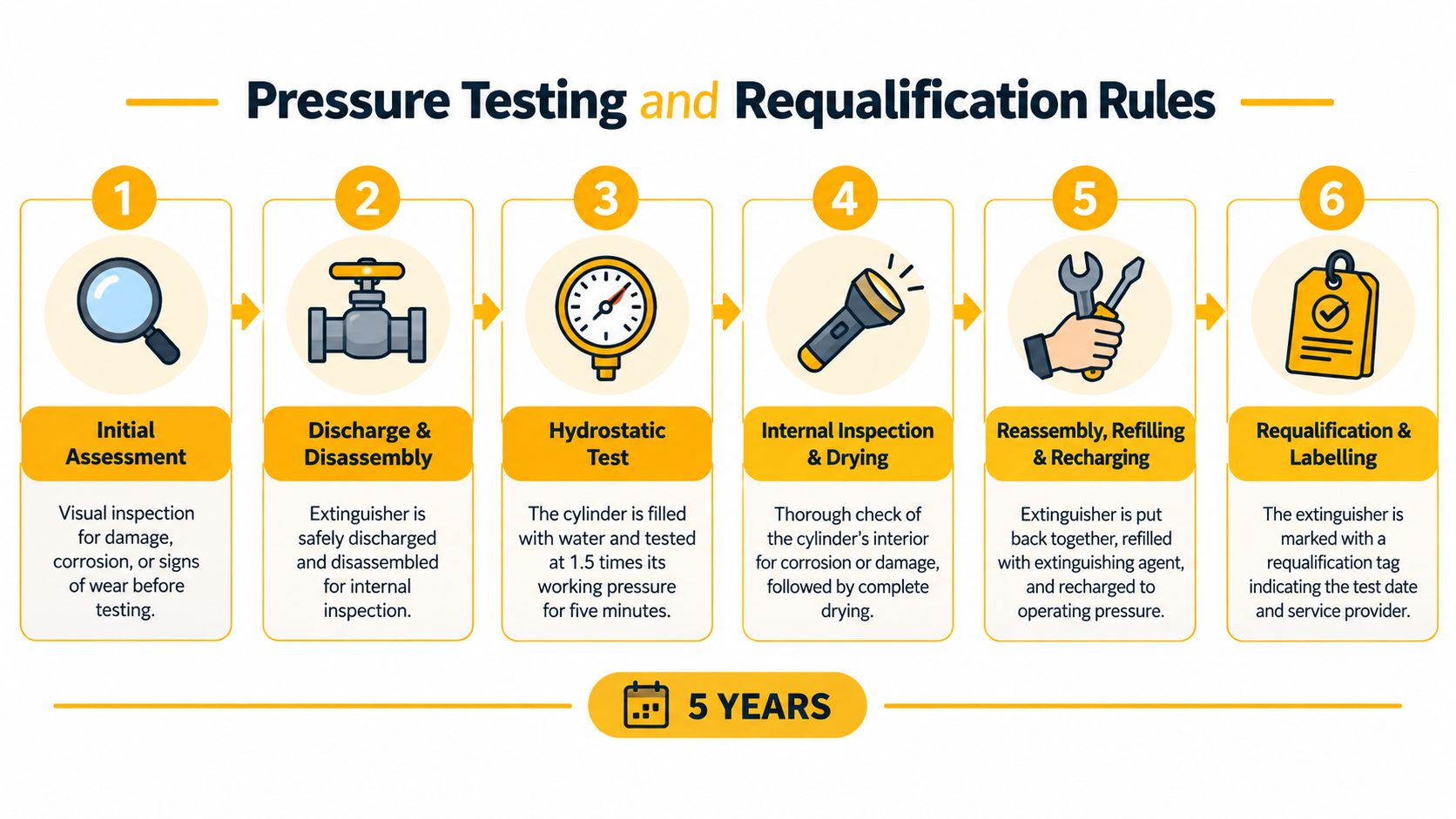
A five-year service tests whether an extinguisher's pressure vessel remains fit for use. It also confirms that the agent and components can be safely returned to service. For Queensland facility managers, the hidden gap is assuming a current service tag proves compliance. Requalification requires a documented test, outcome and follow-up action.
The test pressure
AS 1851 maintenance guidance specifies hydrostatic testing at 1.5 times the working pressure, the marked periodic test pressure, or 2 MPa, whichever is greater. The provider must confirm the applicable benchmark from the cylinder markings and relevant requirements.
The extinguisher is normally emptied and disassembled before inspection. The technician examines the interior and exterior for corrosion, deformation or other damage that may affect vessel integrity, then performs the hydrostatic test with suitable equipment. A failed vessel must not return to service.
Refill and agent checks
After testing, the vessel must be thoroughly dried before reassembly and recharged to its specification. The agent also needs checking. Powder should remain free-flowing, liquid agent should discharge without restriction, and CO2 charge verification is performed by weight.
Plan for units to be removed from service and confirm how coverage will be maintained during the work. The final record should identify the extinguisher, test result, requalification date, defects or corrective action, and service provider. Retain that evidence with the asset register so overdue or failed units are visible before the next interval.
Documentation and Recordkeeping Obligations
A compliant extinguisher program needs a record for every unit, not just a folder of invoices. The record should allow a manager to answer four questions quickly: what equipment exists, where it is, what work was completed and what defects remain open.
Build an asset-level register
Start with one register covering every portable extinguisher. A spreadsheet can work for a small site if staff keep it current. A facilities platform may suit a larger portfolio where multiple buildings, contractors and due dates need central control.
Useful fields include:
| Register field | What it should identify |
|---|---|
| Asset ID | A unique code for the individual extinguisher |
| Location | The room, tenancy or area where it is installed |
| Type and rating | The Australian extinguisher type and its marked rating |
| Manufacture details | The markings used to track requalification timing |
| Six-monthly outcome | Inspection date, result and corrective action |
| Yearly service | Provider, date, work completed and report reference |
| Five-year status | Pressure-test result, requalification date and label |
| Current condition | In service, removed, repaired or replaced |
Link photographs, service reports and defect closures to the same asset ID. If a unit moves from a reception area to a workshop, update the register and check whether its selection remains appropriate for the new hazard.
Make the audit trail usable
Paper tags remain important at the equipment location, but they can be damaged, obscured or separated from supporting paperwork. Electronic records make it easier to search by building, date, asset or outstanding defect, while a paper backup may still be sensible for sites with limited connectivity.
Each inspection record should show:
- Who completed the work
- When it occurred
- What was inspected
- Whether the result passed or failed
- What defect was found
- Who was assigned the correction
- When the correction was closed
- Which provider completed technical work
Recordkeeping principle: A tag proves that information was placed on the extinguisher. A complete service report explains what the technician actually did.
Don't delete superseded records when a unit is replaced. Keep the old asset history, link the replacement to the location and record the reason for the change. That preserves a defensible maintenance story for the building.
Signage and Location Requirements
A correctly serviced extinguisher still fails its practical purpose if occupants can't find it quickly. AS 2444 requires portable extinguisher location signs to be clearly visible from up to 20 metres on approach, with the bottom edge mounted at least 2000 mm above the floor (AS 2444 signage requirements).
The sign should be mounted directly above the extinguisher. It must use white symbols or text on a red field in accordance with the applicable AS 2700 colour convention. Check visibility from the normal approach, not only from directly beneath the sign.
Match signs to Australian extinguisher types
Australian signage uses colour conventions that help occupants identify equipment:
- Water extinguishers: Red signs
- Carbon dioxide extinguishers: Red with black writing
- Dry chemical powder: Red and white
- Foam: Blue
- Wet chemical: Oatmeal
These conventions should be coordinated with the extinguisher's identification and the site's emergency procedures. Don't substitute an international classification system for the Australian classes and signs used at the premises.
AS 2444 also requires selection and location to reflect the extinguisher's classification and rating and the hazard classification of the area. A sign can't correct an extinguisher that was selected for the wrong risk.
For practical examples of cabinet and extinguisher presentation, see the fire extinguisher and cabinet guide. Check signs after fit-outs, shelving changes and tenancy alterations because new obstructions can make previously compliant equipment difficult to locate.
Practical Compliance Checklist and Quick Reference
Use the checklist below as a site-control tool. It works best when each task has an owner, a due date and a record location.
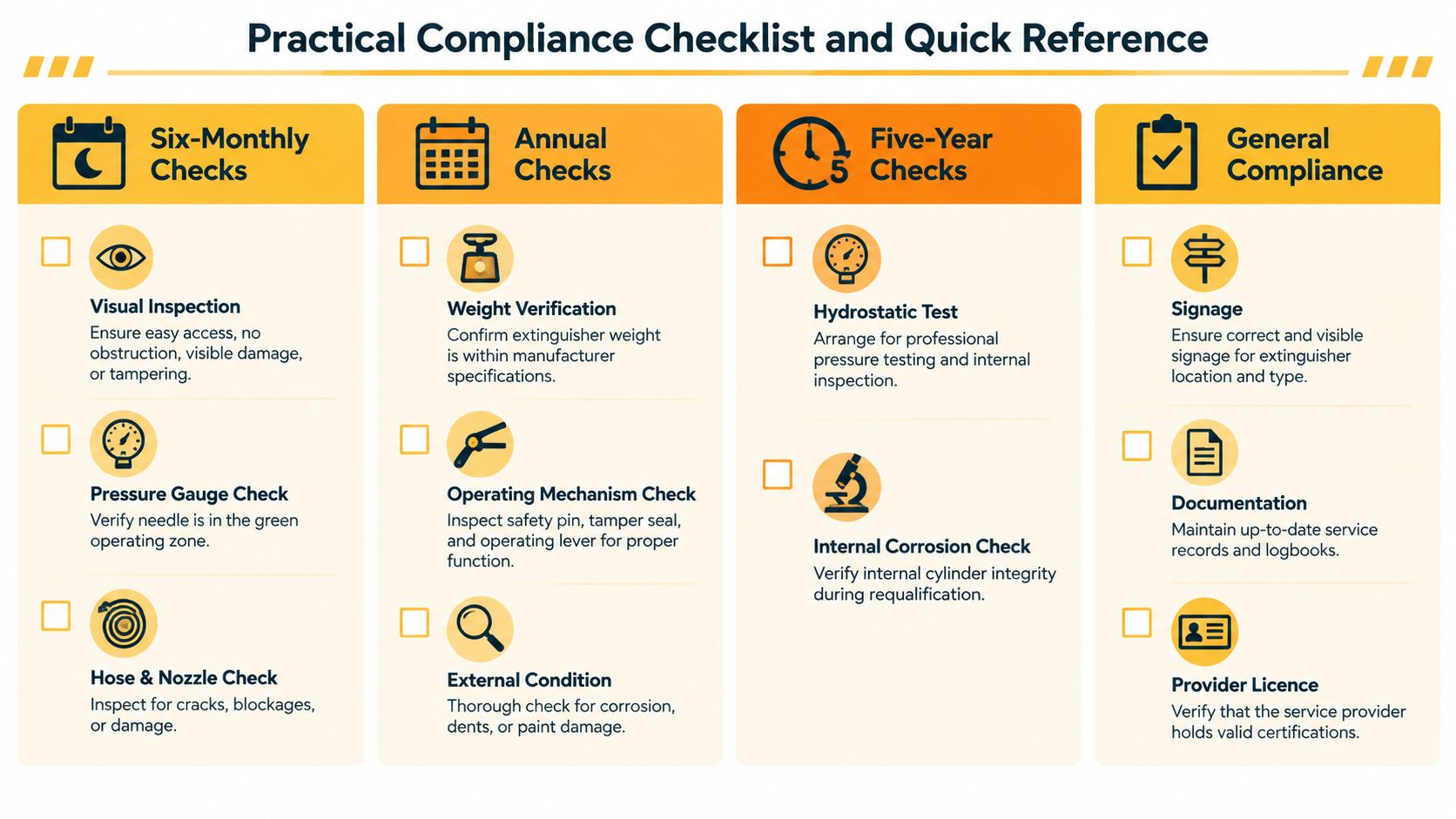
Schedule and evidence
| Timing | Site action | Responsible party | Evidence to retain |
|---|---|---|---|
| Six-monthly | Inspect accessibility, condition, hose, nozzle, gauge where fitted, pin and seal | Trained site representative or appointed service provider, within the applicable procedure | Dated inspection record, tag and punch information, defect report |
| Yearly | Complete preventive service and update equipment status | Licensed or accredited service provider | Service report, updated tag, asset-register entry |
| Five-yearly | Arrange hydrostatic testing, internal inspection, requalification and recharge as required | Approved specialist provider | Test outcome, requalification label, service report and asset history |
| Ongoing | Check that signs remain visible and equipment remains in the selected location | Facility manager or site team | Inspection notes, photographs and corrective actions |
| When defects arise | Remove or identify unsafe equipment, arrange replacement coverage and close the fault | Facility manager with service provider | Non-conformance record and closure evidence |
Before an audit or handover
- Walk the whole site: Compare physical locations with the asset register.
- Sort by due date: Identify overdue six-monthly, yearly and five-year work.
- Verify the provider: Check that technical servicing is assigned to a properly licensed or accredited provider.
- Review open defects: Confirm that damaged, discharged or obstructed units weren't left in service.
- Check hazard selection: Confirm that extinguisher type, classification and rating remain suitable under AS 2444.
- Test your retrieval process: Staff should be able to produce the records without searching through unrelated invoices.
A manager can use this list during a monthly facilities meeting, then attach the completed record to the building's maintenance file. The system works because it separates routine observation from technical requalification instead of calling everything “testing”.
Cross References to Related Regulations and Resources
Portable extinguisher maintenance sits within a wider Queensland fire safety system. The building's fire safety arrangements may also include emergency and exit lighting, smoke and heat alarms, fire blankets, hose reels, hydrants, fire and smoke doors, evacuation procedures and essential fire safety measures recorded for the premises.
That wider context affects scheduling. A contractor visit for extinguishers may be coordinated with other maintenance activities, but each system still needs its own inspection scope and evidence. Combining appointments can reduce access disruption. Combining records without clear asset-level detail creates confusion.
How managers should connect the duties
The building owner, body corporate or facility manager should identify which obligations apply to the premises under Queensland building and fire safety requirements, workplace health and safety duties and local arrangements. The responsible person should then confirm the required service providers, inspection frequencies and documentation with the relevant regulator, building certifier or qualified fire professional.
Don't assume that an extinguisher service report proves compliance for exit lighting or hydrants. It proves only the work described in that report. Maintain separate registers or clearly separated asset categories so an audit can distinguish equipment types and responsible tasks.
Useful pathways include the Queensland fire safety information for public guidance and the applicable Queensland building and workplace safety authorities for premises-specific obligations. Standards documents should be obtained from the authorised publisher, and service work should be assigned according to the relevant licence and competency requirements.
The strongest system is integrated at calendar level but separated at evidence level. One maintenance plan can show every due date. Each system then retains its own checklist, report, defect history and completion record.
Glossary of Key Terms
- AS 1851: The Australian maintenance framework for inspection, testing, preventive maintenance and survey of fire protection systems and equipment.
- AS 2444: The standard used to select and locate portable fire extinguishers according to equipment classification, rating and area hazard.
- AS/NZS 1841: The series covering portable extinguisher manufacture and specification.
- AS/NZS 1850: The product test standard used for type testing extinguishers made to AS/NZS 1841.
- Hydrostatic test: A pressure-vessel test using water to assess whether an extinguisher cylinder can safely withstand the applicable test pressure.
- Preventive maintenance: Planned technical work intended to keep equipment serviceable, rather than waiting for a failure.
- Punch and tag: The physical service indicators placed on or attached to an extinguisher to show inspection or service history.
- Asset register: A controlled list identifying each extinguisher, its location, type, service dates and condition.
- Hazard classification: The risk characteristics of the area that guide extinguisher selection and placement.
- Requalification: The process of pressure testing, inspecting and returning an extinguisher to approved service condition.
Related Resources and Standards Index
Use authorised standards and government material for the controlling requirements. Trade summaries can help explain the process, but they shouldn't replace the applicable standard, mandatory product rule or Queensland direction.
- AS 1851-2012: Standards Australia's catalogue entry describes the framework for inspection, testing, preventive maintenance and survey of fire protection systems and equipment. Access the AS 1851-2012 standard entry.
- AS 2444: Use the AS 2444 standard entry for selection and location requirements.
- Portable non-aerosol extinguisher mandatory standard: Review the Commonwealth product-safety requirements covering materials, performance and identification.
- Hydrostatic servicing reference: The AS 1851 extinguisher servicing document outlines the pressure-testing and agent-handling requirements discussed above.
- Queensland testing explanation: The fire equipment testing requirements guide explains the difference between six-monthly inspection and five-year hydrostatic testing.
- Service planning: Facility managers can use the fire safety schedule resource when coordinating recurring maintenance tasks.
- Commercial service support: The fire extinguisher servicing resource provides a pathway for arranging inspection, servicing and related documentation.
Celtic Fire & Security supplies, installs, tests and maintains fire extinguishers and related commercial safety systems across North Brisbane, Moreton Bay, the Sunshine Coast, Somerset and Ipswich. Visit Celtic Fire & Security to arrange an AS 1851-aligned maintenance discussion, review your service records or organise a practical site inspection.
No responses yet