
You don't notice the cabinet until the day it matters. A routine audit is due, a unit has been knocked off its hook in a tight corridor, and now the question isn't whether there's an extinguisher on site, it's whether people can find it, reach it, and use it fast enough without creating a corridor problem of their own. In Queensland, that's not a storage issue, it's a compliance decision.
Table of Contents
- Why a Fire Extinguisher Cabinet Matters on a Queensland Site
- Australian Extinguisher Classes and What They Mean for Cabinet Design
- Queensland Compliance Layer Behind the Cabinet
- Recessed, Semi-Recessed, or Surface Mounted
- Sizing the Cabinet to the Extinguisher
- Cabinet Materials for Coastal and Industrial Queensland
- Does a Cabinet Slow Access or Improve It
- Queensland Cabinet Decision Checklist for Facility Managers
Why a Fire Extinguisher Cabinet Matters on a Queensland Site
A facility manager in Brisbane can pass the fire round for months and still get caught out by one bad cabinet choice. The extinguisher is there, the tag is current, and the wall looks neat, but the unit sits in the wrong place, protrudes into the corridor, or gets knocked when deliveries come through. That's when the cabinet stops being a background item and becomes the thing that decides whether the site stays audit-ready.
The cabinet is part of the access chain
Under AS 2444, portable fire extinguishers and fire blankets must be selected, located, and identified so they're readily accessible in an emergency. This is the reason cabinets are used in many commercial buildings. They protect the unit from damage while still preserving visibility and rapid access, which is the balance every Queensland site has to get right.
Practical rule: if a person has to hunt for the extinguisher, duck around a protrusion, or fight a jammed door, the cabinet's doing the wrong job.
The best cabinets solve a real workplace problem. They keep the extinguisher in the same place every time, reduce casual knocks in busy corridors, and help the first person on scene get straight to the unit without wasting seconds. That matters on a site where the extinguisher isn't decorative, it's an active control measure.
Why Queensland managers should treat the cabinet as a compliance item
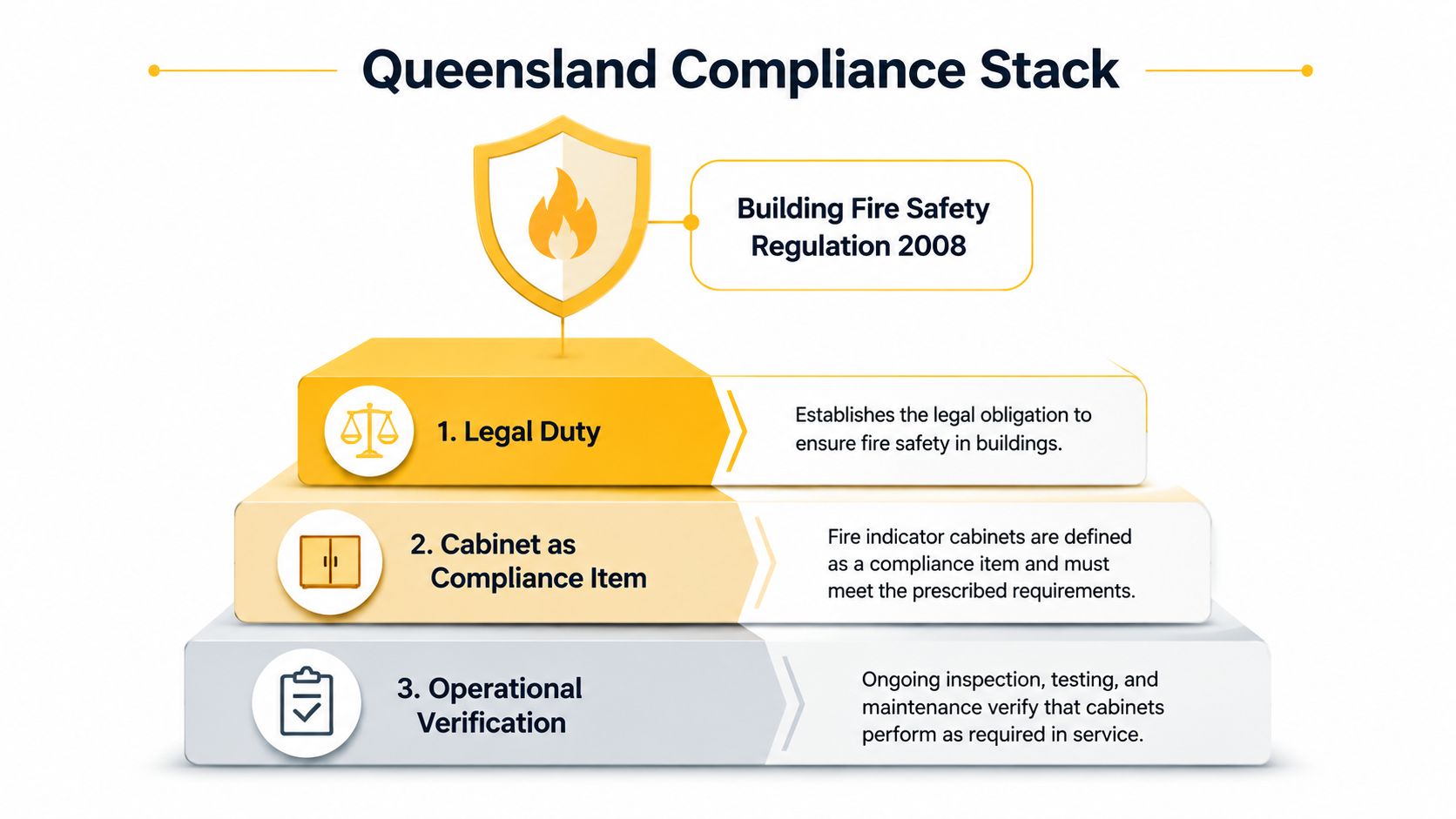
In Queensland, the cabinet sits inside a broader fire-safety system that includes the Building Fire Safety Regulation 2008 and routine servicing obligations. It's not enough for the extinguisher to exist. It has to stay serviceable, visible, and documented in a way that stands up to inspection.
That's why a poorly chosen cabinet can fail an audit just as easily as a missing extinguisher. The cabinet has to support the emergency use case, not interfere with it. On a good install, the extinguisher is obvious at a glance, protected from damage, and still simple to remove in one motion.
A lot of sites get this right only after a near miss or a failed inspection. A better approach is to choose the cabinet as part of the compliance design, not as a finishing touch. That's the mindset that keeps the rest of the fire protection program clean.
Australian Extinguisher Classes and What They Mean for Cabinet Design
Australian extinguisher selection starts with the hazard, not the cabinet. A retail kitchen, a switchroom, and a workshop don't need the same unit, because the fire classes are different and the extinguisher body has to match the risk on site. The cabinet then has to house that exact unit without hiding it, binding it, or making it awkward to remove.
Match the class first
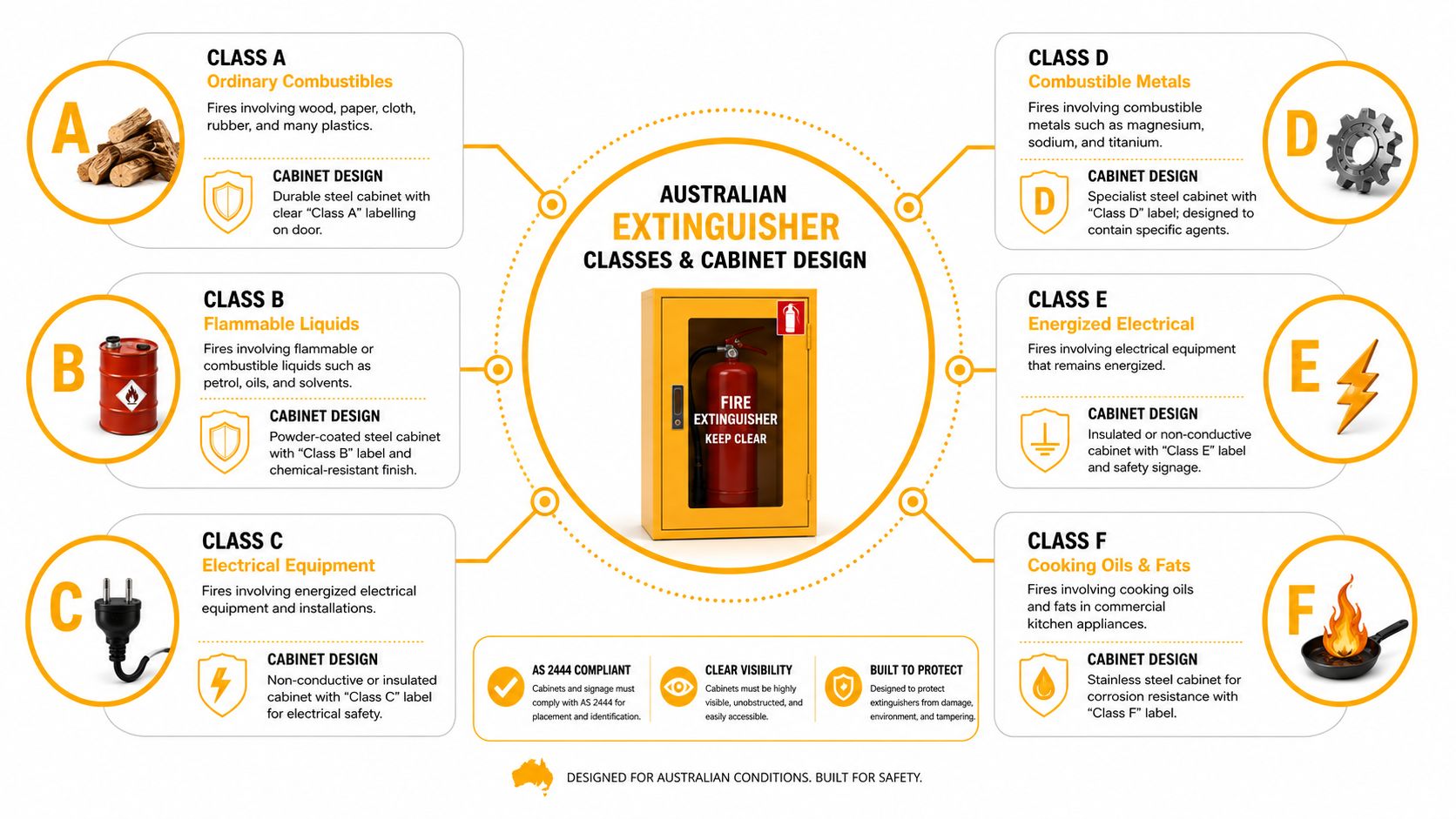
In Australia, the core extinguisher classes are Class A for ordinary combustibles, Class B for flammable liquids, Class C for flammable gases, Class D for combustible metals, Class E for energised electrical equipment, and Class F for cooking oil and fat fires. That class system is the starting point for everything else. A cabinet can only support the extinguisher. It can't make the wrong extinguisher right.
A retail kitchen often needs a different solution to a general office tenancy. A workshop may need a unit suited to electrical risk, while a plant area with gas cylinders needs a different class again. The cabinet doesn't change the fire behaviour, so the extinguisher type has to be right before the enclosure is even specified.
Read the unit before you read the cabinet
The extinguisher body usually tells you what you're looking at through its Australian labelling and pictograms. That's important in a hurry, because the person reaching for it shouldn't need to read the fine print before deciding whether it's the correct unit for the fire they're facing. The cabinet should make that identification easier, not harder.
The cabinet is class-neutral housing. The extinguisher inside it is still the thing that has to match the hazard.
Portable fire extinguisher basics and site selection sits in the same practical lane as this topic, because selection and visibility go together. In a Queensland fit-out, I look at the hazard class first, then I check whether the cabinet can hold the actual cylinder envelope, keep the label visible, and let the door open without drama. If it doesn't do all three, it's the wrong cabinet.
Queensland Compliance Layer Behind the Cabinet
Queensland doesn't treat extinguisher storage as a cosmetic choice. The legal duty starts with the building owner or occupier, who has to keep prescribed fire safety installations in working order and keep maintenance records under the Building Fire Safety Regulation 2008. That means the cabinet isn't just a shell. It sits inside the legal duty to maintain the extinguisher and prove that it's been maintained.
The monthly check still has to happen
AS 1851 requires monthly visual inspections for portable fire extinguishers, and it also requires periodic discharge and servicing at defined intervals depending on the extinguisher type and use conditions. That's the most important routine number most commercial sites have to plan around. If the cabinet blocks the door, hides the label, or makes the unit awkward to inspect, the cabinet is working against the maintenance program.
The technical job is simple. The extinguisher must be seen, checked, and reached without removing half the enclosure or moving other fittings out of the way. If the servicing person has to work around the cabinet every month, the site is increasing the chance that a defect goes unnoticed.
Why the compliance path matters to managers
A lot of Queensland facilities have a mix of fire protection gear, alarms, exit lighting, and emergency hardware. That's where the cabinet becomes part of the broader verification chain. A maintenance record without a serviceable unit behind it doesn't help anyone during an audit. The record only means something if the physical installation still matches the schedule.
Fire safety schedule requirements for extinguishers are where this becomes operational, because the schedule is what tells the site what must be maintained and documented. If the extinguisher is cabinet-mounted, the cabinet has to preserve the monthly check rather than complicate it. That's the difference between a neat install and a compliant one.
A cabinet should protect the extinguisher, not protect the site from seeing the extinguisher.
Recessed, Semi-Recessed, or Surface Mounted
The cabinet type is usually decided by the corridor, not by the brochure. In a Brisbane office tower, a narrow tenancy hallway can make a surface-mounted box a bad idea straight away. In a warehouse aisle on the Sunshine Coast, the wall structure and traffic pattern may point to a different answer again. The right choice comes down to how much the cabinet projects, how the door opens, and how easy it is to inspect.
Recessed cabinets suit tight paths of travel
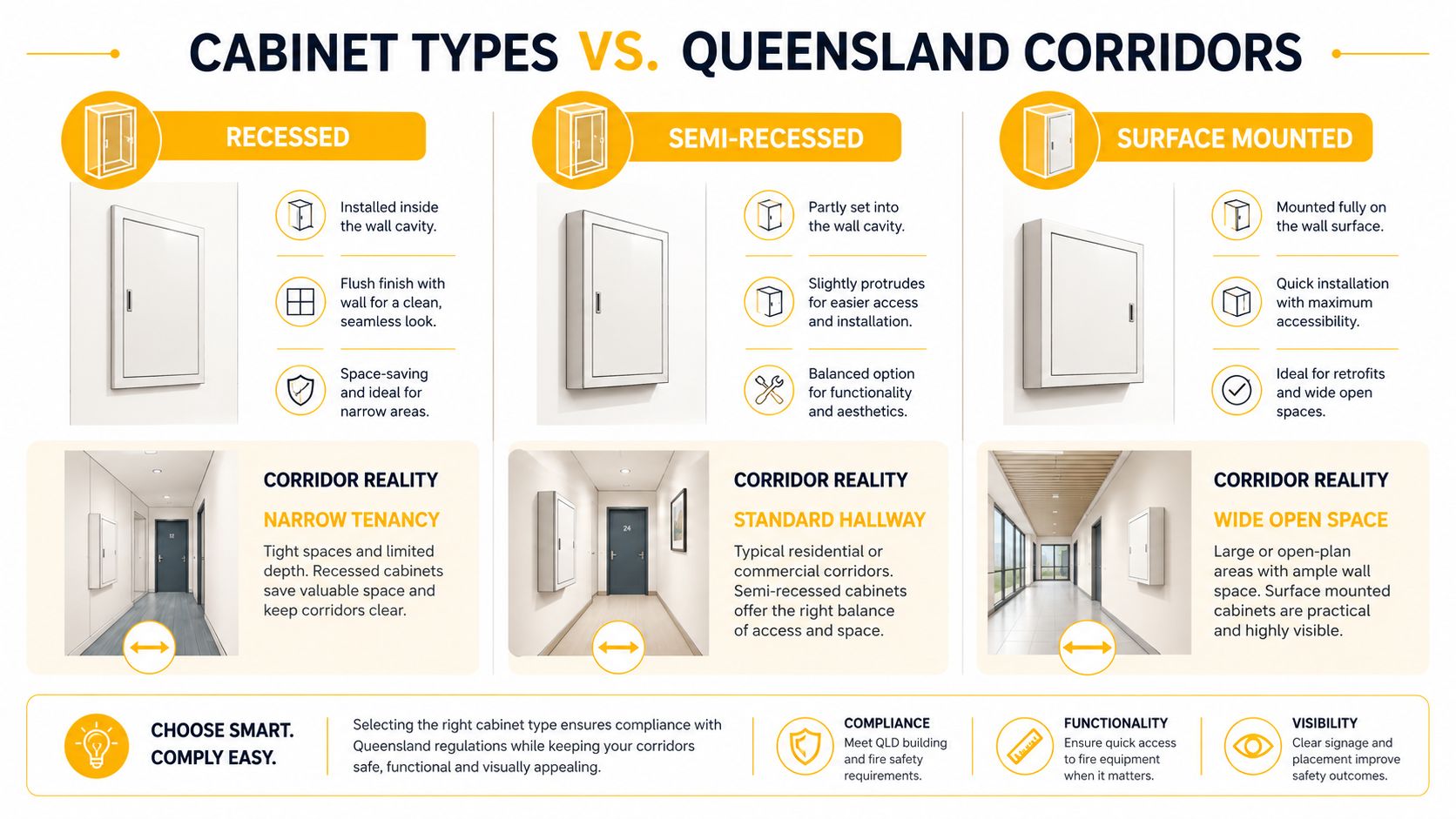
A recessed cabinet keeps most of the body inside the wall and leaves less to catch on people, trolleys, or deliveries. That matters because Australian guidance commonly applies a maximum protrusion of 100 mm from the wall for objects in circulation paths, so a recessed or semi-recessed cabinet can be the only way to keep the route compliant. On a narrow corridor, that's often the cleanest answer.
A recessed unit also tends to sit better in buildings where audit outcomes depend on the extinguisher being obvious but not intrusive. The face is visible, the handle can stay within reach, and the cabinet doesn't dominate the wall. That's why recessed work often feels invisible when it's done properly.
Semi-recessed is the compromise when the wall depth is limited
Semi-recessed cabinets make sense where the wall won't take a full recess, or where retrofit work has to respect existing construction. You get less projection than a surface-mounted box, but you don't need the full wall cavity of a recessed installation. In older Queensland stock, that's often the practical balance.
Surface-mounted suits open or low-conflict areas
Surface-mounted cabinets are the simplest to install, especially where cutting into the wall isn't realistic. They're often the sensible option in wider areas, equipment rooms, or locations outside the main circulation path. They're not the first choice for a tight corridor, because projection is the whole issue there.
- Recessed: best where corridor clearance is tight and wall depth allows it.
- Semi-recessed: best where you need to reduce protrusion but can't fully recess.
- Surface mounted: best where wall construction or layout makes recessing impractical.
The quick cue is straightforward. If the route is narrow, lean recessed. If the wall is shallow, choose semi-recessed. If the unit can sit out of the traffic stream, surface-mounted can be fine.
Sizing the Cabinet to the Extinguisher
Cabinet sizing has to follow the actual cylinder, not just the extinguisher rating on the label. A 4.5 kg ABC dry chemical powder extinguisher and a 9 kg unit don't take the same space, and the wrong tub depth or internal width can leave the door binding or the unit sitting too tight for easy removal. That's a practical failure, not a cosmetic one.
Build around the cylinder envelope
A technical cabinet schedule needs to account for the full body of the extinguisher, including the hose, horn, handle, and valve clearance. For common units, U.S. technical schedules show a 10 lb cabinet typically needs about 24 in x 9.5 in x 6 in internal clear dimensions, while 20 lb cabinets are commonly around 27 in x 12 in x 8 in, which shows how fast the dimensions step up between common sizes. Those figures are a useful reminder that a larger extinguisher needs a materially larger enclosure. Technical cabinet dimension schedule
For Queensland sites, the practical translation is simple. Don't assume one cabinet suits every extinguisher on the tenancy. Check the actual unit and the internal clearances before the order goes in.
Reach height still governs the install
For wall-mounted extinguishers, the handle must be kept at or below 60 in (1.5 m) above the finished floor for units 40 lb or less, while heavier units are limited to 42 in (1.07 m). That's why cabinet selection matters to the audit. A recessed cabinet can help preserve the required reach height while reducing corridor protrusion, which is often exactly what a high-traffic site needs. Cabinet height and handle reach guidance
| Australian portable extinguisher envelope and cabinet fit | |
|---|---|
| Extinguisher class | Typical cabinet internal clearance approach |
| Class A, B, C, D, E or F unit | Match the cabinet to the cylinder envelope, not just the label rating |
| 4.5 kg ABC powder unit | Smaller tub depth and narrower internal width are usually sufficient |
| 9 kg ABC powder unit | Needs more internal room, especially around hose and handle clearance |
If the door has to be forced shut, the cabinet is the wrong size.
Cabinet Materials for Coastal and Industrial Queensland
Queensland sites punish cheap hardware. Salt air, humidity, washdown routines, UV exposure, and regular public contact all shorten the life of a basic enclosure. That's why material selection matters as much as cabinet type, especially on coastal or industrial properties where the extinguisher cabinet has to survive the environment as well as the audit.
Match the finish to the exposure
Specification guidance emphasises that cabinet choice should account for material and finish, including steel versus stainless steel and corrosion resistance for washdown or industrial areas, plus latch style for tamper concerns. That's the right way to think about it. A standard indoor cabinet might suit a protected office corridor, but it won't age the same way in a damp plant room or a public-facing coastal strip. Cabinet specification and maintenance guidance
Powder-coated steel is common indoors and can be perfectly fine where the environment is controlled. Stainless steel makes more sense where moisture, salt, or cleaning chemicals are part of the day-to-day picture. In industrial sites, the latch style matters too, because tamper resistance only helps if the door still opens cleanly when the unit is needed.
Why the environment affects inspection outcomes
A corroded cabinet can become a servicing problem long before anyone thinks about replacement. If the door sticks, the monthly visual check is slower. If the glazing degrades or the frame rusts, the extinguisher is harder to identify. That's not theoretical on Queensland sites near the coast or in washdown zones.
The answer isn't to overspec everything. It's to match the cabinet to the actual risk profile. A well-chosen enclosure reduces replacement churn, keeps the extinguisher visible, and helps the maintenance technician do the monthly check without fighting the hardware.
In practical terms, the extra cost of a better material often sits inside the cost of fewer failures, fewer service hassles, and fewer avoidable call-backs. On a site with public access or salt exposure, that usually pays for itself in reduced grief alone.
Does a Cabinet Slow Access or Improve It
The complaint comes up a lot. Someone sees a cabinet and assumes it will slow the first person on scene. In practice, the opposite is true when the cabinet is chosen properly. A bad cabinet hides the extinguisher, projects into the route, or jams under wear. A good cabinet keeps the unit visible, protected, and at the right reach height.
Access gets better when the cabinet removes guesswork
The first person to grab an extinguisher shouldn't be scanning the corridor or checking whether the unit is missing. A cabinet with clear glazing and a secure latch makes the extinguisher easy to locate while still protecting it from knocks and vandalism. That's especially useful in shared tenancy corridors, loading areas, and public access zones.
The bigger point is that the cabinet shouldn't interfere with the path to the extinguisher. If the installation keeps the unit within reach and out of harm's way, access improves. If it pushes the extinguisher too far into the corridor or makes the door hard to open, the cabinet has become the problem.
Security and usability can live together
A lot of managers worry about tampering, and that's fair. A secure cabinet helps in busy premises, but the access method has to stay simple enough for an emergency. If the latch, door, or frame makes the extinguisher harder to inspect or slower to remove, the spec is wrong.
The same logic applies to training. Staff need to recognise the cabinet quickly, know that the extinguisher is inside, and be able to operate it without hesitation. Fire extinguisher training and emergency access matters because hardware alone doesn't create readiness. The cabinet has to support what people are trained to do.
A cabinet is useful only when it helps the next person act faster, not slower.
Queensland Cabinet Decision Checklist for Facility Managers
The right decision starts with the site type. A small retail tenancy usually needs the extinguisher visible, protected, and easy to inspect in a shared corridor. A commercial office often leans toward recessed or semi-recessed units where corridor projection matters. Industrial and coastal sites need tougher materials and a closer look at door hardware and corrosion resistance. Strata and multi-tenant buildings need all of that plus clean records.
Use the site profile to choose the cabinet
- Small retail tenancy: choose a recessed or semi-recessed cabinet if the path of travel is tight, and keep the extinguisher reachable without obstruction.
- Commercial office: choose the cabinet type that preserves corridor clearance and keeps the extinguisher obvious during the monthly check.
- Industrial or coastal site: specify corrosion-resistant materials, check latch style for tamper resistance, and avoid finishes that won't survive the environment.
- Strata or multi-tenant building: prioritise visibility, access, and maintenance records under the fire safety schedule, because multiple users mean more wear and more chance of misuse.
The standards remain unchanged. The extinguisher must match the Australian fire class, the cabinet must preserve access, and the installation must suit the wall and corridor. The monthly AS 1851 inspection still applies, and the owner or occupier still has to keep the prescribed fire safety installation working and documented under the Building Fire Safety Regulation 2008.
A correctly specified cabinet makes compliance easier, not harder, because it keeps the extinguisher visible, reachable, and serviceable on every monthly check. If you need a site-specific cabinet review, Celtic Fire & Security can supply, install, test, and maintain portable extinguishers and associated fire safety hardware across South East Queensland. Visit Celtic Fire & Security to arrange a practical assessment for your corridors, cabinets, and inspection access.
No responses yet