
Most commercial security alarm installations in South East Queensland land between roughly A$1,500 and A$8,000, depending on system type, zone count and whether monitoring is included. A Queensland commercial-security guide places larger intruder alarm projects from about A$3,000 to A$8,000 or more, while smaller professionally installed systems can sit much lower.
You may be staring at two quotes for the same shop, office or warehouse and wondering whether one installer has inflated the price. In practice, the gap usually comes from what each quote includes, how the site has been assessed and whether the system is being designed for a basic local alarm or a commercial-grade, monitored installation. The right question isn't “Which quote is cheapest?” It's “What exactly am I buying, and what has been left out?”
Table of Contents
- Why Two Quotes for the Same Alarm Can Differ by Thousands
- The Five Cost Drivers Behind Every Security Alarm Quote
- Comparing Wireless, Hardwired and Hybrid Alarm Systems
- How Monitoring Choices Change Your Total Project Cost
- Real SEQ Scenarios and What They Typically Cost in 2026
- Australian Standards and Licensing That Shape a Compliant Quote
- Getting Accurate Quotes and Keeping Your Project on Budget
Why Two Quotes for the Same Alarm Can Differ by Thousands
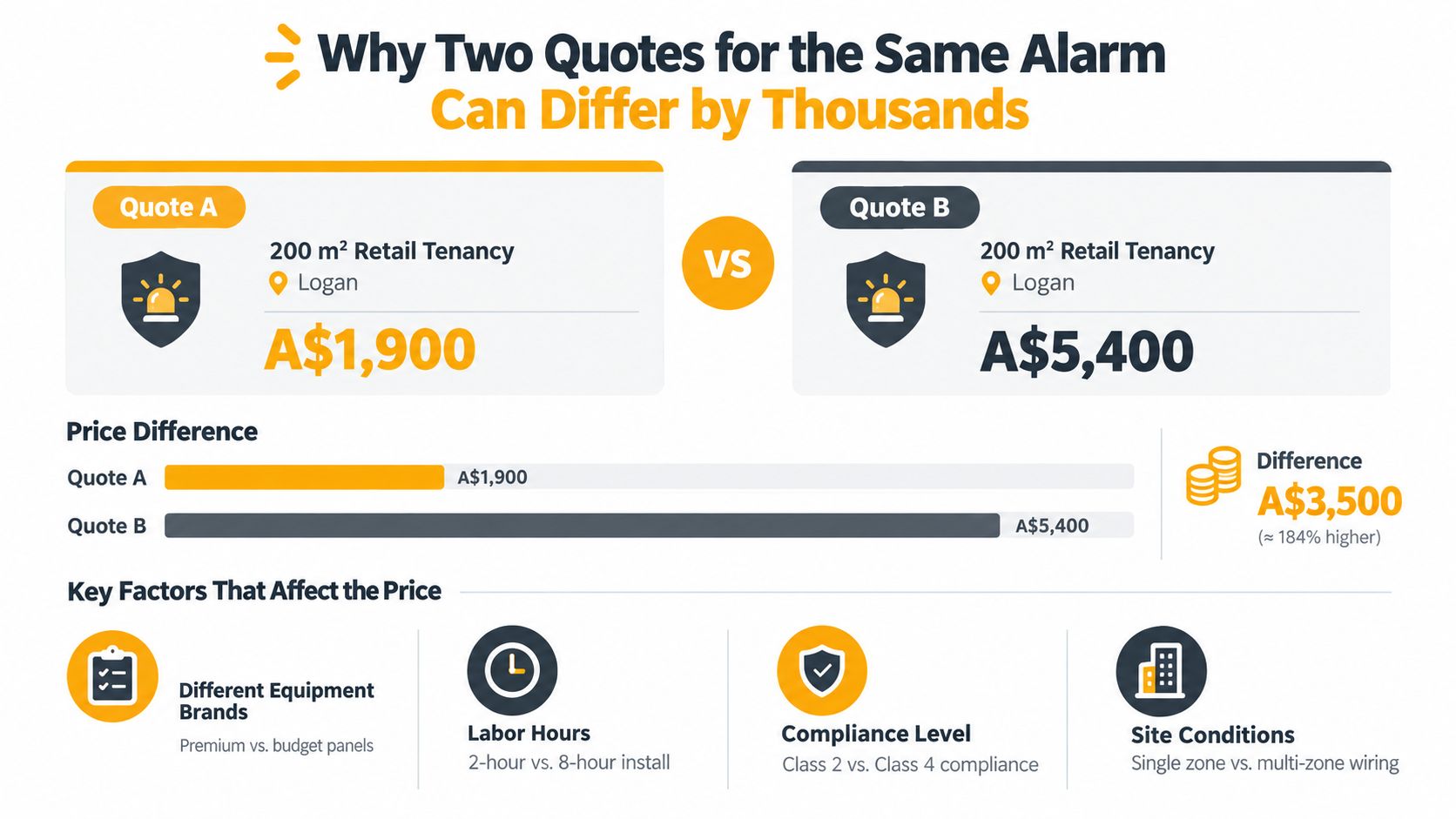
A business owner in Logan might hand an installer the same brief for a 200 m² retail tenancy and receive one quote for A$1,900 and another for A$5,400. Both may list an alarm panel, motion detectors, keypad and siren. On the surface, they appear comparable. They usually aren't.
The first installer may have priced a straightforward wireless system with limited zones, minimal configuration and self-monitoring. The second may have allowed for a more robust panel, additional detectors, tamper protection, new cabling, commissioning, app configuration and professional monitoring. Neither price is automatically dishonest. The problem is an incomplete scope.
Start with the floor plate
Installers adjust sensor density according to the building's layout, entrances, vulnerable openings and operating pattern. A simple open retail floor can need fewer devices than a tenancy divided by stock rooms, offices, storerooms and staff areas. Roller doors, glazed entries and isolated rear doors also change the design.
Existing cabling creates another major divide. If the installer can test and reuse suitable cable, labour may be controlled. If the cable is undocumented, damaged or unsuitable for the selected panel, the quote may include new routes, conduit, access equipment and additional testing.
Separate the five cost levers
Every serious quote should be readable through five questions:
- Hardware: What panel, detectors, siren, communicator and batteries are included?
- Labour: How much installation, programming, testing and handover time has been allowed?
- Monitoring: Is the system self-monitored, app-connected or linked to a control room?
- Integration: Does it connect to CCTV, access control, smoke detection or other systems?
- Maintenance: Who replaces batteries, attends faults and keeps the system operational?
Practical rule: If a quote doesn't show those five areas clearly, you aren't comparing prices. You're comparing assumptions.
Queensland pricing guides place fitted wireless systems around A$600 to A$1,500, hardwired new-build systems around A$1,000 to A$2,500, and larger whole-site systems around A$1,500 to A$3,500. Broader commercial systems can reach A$3,000 to A$8,000 or more when partitioning, communications and commercial requirements increase, as outlined in this Australian commercial alarm pricing guide.
Read your quotes line by line. Ask each installer to identify the number of zones, cable assumptions, monitoring tier, integration work, commissioning documents and ongoing service terms. That turns a confusing price gap into a list of decisions you can challenge or approve.
The Five Cost Drivers Behind Every Security Alarm Quote
The headline security alarm installation cost is only useful when you know what sits underneath it. For South East Queensland businesses, the installer generally adjusts five cost levers: hardware, labour, monitoring, integration and maintenance.
Hardware sets the starting point
Hardware can include the control panel, keypads, PIR detectors, door contacts, glass-break detection, external siren and strobe, batteries and a communicator. A practical equipment allowance can range from A$400 to A$3,500, depending on coverage and specification. Queensland pricing guidance also indicates that each additional sensor or zone can add about A$80 to A$250, while a communicator or panel upgrade can add A$300 to A$800. See the Queensland alarm installation pricing guide for those component ranges.
Labour is more than mounting devices
Labour includes the site visit, cable routing, mounting, termination, programming, testing and user handover. Australian cost guidance places installation labour around A$400 to A$1,800, depending on access, cable paths and commissioning requirements, as shown in this Australian alarm cost guide. A quote that lists hardware but gives no labour detail deserves scrutiny.
Monitoring creates an ongoing commitment
Professional monitoring adds a recurring operating cost rather than a one-off installation charge. Queensland guides commonly place back-to-base monitoring around A$25 to A$60 per month, while broader Australian guidance places professional monitoring around A$30 to A$80 per month. The final amount depends on the service, communicator and escalation arrangement.
Integration expands the commissioning scope
Connecting the alarm to CCTV, access control or other building systems means more than adding a cable. The installer must define events, test triggers, confirm permissions and show staff how the systems interact. Treat integration as its own line, not as a vague inclusion hidden inside “setup”.
Maintenance protects the investment
Maintenance covers inspection, fault diagnosis, battery attention, programming support and service attendance. It can be negotiated, but ignoring it isn't a saving. A system that generates nuisance alarms or sits with an unresolved fault becomes an operational problem.
| Cost Lever | Typical SEQ Range | Negotiable? |
|---|---|---|
| Hardware | A$400 to A$3,500 | Partly |
| Labour and installation | A$400 to A$1,800 | Often |
| Monitoring | A$25 to A$80 per month | Yes |
| Integration | Site-specific | Yes |
| Maintenance | Site-specific | Yes |
The fixed elements are usually the equipment required for the agreed design and the labour needed to complete the work safely. Monitoring terms, maintenance response and integration scope are more open to negotiation. What isn't acceptable is removing a cost from the quote and adding it after commissioning.
Comparing Wireless, Hardwired and Hybrid Alarm Systems
A finished Brisbane retail tenancy, a new office fit-out and a warehouse rarely deserve the same alarm architecture. The choice changes cable access, installation disruption, future expansion and the labour hidden behind the equipment list. Price the building first, then choose the system.
Wireless systems usually suit occupied premises and finished offices because installers can avoid much of the cable routing. They still require a proper signal survey, battery plan and allowance for building materials. Metal roofing, dense storage and large floor plates can demand extra wireless infrastructure, reducing the initial saving.
Hardwired systems are usually the better value during a new build or major fit-out, when cable routes and ceilings are accessible. They provide stable connections across many monitored points. In an existing site, concrete, finished ceilings, difficult risers and fire-rated penetrations can turn the same design into a labour-heavy retrofit.
Hybrid systems combine a wired backbone with wireless peripherals. Use them when the panel or critical doors can be cabled, while other areas would be expensive or disruptive to wire. They also give a business room to expand when partitions, tenancy layouts or operating needs change.
| System Type | Typical SEQ Cost | Best Fit |
|---|---|---|
| Wireless | Site-specific, generally lower for uncomplicated installations | Finished retail and small offices |
| Hardwired | Site-specific, with cost driven heavily by cable access | New builds and accessible fit-outs |
| Hybrid | Site-specific, balancing wired reliability and wireless flexibility | Retrofits and changing premises |
Fitted wireless systems commonly sit around A$600 to A$1,500, hardwired new-build systems around A$1,000 to A$2,500, and larger whole-site systems around A$1,500 to A$3,500 Australian alarm cost guide. Treat those as starting points, not promises. Commercial premises can add zones, communications equipment and system integration.
Wireless saves cable. It doesn't remove design, testing or maintenance.
For multi-storey premises, ask how the quote allows for risers, ceiling access and fire-rated penetrations. For warehouses, ask for the wireless range assessment and the impact of shelving, stock and other obstructions. The estimator should explain why the selected architecture fits the building, not just why it looks cheaper on page one. Compare the quote line by line, especially the hardware, labour and future expansion allowance.
How Monitoring Choices Change Your Total Project Cost
Monitoring should be selected before the installer finalises the design. It changes the communicator, programming, testing and handover requirements, so adding it after installation can mean extra hardware and another site visit.
Self-monitoring
Self-monitoring sends alerts to nominated phones or an app. It avoids a professional monitoring fee, but the business owner or manager must notice the alert, decide whether it's genuine and act outside trading hours. That may be workable for a small owner-operated premises, but it's a weak arrangement where nobody reliably carries the responsibility.
App alerts and cloud video
App-based alerts can sit between a local alarm and a control-room service. They may support event notifications and, where the system includes compatible cameras, cloud video clips. The installer still needs to confirm the site's internet service and configure the user permissions properly.
Back-to-base monitoring
Back-to-base monitoring adds a control-room response pathway. It requires suitable communications equipment, alarm transmission testing and agreed escalation contacts. Australian pricing guidance places monitoring setup around A$500 to A$1,200 and ongoing professional monitoring around A$30 to A$80 per month, while Queensland guides commonly show A$25 to A$60 per month for back-to-base services. Those figures are discussed in this guide to monitored alarm systems.
| Monitoring Type | Monthly Cost (AUD) | One-off Setup | Extra Hardware Needed |
|---|---|---|---|
| Self-monitoring | No recurring monitoring fee | App and user setup | Compatible panel or communicator |
| App-based alerts | Provider and service dependent | Configuration may apply | Internet-connected communicator |
| Back-to-base | A$25 to A$80 per month | A$500 to A$1,200 may apply | Communicator and monitoring connection |
Don't choose monitoring by monthly price alone. Confirm who receives the signal, who calls the nominated contacts, what happens during a communications failure and whether the plan includes testing or only alarm receipt. Also ask whether the monthly fee changes after an introductory period.
A cheap installation with the wrong monitoring model can become expensive to correct. Specify the monitoring path, communicator, connection fee, monthly charge and cancellation terms in the original quote.
Real SEQ Scenarios and What They Typically Cost in 2026
Three project types show how quickly the five cost levers change the final security alarm installation cost. These are useful planning scenarios, not guaranteed quotes. Actual pricing depends on the inspection, access, selected equipment and the installer's written scope.
Logan retail tenancy
An 80 m² shop in a Logan shopping strip may use six PIR detectors, one keypad, app-based self-monitoring and no system integration. A practical planning range for that uncomplicated installation is A$1,500 to A$2,400.
The price remains controlled because the premises is compact, the zone count is modest and the monitoring arrangement doesn't require a back-to-base connection. The installer still needs to check detector placement, entry and exit delays, user permissions and alarm transmission through the selected app.
Gold Coast strata office
A two-storey strata office with two tenancies and sixteen zones requires a different approach. A hardwired design with back-to-base monitoring, front-door access control integration and a CCTV handshake can sit around A$6,500 to A$9,500.
Here, labour and commissioning become as important as the panel and detectors. The quote should identify responsibility for access-control programming, CCTV event handling, tenant permissions, testing and documentation. A body corporate manager should also confirm who owns the monitoring account and who can authorise future changes.
Yatala warehouse
A light-industrial warehouse may need roller-door reed switches, separate zones for offices, a loading bay and an external compound, plus a 4G dual-path communicator and monitored back-to-base service. A realistic project allowance is A$4,500 to A$7,000.
Concrete tilt-panel construction can add A$800 to A$1,500 for cable runs alone, depending on access and routing, as reflected in the relevant commercial installation planning guidance. A warehouse quote that ignores cable paths is incomplete, even if the equipment list looks detailed.
| Scenario | Property Type | System Type | Total Project Cost (AUD) |
|---|---|---|---|
| Logan tenancy | Small retail, 80 m² | Wireless or simple hybrid, app self-monitoring | A$1,500 to A$2,400 |
| Gold Coast office | Two-storey strata office, two tenancies | Hardwired, monitored, integrated | A$6,500 to A$9,500 |
| Yatala warehouse | Light industrial | Zoned system with dual-path communication | A$4,500 to A$7,000 |
For a related benchmark, compare the alarm scope with this CCTV installation cost guide. CCTV and alarm integration can alter both hardware selection and commissioning time, so pricing them separately doesn't always show the true project total.
Australian Standards and Licensing That Shape a Compliant Quote
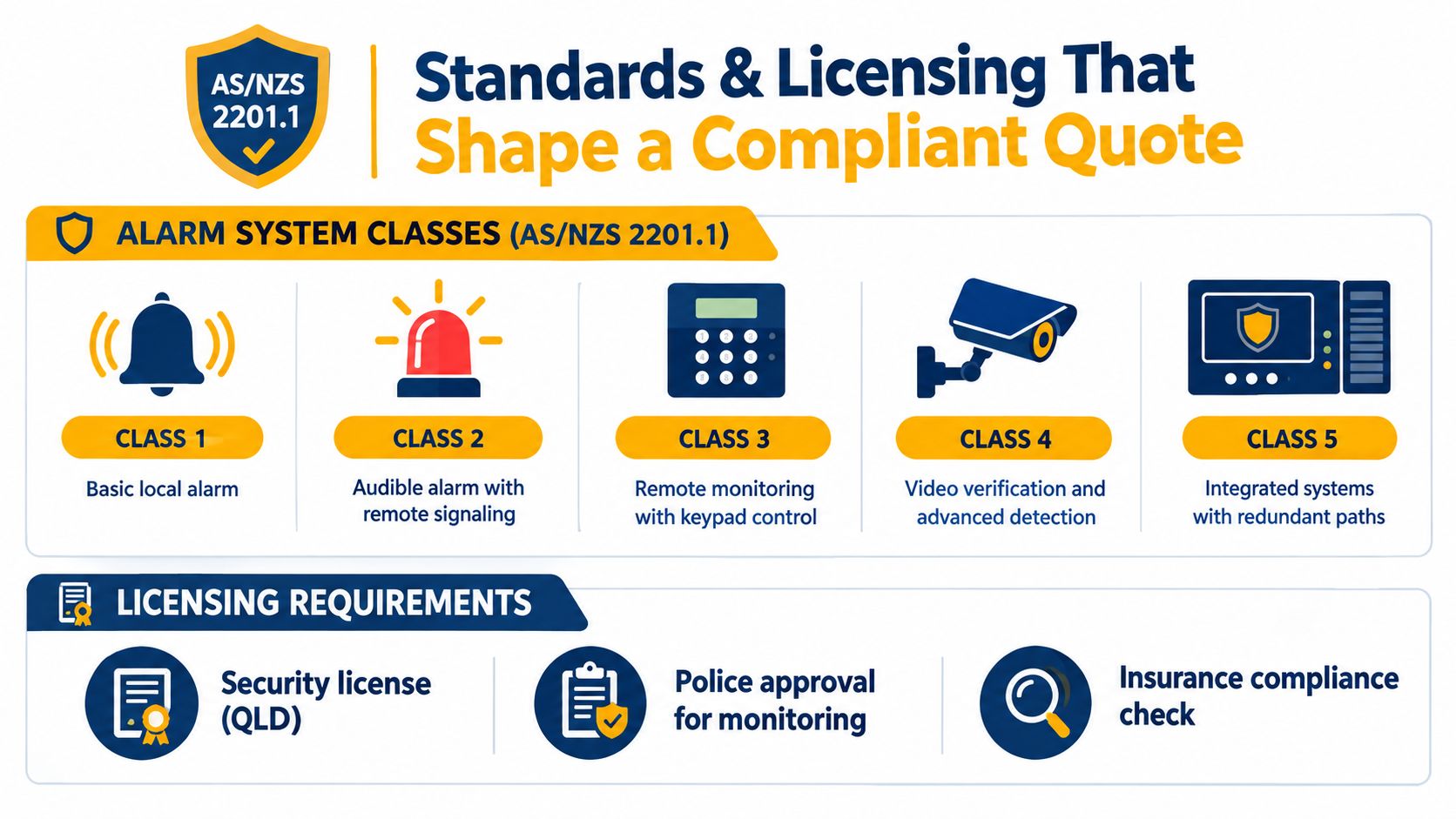
A compliant quote should identify the standard, system class and licensing basis behind the design. Hardware brand alone doesn't prove that the installation is suitable for a commercial risk.
AS/NZS 2201 covers Australian intrusion alarm systems, including design, installation, commissioning and maintenance. The commercial pricing guidance cited earlier identifies this standard as the framework used for intruder alarm work. Ask the installer which AS/NZS 2201 class the quote targets and whether the proposed detector coverage, tamper protection and reporting arrangement support that classification.
Queensland premises also need appropriate fire protection where extinguishers form part of the broader site safety plan. Queensland Fire guidance states that portable extinguishers must comply with AS/NZS 1841.1:2007 and uses Australian fire classes A, B, C, D and F to match the extinguisher medium to the hazard. Alarm work and extinguisher selection are different scopes, but a commercial quote should never use non-Australian extinguisher classifications.
Check the contractor before approving the price
Ask for the relevant Queensland licence details and confirm that the person or business carrying out the work is authorised for the proposed activity. The quote should also state what documentation you'll receive after commissioning, including test results, user instructions and compliance records where applicable.
Don't assume that a low price represents a compliant alternative. A cheaper design may omit tamper protection, communications testing, documentation or the installation work needed to meet the agreed risk class.
Ask one direct question before signing: “Which standard and system class does this quote satisfy, and what evidence will you provide at handover?”
Getting Accurate Quotes and Keeping Your Project on Budget
A useful quote starts before the estimator arrives. Give the installer enough information to price the actual building rather than a generic alarm package.
Give the estimator a proper brief
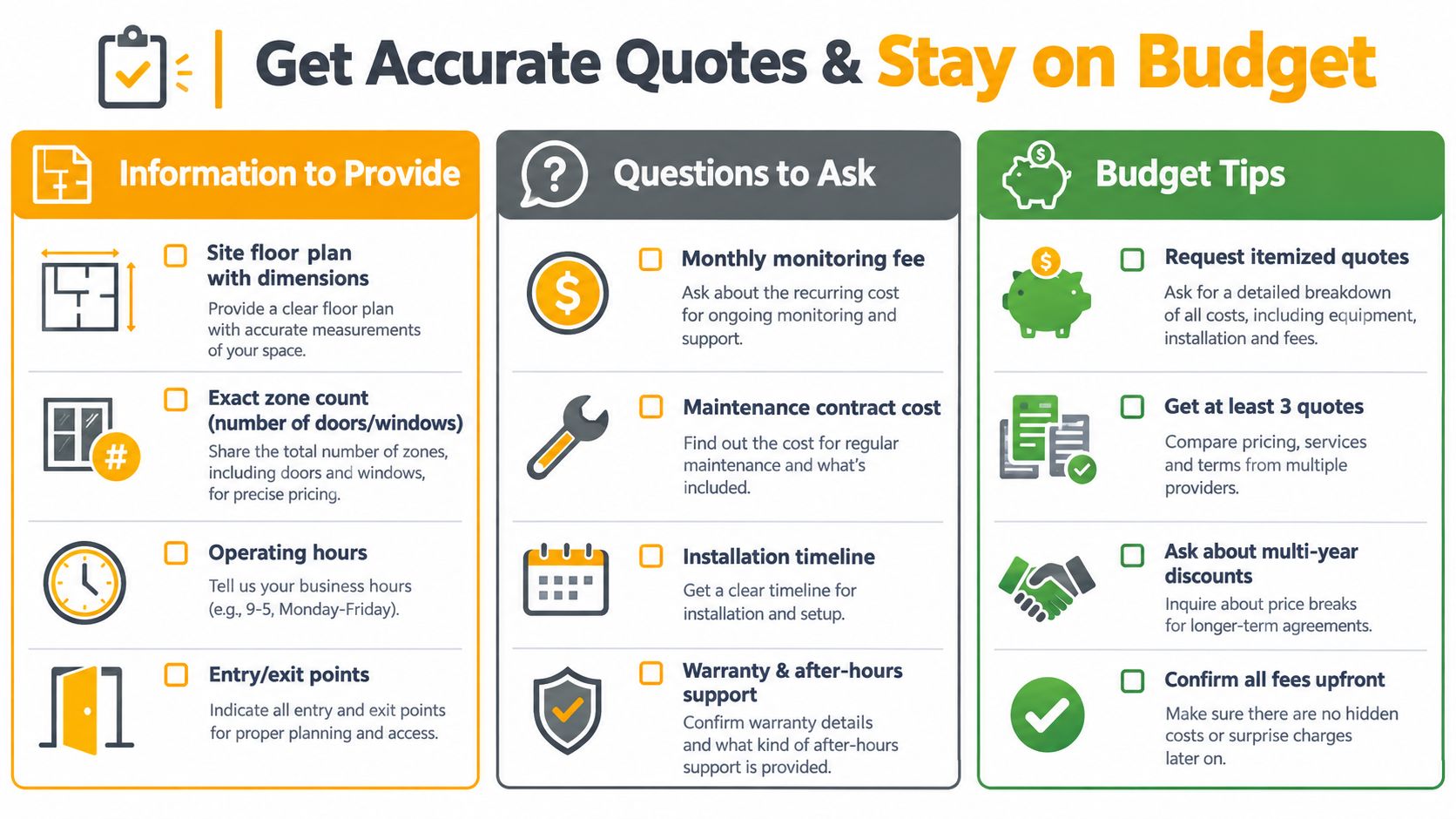
Provide a floor plan with dimensions, mark every external door and accessible window, identify staff-only areas and explain how the site operates. Include the operating hours, expected users, existing cabling, tenancy boundaries and any requirement to connect CCTV, access control or smoke detection.
Also state whether monitoring is in scope. An installer can't price the communicator, programming and handover accurately if the monitoring decision is left until the end.
Demand an itemised comparison
Each quote should show:
- Hardware: List the panel, keypads, detectors, siren, communicator, batteries and accessories.
- Labour: Separate installation, programming, testing, commissioning and handover.
- Cabling: State whether cable, conduit, penetrations, patching and access equipment are included.
- Integration: Describe exactly what CCTV, access control or other systems will do.
- Monitoring: Show connection charges, monthly fees, escalation contacts and contract terms.
- Maintenance: State warranty, service response, battery replacement and call-out conditions.
Ask whether the price includes a Certificate of Compliance and the relevant Queensland Building and Construction Commission documentation. Confirm possible extras before work begins, especially after-hours rates, conduit, height-access equipment and data cabling required for communications.
Negotiate the right items
You can often improve the commercial outcome by bundling monitoring over 24 or 36 months, scheduling installation during quieter periods and agreeing the scope in writing. Don't negotiate by deleting essential detectors or reducing the system class. Negotiate contract terms, duplicated site visits, avoidable access costs and clearly defined service inclusions instead.
Celtic Fire & Security provides commercial alarm installation, configuration, testing and maintenance across North Brisbane, Moreton Bay, the Sunshine Coast, Somerset and Ipswich. For a site-specific quote, review its commercial security alarm system services and take your floor plan, zone requirements and monitoring preference to the estimator.
Before signing, make sure the quote answers three final questions: what will be installed, what will it cost after every known add-on, and who will support it after handover. That is how you keep the security alarm installation cost tied to a defined result instead of an attractive first-page figure.
Celtic Fire & Security can assess your commercial site, quote the alarm hardware and installation scope, configure monitoring or system integration, and provide ongoing testing and maintenance. Visit Celtic Fire & Security to discuss your South East Queensland requirements and request a quote based on the actual building, zones and operating needs.
No responses yet