
It's 8.15 on a Tuesday morning. A facility manager has a contractor on site, a fire-safety audit approaching, and a log book that says the emergency lighting was tested. The first fitting in the corridor illuminates when its test switch is pressed. That looks reassuring, until the asset register lists a different number of fittings, the floor plan is out of date, and nobody can show whether the batteries held their rated duration.
That situation is common across commercial premises in North Brisbane, Moreton Bay, the Sunshine Coast, Somerset and Ipswich. The central issue in emergency lighting testing requirements Australia is not whether a green indicator is on or a lamp comes on briefly. It's whether the right fittings were tested, by an appropriately licensed person, using the required method, and supported by fitting-level records.
Table of Contents
- What Compliance Day Actually Looks Like on a Queensland Site
- Why Emergency and Exit Lighting Exists in the First Place
- How AS/NZS 2293.2 Sets the Testing Intervals
- Visual Check, Functional Test, and Full-Duration Discharge Test Compared
- Who Can Legally Test and Certify Emergency Lighting in Queensland
- Records You Should Expect to See in a Compliant Log Book
- Common Non-Compliance Issues Found at Audit and Handover
- A Practical 12-Month Rhythm for Staying Compliant
What Compliance Day Actually Looks Like on a Queensland Site
The technician starts with the site contact, the current fire-safety documentation and the emergency-lighting register. Before touching a test switch, they compare the register with the floor plans and walk the escape paths. An exit sign above a rear door may be missing from the paperwork, while a fitting recorded in the register may have been removed during a tenancy refurbishment.
That mismatch matters. A tester can't produce defensible evidence for an asset that hasn't been correctly identified. The fitting needs a location, an identifier and a result that someone can trace later.
The walk-through before the test
The technician checks exit signs, emergency luminaires, indicators, diffusers, labels, obstructions and visible damage. They note mixed arrangements, such as self-contained fittings alongside equipment supplied by a central battery system. Fittings without accessible test switches need an approved testing method that still demonstrates operation under simulated mains failure.
The brief switch-on check comes next, but it's only an initial condition check. It can identify a lamp, LED, indicator or control issue. It can't establish whether the battery will continue supplying light through the full rated emergency period.
Practical rule: If the register, floor plan and ceiling fittings don't agree, resolve the asset list before treating the test as complete.
The formal result records each fitting, the test date, operating outcome, defects, corrective action and completion status. A failed battery may require isolation and rectification rather than a note saying “retest later”. Queensland commercial premises need an ongoing maintenance routine, not a commissioning certificate that sits in a folder indefinitely.
That applies equally to a small retailer in Moreton Bay and a multi-tenant office in Brisbane. The scale changes, but the fundamentals remain the same: scheduled testing, licensed work and records that show what happened to every fitting.
Why Emergency and Exit Lighting Exists in the First Place
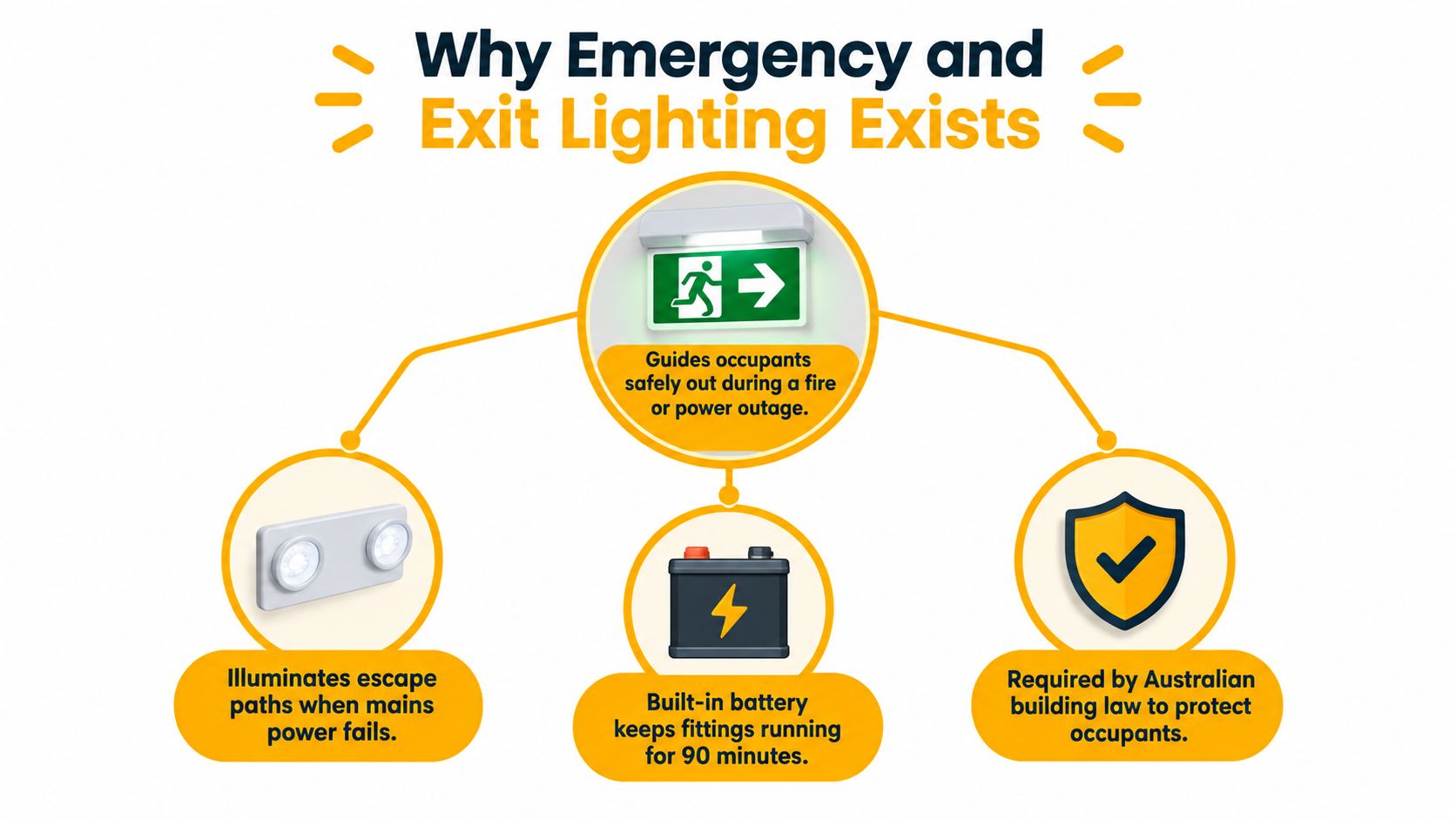
Emergency lighting has two separate jobs during an incident. Emergency luminaires illuminate escape paths, while illuminated exit signs identify exits and support wayfinding when normal lighting fails. A fitting that works during ordinary operation may still fail when the mains supply is interrupted.
Consider someone leaving a familiar building during a power outage or fire. Smoke can obscure landmarks, occupants may move away from their usual route, and a dark stairwell can turn a straightforward exit into a hazard. The system needs to provide enough light for people to recognise the path, avoid obstacles and find the marked exit.
Two common system arrangements
Self-contained fittings contain their own battery, charger and control equipment. Each fitting can age differently, which is why testing one fitting or checking only the normal light doesn't demonstrate that the other batteries have adequate capacity.
Central-battery or central-supply systems use a shared battery arrangement to supply multiple fittings. These systems may provide monitoring information, but the service evidence still needs to identify the fittings or circuits covered and record failures and corrective action.
The normal electrical supply has to be interrupted during the critical test. The fitting then operates from its standby battery for the installed system's rated emergency duration. For most Australian installations, that rated duration is 90 minutes, or approximately one and a half hours, as described in the Australian emergency-lighting maintenance guidance.
A brief press of a test button doesn't prove that result. It may show that a lamp illuminates and that the changeover circuit responds. It won't expose a battery that has enough residual capacity for a short demonstration but not the complete rated period.
The system's life-safety purpose makes the maintenance approach proportionate. Testing isn't paperwork added after the technical work. The records show whether the equipment intended to guide occupants through an emergency has been challenged under the conditions it needs to withstand.
How AS/NZS 2293.2 Sets the Testing Intervals
The core Australian maintenance framework is AS/NZS 2293.2, titled Emergency lighting and exit signs for buildings, Part 2: Routine service and maintenance. It establishes recurring inspection and testing rather than a one-off commissioning check. For Queensland prescribed fire-safety installations, the Queensland Development Code fire-safety maintenance framework incorporates the AS/NZS 2293 maintenance approach, as outlined in Queensland emergency-lighting compliance guidance.
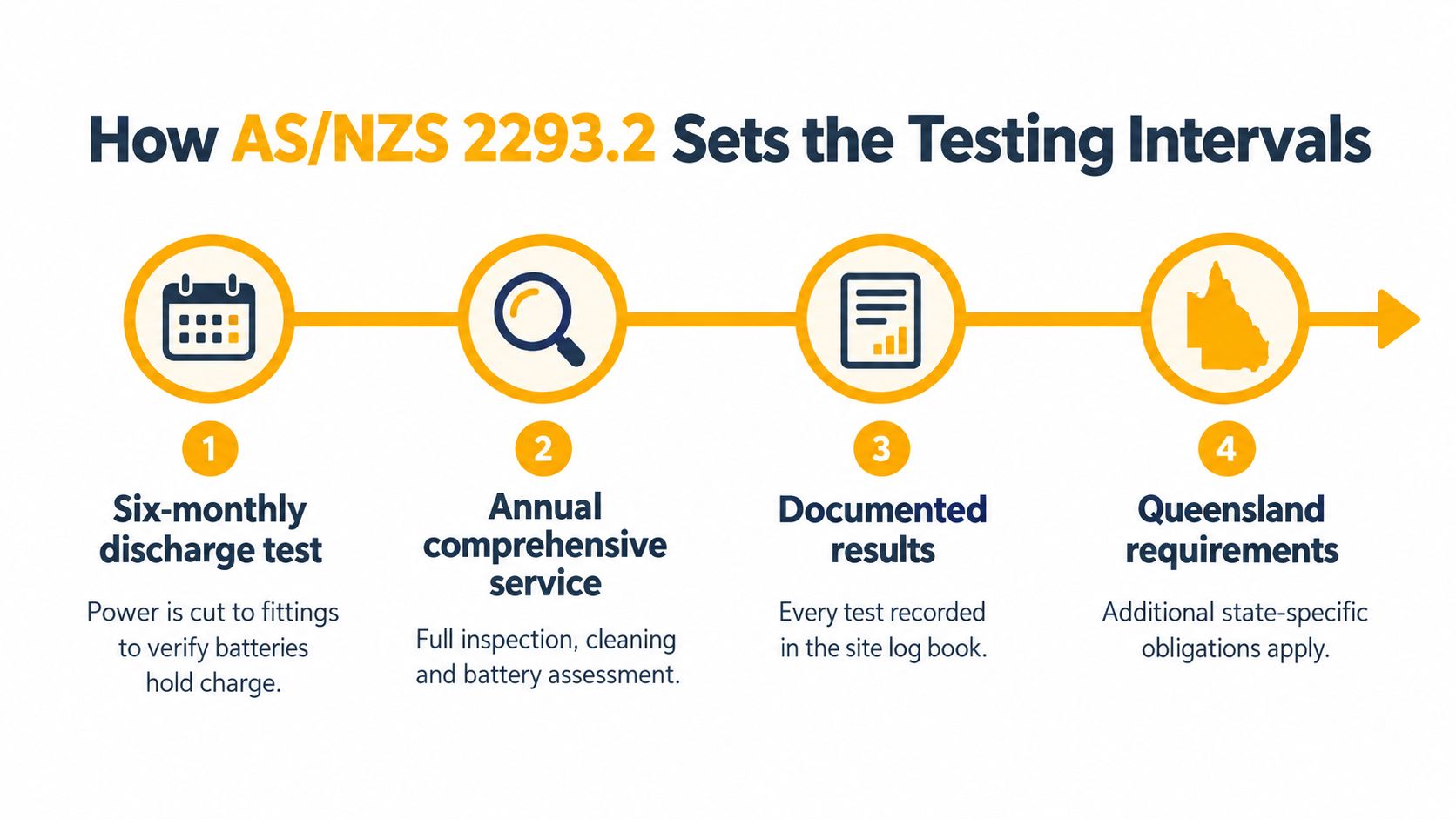
Six-monthly discharge testing
The central interval is every six months. The normal electrical supply is interrupted so emergency luminaires and exit signs operate from their batteries for the system's full rated duration. For most Australian installations, that duration is 90 minutes.
Every fitting needs a result. The purpose is to identify failed or degraded batteries, lamps or LEDs, chargers, control equipment and individual fittings that don't maintain illumination. A fitting that goes dark before the required duration has demonstrated a fault. It shouldn't be recorded as compliant just because it illuminated at the start of the test.
The practical annual rhythm is therefore at least two full-duration discharge tests across a 12-month period for most commercial premises. The exact arrangement still needs to be checked against the building's approved fire-safety solution, adopted standard and Fire Safety Management Plan.
The annual service
AS/NZS 2293.2 also provides for a more thorough annual service. It adds closer inspection, cleaning and examination of battery and charger condition. Dust, damage, poor access, deteriorated labels and charging problems can all affect the reliability of the installation, even where a fitting appears to operate.
A facility manager should ask the service provider to separate the discharge-test result from the annual maintenance findings. That distinction makes it easier to see whether a fitting passed the autonomy test, whether it needs cleaning or repair, and whether corrective work was completed.
A certificate saying “all emergency lights checked” is weaker than a fitting-level result showing what was tested, how it performed and what happened to defects.
For a concise explanation of the maintenance rhythm, see this guide to how often emergency lighting should be tested.
The following video can help visualise the testing process and the role of the standby supply.
Visual Check, Functional Test, and Full-Duration Discharge Test Compared
Australian guidance often uses “test” as if it describes one activity. On a working site, three different checks need to be separated.
A visual switch-on check confirms visible condition and immediate illumination. A functional simulated-failure test confirms that the fitting changes from mains operation to emergency operation. A full-duration discharge test challenges the battery and associated equipment for the installed rated period.
| Test type | Performed by | Evidence produced | What it proves |
|---|---|---|---|
| Visual switch-on check | Site staff or a suitably qualified service person, depending on the task | Condition note, location and immediate operating result | The fitting appears intact and illuminates at that moment |
| Functional simulated-failure test | Appropriately licensed tester | Fitting-level result showing mains interruption and emergency operation | The changeover function responds and the fitting operates on standby supply |
| Full-duration discharge test | Appropriately licensed tester | Fitting-level result, defects, corrective action and completion status | The battery and control arrangement maintain illumination for the system's rated duration |
A visual check has value, particularly between scheduled service visits. It can identify a damaged diffuser, failed indicator, obstructed sign or fitting that won't illuminate. It doesn't prove battery capacity.
The sustained discharge test catches failures that a short activation can miss. A battery may be degraded, a charger may not restore capacity, or control equipment may allow a fitting to illuminate briefly before it fails. Self-contained batteries also age independently, so testing a sample isn't evidence that the entire site will perform.
Mixed sites create another trap. Exit signs, emergency luminaires, central-battery circuits and fittings without accessible test switches may need different access arrangements, but they still require clear identification and a documented result. A computer-monitored system can improve visibility, but its report must still be linked to the equipment and maintenance records.
If a contractor only presses a button and writes “passed”, ask whether the normal supply was interrupted and whether the full rated duration was completed.
The right question isn't “Did the light come on?” It's “What condition did this test prove, which fitting did it apply to, and where is the evidence?”
Who Can Legally Test and Certify Emergency Lighting in Queensland
Emergency-lighting inspection and testing is regulated work in Queensland. The Queensland Building and Construction Commission Regulation 2018 identifies inspection or testing of emergency-lighting systems as work that may be performed by a person holding an electrical mechanic licence. QBCC also recognises a specific fire-protection electrical licence stream for inspecting and testing emergency lighting.
That distinction affects how a landlord, body corporate, facility manager or business operator appoints a contractor. A normal visual walk-through isn't equivalent to licensed testing involving electrical isolation, battery discharge verification, fitting identification and defect documentation.
The 2021 licensing change
From 1 May 2021, the former “emergency lighting, inspect and test” licence class automatically transitioned into the electrical stream as an “inspect and test, emergency lighting” licence class. Queensland's licensing framework therefore treats the work as part of the contemporary electrical licensing structure, rather than as an informal general fire-protection activity. The licensing transition is described in the QBCC emergency-lighting licence framework.
Before a service visit, request the contractor's licence details in writing and confirm that the licence covers the work being performed. Don't rely on a company name, a uniform or a previous commissioning certificate. The individual or business engaged must hold the appropriate authority for the actual inspection and testing task.
Certification is separate evidence
Queensland guidance also identifies an annual survey or certification pathway for fire-protection equipment. After an annual survey, a certificate may state that no changes have affected the equipment in a way that would cause it to fail its design requirements. That certificate supports the maintenance record, but it doesn't replace the underlying fitting-level test results.
The cheapest quote often covers the shortest activity. Compare the scope, licence, test method, duration, asset identification and reporting format before comparing price. A lower fee isn't a saving if the contractor leaves the building owner unable to demonstrate that the prescribed work occurred.
Records You Should Expect to See in a Compliant Log Book
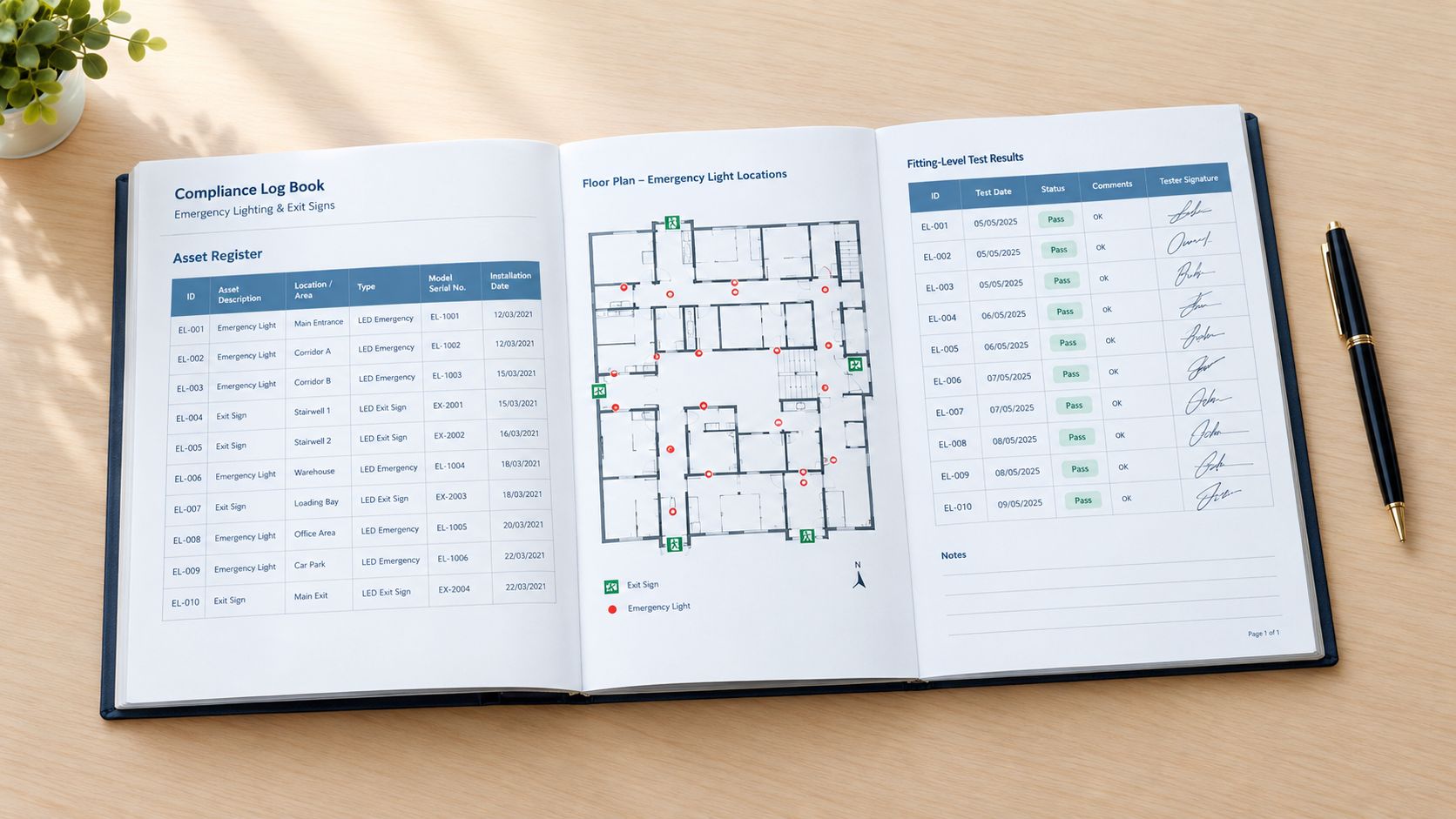
A compliant log book should let another person reconstruct the service without standing beside the fitting. Start with an asset register linked to floor plans. Each emergency luminaire and exit sign needs an identifier and location that matches what the technician finds on site.
The test record should then capture the result for each fitting, not just a single statement covering the building. The core fields are straightforward:
- Fitting identification: Use the asset number and location shown on the register and plan.
- Test date: Record when the inspection or discharge test occurred.
- Operating result: Show whether the fitting operated as required under the test method.
- Defect details: Describe failed batteries, LEDs, chargers, indicators, damage or access problems.
- Corrective action: State what was repaired, replaced, isolated or scheduled.
- Completion status: Confirm whether the defect is closed or remains outstanding.
What an auditor needs to trace
A page reading “all fittings passed” doesn't show which fittings were present, which test was performed or whether a failed unit was repaired. The useful evidence connects the register, floor plan, service report and rectification record.
For a central-battery or computer-monitored system, retain the system report alongside the service documentation. The report should identify the circuits or fittings covered, show failures and preserve the action taken. Digital records are useful only when the building team can retrieve them and match them to the physical installation.
Commercial landlords and body corporates should retain certificates, test reports, defect notices, repair invoices and handover information together. The fire safety schedule guide can help align emergency lighting with the wider building documentation.
A technician may find the equipment in good condition and still report a documentation failure. That isn't pedantry. Written evidence is what allows an owner, manager, insurer or auditor to verify maintenance after the contractor has left.
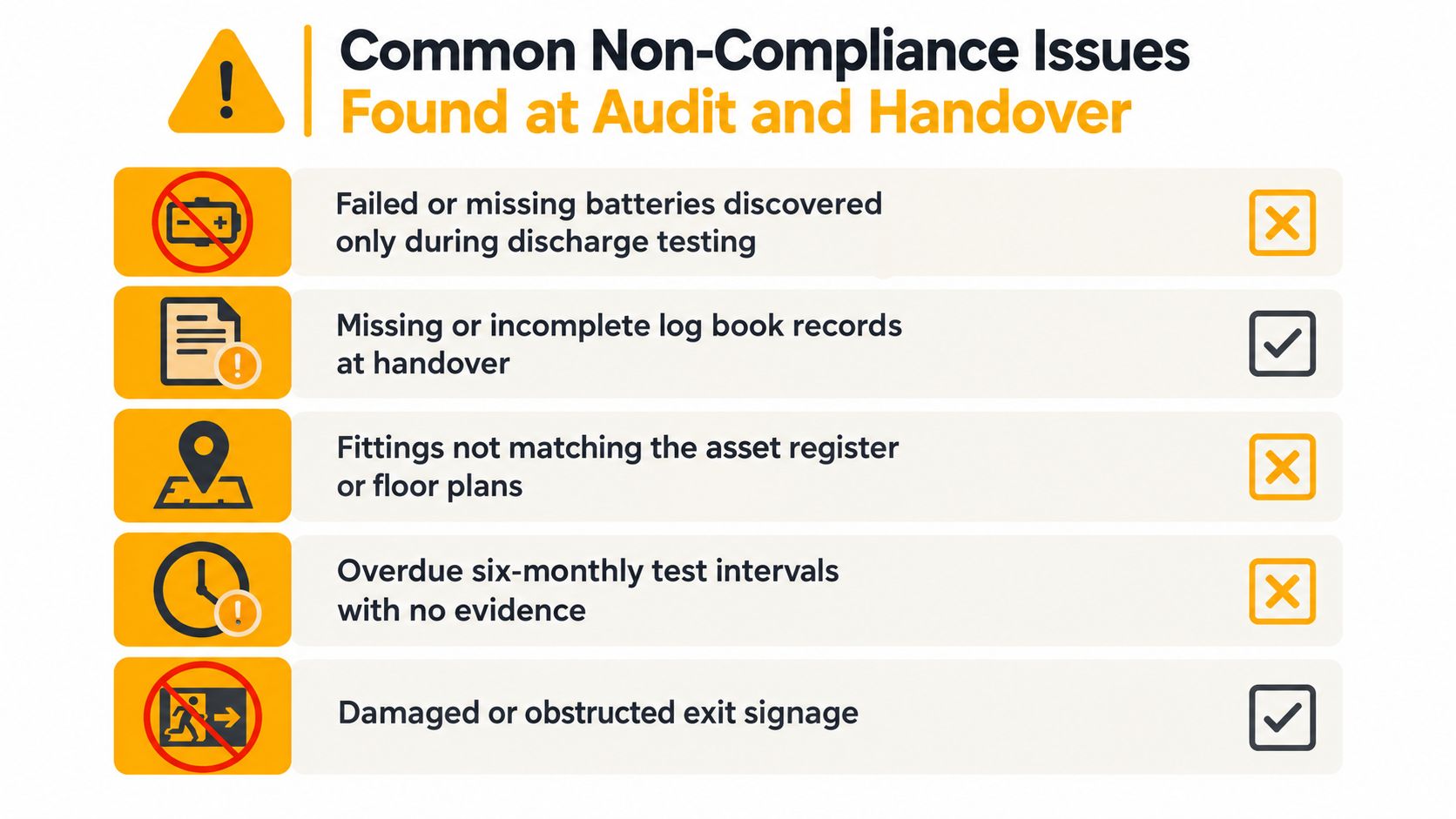
Common Non-Compliance Issues Found at Audit and Handover
The recurring failures are usually ordinary, not dramatic. A site has lights on the wall, but the register is incomplete, the last report records only a date, or the “six-monthly test” was a short switch-on check.
A commissioning certificate doesn't prove ongoing maintenance. Batteries degrade, tenancies change, fittings move and exit paths become obstructed. A new owner or body corporate inherits the physical system and the evidence gap at the same time.
Run this site check before the next audit
- Count against the register: Walk every floor and compare fittings with the asset list and floor plans.
- Read the latest report: Check whether it records fitting-level results, not only a service date.
- Confirm the test method: Look for evidence of mains interruption and the full rated-duration discharge test.
- Check the annual service: Confirm that cleaning, battery and charger condition were addressed.
- Verify the tester: Confirm the person held the appropriate QBCC or electrical licence for the work.
- Inspect the escape path: Remove stock, decorations or equipment obstructing exit signs and emergency luminaires.
Mixed tenancy sites need particular attention. One occupier may have arranged a visit while another has altered, covered or disconnected fittings. The building owner or manager needs a single current register and a coordinated maintenance record, rather than separate paperwork that leaves gaps between tenancies.
A failed battery discovered during discharge testing isn't evidence that testing was unnecessary. It's evidence that the test did its job. The compliance failure occurs when the defect is ignored, omitted from the record or carried forward without a clear rectification status.
A Practical 12-Month Rhythm for Staying Compliant
Queensland businesses can manage emergency lighting through three linked controls: defined technical intervals, suitably licensed personnel and written evidence. Remove any one of them and the maintenance program becomes difficult to defend.
At the start of the cycle, verify that the asset register, floor plans and Fire Safety Management Plan describe the same installation. Check additions, removals, tenancy alterations, central-battery equipment and fittings that technicians couldn't access during the previous visit.
Put the calendar around the building
Schedule the first full-duration discharge test in line with the approved maintenance program. Schedule the second six-monthly test so the interval remains controlled, then place the annual service in a maintenance window that allows cleaning, closer inspection and rectification.
Use the same asset identifiers at every visit. That simple discipline makes a failed fitting visible across reports instead of allowing it to disappear under a new description.
A working maintenance calendar should include:
- Register review: Confirm locations, quantities and labels against the installed system.
- Six-monthly discharge testing: Arrange the prescribed simulated-failure test for every fitting.
- Annual service: Include closer inspection, cleaning and battery and charger assessment.
- Defect close-out: Track repairs, replacements, isolation and completion status.
- Document review: File reports and certificates where the responsible manager can retrieve them quickly.
A preventive program should also coordinate emergency lighting with other fire-protection obligations, access arrangements and tenant communications. The preventive maintenance plan provides a useful structure for organising recurring site work without relying on memory.
Celtic Fire & Security provides emergency and exit lighting testing, maintenance and compliance reporting for commercial sites across North Brisbane, Moreton Bay, the Sunshine Coast, Somerset and Ipswich. Arrange a review of your asset register, licensed testing schedule and fitting-level records by visiting Celtic Fire & Security.
No responses yet