
A facility manager points to the current service tag on a fire hose reel and asks the question I hear regularly: “So, is the system compliant?” The tag shows that someone attended the site, but it doesn't tell you whether the hose fully deploys, whether the nozzle is clear, or whether the hydraulically most disadvantaged reel delivers usable flow.
That distinction matters on Queensland commercial sites. A proper fire hose reel testing program combines condition checks, functional operation, measured performance, correct licensing and records that demonstrate what the technician tested. A reel can look tidy and still reveal a restricted nozzle, seized valve, damaged hose or weak supply when water is measured under operating conditions.
Table of Contents
- Why a Visual Check Is Not Enough on Queensland Sites
- Australian Standards and Queensland Licensing That Apply
- Running the Annual Flow Test Step by Step
- Six-Monthly Service vs Annual Flow Test
- Common Test Failures and What They Reveal
- Recordkeeping That Stands Up to an Audit
- When to Repair, Replace, or Call a Licensed Contractor
Why a Visual Check Is Not Enough on Queensland Sites
A retail reel can look ready for use: the cabinet is accessible, the hose is neatly wound and the service tag is current. Extend that hose during the annual test, however, and the flow reading may show inadequate discharge. The tag confirms that someone attended. It does not confirm firefighting performance.
A fire hose reel testing program must separate condition from performance. Six-monthly work checks access, leakage, free hose movement, corrosion and visible condition. The annual test measures the effort required to unwind the hose and the water flow delivered at the reel. Queensland requirements identify both six-monthly and yearly inspections for prescribed fire hose reels, carried out by an appropriately qualified person under the applicable building and maintenance rules (Queensland fire-safety legislation).
A current tag, invoice or summary report is not the prescribed maintenance record. Those documents may show that routine servicing occurred, but they do not necessarily record what the technician inspected, tested or found. For an audit, the underlying maintenance record needs to identify the work completed and its result.
What each visit can prove
A visual or six-monthly service can find a reel blocked by stock, hard to reach, leaking, corroded or unable to run freely. It can also expose missing signage and obvious deterioration. These findings matter because a hose that cannot reach the fire area is not serviceable, even when water is available.
The annual flow test examines the system under operating conditions. It can indicate whether the supply, isolation valve, hose, nozzle and connecting pipework are working together at the tested reel. A poor reading may point to a restricted nozzle, a valve that is not fully open, hose damage, undersized or obstructed pipework, or weak supply pressure.
The hydraulically most disadvantaged reel deserves particular attention. Pipe length, elevation and fittings can make one reel perform worse than others on the same site. Testing a convenient reel does not automatically establish that every outlet will deliver the same result.
Practical rule: A current tag records a service event. A measured test record shows what the reel delivered.
Queensland treats inspection and testing of unpumped fire hose reel systems as regulated work. Owners therefore need to assess both real-world usability and audit evidence when selecting a contractor. A reel that cannot deliver usable flow creates a safety problem, while an incomplete record creates a separate compliance problem.
Australian Standards and Queensland Licensing That Apply
A compliant hose reel depends on two separate decisions: the equipment must meet the applicable Australian Standards, and the person testing it must hold the Queensland authority for that work. Those requirements affect what the annual flow result can prove and whether the report will stand up to review.
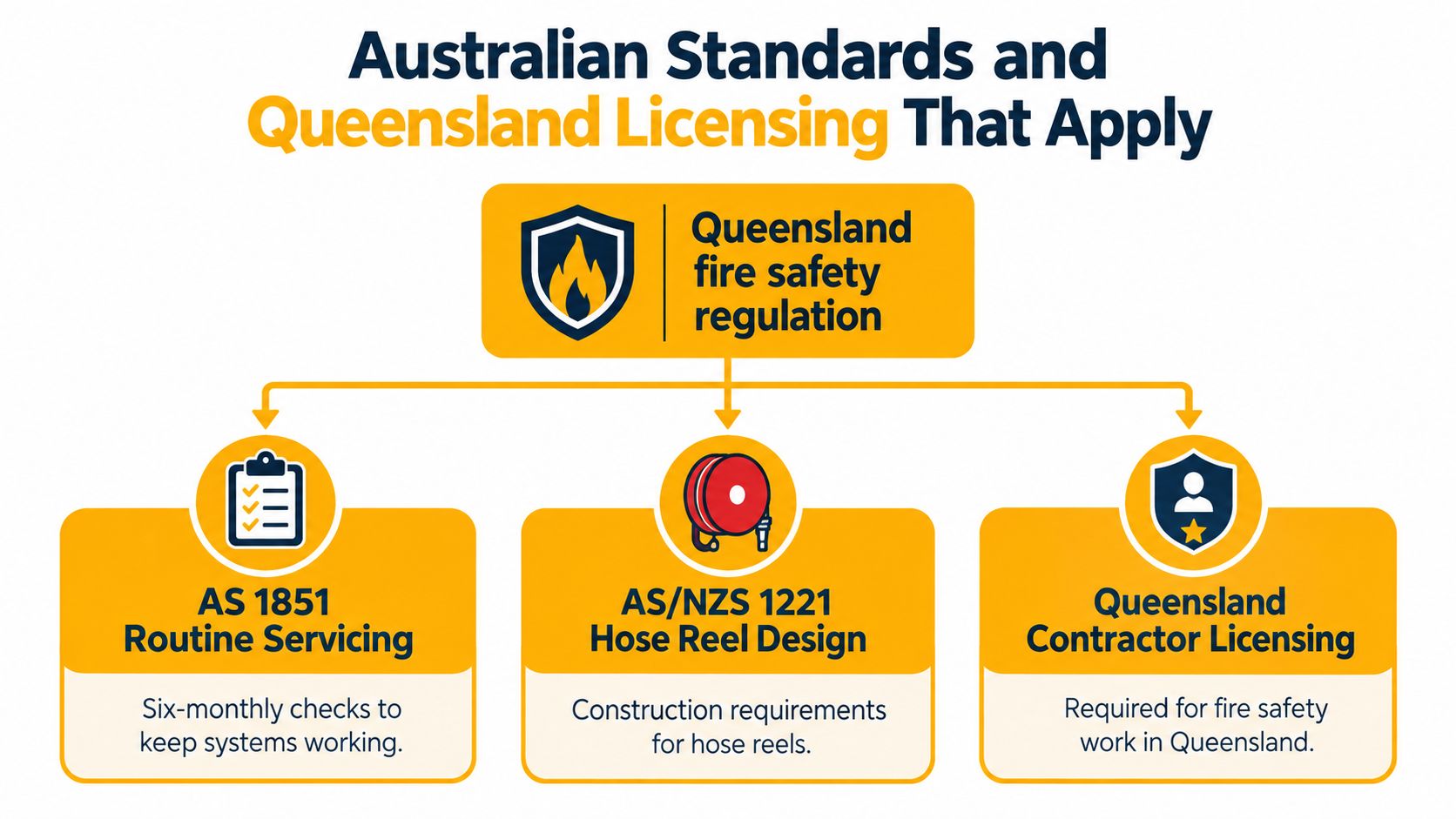
Three standards usually guide a commercial hose-reel program:
- AS 1851 sets the routine servicing framework, including recurring inspection and testing activities for fire hose reels.
- AS/NZS 1221 covers design, construction and performance requirements for fixed and swing-arm hose reels intended for one operator (AS/NZS 1221 requirements).
- AS 2441 covers installation, including the arrangement and connection of installed fire hose reels.
For a closer explanation of these three standards, review our analysis of the Australian Standards governing hose reel compliance, including AS 1851, AS/NZS 1221 and AS 2441 at Celtic Fire & Security.
Check the Queensland licence scope
Queensland's current fire-protection licensing framework commenced on 1 May 2021. The former fire hydrants and hose reels inspection-and-test class then moved into water-based fire-system and portable-fire-equipment streams (QBCC licensing reforms). Transitional arrangements allowed affected licensees to continue inspecting and testing fire hydrants and hose reels until 31 October 2021. From 1 November 2021, the full scope required an additional licence class.
A technician's general fire-protection experience does not establish authorisation for every task. The relevant scope includes inspection and testing of unpumped fire hose reel systems, along with the six-monthly fire-hydrant work specified by AS 1851. Queensland legislation also separates maintenance downstream of the hose attachment point from inspection and testing of the system.
A contractor may be authorised to certify equipment downstream of the attachment point without holding the scope needed to inspect and test the system. QBCC's portable-stream information explains this distinction and identifies inspection and testing of unpumped hose-reel systems as defined licensing work (QBCC fire-protection licence information).
Ask for evidence before accepting the report
Request the business's current Queensland licence details and ask which class covers the work being performed. The report should identify the technician, the test completed and the measured result.
An invoice records a transaction, and a service sticker records that information was placed on the reel. Neither replaces a maintenance record that connects the standard, test method, licence scope and result. That evidence lets an auditor, owner or later technician understand what the flow reading represented.
Running the Annual Flow Test Step by Step
An annual test on an unpumped system should be controlled, repeatable and easy for another person to understand from the record. The following sequence reflects the practical order used on commercial sites.
Start with the reel and its surroundings
Confirm the reel's location and identification first. Check that the cabinet or drum is accessible, the signage is present and the hose can be deployed into the area it is intended to protect.
Inspect the cabinet, drum, mounting arrangement, hose, couplings, nozzle and stop valve. Look for cuts, abrasion, flattening, UV deterioration and leaking connections. Operate the valve and nozzle through their usable range, and check that the reel rewinds without fouling.
A hose that can't be fully deployed because of stored goods, a seized valve, a blocked nozzle or poor access has a serviceability defect. Water at the connection point doesn't remove that defect.
Prepare the hose for a meaningful reading
Fully extend the hose before measuring discharge. This removes kinks and tests the reel in the condition in which it is expected to operate. Testing a short length still coiled on the drum can produce a result that doesn't represent the operating arrangement.
Open the stop valve with the nozzle initially closed. Then open the nozzle fully and allow the discharge to stabilise before taking the flow reading. The measurement should be taken at the most hydraulically disadvantaged reel, not just the reel that's closest to the main entrance or easiest to reach.
The AS 1851 material identifies minimum flow benchmarks of 0.33 L/s for a 19 mm hose and 0.41 L/s for a 25 mm hose (Queensland fire-service advisory notes). The applicable benchmark depends on the hose diameter and the installation's design basis, so don't treat one nominal figure as universal.
Record the result, not just the outcome
A useful record identifies the exact reel, hose size and measured flow. It also captures defects and the action taken, so a later reviewer can distinguish a clean-and-adjust visit from a repair recommendation or an installation investigation.
| Step | Action | What to record |
|---|---|---|
| 1 | Confirm access, signage and reel identification | Reel number, location and access condition |
| 2 | Inspect cabinet, drum, hose, couplings, nozzle and valve | Damage, leakage, corrosion and missing components |
| 3 | Fully extend the hose | Deployment condition, kinks and reach |
| 4 | Open the stop valve with the nozzle closed | Valve operation and defects |
| 5 | Open the nozzle fully and stabilise discharge | Test condition and nozzle status |
| 6 | Measure flow at the most disadvantaged reel | Flow in L/s, hose diameter and reel location |
| 7 | Assess findings and corrective action | Defect classification, action and retest requirement |
A pass or fail line on its own doesn't explain what happened. The measured flow, test location and defect notes are what make the result useful for maintenance decisions.
Six-Monthly Service vs Annual Flow Test
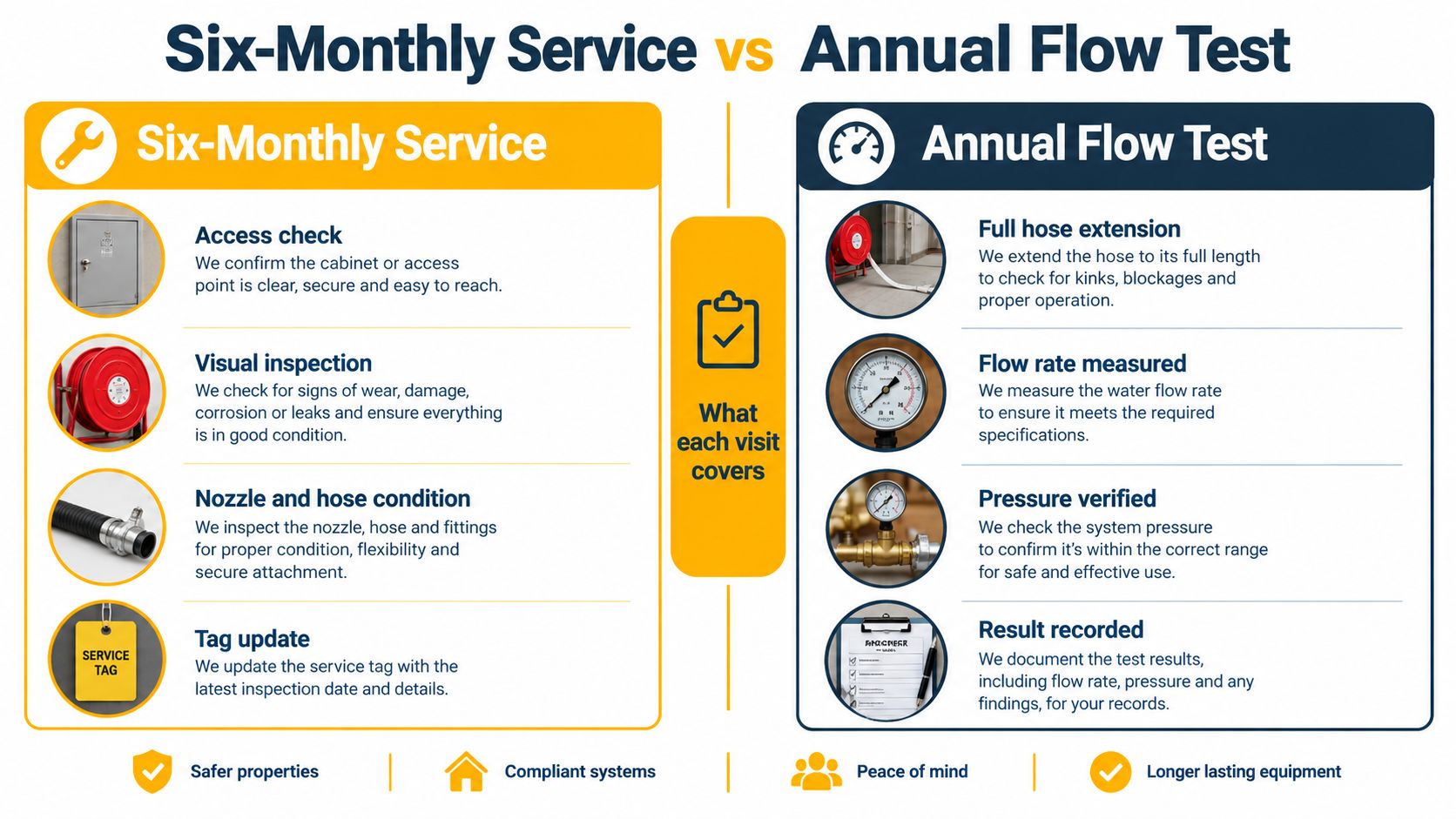
A reel can look ready during a six-monthly visit and still reveal a supply problem when water is discharged. The two visits answer different questions, so calling both a general “hose reel service” can hide what was checked. Queensland requirements recognise six-monthly and yearly service inspections for prescribed hose reels, carried out by an appropriately qualified person.
The six-monthly service examines condition and serviceability. Can staff reach the reel? Does the hose unwind freely? Are the valve, nozzle, couplings and cabinet free from obvious leaks, corrosion or damage? This visit should identify a cabinet blocked by stock, a deteriorating hose, or a nozzle obstructed by debris.
The annual flow test supplies operational evidence. The technician fully extends the hose, opens the nozzle, measures discharge and assesses the relevant reel under flowing conditions. The result is a diagnostic clue, not a tick-box outcome. It can expose restriction at the nozzle or valve, a damaged hose, undersized or obstructed pipework, or inadequate supply pressure.
What the annual result doesn't prove
A satisfactory reading at one reel does not establish identical performance throughout the building. The hydraulically most disadvantaged reel may be remote, positioned higher or affected by longer pipework, so selecting a convenient nearby reel can produce false confidence. The reading also does not prove that an inaccessible reel is usable, or that a physically damaged hose is safe because water passed through it.
The result describes flow at a defined location and test condition. The technician must still inspect the hardware, confirm the selected reel and record defects separately.
Site disruption depends on access, layout and where discharged water can go. Arrange access with tenants, warehouse staff or retail managers before the visit. The reel should be fully deployable, and the most disadvantaged location should be testable without improvised arrangements.
Common Test Failures and What They Reveal
Low flow isn't always evidence that the reel itself needs replacement. The test method can create a misleading result, and a poor method can also create a misleading pass.
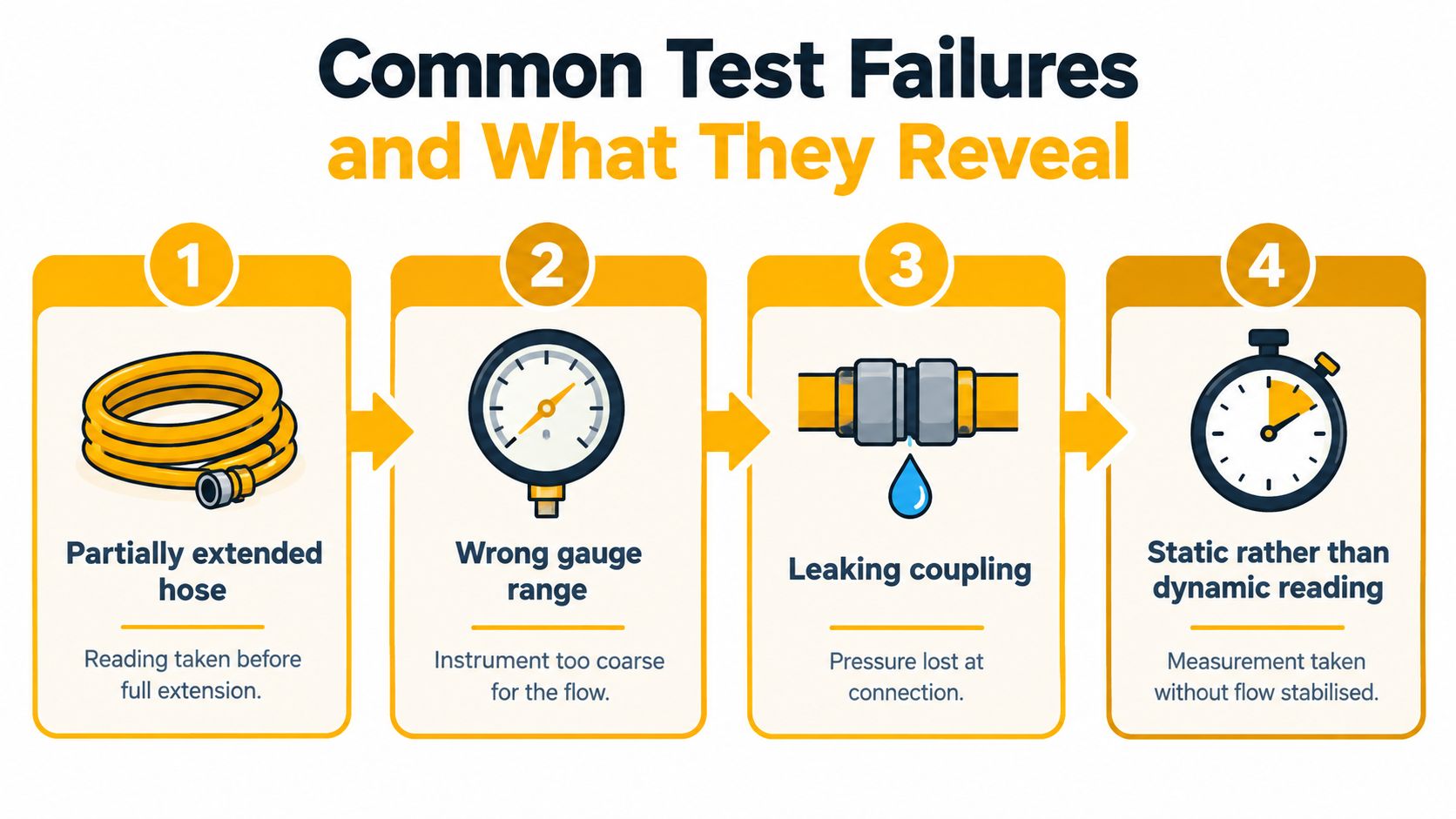
The first error is measuring a partially extended hose. Coils left on the drum can restrict flow and prevent the test from representing actual deployment. The second is choosing a convenient reel instead of the hydraulically most disadvantaged one. A nearby reel may perform well while a distant, high or hydraulically remote reel exposes the actual supply limitation.
A restricted nozzle is another common problem. If the nozzle isn't opened fully, the reading describes the restriction created by the test setup rather than the available system performance. Static pressure causes a similar misunderstanding. Pressure with no water moving doesn't demonstrate usable discharge flow.
Read the result as a clue
When the method is sound and the flow remains low, investigate the system rather than jumping straight to a replacement reel. Possible causes include undersized pipework, a partially closed isolation valve, a fouled strainer or a water supply that has drifted below the installation's design pressure.
A single result can't identify the root cause by itself. Compare the test conditions, inspect valves and connections, and determine whether the restriction follows the reel, the branch pipework or the broader supply arrangement.
Some defects are decisive even when water is present:
- Damaged hose: Cuts, abrasion, flattening, UV deterioration or leaking couplings compromise serviceability.
- Seized valve: A valve that can't operate reliably prevents controlled discharge.
- Blocked nozzle: Water in the line isn't enough if the nozzle can't produce the intended stream.
- Poor access: A reel blocked by stock or fit-out changes can't be deployed when needed.
- Missing signage: Users may not locate the equipment quickly in an emergency.
A flow result is one piece of evidence. The technician still has to establish whether the equipment can be found, operated, deployed and safely used.
For marina installations, the performance picture can be more demanding. Queensland guidance states that the two most hydraulically disadvantaged reels, operating simultaneously, must each provide at least 0.63 L/s at a running pressure of not less than 275 kPa. Where normal supply can't consistently achieve that performance, the guidance specifies a booster pump capable of at least 1.26 L/s at the required pressure (Queensland marina fire-safety guidance). That example shows why a single convenient-reel test can't answer every system question.
Recordkeeping That Stands Up to an Audit
A sticker is useful for showing the next service status at a glance. It isn't enough to defend a compliance claim when someone needs to understand exactly what happened on site.
Queensland fire-safety requirements link prescribed hose-reel maintenance to six-monthly and yearly inspections under QDC MP 6.1. The record should show the work performed by an appropriately qualified person, not merely the date an invoice was issued. Queensland guidance specifically distinguishes the required maintenance record from a tag, invoice or summary report.
Fields worth putting in the maintenance log
At minimum, retain:
- Site details: The property address and relevant building or tenancy.
- Reel identification: Reel number, location and whether it was the most disadvantaged reel tested.
- Equipment details: Hose diameter and any relevant installation information.
- Measured performance: Flow in litres per second, with the test condition recorded.
- Service date: The date of inspection or annual flow test.
- Technician details: Name, business and Queensland licence class relevant to the work.
- Defects: Damage, leakage, access problems, valve faults, nozzle restrictions or signage issues.
- Corrective action: Cleaning, adjustment, repair, replacement, escalation or retest outcome.

Store the completed report with the site's broader fire-safety documentation, including the relevant fire safety schedule records. Keep records for the period required by the building's approval conditions, applicable Queensland requirements, insurer expectations and your document-control policy. Where those requirements differ, use the longer defensible retention period and preserve superseded reports rather than deleting them when a new tag is fitted.
A sound contractor brief can be simple: identify every reel, specify the required service interval, require measured annual flow results, and require defect and corrective-action notes. That produces evidence a building manager can review without relying on a technician's memory.
When to Repair, Replace, or Call a Licensed Contractor
Clean or adjust a component when the defect is minor and the equipment remains sound. A nozzle may need cleaning, a valve may need exercising, or a hose may need to be correctly re-racked after inspection. The technician should document the action and confirm operation again.
Replacement becomes more appropriate when the hose is damaged or deteriorated, couplings leak, the nozzle remains defective, the valve is seized, or the reel drum can't operate without fouling. Low flow that persists after equipment-level checks may indicate a pipework, isolation, pump or supply issue rather than a component that can be fixed at the reel.
Installation-level concerns, including simultaneous operation requirements, pump sizing or inadequate supply pressure, need a licensed contractor who can assess the system against its design basis. If a new or relocated reel is required, review the installation requirements before work starts using guidance such as commercial fire hose reel installation information.
Quick answers for site managers
How long does a compliant test take? The duration depends on access, the number of reels, discharge arrangements and whether defects require investigation. A technician should allow enough time to deploy the hose fully, measure flow properly and complete the record.
What if a reel is inaccessible? Record it as a serviceability defect and arrange access before the test is closed out. Don't treat an inaccessible reel as tested because another reel passed.
When should records be reviewed? Review them after every visit, before the next scheduled service and whenever the building layout, tenancy or water-supply arrangement changes.
Celtic Fire & Security provides commercial fire hose reel inspection, maintenance, testing and compliance documentation across North Brisbane, Moreton Bay, the Sunshine Coast, Somerset and Ipswich. If your site needs a documented six-monthly service or annual flow test, visit Celtic Fire & Security to arrange a review of your hose reels and maintenance records.
No responses yet