
Fire Extinguisher Servicing in Queensland: Your Compliance Questions Answered
If you own or manage commercial premises in Queensland, you are the occupier responsible for keeping every fire safety installation on site in working order – fire extinguishers included. That duty is set out in the Fire and Emergency Services Act 1990 (Qld) and the Building Fire Safety Regulation 2008 (Qld), and it is tested whenever an inspector, insurer or auditor asks for evidence.
For facility managers, property managers and body corporates, the practical questions are always the same: how often do extinguishers need servicing, what paperwork proves it, and who is allowed to do the work? Here are clear answers to the questions we hear most often.
How often must fire extinguishers be serviced in Queensland?
Queensland does not set its own timetable for extinguisher maintenance. Instead, the regulations require installations to be maintained to the standard of performance they were designed and installed to, which in practice means the Australian Standards – principally AS 1851, Maintenance of fire protection systems and equipment. That standard breaks servicing into a few distinct intervals.
Six-monthly inspections
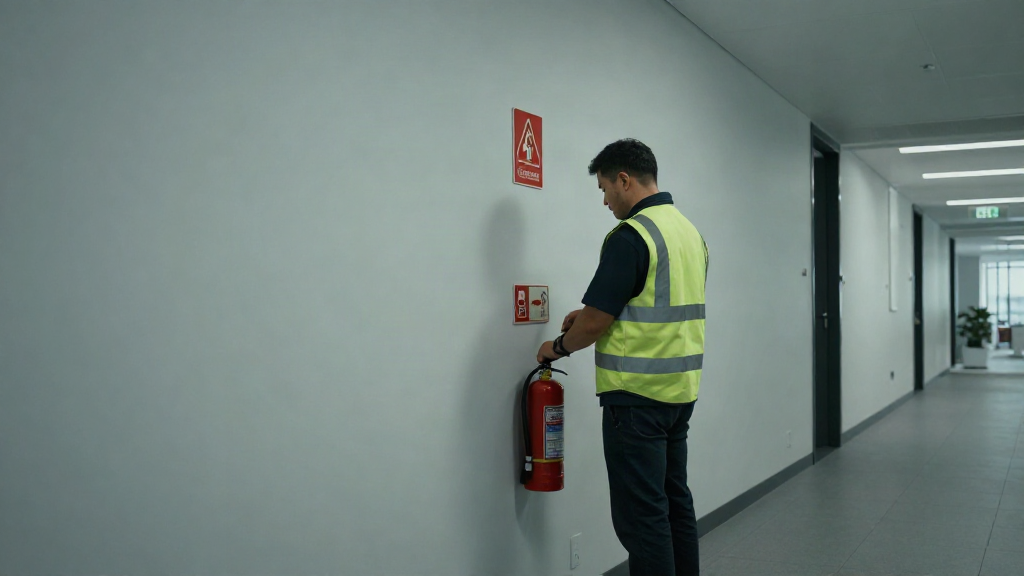
Every extinguisher should receive a visual inspection at least every six months. This is a quick but important check: is the unit still in its designated location, is it undamaged, is the pressure gauge reading in the acceptable range, is the seal and tamper indicator intact, and is the surrounding signage and access clear? A six-monthly inspection confirms the extinguisher is ready to use, but it is not a substitute for a full service.
Annual service
Once a year, each extinguisher should receive a more thorough maintenance service from a competent technician. The unit is examined in detail – body and seams, valves, hoses and nozzles, the charge or weight of the extinguishing agent, and the mounting and housing. Findings are recorded and the service tag is updated.
Longer-interval maintenance and pressure testing
Beyond the annual service, certain extinguisher types have extended maintenance and pressure-test intervals that typically fall due around the five-year mark and again later in the unit’s life. These depend on the type and construction of the extinguisher, so it is worth confirming the exact schedule for your equipment. Rather than tracking these dates yourself, a servicing provider should schedule them on your behalf so nothing slips.
What records and tagging do you need to prove compliance?
Queensland’s Building Fire Safety Regulation 2008 requires occupiers to keep records of the maintenance of fire safety installations for two years. When an inspector or insurer asks, you need to be able to show what was done, when it was done, and by whom.
In practice, compliant record-keeping has two layers. First, each extinguisher carries a service tag or label recording the date of the last service, the technician who performed it and the next due date – so anyone can read the unit’s status at a glance. Second, you hold the supporting documentation: service reports and certificates listing each extinguisher, the work carried out, and any defects or repairs. Digital records are acceptable and far easier to produce than a folder of paper certificates, so choose a provider who keeps them for you.
Who is qualified to service your extinguishers, and what should a check cover?
In Queensland, fire protection work such as inspecting and testing fire protection systems – including extinguishers – is licensed work. A technician performing it should hold a current QBCC fire protection licence for inspect and test, and carry out the work to AS 1851. Experience matters too: an accredited provider will train its technicians to recognise the difference between a unit that needs a simple service and one that has reached the end of its serviceable life.
What a service visit should cover
-
Confirmation that each extinguisher is in its correct location and still suits the hazard it is there for
-
Body, valve, hose, nozzle and pressure gauge condition
-
Weight or charge of the extinguishing agent
-
Seal, tamper indicator and mounting or housing
-
Clear signage and unobstructed access to the unit
-
An updated service tag and a written report of any defects
What happens if your extinguishers are overdue?
Overdue servicing is a compliance problem rather than a paperwork formality. As the occupier, you carry the legal duty to maintain fire safety installations, and a lapse can lead to penalties, pressure from your insurer, and – most importantly – equipment that may not perform when it is genuinely needed. It also tends to surface at the worst possible moment, such as during a building inspection or after an incident. If you are unsure where your extinguishers sit, a site audit will quickly establish what is current and what needs attention.
How Celtic Fire & Security keeps your premises compliant
Celtic Fire & Security supplies, installs, tests and maintains fire protection and security systems across Brisbane, the Sunshine Coast and surrounding regions. Our skilled technicians work to strict Australian Standards, service extinguishers alongside emergency lighting, fire and smoke doors, hydrants and smoke alarms, and handle the record-keeping so your compliance evidence is always current. One accredited team manages the whole schedule – so the job is done once and done right.
You can see the full range of installation, testing and maintenance services at celticfiresecurity.au/services.
The bottom line
Fire extinguisher servicing in Queensland is straightforward once the intervals and records are in place: a visual inspection every six months, a full annual service, and longer-interval maintenance tracked on your behalf. Keep the tags and records current, use a licensed and accredited provider, and your premises stay protected – and provably compliant.
No responses yet