
You're in the kitchen preparing dinner when a faint alarm sounds down the hallway. There's no visible flame, only a growing haze from a smouldering appliance or overheated furnishing. In a Queensland home, that early warning can matter before smoke reaches the bedrooms, stairwell or back rooms.
Queensland's approach to domestic smoke alarms reflects the serious consequences of delayed detection. After the 2011 Slacks Creek house fire killed 11 people, including eight children under 18, the state introduced staged reforms requiring interconnected photoelectric smoke alarms in domestic dwellings. The requirements now apply progressively from 1 January 2017 to 1 January 2027. Queensland Fire Department's smoke alarm reform guidance sets out the relevant dates and obligations.
The technology matters because not every fire begins with a tall flame. A fire may smoulder inside a sofa, mattress, electrical item or pile of materials before it develops openly. Photoelectric alarms are designed to respond particularly well to that smoke-rich stage, while interconnection helps ensure an alarm in one area can be heard throughout the dwelling.
Table of Contents
- Introduction to Photoelectric Smoke Alarms in Queensland Homes
- How Photoelectric Smoke Alarms Detect Smoke
- Photoelectric vs Ionisation Alarms Compared
- Queensland Rules and Australian Standards You Must Follow
- Where to Place and Interconnect Alarms for Best Protection
- Testing Cleaning and Maintaining Your Alarms
- Choosing Compliant Alarms and Next Steps for Your Property
Introduction to Photoelectric Smoke Alarms in Queensland Homes
A homeowner, landlord or small business operator needs more than an alarm fixed to the ceiling. Check which sensing technology it uses, where it is installed, whether alarms communicate with one another, and how they're maintained. Those details determine how reliably people receive warning throughout the property.
Queensland's staged reform programme places photoelectric technology at the centre of domestic fire safety. From 1 January 2017, requirements applied to new dwellings and substantial renovations. From 1 January 2022, they applied when a dwelling was sold or leased. From 1 January 2027, the requirements are scheduled to apply to all remaining domestic dwellings in Queensland, including existing private homes, townhouses, units and manufactured homes. The relevant dates and obligations appear in the Queensland Fire Department's official reform information.
The technology matters because a fire can smoulder before flames become obvious. Smoke from an overheating appliance, sofa or mattress may spread while occupants are asleep. A compliant alarm that detects smoke early, with interconnected alarms sounding in other rooms, can give people more time to wake, leave safely and call emergency services.
It cannot make a fire safe to investigate or replace sensible cooking, electrical and heating practices.
Practical rule: Treat a smoke alarm as an early-warning device, not confirmation that it's safe to investigate the fire.
Building layout also affects protection. Open-plan living areas, enclosed bedrooms, two-storey townhouses, garages, laundries and air-conditioned rooms can change how smoke travels. One alarm near a kitchen may not warn someone sleeping behind several closed doors.
This guide covers how photoelectric alarms work, why Queensland requires them in domestic settings, how they compare with ionisation alarms, and how to select, position, test and maintain a compliant system. Commercial-adjacent spaces require extra care, since dust, humidity, aerosols and cooking activity can cause nuisance alarms and affect maintenance.
How Photoelectric Smoke Alarms Detect Smoke
A photoelectric alarm uses a light source and a photosensitive sensor inside a detection chamber. The components are positioned so the light normally doesn't fall directly on the sensor.
A simple analogy is a torch beam in a dark room. If the air is clean, you may not see the beam from the side. If dust enters the beam, particles scatter the light in different directions, making the beam visible. A photoelectric alarm applies the same basic principle inside a small chamber.
The detection process
Clean air enters the chamber. The alarm continuously samples the air around it while the light source and sensor remain in their normal positions.
Smoke particles enter. Smoke from a fire moves into the chamber through openings in the alarm casing. The alarm isn't waiting for a visible flame. It's responding to particles suspended in the air.
Light scatters. The particles redirect some of the light towards the photosensor. Larger, visible particles commonly associated with smouldering fires create a particularly useful signal for this sensing method.
The sensor recognises the change. When scattered light reaches the photosensor at a sufficient level, the alarm's electronics interpret the change as smoke.
The sounder activates. The alarm produces an audible warning. In an interconnected installation, the signal can also cause other connected alarms to sound.
The result is a sensor that is well suited to fires producing substantial smoke before open flames appear. This is important in bedrooms and living areas, where occupants may be asleep or separated from the first signs of fire by walls and doors.
Why the chamber needs maintenance
Dust, insects and airborne residue can interfere with the sensing chamber. A dirty alarm may become more prone to nuisance activation, or its performance may be affected when smoke enters. Cleaning doesn't turn an expired alarm into a reliable one, so the device's service life and power source still need to be managed.
Photoelectric sensing also shouldn't be confused with a camera. The alarm doesn't identify the object producing smoke or assess whether a fire is safe. It detects a change in the chamber and gives occupants a warning that requires immediate attention.
Photoelectric vs Ionisation Alarms Compared
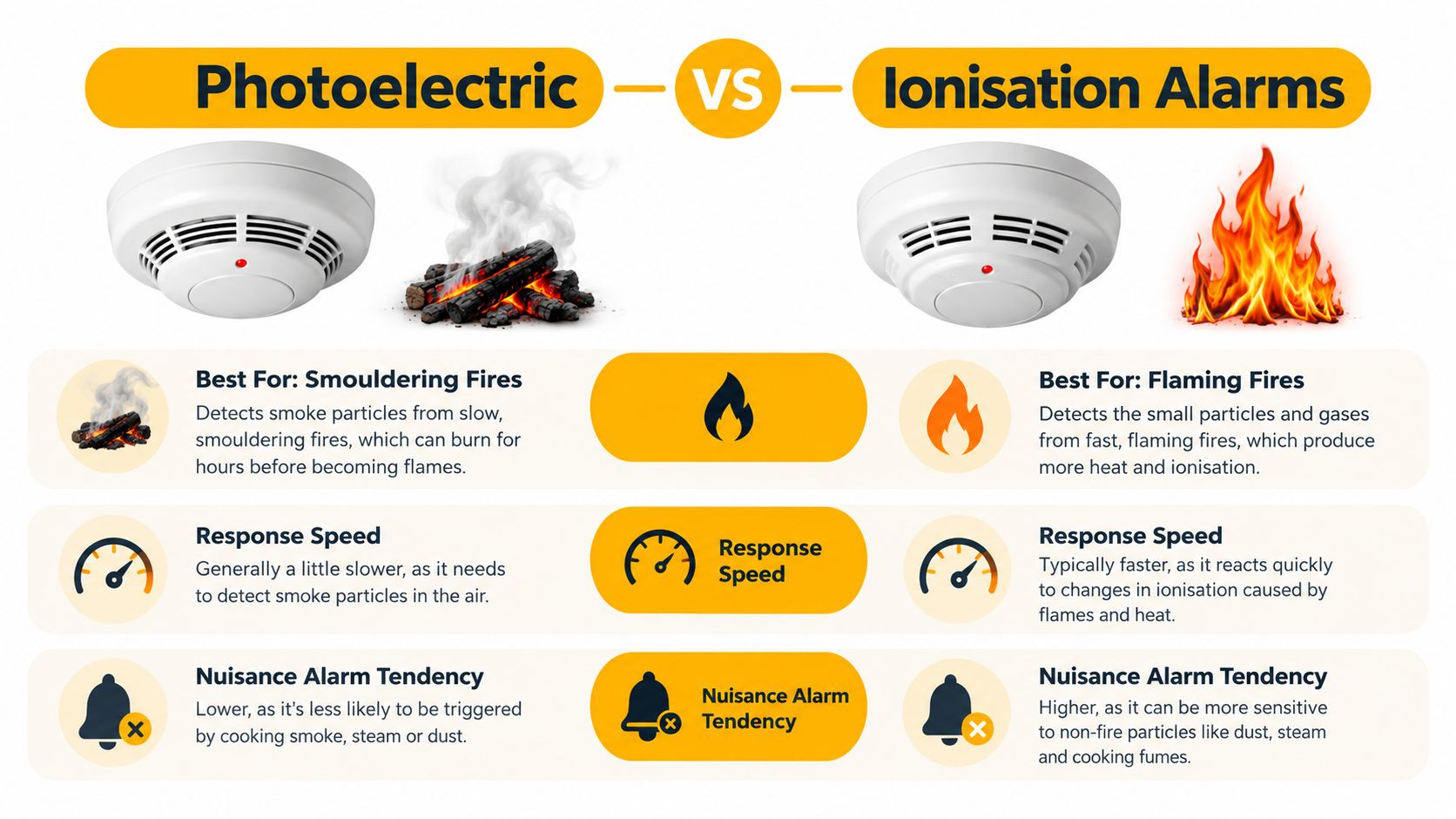
A smouldering mattress, overheated wiring or a forgotten pan can fill a room with smoke before flames become obvious. A fast-flaming fire behaves differently, producing heat and flame quickly. Photoelectric and ionisation alarms are designed around these different fire patterns, but Queensland's domestic reforms place photoelectric technology at the centre of the required home system.
Photoelectric alarms respond particularly well to smouldering fires, while ionisation alarms may respond sooner to some rapidly developing flaming fires. Fire and Rescue NSW testing reported mean activation times of 17.03 minutes for photoelectric alarms and 44.19 minutes for ionisation alarms in the relevant experiments. The Fire and Rescue NSW's analysis of smoke alarms in homes provides the source for those results.
A separate ABCB domestic smoke alarm study found photoelectric alarms activated first in 17.03% of test scenarios, compared with 44.19% for ionisation alarms. These figures describe the tested scenarios, not a promise about every real fire. Fire behaviour, room conditions, alarm position and airflow can all affect response. Ionisation alarms tended to activate first in more flaming fires, while photoelectric alarms activated first in most smouldering fires.
| Feature | Photoelectric alarms | Ionisation alarms |
|---|---|---|
| Primary strength | Smouldering fires that produce visible smoke before open flames | Some rapidly developing flaming fires |
| Detection principle | Detects light scattered by smoke particles | Detects disruption to an ionised electrical current |
| Queensland domestic requirement | Required for domestic dwellings under the staged reforms | Not permitted as the required domestic sensing technology |
| Common placement decision | Bedrooms, hallways and living areas, subject to compliant placement | Requires careful consideration and does not meet Queensland's domestic photoelectric requirement |
| Nuisance alarm considerations | Cooking smoke, dust, humidity and aerosols can still affect operation | Cooking smoke and steam may also cause unwanted activations |
The practical choice becomes less straightforward in mixed-use premises. A small office attached to a residence, a workshop beside a home, or a retail tenancy exposed to dust and aerosols may need a broader detection design than a standard domestic layout. Unwanted alarms can lead people to remove batteries, isolate devices or ignore warning sounds. A licensed technician should assess the environment instead of choosing equipment from a shelf label alone.
An alarm that sounds without an obvious fire still needs investigation. The guidance in this article about smoke alarms that keep going off covers common causes, including contamination and environmental triggers. Persistent or unexplained activation should receive professional attention rather than permanent disabling.
Queensland Rules and Australian Standards You Must Follow
Queensland's domestic smoke alarm rules cover the complete system, not just the device on the ceiling. A compliant installation uses interconnected photoelectric smoke alarms, places them in the required parts of the dwelling, provides an approved power arrangement and meets the relevant Australian Standard.
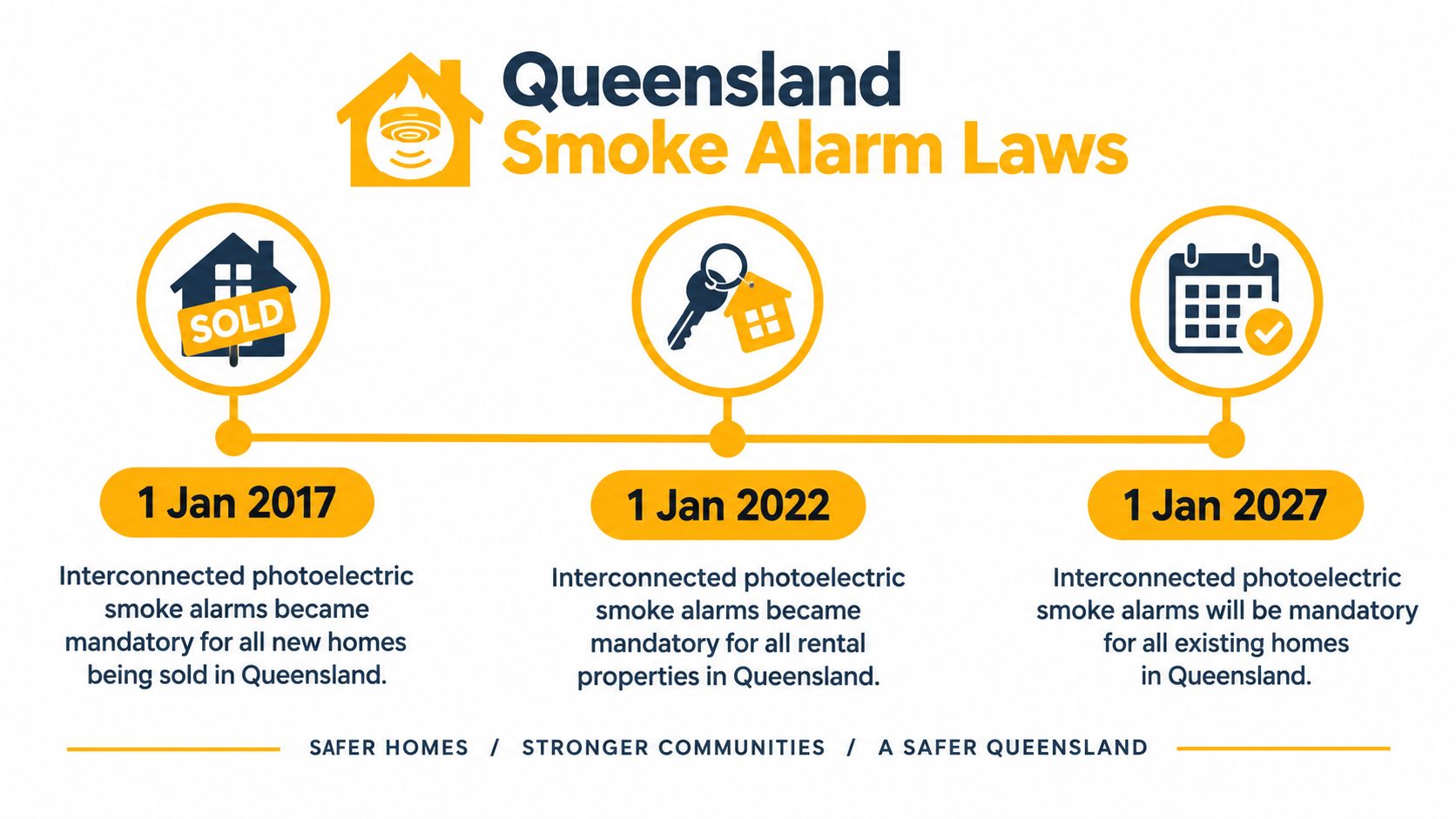
The staged reform dates create a property-specific timeline:
- 1 January 2017: The requirements applied to new dwellings and substantial renovations.
- 1 January 2022: The requirements applied when a dwelling was sold or leased.
- 1 January 2027: The requirements are scheduled to apply to all remaining domestic dwellings in Queensland.
Under the staged reforms, existing private homes, townhouses, units and manufactured homes are required to have interconnected photoelectric smoke alarms by 1 January 2027. The alarms must comply with AS 3786-2014, as set out in the state's reform guidance.
What compliant equipment means
The state's smoke alarm guidance says the required devices must not contain an ionisation sensor. They must use photoelectric technology and have one of the specified power arrangements:
- Hardwired supply with secondary power, installed correctly as part of the building's electrical system.
- A non-removable 10-year battery, where that product arrangement is used.
Interconnected means that one alarm detecting smoke causes the other connected alarms to sound. The arrangement works like a linked warning network. Smoke detected in a distant room can therefore alert people elsewhere, including occupants who are asleep, behind closed doors or on another storey.
Compliance is not just a product choice. The alarm, location, power supply, interconnection and installation all need to work as one system.
Queensland's requirements concern domestic dwellings. A business owner should not assume an attached commercial space can be assessed exactly like a house. Commercial premises may have different occupancy patterns, environmental conditions, fire loads, emergency lighting, evacuation arrangements and documentation requirements. A technician may need to assess smoke alarms alongside heat detection, fire extinguishers, fire doors, exit lighting or other systems.
National requirements can also differ between Australian jurisdictions. Recent industry coverage identifies Queensland's National Construction Code alignment date as 1 May 2027, while several other states moved on 1 May 2026. The Australian NCC smoke alarm update explains why owners operating across state borders should check the rules for each site instead of relying on one national assumption.
A compliance record should identify the equipment installed, its location, test results, defects and corrective actions. For property transactions, leasing arrangements or managed portfolios, this documentation helps owners, agents, body corporates and facility managers see what has been checked and what still needs attention.
Owners who need documented evidence of completed work may include a smoke alarm compliance certificate in the property's safety records, subject to the circumstances and the provider's scope of work.
Where to Place and Interconnect Alarms for Best Protection
A good alarm in the wrong room can leave a dangerous gap. Start with the areas where people sleep and the paths they use to move through the dwelling during an evacuation.
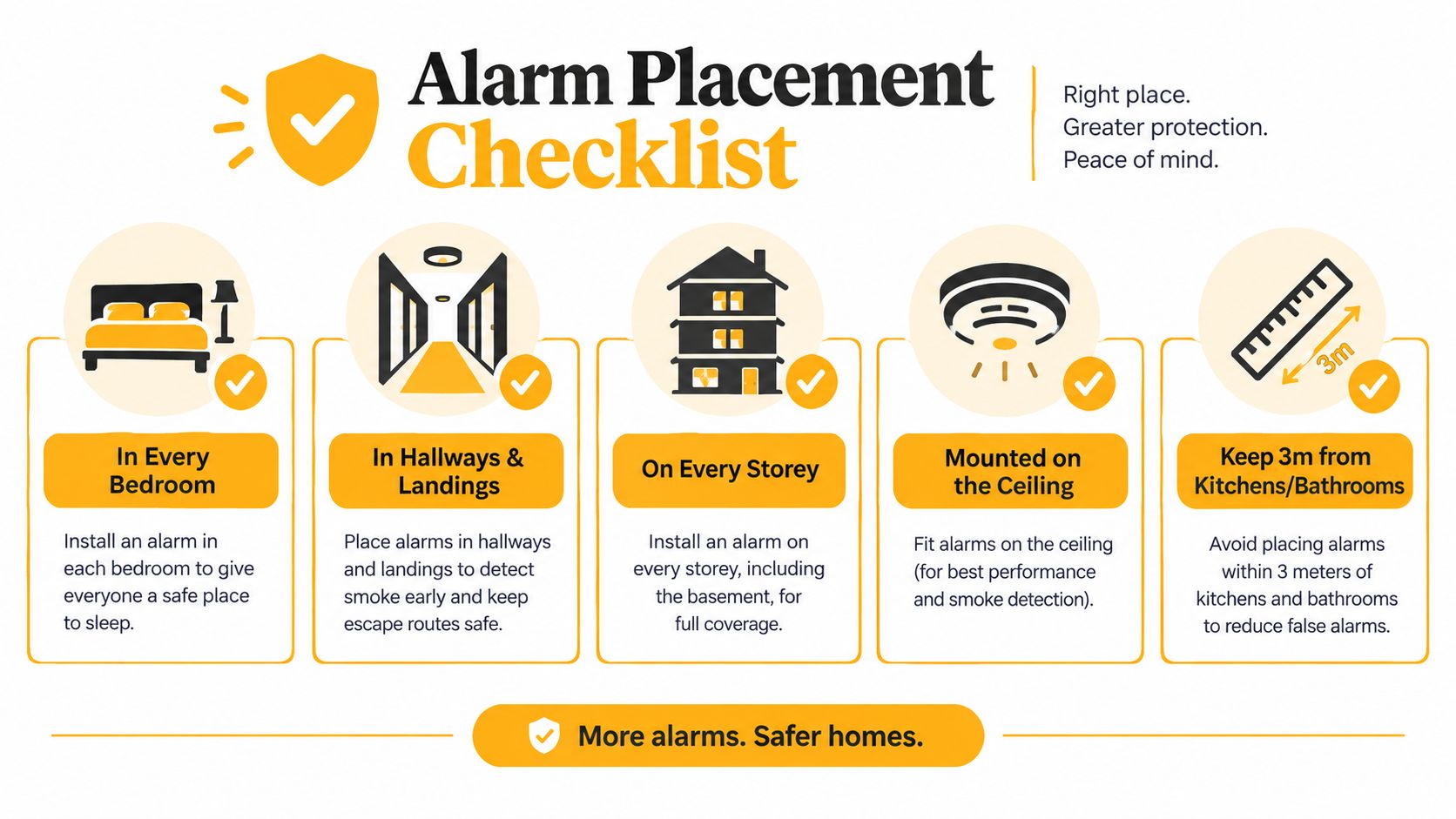
Queensland's domestic guidance requires alarms in every bedroom, in hallways and on each storey. The placement should support smoke detection and audibility, not just satisfy a visual checklist. Ceiling mounting is generally important because smoke rises, but the exact position must account for corners, beams, air movement and the manufacturer's installation instructions.
A practical layout approach
For a single-storey home, review every bedroom first, then the hallway or passage leading to those rooms, followed by the main living area where appropriate. A kitchen should not be treated as a substitute for coverage in an adjoining passage or sleeping area. Cooking smoke and steam can cause nuisance activations if an alarm is placed too close to the source.
For a two-storey townhouse, consider the bedrooms, the hallway outside sleeping rooms, the stairway or landing and the lower-level living areas. A unit may have fewer rooms, but concrete walls, fire doors and closed bedroom doors can still affect how clearly an alarm is heard.
- Bedrooms: Install coverage inside each sleeping room, not only outside the sleeping area.
- Hallways and landings: Protect the routes connecting bedrooms to the rest of the dwelling.
- Every storey: Include each level, including levels with different uses or separated access.
- Ceilings: Follow the product instructions and avoid positions where dead air or obstructions may delay smoke entry.
- Kitchens and bathrooms: Keep sufficient separation from cooking vapour and shower steam, while preserving coverage of nearby access routes.
Interconnection is particularly valuable in layouts where one alarm may be separated from another by doors, walls or floors. If smoke reaches an alarm in the garage-adjacent utility area, all connected alarms should sound together, giving someone in a bedroom a better chance of receiving the warning promptly.
Mixed-use and difficult environments
Small commercial premises need a site-specific assessment. Dust from workshops, humidity in laundries, aerosols in salons and cooking vapour in hospitality areas can affect alarm reliability and occupant response. A heat alarm may be more appropriate in some high-nuisance locations, but that decision must fit the applicable design, standard and occupancy risk. Don't replace a required smoke alarm with a heat alarm to stop unwanted activations.
Keep alarms accessible for testing and cleaning. Don't paint over them, cover them during renovations and don't disconnect an interconnected unit because another alarm is inconveniently located. Correct the cause, relocate equipment where permitted, or obtain a revised design from a qualified provider.
Testing Cleaning and Maintaining Your Alarms
A photoelectric alarm can detect a smouldering fire effectively, yet still fail to warn occupants if its power, sensor chamber or interconnection is neglected. As noted earlier, real-world alarm performance depends on more than choosing a compliant device. Dust, insects, moisture, paint, a depleted battery or an expired sensor can obstruct the warning when it is needed.
A simple maintenance routine
- Test monthly: Press the test button on every alarm and confirm the sound is clear. In an interconnected system, verify that the other alarms activate as the manufacturer describes.
- Clean carefully: Use a soft brush or vacuum attachment around the external openings. Keep cleaners, paint and insecticide out of the alarm.
- Check for damage: Look for cracks, loose fittings, missing covers, corrosion, tampering and water ingress.
- Review the power source: Replace a removable battery according to the product instructions. A sealed, non-removable 10-year battery alarm must be replaced at the end of its service life. Do not open it or install an improvised battery.
- Record defects: Note the date, alarm location, test result and action taken. Rental, body corporate and commercial properties should retain these records with their property documentation.
The test button checks whether the alarm can sound. It does not prove that the sensing chamber is clean or that smoke will reach the sensor correctly. Cleaning and visual checks therefore belong in the same routine.
A chirping alarm should not be silenced indefinitely. It may signal a low battery, contamination, a fault or the end of the unit's service life. If the sound returns after the correct battery change and cleaning, arrange an inspection instead of guessing.
For battery work, follow this smoke alarm battery replacement guidance and confirm whether the unit has a replaceable battery or sealed power source. Commercial operators should include alarms in scheduled preventative maintenance and retain evidence of tests, faults and rectification. A licensed technician can also check alarm condition and interconnection during planned servicing.
Choosing Compliant Alarms and Next Steps for Your Property
For a Queensland domestic property, begin with the legal baseline: choose photoelectric alarms that comply with AS 3786-2014, contain no ionisation sensor, interconnect across the dwelling and use an approved hardwired or non-removable 10-year battery arrangement.
Then inspect the property rather than buying a device based only on appearance. Count bedrooms and storeys, identify hallways and landings, check whether alarms are already interconnected, and look for locations affected by cooking smoke, shower steam, dust or aerosols. A two-storey townhouse, a compact unit and a workshop beside a residence may require different installation decisions.
The 1 January 2027 deadline applies to remaining domestic properties in Queensland, so owners should allow time to identify defects, arrange electrical work where needed, replace incompatible alarms and document the completed installation. Landlords, agents and body corporate managers should also confirm which party controls the alarm system and who is responsible for ongoing testing.
Celtic Fire & Security supplies, installs, tests and maintains smoke and heat alarms for residential and commercial environments across North Brisbane, Moreton Bay, the Sunshine Coast, Somerset and Ipswich. For a business site, ask the provider to consider the wider fire protection system, including extinguishers, emergency and exit lighting, fire doors, hydrants and scheduled records where relevant.
The safest next step is a property assessment followed by a written scope. That gives you a clear answer on alarm type, location, interconnection, power supply, defects and maintenance rather than leaving compliance to assumption.
Celtic Fire & Security can supply, install, test and maintain compliant photoelectric smoke alarm systems for Queensland homes and businesses. Visit Celtic Fire & Security to arrange an assessment and discuss the right upgrade or maintenance plan for your property.
No responses yet