
Queensland's baseline maintenance rhythm is a professional inspection, tag and punch every six months, with a separate five-year professional pressure-testing requirement for extinguishers. That timetable, anchored in AS 1851, is the starting point for understanding fire extinguisher testing requirements in QLD, but it isn't the whole job. Coastal salt, industrial contaminants, heat, equipment type, discharge events and the quality of your records can all change how defensible your maintenance program is during an audit.
Table of Contents
- Understanding Queensland Fire Extinguisher Standards
- Mandatory Intervals for Inspection and Servicing
- The Five-Yearly Overhaul and Pressure Testing
- Australian Fire Extinguisher Classes and Use Cases
- Compliance Tagging and Recordkeeping Protocols
- Environmental Factors and Testing Frequency
- Integrating Extinguishers into Asset Management
- Choosing a Licensed Fire Protection Provider
- Frequently Asked Questions About Extinguisher Testing
Understanding Queensland Fire Extinguisher Standards
Queensland businesses should treat the six-monthly inspection cycle as a minimum operating rhythm, not an optional reminder. Queensland Government fire safety guidance states that portable extinguishers must be inspected, tagged and punched every six months at a minimum, while also identifying a separate five-year professional pressure-test requirement. The framework is anchored in AS 1851, so maintenance isn't something to arrange only after an incident, a failed audit or a property handover. Queensland Government guidance on inspecting and maintaining fire extinguishers sets out that structured approach.
For a facility manager, the practical meaning is straightforward. Every extinguisher needs a known location, an identifiable service history and a planned next action. A compliant site doesn't rely on someone noticing a dusty cylinder during a general walk-through. It uses a recurring calendar that accounts for routine inspections, annual servicing and the more involved five-year event.
Why the standard matters
AS 1851 gives technicians a consistent method for examining fire protection equipment. It also gives auditors, insurers and building managers a common reference point when they assess whether maintenance has been completed properly. A service sticker on the wall is useful evidence, but it must match the underlying service record and the condition of the unit.
Queensland fire safety obligations also sit within a wider building and workplace safety context. The extinguisher must be accessible, suitable for the hazard and maintained in a condition where a person can use it during an emergency.
Practical rule: Put every extinguisher on the same planned maintenance register as your other life-safety assets. If it has no owner, due date or service history, it isn't under effective control.
For a plain-English explanation of the Australian standards that affect portable extinguishers, see this guide to Australian standards for fire extinguishers. The goal isn't to memorise every clause. It's to understand why a six-monthly check, annual service and five-year overhaul belong in a managed compliance calendar.
Mandatory Intervals for Inspection and Servicing
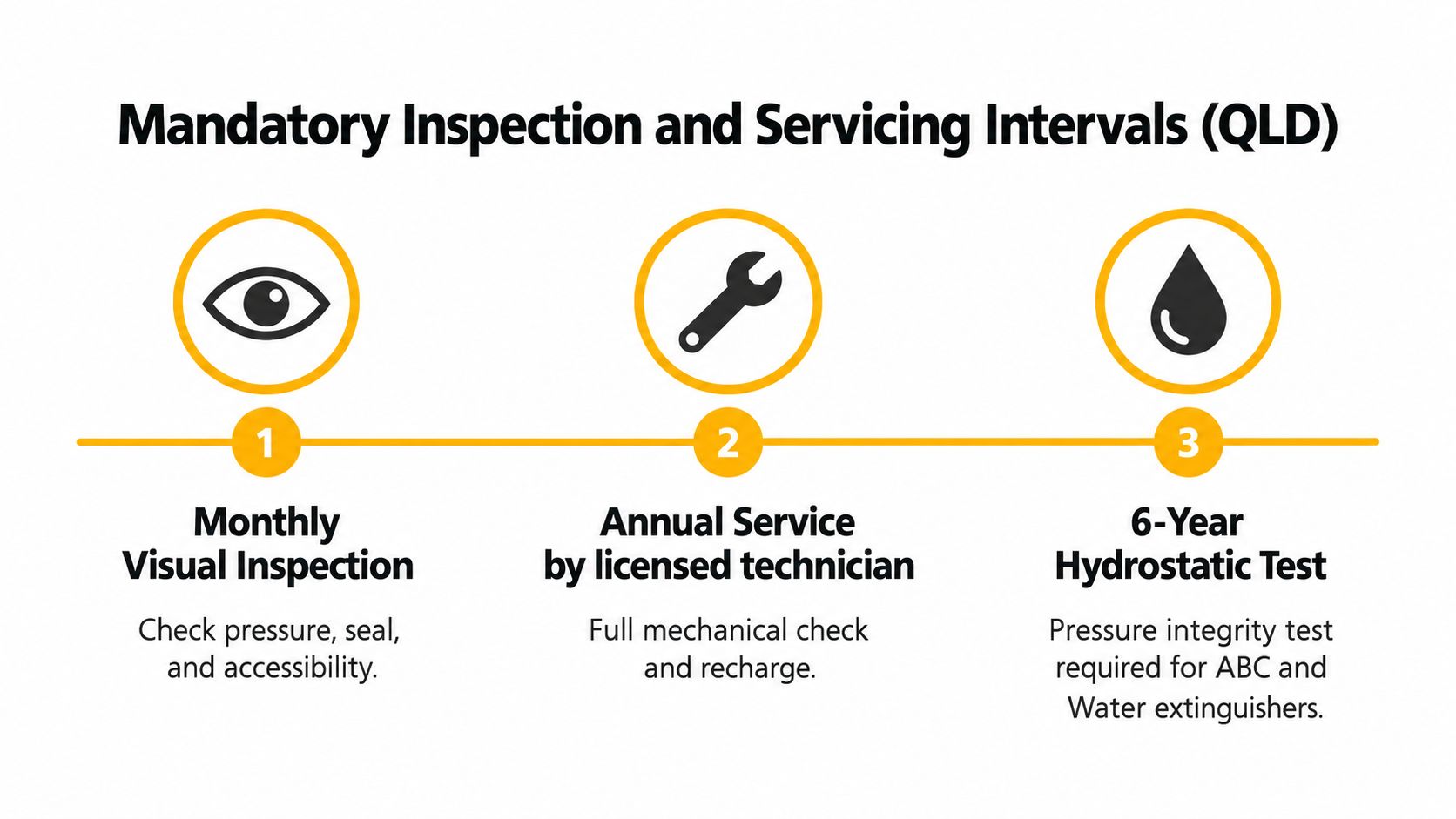
A useful maintenance calendar separates what site staff can observe from what requires a qualified technician. Monthly checks can identify obvious problems early, but they don't replace the professional servicing intervals required under the Queensland framework and AS 1851.
The working calendar
- Monthly visual check: Look at the extinguisher's pressure indication, tamper seal, accessibility, signage, mounting and visible condition. Staff should report corrosion, impact damage, leakage, missing pins or obstruction immediately.
- Six-monthly professional inspection: A qualified person inspects, tags and punches the unit in line with the routine servicing requirements. This is the minimum recurring professional rhythm identified in Queensland guidance.
- Annual service: The yearly service is more detailed than a casual visual glance. The technician assesses the extinguisher and associated components, records defects and confirms whether the unit remains suitable for service.
- Five-year service: The extinguisher enters a professional overhaul and pressure-testing cycle. The exact work depends on the extinguisher type and its service history.
The monthly check helps your team spot a problem between scheduled visits. It doesn't authorise staff to dismantle, recharge or pressure-test an extinguisher. Those tasks need the right competence, equipment and documented process.
What to record at each visit
Record the asset identification, location, date, condition, defects and service completed. If a unit is inaccessible because stock has been placed in front of it, that is a defect requiring action, not a minor housekeeping note. If an extinguisher has been discharged, even partly, remove the assumption that its gauge alone proves it is ready.
The most reliable approach is to schedule the six-monthly and annual visits before the previous service period expires. Add reminders for the five-year overhaul, and assign someone to confirm that defects have been closed rather than merely reported.
The Five-Yearly Overhaul and Pressure Testing
The five-year event is where many businesses underestimate the work involved. It isn't another quick look at the gauge or a replacement service sticker. Queensland guidance identifies professional pressure testing every five years, and AS 1851 Section 10 sets out the detailed five-yearly service requirements for portable and wheeled extinguishers. Queensland Fire and Emergency Services guidance on using fire extinguishers explains the professional testing principle and the need to respond to equipment issues.
For applicable stored-pressure units, the process can involve:
- Discharging the extinguisher.
- Opening and internally inspecting the cylinder and components.
- Checking for corrosion, damage or deterioration.
- Refilling the unit with the correct agent.
- Recharging it to the required condition.
- Pressure-testing the cylinder where required.
- Recording the work and returning the unit to service only when it is fit for purpose.
The exact treatment varies with the extinguisher type and service history. A dry chemical unit, a water unit and a wheeled extinguisher don't all receive identical handling, so a generic “tested” tick isn't enough to demonstrate that the correct procedure was followed.
Don't wait for the calendar after an incident
A discharge event changes the maintenance decision. An extinguisher that has been used, even briefly, may have lost pressure or contaminated its operating components. An abnormal gauge reading, damaged hose, broken seal, leaking valve or impact to the cylinder also calls for prompt assessment.
A scheduled inspection controls routine risk. It doesn't override the need to act when the equipment shows an immediate fault.
Facility teams should quarantine or clearly identify affected units while arranging assessment, and provide temporary protection where the risk requires it. Waiting for the next six-month visit can leave a gap in protection and create an awkward explanation when an auditor asks why a known defect remained open.
The five-year overhaul is also a planning issue. Book it early enough to manage replacement equipment, transport and any units that fail inspection. The cheapest administrative option is rarely the safest if it leaves a commercial site without suitable protection while cylinders are away for service.
Australian Fire Extinguisher Classes and Use Cases
Choosing the right extinguisher is as important as testing the one already on the wall. Australian classifications describe the fire risk, and the extinguisher must match the material involved. A compliant maintenance program should therefore check both condition and suitability.
Match the unit to the hazard
- Class A: Ordinary combustible materials such as paper, cardboard, timber and many plastics. Water and foam extinguishers are commonly considered for these risks, subject to the site assessment.
- Class B: Flammable liquids such as fuels, solvents and some paints. Foam, dry chemical powder or carbon dioxide may be appropriate depending on the hazard and equipment selection.
- Class C: Flammable gases. Dry chemical powder is commonly selected for this risk, with the gas supply isolated where it is safe to do so.
- Class E: Energised electrical equipment. Carbon dioxide and dry chemical powder are commonly used options because water and foam can create an electric shock hazard while power remains present.
- Class F: Cooking oils and fats in commercial kitchens. A wet chemical extinguisher is generally the relevant choice for deep-fryer and cooktop risks.
Australian practice also uses Class E for electrical risks. Don't substitute international class terminology when you document a Queensland site, because the classification needs to make sense to the people responsible for selecting and using the equipment.
A switch room may need carbon dioxide or dry chemical powder, while a commercial kitchen needs equipment selected for cooking-oil hazards. A vehicle workshop can combine ordinary combustibles, flammable liquids, gases and electrical equipment, so one extinguisher type may not address the whole risk profile.
Never use a water extinguisher on energised electrical equipment. The correct response is to raise the alarm, isolate the energy source if safe and trained to do so, and use equipment selected for that hazard.
Compliance Tagging and Recordkeeping Protocols
A service tag is only one part of the evidence trail. It shows that a service event was recorded on the unit, but an audit-ready system also needs a register, defect history and proof of what the technician did.
Build a defensible record
For each extinguisher, record:
- Asset identity: Use a unique identifier and note the exact location.
- Equipment details: Record the extinguisher type, capacity and relevant manufacturer information.
- Service dates: Capture the six-monthly inspection, annual service and five-year event when applicable.
- Condition findings: Note corrosion, damaged hoses, missing pins, broken seals, pressure issues and access problems.
- Corrective action: Record whether the defect was repaired, the unit replaced or further work remains outstanding.
- Technician details: Keep the service provider and the person who performed the work identifiable.
- Service outcome: State what was inspected, serviced, tested, removed from service or returned to operation.
The record must capture defects, missing items and the service performed, not just the fact that someone attended. A tag without supporting documentation leaves the facility manager relying on an incomplete trail.
Keep the physical tag and digital register aligned
The date punched or marked on the tag should agree with the central register. If a technician swaps an extinguisher, update the location and asset identity immediately. If a unit is removed for overhaul, record the temporary replacement so the site doesn't appear compliant on paper while protection is absent in practice.
A site-level fire extinguisher check guide can help staff understand what to observe between formal service visits. Staff observations are useful, but they shouldn't be represented as a substitute for the professional inspection and servicing program.
Environmental Factors and Testing Frequency
The standard six-monthly cycle is the baseline, but it isn't always the complete maintenance answer. Aggressive or corrosive environments can shorten pressure-testing intervals, and servicing requirements can vary according to extinguisher type and exposure.
That matters across South East Queensland. A coastal Sunshine Coast property may expose cylinders and fittings to salt-laden air. An industrial shed in North Brisbane may have dust, chemicals, welding activity or vehicle exhaust. Food premises can create heat, grease and cleaning-chemical exposure, while outdoor installations face weather that indoor units avoid.
Inspect the environment, not just the cylinder
Look for:
- Salt and moisture: Surface corrosion around the cylinder, valve, brackets and wall fixings.
- Chemical exposure: Residue, coating damage or corrosion near processing areas and workshops.
- Heat: Locations near cooking equipment, plant or direct sunlight that may affect equipment condition.
- Impact risk: Forklifts, vehicles, stored materials and busy loading areas can damage or obstruct units.
- Outdoor exposure: Weather shields may help, but they don't eliminate the need for condition-based inspection.
If corrosion is advancing, the correct response isn't to wait for the next calendar date. Ask the service provider whether the unit needs removal, replacement or a shortened testing interval. The same reasoning applies where the extinguisher is repeatedly exposed to discharge, vibration or contaminants.
Field observation: The calendar tells you when to inspect. The site tells you how closely you need to manage the equipment.
A strong program documents why an interval is suitable for the environment and what evidence would trigger an earlier review. That creates a risk-based plan rather than a false sense of security based on an unchanged recurring appointment.
Integrating Extinguishers into Asset Management
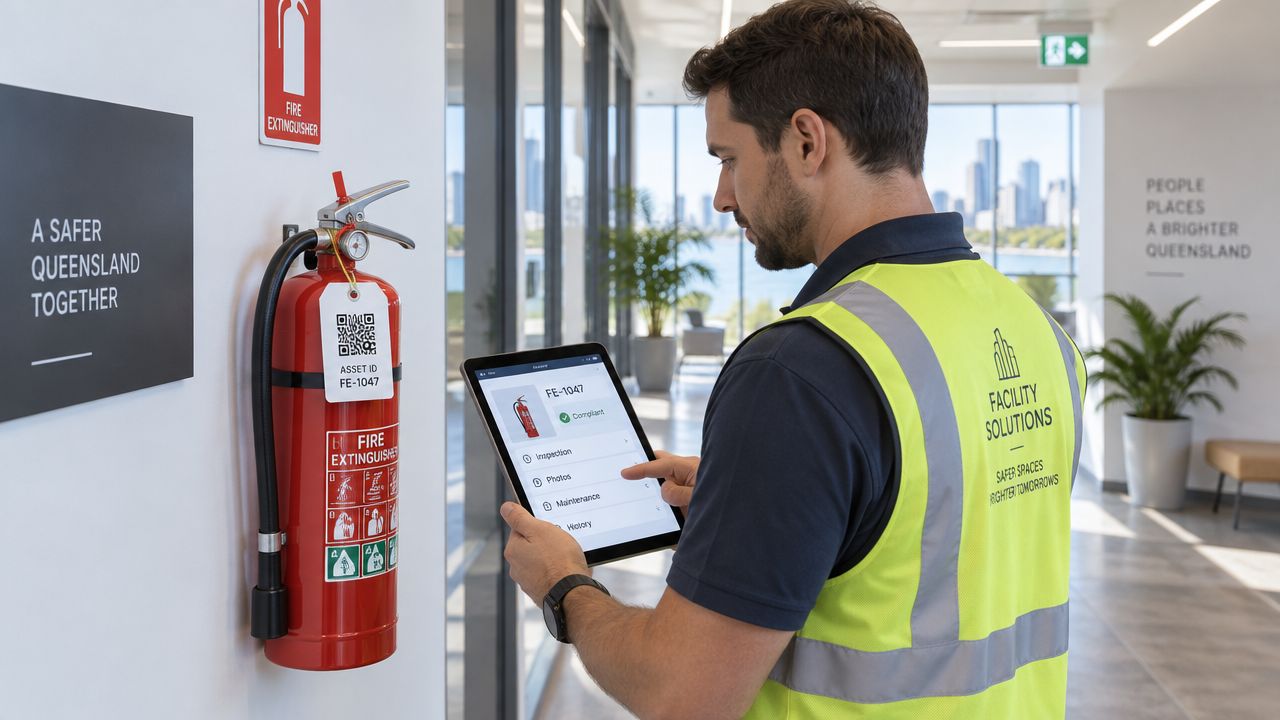
Extinguishers shouldn't sit in a separate spreadsheet that nobody checks until an auditor arrives. Treat them as part of the building's broader life-safety asset register, alongside smoke and heat alarms, emergency and exit lighting, fire doors, fire blankets, hose reels and hydrants.
Queensland guidance continues to connect fire safety management with the Building Fire Safety Regulation framework and QDC MP 6.1. The core legal structure has remained stable while guidance and advisory materials have been refreshed, so the practical focus is on maintaining evidence, using qualified people and managing the full group of fire-safety assets rather than chasing a new extinguisher frequency. This Queensland fire prevention guidance also highlights the value of considering protection systems as part of a wider safety plan.
Make the register operational
A useful register links each asset to its location, responsible person, inspection history, defects and next due action. It should also make overdue items visible, so a missed service isn't hidden among completed work orders.
This approach helps when contractors change, tenants move in or out, or a building manager inherits an unfamiliar site. It also gives insurers and auditors a clearer record of how the business manages foreseeable fire risks.
Choosing a Licensed Fire Protection Provider
A provider should do more than attach a tag. Ask how it identifies equipment, records defects, manages five-year overhauls, handles unsuitable units and reports outstanding risks.
For Queensland commercial work, confirm the provider has the licences and technical capability relevant to the task. A QBCC-registered provider can support a more defensible process, but the facility manager should still check the scope of the licence, the service documentation and the standards referenced in the report.
Questions worth asking before engagement
- Standards basis: Does the service report identify the applicable Australian Standard and servicing level?
- Technician competence: Who performs the work, and what qualifications or authorisations support it?
- Five-year capability: Can the provider coordinate discharge, internal inspection, recharge and pressure testing where required?
- Defect handling: Will the report distinguish urgent defects, access issues and recommendations?
- Asset coverage: Can the provider maintain the register across extinguishers and related fire systems?
- Regional response: Does the service area cover your site and provide a practical response when a unit is removed?
Celtic Fire & Security provides commercial extinguisher testing, servicing, tagging and compliance records across North Brisbane, Moreton Bay, the Sunshine Coast, Somerset and Ipswich, with broader fire protection and security services available through the same provider. Before appointing any contractor, review the scope, licences and documentation process, and use this guide to fire extinguisher testing costs when comparing proposals.
Frequently Asked Questions About Extinguisher Testing
What happens if a service tag is overdue?
Treat the extinguisher as requiring immediate review. Arrange an inspection, confirm its condition and document the reason for the overdue status. Don't backdate a tag or assume the equipment is compliant because it looks clean.
Is a visual check the same as a professional service?
No. A visual check identifies obvious problems such as obstruction, damage, corrosion, a missing seal or an abnormal gauge reading. Professional servicing follows the applicable maintenance procedure and records the service performed.
Can staff recharge an extinguisher after use?
Staff should not assume they can. A discharged unit needs assessment, and recharge or pressure-related work should be handled by a suitably qualified professional with the correct equipment and documentation process.
Does the six-monthly cycle cover every environment?
It is the minimum routine rhythm, but aggressive or corrosive environments may require a different plan. Coastal exposure, chemicals, heat, outdoor placement and extinguisher type can all affect the decision.
What should an auditor see?
The auditor should be able to match the extinguisher to its location and service tag, then trace the inspection history, defects, missing items, corrective actions and service performed in the maintenance records.
Celtic Fire & Security supplies, installs, tests and maintains commercial fire extinguishers and related fire-safety systems across South East Queensland, with scheduled servicing, tagging and compliance documentation. Visit Celtic Fire & Security to arrange a site review and build a maintenance program suited to your equipment, hazards and environment.
No responses yet