
The alarm panel is chirping in a back office. It's been doing it for two weeks. A cleaner has muted it twice, staff have learned to walk past it, and the owner only notices the fault on the morning of a scheduled fire safety inspection.
That scene is common across Queensland. It also exposes the wrong way to think about a commercial fire alarm system. The panel, detectors, sounders and monitoring communicator aren't separate purchases that can be forgotten after handover. Together, they form a managed compliance and life-safety asset whose performance depends on design, commissioning, records, monitoring and maintenance.
Table of Contents
- Why Your Commercial Fire Alarm System Matters More Than You Think
- Australian Standards and Queensland Rules Explained Simply
- Inside a Commercial Fire Alarm System and What Each Part Does
- Designing and Sizing a System That Actually Fits Your Building
- Installation, Commissioning, and the Tests That Count
- Ongoing Testing and Maintenance Under AS 1851
- Cutting False Alarms and the Real Cost of Getting It Wrong
- Choosing the Right Provider and Your First 90 Days of Compliance
Why Your Commercial Fire Alarm System Matters More Than You Think
The owner in that back office hasn't necessarily got a defective system. They've got a failed management process. A fault that remains active for weeks tells you that nobody owns the alarm logbook, nobody has investigated the cause, and nobody has confirmed whether the building remains adequately protected.
A commercial fire alarm system protects a Queensland business in four practical ways:
- It detects danger early. Smoke or heat detection gives occupants more time to respond before conditions deteriorate.
- It sends warnings when the building is quiet. A monitored pathway can transmit an alarm after hours, when no employee is walking past the panel.
- It creates evidence of care. Testing, defect rectification and service records help demonstrate that essential fire safety measures are being maintained under Queensland's fire-safety framework.
- It supports dependable risk management. Insurers and building stakeholders expect life-safety equipment to be maintained, tested and documented. A neglected system can complicate an incident review and create avoidable compliance questions.
Queensland's framework includes the Fire Services Act 1990, the Building Fire Safety Regulation 2008, and the Building Regulation 2021. Current regulator guidance says these laws establish minimum standards for constructing, maintaining and equipping buildings to reduce fire risk and support safe evacuation. The regulatory picture also continues to change, so owners should verify current obligations through Queensland Fire Department's occupier and compliance guidance.
Practical rule: A fault signal is an instruction to investigate, not a noise to silence.
The system becomes the point between a contained incident and a major loss when people rely on it to detect, warn, control interfaces and summon assistance. That only works when every part of the chain performs as designed. The rest of this guide focuses on that chain, including Queensland standards, system components, commissioning tests, unwanted alarm control, contractor selection and a practical first 90 days.
Australian Standards and Queensland Rules Explained Simply
A compliant commercial fire alarm system sits inside a stack of documents. Each document answers a different question, and confusing those roles is how projects end up with equipment that operates but fails inspection.
AS 1670.1 is the primary design and installation reference for automatic fire detection, alarm, warning and control-and-indicating equipment. AS 1851-2012 governs routine service of fire protection systems and equipment, including inspection, testing, preventive maintenance and survey of installed systems. The Standards Australia description of AS 1851-2012 confirms its role across routine servicing, while Queensland guidance applies that maintenance regime to essential fire safety measures in relevant buildings.
The product-performance side sits within the AS ISO 7240 family. The National Construction Code then establishes the building compliance context, including the relevant fire safety provisions. In Queensland, the Building Act 1975, the applicable Building Fire Safety Regulation, the Queensland Development Code and project-specific approvals determine how those requirements apply to the building.
| Document | What It Covers | When It Applies |
|---|---|---|
| AS 1670.1 | Detection, alarm, warning and control-and-indicating system design and installation | New systems, alterations and relevant upgrades |
| AS 1851-2012 | Inspection, testing and preventive maintenance | Ongoing service of installed fire protection systems |
| AS ISO 7240 | Product and system performance requirements | Selection and certification of compatible equipment |
| National Construction Code | Building fire safety and compliance pathways | Building work, upgrades and approval decisions |
| Queensland legislation and codes | State obligations, occupancy duties and enforcement context | Construction, occupation, maintenance and audits |
A Brisbane tenancy example
Take a small commercial tenancy in Brisbane. The first question isn't which detector brand costs less. It's the building classification, the approved fire strategy, the required level of detection, the evacuation arrangement and whether the system must connect to a monitoring service.
The designer documents detector positions, manual call points, notification devices, interfaces and cable pathways. The installer follows the approved design, then commissions the system and records the results. A suitably licensed contractor services the installed system to the required routine, and the owner keeps the drawings, certificates, defect records and logbook together.
Queensland requires relevant fire detection work to be carried out by appropriately licensed professionals. A BSA-licensed fire detection contractor should be able to explain the licence scope, design assumptions and maintenance responsibility before work starts.
Standards aren't paperwork added after the job. They're the audit trail showing what the system was intended to do, what it did at handover and whether someone has kept it operational since.
Inside a Commercial Fire Alarm System and What Each Part Does
A commercial system is easier to manage when you understand its functional blocks. Start at the front counter and work outward.
The panel and field devices
The fire indicator panel, or FIP, is the system's brain. It receives signals, identifies alarm and fault conditions, operates programmed cause-and-effect functions and communicates with connected interfaces. Network cards can link panels across a larger site, while isolator cards help maintain loop integrity when a cable fault occurs.
Detection choices depend on the environment:
- Photoelectric point smoke detectors suit many standard commercial areas because they respond to visible smoke particles.
- Ionisation detectors have a different sensing principle and may be unsuitable where environmental conditions create instability.
- Aspirating smoke detection draws air through sampling pipework for highly sensitive or difficult-to-access spaces.
- Heat detectors suit areas where smoke, dust, steam or fumes would make smoke detection unreliable.
- Carbon monoxide and multi-criteria detectors can combine sensing inputs where the design calls for greater discrimination.
Photoelectric detection has become the common commercial choice in many ordinary occupied spaces, but no detector should be selected by popularity alone. A kitchenette, warehouse, plant room and clean office don't create the same conditions.
Warning, evacuation and interfaces
Manual call points let occupants initiate an alarm. Sounders provide an audible warning, strobes provide visual notification, and an EWIS or occupant warning system can deliver a programmed evacuation strategy where the building requires it. Strategies described as L1 through L5 represent different levels of automatic detection coverage, so the designation must match the approved fire strategy rather than a sales quote.
Power supplies and standby batteries keep the system active during a mains failure. Line isolators, monitored circuits and correctly terminated cables help the panel identify and contain faults. Monitoring may use a telephone pathway, IP connection or dual-path communicator, with signals sent to a Grade A1 or A2 monitoring centre where the service arrangement requires it.
Queensland's monitoring reliability requirement in AS 1670.3 is at least 0.9995, or 99.95% average network reliability, as explained in this Australian standards overview of AS 1670. The same source notes that AS 1670.3 received a 2024 edition, so monitoring design can't be treated as permanently settled.
On real sites, detectors get painted, sounders become obstructed, batteries age, interfaces are never tested and monitoring paths fail after telecommunications changes. Those are lifecycle failures, not brand failures.
Designing and Sizing a System That Actually Fits Your Building
A drawing with evenly spaced detectors isn't a design. It's a ceiling plan with symbols on it.
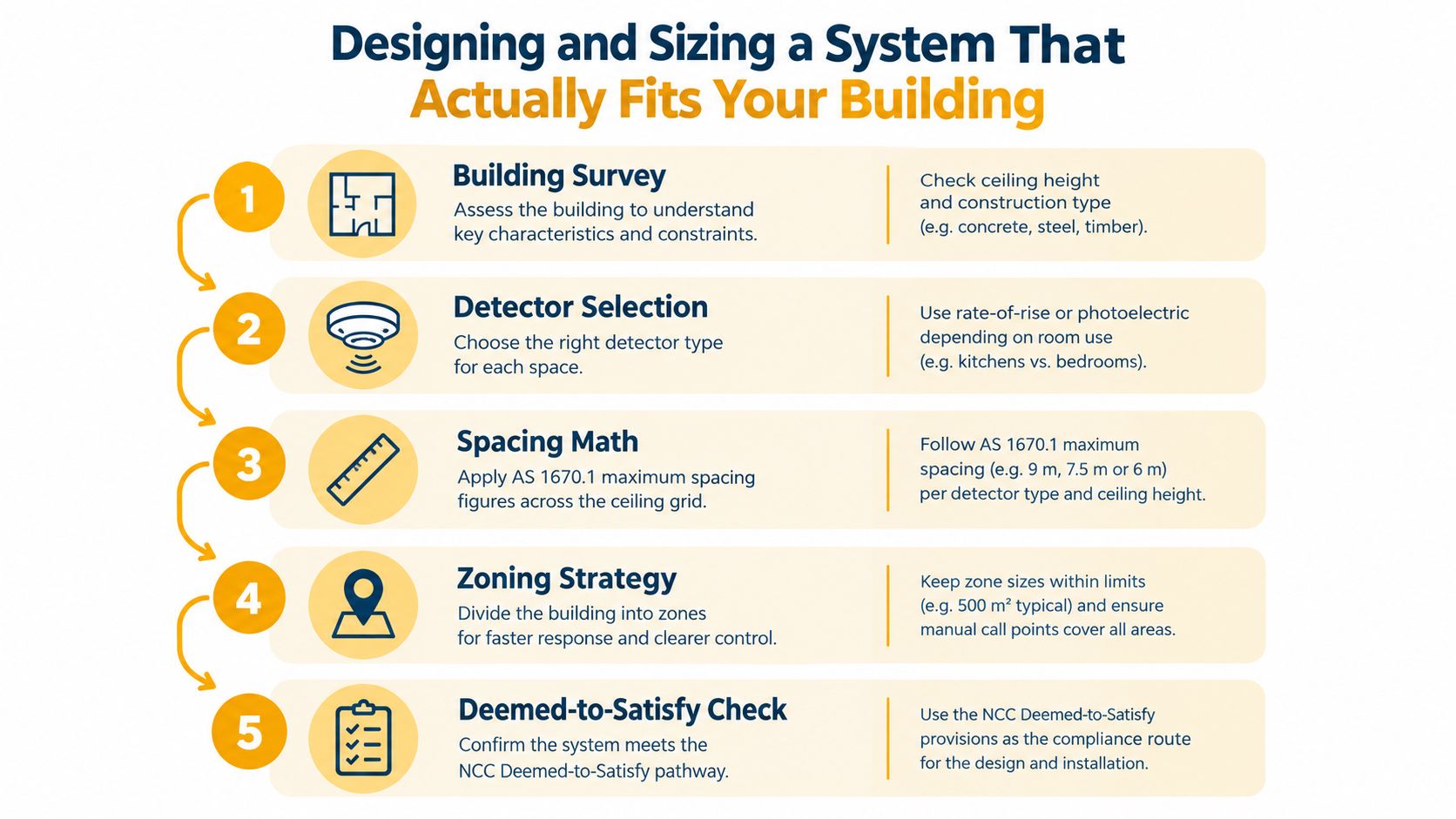
Good design starts with a building survey. The designer checks ceiling height, construction, room use, obstructions, shafts, air-conditioning supply and return paths, dusty or humid areas, kitchens, amenities and future tenancy changes. AS 1670.1 spacing rules then get applied to the actual ceiling geometry, with the National Construction Code Deemed-to-Satisfy pathway used where appropriate.
Select the detector for the room
A photoelectric detector near a bathroom door may react to steam. A smoke detector beside a toaster may repeatedly activate during breakfast service. An aspirating system may suit a server room, while a heat detector may be more stable in a dusty plant area.
Airflow matters just as much. Strong supply air can dilute smoke before it reaches a detector, while return air can carry cooking aerosols or steam into an adjacent device. Ceiling beams, bulkheads and storage racking can also change how smoke travels.
Queensland's unwanted-alarm guidance uses a practical performance test for monitored Class 2 and Class 3 buildings. The test can include a four-minute hot shower at maximum flow and temperature, cooking fumes from a normal meal, and specified air-conditioning conditions, as set out in the Queensland unwanted alarms guideline. That approach exposes poor placement that looks acceptable on a plan.
Zone the building for response
Zones should help occupants and responders identify the affected area without creating an unmanageable panel layout. Manual call points need sensible coverage along escape routes, sounders must be audible where people work and sleep, and the FIP should be accessible to responding crews without being hidden behind tenant furniture.
For a 600 m² suburban Brisbane office, the right zone count and device arrangement depend on the floor plan, tenancy boundaries, fire strategy, ceiling layout and interfaces. Don't accept a zone count calculated from floor area alone.
The client should receive:
- As-installed drawings showing device locations and cable routes.
- A cause-and-effect matrix showing every programmed interface.
- A battery calculation demonstrating standby and alarm capacity.
- An AS 1670.18 verification report and commissioning documentation.
The four-unwanted-alarm limit is a design consideration from day one, not a complaint to handle later.
Installation, Commissioning, and the Tests That Count
Installation quality starts before the first detector is fixed. Cable containment, segregation, loop topology, penetrations, fire stopping and access for future servicing determine whether the system will remain maintainable. Devices must be mounted in the designed positions, labelled clearly and terminated so the panel can supervise the circuit correctly.
Commissioning should challenge the building, not just the equipment. Queensland guidance specifically recognises environmental conditions that can create unwanted activations, so a competent team checks detector behaviour around amenities, kitchenettes and air-conditioning flows.
| Test | What It Proves |
|---|---|
| Detector alarm test | The detector senses the test stimulus and reports correctly to the FIP |
| Hot-shower simulation | Steam and humidity conditions don't create an unacceptable unwanted activation |
| Cooking-fume challenge | Detector selection and placement suit the kitchenette or food-preparation environment |
| Air-conditioning test | Airflow doesn't prevent detection or carry nuisance aerosols to a device |
| Sounder and strobe test | Occupants receive the required audible and visual warning |
| Battery capacity test | Standby power supports the system under the specified operating conditions |
| Door-holder release test | Fire doors release when the programmed alarm condition occurs |
| Smoke-control interface test | Connected plant responds correctly to the cause-and-effect sequence |
| Monitoring transmission test | Alarm and fault signals reach the monitoring service correctly |
Compare the service routines
Queensland guidance for AS 1670.1 systems ties routine maintenance to AS 1851-2012 Section 6, with monthly, six-monthly, yearly and five-yearly activities. The monthly routine checks panel operation, indicators and warning devices. The annual routine includes full system testing, fault and isolation simulations, evacuation tone verification and battery capacity testing. The five-yearly routine addresses deeper service requirements, including detector cleaning where applicable.
The commercial fire alarm installation service should finish with more than a panel that shows “normal”. Keep the verification documentation, cause-and-effect sign-off, as-installed drawings, commissioning certificate, defect closure evidence and handover instructions in the building's compliance file.
Queensland guidance also states that commercial AS 1670.1 systems aren't intended to be maintained by the building owner or manager. A BSA-licensed fire detection contractor should own the specialist maintenance calendar, while trained site staff can carry out permitted routine observations and coordinate access.
Ongoing Testing and Maintenance Under AS 1851
A maintenance calendar is a control system for hidden faults. It catches failed indicators, isolated zones, weak batteries, dirty detectors, damaged sounder circuits and incorrect tenant changes before an emergency exposes them.
| Routine | Frequency | Carried Out By | Records Kept |
|---|---|---|---|
| Functional panel and warning check | Monthly | Trained on-site staff or authorised service personnel, as permitted | Logbook entry, faults and actions |
| System service and component checks | Six-monthly | BSA-licensed fire detection contractor | Service report, defects and isolations |
| Full system and battery testing | Yearly | BSA-licensed fire detection contractor | Test results, cause-and-effect outcomes and certificates |
| Extended inspection and deeper service | Five-yearly | BSA-licensed fire detection contractor | Cleaning evidence, inspection records and defect closure |
The owner still needs an active role. Staff should report faults, maintain access to devices, record isolations and make sure contractors can test every area. They shouldn't open panels, alter programming or decide that a recurring alarm can remain disabled.
False alarms consume emergency capacity
Fire and Rescue NSW reported about 58,000 automatic fire alarm activations in 2025, with roughly 98% unwanted, and automatic fire alarms accounted for around 40% of all Fire and Rescue NSW responses, according to its automatic fire alarm information. Western Australia's DFES also attended more than 9,200 Direct Brigade Alarm false fire alarms in 2024–25, as recorded in its Direct Brigade Alarm guidance.
Those figures aren't a reason to reduce detection. They're a reason to manage it properly. Queensland guidance says monitored systems must not generate more than four unwanted alarms in a financial year, or the prescribed average where that is greater, as stated in Queensland Fire Department's advisory notes.
A facility manager who ignores repeated activations creates alarm fatigue, disrupts occupants and increases the chance that someone treats a genuine alarm as another nuisance. Keep the logbook current, investigate every repeat event and use the commercial fire protection service process to link defects, isolations, cleaning and corrective work to the system history.
Cutting False Alarms and the Real Cost of Getting It Wrong
A false alarm isn't harmless. It can empty a crowded venue, interrupt trading, unsettle residents or staff, and damage confidence in the building's emergency procedures. When the fire service attends and finds no fire, the owner still carries the operational disruption and may face consequences under the applicable local arrangements.
The causes are usually identifiable. A detector sits too close to a toaster, steam escapes through a bathroom doorway, a dishwasher plume reaches a smoke chamber, or an ageing device drifts out of calibration. Dust, insects, construction residue, tenant fit-outs and missed cleaning routines add to the problem.
| Cause | Where It Lags | Fix | Who Owns It |
|---|---|---|---|
| Steam near amenities | Detector placement or airflow | Relocate, review detector type and retest under operating conditions | Designer and licensed contractor |
| Cooking aerosols | Kitchenette layout and poor commissioning | Reassess location, ventilation and detection technology | Occupier and contractor |
| Dirty smoke chamber | Missed preventive service | Clean or replace the device and record the action | Licensed contractor |
| HVAC interference | Supply or return air movement | Test airflow, adjust placement and verify coverage | Designer and contractor |
| Tenant modifications | New partitions, ceilings or equipment | Update drawings and review detection coverage | Building owner and tenant |
| Repeated unexplained alarms | Weak investigation process | Analyse event history, inspect the environment and document remediation | Facility manager and contractor |
The Queensland rule makes repeat events a compliance issue as well as a nuisance issue. A monitored system that exceeds the permitted unwanted-alarm level needs diagnosis, not a permanent isolation.
Procurement questions worth asking
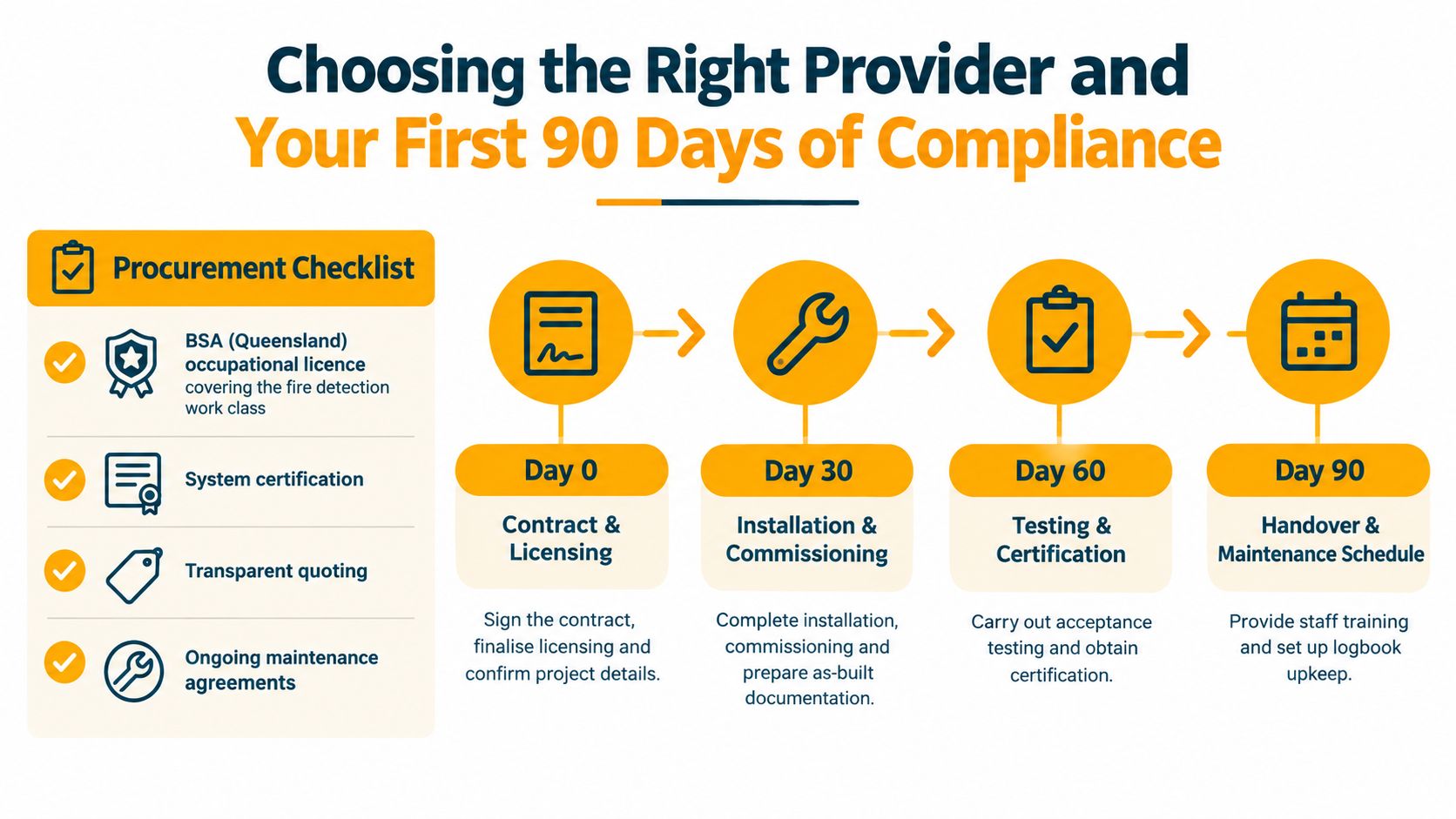
Ask a provider to show the relevant Queensland occupational licence, current standards basis, proposed monitoring arrangement, test equipment and sample handover pack. The quote should identify design, installation, commissioning, monitoring, defects, after-hours response and ongoing service separately.
A genuine fire specialist can explain the cause-and-effect sequence in plain language. They'll also discuss detector environment, battery calculations, isolations, logbooks and interface testing. A general tradesperson who focuses only on device supply and installation is not enough for a life-safety system.
For practical troubleshooting of recurring activations, use the guidance in what to check when a smoke alarm keeps going off, then have a licensed contractor confirm the system response and any required changes.
Choosing the Right Provider and Your First 90 Days of Compliance
The cheapest commercial fire alarm system quote often excludes the work that protects you later. Compare providers on competence, records and lifecycle support, not only on the panel brand.
Check these items before signing:
- Licence scope: Confirm the installer holds a Queensland BSA occupational licence covering the relevant fire detection work, and that the maintenance contractor is licensed for routine servicing.
- Standards currency: Ask which editions of AS 1670.1, AS 1670.4, AS 1851 and AS 4428 the design and service proposal uses.
- Documentation: Require a logbook, as-installed drawings, cause-and-effect matrix, commissioning certificate and design compliance certificate.
- Monitoring: Confirm the monitoring centre grade, communications pathway, resilience arrangement and compliance basis under AS 1670.3.
- Technical capability: Look for dedicated fire technicians, calibrated test equipment, documented quality assurance and experience with interfaces, not just standalone detectors.
- Service ownership: Make sure the proposal names who manages isolations, defects, retesting, records and scheduled maintenance.
A practical 90-day reset
Weeks 1 to 2, establish the baseline. Gather the existing logbook, drawings, certificates, panel history, monitoring details, defect notices and records of tenant alterations. Photograph inaccessible or damaged equipment and list every active fault or isolation.
Weeks 3 to 6, audit and scope. Commission an independent compliance audit. The audit should compare the installed system with the approved design, inspect detector environments, test notification coverage, review interfaces, verify monitoring transmission and identify missing documentation.
Weeks 7 to 10, remediate and train. Correct priority defects, clean or replace unsuitable devices, restore isolations, update drawings and test cause-and-effect functions. Retrain staff on alarm response, access, fault reporting and logbook entries.
Weeks 11 to 12, lock in the lifecycle. Appoint a BSA-licensed maintenance contractor, agree the AS 1851 schedule, set access arrangements and store the compliance file where managers can retrieve it during an inspection.
Celtic Fire & Security supplies, installs, commissions, tests and maintains commercial fire detection and alarm systems across North Brisbane, Moreton Bay, the Sunshine Coast, Somerset and Ipswich, with related fire-protection and security services under applicable Australian standards and licences.
If your Queensland site has recurring faults, missing records or an overdue service routine, contact Celtic Fire & Security for a documented assessment, compliant remedial work and an ongoing maintenance plan that treats your commercial fire alarm system as a managed lifecycle asset.
No responses yet