
A facilities manager in North Brisbane opens the morning mail and finds a notice of request to inspect. The building isn't on fire, nobody has reported an incident, and the premises appear to be operating normally. Yet the document still demands attention because an inspection notice can set a formal compliance process in motion.
For Queensland commercial properties, the right response is calm, organised and specific. Confirm what's being inspected, identify who needs access, gather the records that prove maintenance has been completed, and check that the equipment on site matches the fire risks present. A notice becomes much easier to manage when your physical systems and documentation already tell the same story.
Table of Contents
- Receiving Your Notice of Request to Inspect
- Preparing Documents and Arranging Access
- Verifying Compliance with Australian Standards
- Understanding Australian Fire Extinguisher Classes
- Post-Inspection Steps and Record Keeping
- Maintaining Ongoing Compliance and Prevention Tips
Receiving Your Notice of Request to Inspect
The first mistake is treating the notice as either an emergency or a routine letter to file away. In most commercial settings, it's a formal request to verify conditions, records or access. It may relate to fire protection, building work, security arrangements, tenancy access or court-controlled inspection rights, depending on who issued it and the legal process behind it.
A property manager overseeing a warehouse near North Lakes, for example, might receive a request connected with a scheduled compliance review. The sensible response isn't to move equipment around or arrange hurried servicing. It's to read the notice carefully, confirm the stated purpose, identify the inspection contact and check whether the proposed access arrangements are workable.

Identify the authority behind the notice
The wording matters. A notice issued by a property manager isn't the same as a request from a certifier, regulator, court registry or another party to legal proceedings. The issuer, stated purpose, nominated date and access conditions determine what you need to do next.
Australian court processes demonstrate why the phrase has a technical meaning in some contexts. In the Federal Circuit and Family Court of Australia, a party may file a Notice of Request to Inspect only after a subpoena's production date has passed, provided no objection has been made to production, inspection or copying. The Court says the notice can then be filed on or after the production day and processed as soon as practicable through the relevant filing pathway, as explained in its subpoena inspection guidance.
That legal use is different from a physical fire inspection notice. Don't assume a court form gives an inspector authority to enter a commercial site, and don't assume a building access notice creates a right to inspect subpoenaed documents. Establish the context first.
Practical rule: Read the notice as an instruction about scope and authority, not as proof that your business has already breached a requirement.
Turn the notice into an action list
Record the inspection purpose, areas to be accessed, responsible contact, required documents and any restrictions on timing. Notify reception, security staff, tenants and relevant contractors so nobody delays entry or gives inconsistent information.
For a commercial fire inspection, access commonly needs to include extinguishers, hose reels, hydrants, alarms, emergency lighting, exit paths, fire doors and plant areas. The more precisely you define the inspection route, the less likely you are to discover an inaccessible cupboard or locked service area at the appointment.
Preparing Documents and Arranging Access
Preparation should start with the notice itself, then move from paperwork to the physical site. A clean inspection depends on both. An inspector can't verify a maintained system if the relevant records are missing, and a well-organised folder won't compensate for blocked equipment or unsafe access.
Assemble the evidence before the visit
Keep current documentation in one controlled location, whether that's a secure digital folder, a facilities management platform or a clearly labelled site file. The aim is to let the inspector match each item of equipment and each service activity to a reliable record.
Have these materials ready where they apply:
- Maintenance reports: Keep recent service records for extinguishers, fire hose reels, hydrants, alarms and other installed systems.
- Service identification: Check that extinguisher service tags are present, legible and consistent with the service documentation.
- Emergency lighting records: Make emergency and exit lighting test results available, including any recorded defects and rectification notes.
- System documentation: Gather commissioning material, certificates, test results, service schedules and relevant plans.
- Rectification evidence: Include invoices, technician reports, photographs or completion records that show how previous defects were addressed.
Don't create a replacement record after the notice arrives and present it as historical evidence. If a document is missing, identify the gap and explain it accurately. A transparent gap is easier to resolve than a record that raises questions about whether maintenance occurred.
Prepare the physical route
Walk the site before the appointment. Open service cupboards, check plant rooms, confirm roof or external access arrangements and remove stored goods from the front of fire equipment. Emergency exits must be usable, and inspection points must be reachable without moving stock or exposing the inspector to avoidable hazards.
Use the proposed inspection time to coordinate people rather than just opening the front door. A facilities representative should know the building, a responsible manager should be available for decisions, and a qualified contractor should attend where specialist testing or immediate rectification may be needed.
Separate safety access from business disruption
Retail, hospitality and industrial premises often have competing demands. Kitchen production, loading movements and customer traffic can make an inspection difficult even when the owner is willing to cooperate. Agree on a practical route and time window, then tell staff what areas may be entered and which equipment must remain undisturbed.
Queensland tenancy practice shows why notice details need to match the purpose of entry. For an ordinary property inspection, the Residential Tenancies Authority entry requirements specify 7 days' written notice, inspections limited to once every 3 months unless the tenant agrees otherwise, and a stated time or 2-hour window. Rooming accommodation follows a different 48-hour rule, so applying a familiar notice template to the wrong tenancy category can create an avoidable problem.
Verifying Compliance with Australian Standards
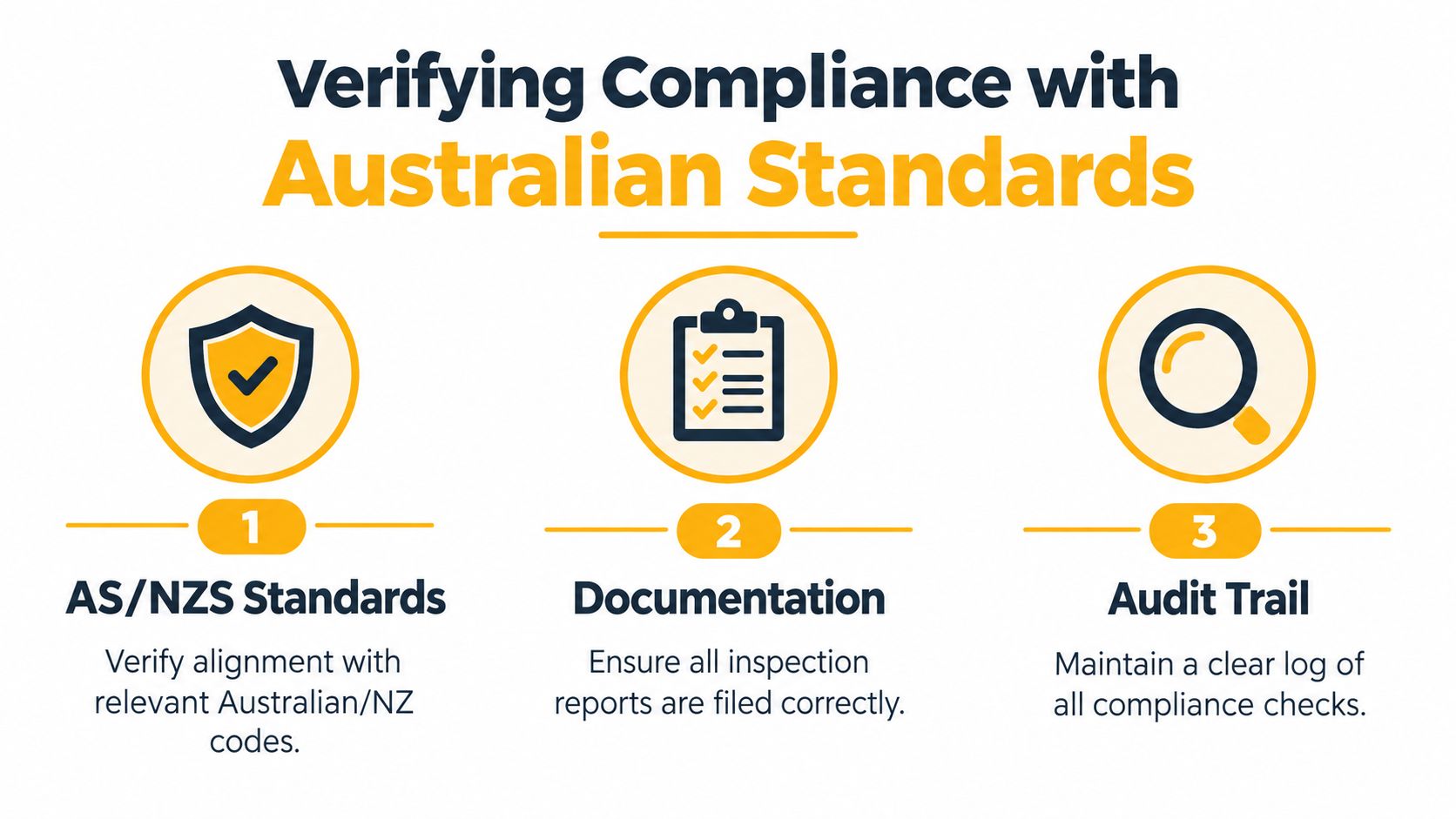
An inspection report is useful only when it connects three things: the equipment installed, the work performed and the requirement that governs the work. A service sticker alone may show that someone attended, but it doesn't necessarily demonstrate that the correct equipment was tested, that defects were resolved or that the records are complete.
For Queensland fire safety work, start by identifying the relevant obligation rather than asking whether the site “looks compliant”. Queensland guidance ties maintenance of prescribed fire extinguishers to Queensland Development Code MP 6.1 and requires that maintenance be carried out by an appropriately qualified person. Queensland business guidance also identifies MP 6.1 as the standard for commissioning and maintenance of fire safety installations in buildings, as set out in the Queensland fire safety management guidance.
Check the report against the site
Walk through the completed report with the inspector. Confirm that equipment identifiers, locations and descriptions match what is physically installed. A report that lists an extinguisher in a corridor when the unit has been relocated to a storeroom isn't a dependable audit trail, even if the extinguisher itself is serviceable.
Ask direct questions:
- Which items passed inspection?
- Which items need repair, replacement or further testing?
- Does the finding relate to equipment condition, access, signage, location or documentation?
- Which Australian Standard or Queensland requirement supports the recommendation?
- Has the issue been closed, or is a follow-up visit required?
Use the fire extinguisher testing guidance for Australian standards as a prompt for the records and service details your team should expect to retain. The report should state enough information for another competent person to understand what was inspected and what remains outstanding.
Understand the compliance chain
Queensland building oversight makes the chain particularly clear. The Queensland Building and Construction Commission says certifiers must be notified if they didn't receive a notice for inspection from the builder, within the framework of the Building Act 1975 and Building Regulation 2021. The QBCC explanation of the certifier's role shows why the notice is more than administrative wording. It forms part of the exchange and recording of inspection information.
That principle applies well beyond new construction. For commercial fit-outs, an omitted notice can affect certification, completion records and audit confidence. Treat every requested inspection as part of a controlled evidence chain, with an identifiable sender, recipient, date, scope, result and close-out decision.
A compliant result is not just a pass on the day. It's a result that can be explained, supported and traced back to the work completed.
Understanding Australian Fire Extinguisher Classes
A notice may prompt a close review of extinguisher placement, but the right question isn't only whether an extinguisher is present. The question is whether the equipment suits the fuel hazards in that location and has been maintained for service.
Queensland fire guidance uses the Australian fire class structure and makes an important distinction: there is no official Class E fire, because electricity isn't a fuel. Electrical equipment can still create ignition and shock hazards, but the classification is based on the burning material, not the presence of electrical power.
| Class | Fire Type | Examples | Extinguisher Type |
|---|---|---|---|
| A | Ordinary combustible materials | Wood, paper and other ordinary combustibles | Water or foam, where suitable for the hazard |
| B | Flammable liquids | Petrol and other flammable liquids | Foam, dry chemical powder or another suitable listed agent |
| C | Combustible gases | LPG and other combustible gases | Dry chemical powder, with isolation of the gas supply where possible |
| D | Combustible metals | Magnesium and other combustible metals | Specialised dry powder selected for the metal |
| F | Cooking oils and fats | Commercial kitchen cooking oils and fats | Wet chemical extinguisher designed for Class F hazards |
The Queensland fire extinguisher classification guidance provides the Australian examples and confirms that electricity isn't treated as a fuel class. That matters when a site team uses imported signage or overseas training material that refers to an electrical Class E.
Match the class to the premises
A retail tenancy may have substantial Class A exposure from packaging, shelving and stock, while a workshop can add flammable liquids or combustible gases. A commercial kitchen has a distinct Class F risk from cooking oils and fats, and the appliance layout may determine whether an extinguisher can be reached quickly without crossing the fire.
Industrial premises need a more detailed hazard review. A general-purpose dry chemical unit isn't a universal answer for every fuel, and a metal-processing area may need specialised Class D equipment rather than the extinguisher used in an office.
Check more than the label
During an inspection, verify location, access, mounting, signage, condition, service status and suitability for the hazard. A correctly classified extinguisher that's obstructed by stock still creates an operational problem. So does an accessible unit with an illegible service tag or a type that doesn't correspond to the fuel risk.
Read the guide to Australian fire extinguisher types alongside the site risk assessment, not as a substitute for one. Selection should reflect the actual materials, processes and people using the building.
Post-Inspection Steps and Record Keeping
The inspection ends when the inspector leaves, but the compliance task doesn't. The report needs an owner, a due date and a clear decision about whether the site can continue operating while work is arranged.
Start by separating findings into three groups: items that are compliant, items requiring routine rectification and items that create an immediate safety or access concern. Don't allow a long list of minor recommendations to hide a blocked exit, an unavailable extinguisher or a failed emergency lighting point.
Close defects with evidence
Assign each action to a named person. The responsible manager should know whether the remedy is a service, replacement, relocation, repair, additional testing or a change to the inspection process. Once the work is complete, retain the updated report and any supporting evidence with the original notice and inspection record.
A useful close-out entry states what was found, what was done, who completed the work, when it was completed and whether a follow-up inspection confirmed the result. Photographs can help with location or access issues, but they don't replace test results or competent service documentation.
Keep one dependable record
Store notices, reports, certificates, service tags, defect registers and correspondence together. Use consistent equipment identifiers so the next technician can connect the physical item with its history. If the site has multiple tenancies or buildings, separate records by address and area rather than relying on a single broad folder.
Queensland fire safety obligations often involve recurring maintenance and evidence, not one-off attendance. A fire safety schedule management approach can help facility teams track systems, responsibilities and outstanding actions without rebuilding the file every time an inspection is requested.
Confirm completion formally
If a certifier, owner, body corporate, tenant or regulator requested the inspection, send the completed outcome through the correct channel. Provide the final report, explain any outstanding work and state when follow-up is planned. Avoid sending a vague message that says “all sorted” when the report still contains open items.
The best record allows a new manager to understand the site without relying on someone's memory. That's the standard to aim for.
Maintaining Ongoing Compliance and Prevention Tips
A notice is least disruptive when it confirms work your team already controls. Maintain a live asset register, review service records as they arrive and inspect access conditions during ordinary site walks. Small changes, such as new shelving, kitchen equipment, stock storage or partition walls, can alter the practical risk even when the original fire systems remain installed.
Use a simple operating rhythm:
- Keep records current: File reports and certificates immediately after service.
- Watch access routes: Keep extinguishers, hose reels, exits and fire doors visible and reachable.
- Train the site team: Make sure staff know what each Australian fire class means and who receives an inspection notice.
- Coordinate contractors: Give service providers current plans, access instructions and known site hazards.
- Review changes: Reassess equipment placement after renovations, fit-outs or changes in stored materials.
Queensland fire guidance requires maintenance of prescribed fire extinguishers in accordance with MP 6.1 and by an appropriately qualified person. That makes planned maintenance more reliable than waiting for a notice, a complaint or a failed inspection to expose a gap.

For businesses across North Brisbane, Moreton Bay, the Sunshine Coast, Somerset and Ipswich, the practical target is a site where access, equipment and paperwork remain inspection-ready. When a notice arrives, confirm its authority and scope, then use your existing records and maintenance process to respond accurately.
Celtic Fire & Security supplies, installs, tests and maintains commercial fire protection, electronic security and locksmith systems across South East Queensland. Visit Celtic Fire & Security to arrange qualified support for extinguishers, alarms, emergency lighting, hydrants, CCTV, access security and inspection documentation.
No responses yet