
You're probably staring at a door report right now, or a surveyor has already left a note about a closer that won't latch, a gap that's blown out, or a tag that's gone missing. In commercial buildings, Australian fire doors don't usually fail because someone bought the wrong product on day one. They fail later, after a handyman swaps hardware, a hinge wears, a seal gets painted over, or a door starts dragging and nobody circles back.
That's the part most owners and facility managers learn the hard way. The door was compliant at handover, then the building settled, tenants changed, maintenance got patched together, and the assembly drifted away from the certified configuration. In Queensland, that drift matters because fire doors sit inside a regulated life-safety system, not as optional joinery, but as a tested barrier that's meant to slow fire spread, support evacuation, and stay traceable over time.
Table of Contents
- Why Fire Door Compliance Matters for Queensland Properties
- Understanding Fire-Resistant Doorsets as Tested Assemblies
- The Regulatory Framework Governing Australian Fire Doors
- Installation Tolerances and Hardware Requirements
- How Compliance Drift Happens After Handover
- Maintenance Obligations and Inspection Schedules
- Choosing a Fire Door Service Provider in South East Queensland
Why Fire Door Compliance Matters for Queensland Properties
A body corporate manager in North Brisbane calls after an audit and says the same thing I've heard for years, “The doors passed when the building was handed over, so why are we being flagged now?” The answer is usually in the details. A gap at the head has opened up, a self-closer has lost tension, or the tag is unreadable, and the building is no longer matching the condition that was originally certified.
That's not a minor paperwork issue. The Australian market for fire doors and partitions was estimated at USD 676.9 million in 2024, with a forecast to reach USD 1,165.9 million by 2030, and Australia accounted for 3.9% of global revenue in 2024 according to the market estimate cited in the brief. Those figures show this is a serious compliance and fit-out category, not a once-off hardware purchase. The largest revenue share in 2024 came from metal doors, while glass was identified as the fastest-growing material segment, which lines up with what's happening in commercial refurbishments, strata upgrades, and industrial fit-outs.
In Queensland, the issue is whether the door set still behaves like a compliant fire-resistant assembly. A door that won't self-close, won't latch, or has been altered after installation can put the owner in a weak position during an inspection or after an incident.
Practical rule: if the door no longer behaves like it did at certification, treat it as a compliance issue first and a joinery issue second.
The guide exists for exactly that situation, where the building is already occupied, tenants are in place, and the problem has been creeping in for months rather than showing up on day one. That's where most fire door risk lives in the world.
Understanding Fire-Resistant Doorsets as Tested Assemblies
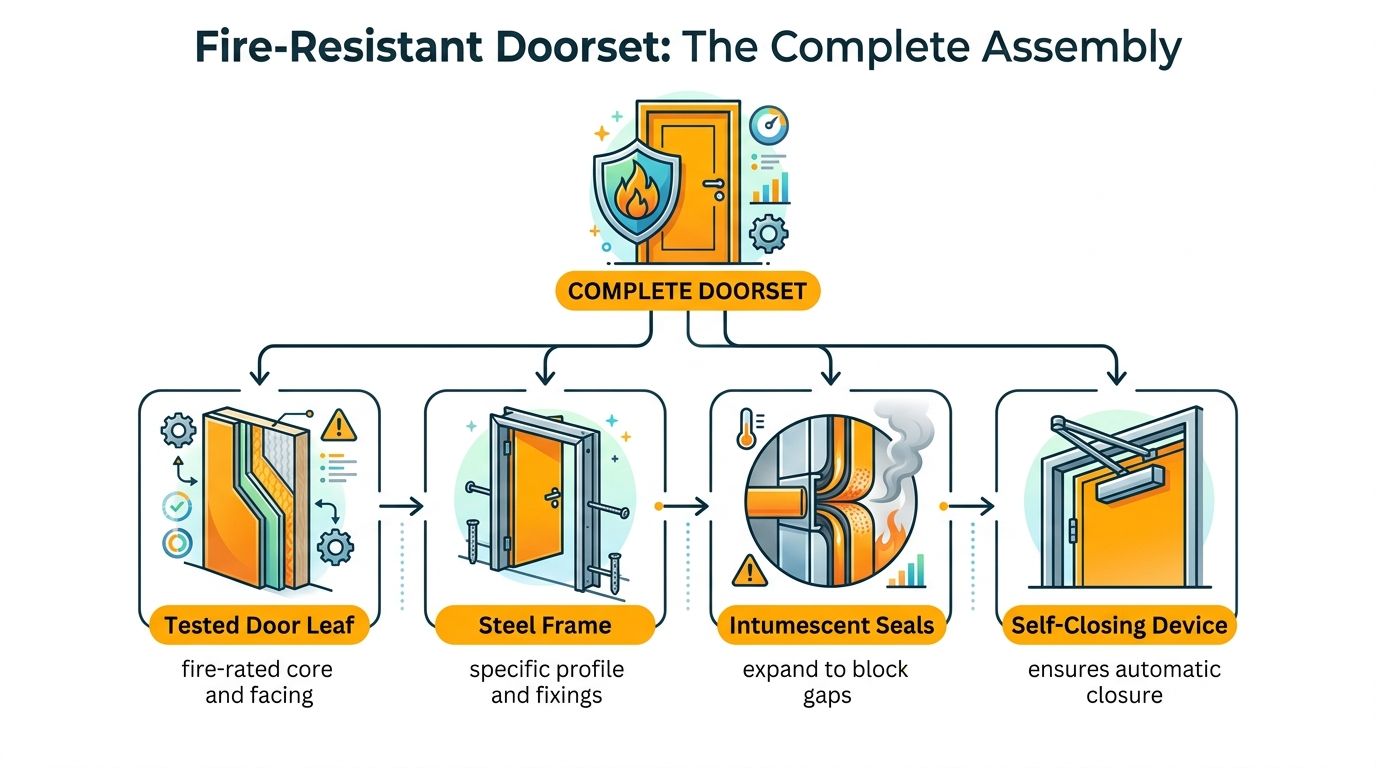
A fire door arriving on site can look complete and still fail the job. The test is whether the leaf, frame, hinges, locks, closer, and seals still match the certified configuration after installation, adjustments, and later maintenance. That matters most after handover, because that is when site teams start swapping parts, adding hardware, or altering gaps to suit day-to-day use.
What makes the assembly different
The leaf carries the rated construction, but it only works inside a matched system. The frame needs the correct profile and fixings, the hinges need to suit the doorset, and the closer has to return the door to a latched position every time. In practice, I often find the problem starts months after installation, when someone replaces a part that “looks close enough” but was never part of the tested setup.
That is why unapproved drilling causes trouble. A new hole for hardware can affect the leaf, the frame, or the way the lockset behaves under fire conditions. The same issue comes up with a hinge swap, a different latch body, or a seal that was fitted later to solve an air leak or noise complaint. Small changes can move the doorset away from the evidence it was certified against.
Do all exits need a fire-resistant doorset
No, and that point gets missed constantly. The requirement depends on the opening, the surrounding fire-resisting construction, and the building context. FPA Australia's guidance, cited in the brief, says an exit doorway may not need a fire-resistant doorset unless it is an opening in fire-resisting construction near a relevant fire source feature.
The better question is direct. Is this opening required to be a fire-resistant doorset under the NCC and the building's fire-resisting construction? That separates genuine compliance work from unnecessary upgrades, and it stops owners spending money in the wrong place while missing the openings that need control. For trade teams, the reference point should be the applicable Australian standards and the approved configuration, not whatever happened to be installed during a tenant fit-out. You can review the relevant standard references at Celtic Fire & Security's Australian standards resource.
A compliant doorset requires the leaf, frame, hardware, and seals to work as one certified system.
The Regulatory Framework Governing Australian Fire Doors
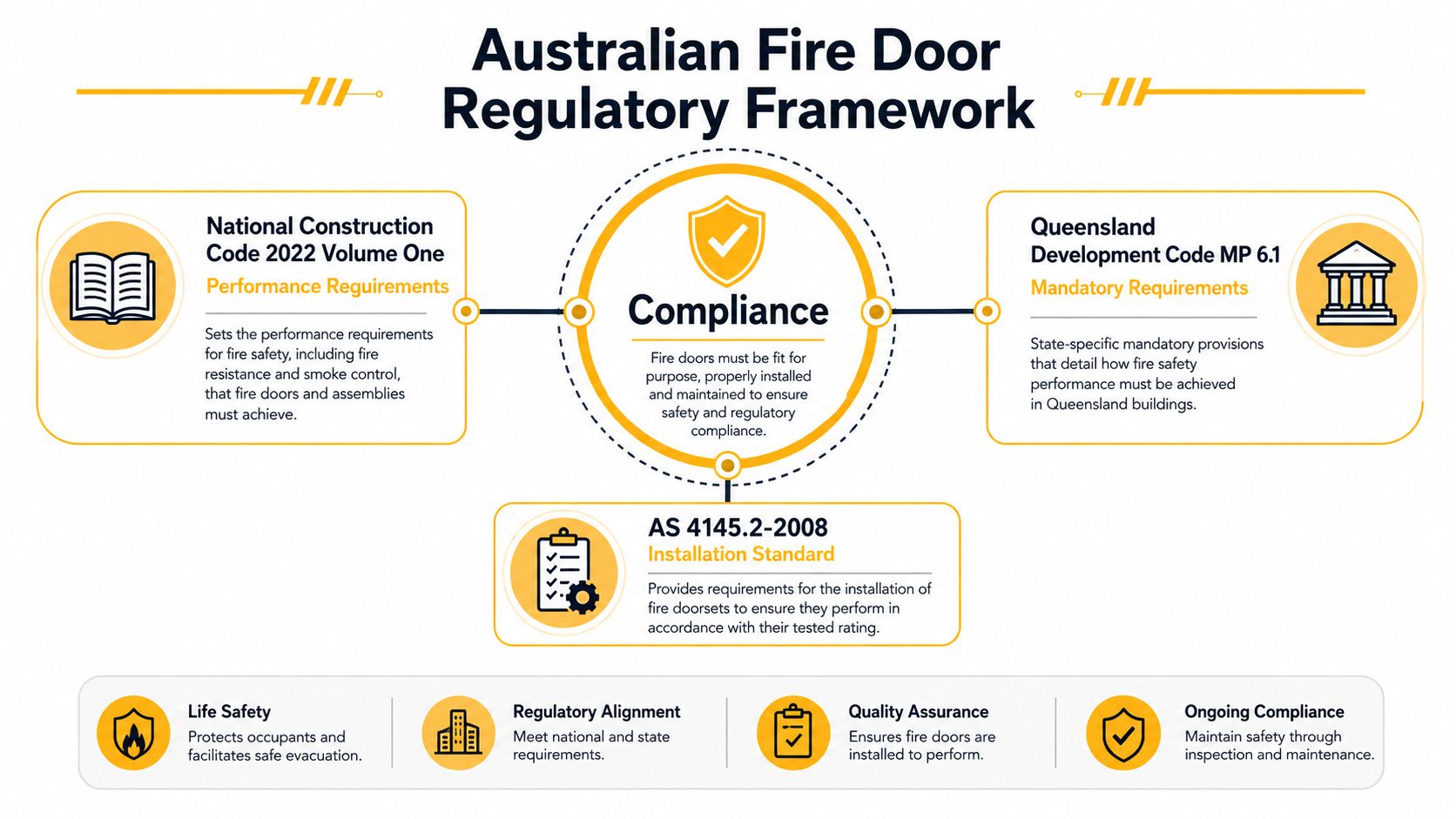
The compliance chain starts with the National Construction Code 2022, Volume One, which includes a dedicated specification for fire doors, smoke doors, fire windows and shutters. That matters because the NCC isn't just describing a product type, it's setting the framework for where these assemblies belong in a building and how they connect to fire-resisting construction.
In Queensland, the maintenance obligation is just as important as the original design. QDC MP 6.1 requires building fire safety installations to perform to a standard no less than what they were originally required to meet. That's the regulatory anchor for the post-handover reality most managers deal with. A door doesn't stop being part of the system after occupation. It still has to meet the original intent.
The Queensland Fire Department's fire door guidance also says buildings approved after 1 April 1976, plus fire doors replaced after that date, must have tags fitted in accordance with AS/NZS 1905.1. That traceability is essential because inspectors need to match the installed door to the approved configuration and service history, not just to a label that was once there.
For technical context, Australian fire incident data cited in a Senate inquiry recorded 101,867 fire-related incidents in 2013–14, with 19,524 of those, or 19%, being structure fires. The same inquiry reported 98 fire deaths recorded by AFAC for 2013–2014. Those figures explain why regulators treat fire doors as a life-safety control, not a decorative boundary.
For a practical standards reference, see this Australian standards reference for fire door work.
Where the standard and the state rule meet
The NCC tells you the compliance intent. Queensland's code and fire authority guidance tell you how that intent stays alive after handover. AS 1905.1 and AS/NZS 1905.1 sit underneath that framework as the technical references for the doorset itself.
That's why fire door compliance in Queensland isn't a one-off sign-off exercise. It's a system of design, installation, tagging, and ongoing maintenance.
Installation Tolerances and Hardware Requirements
A good fire door can still fail inspection because of a gap you can barely see with the naked eye. That's the part owners underestimate. The tolerances are tight because the assembly is supposed to resist flame and hot gases, and extra clearance gives those gases a direct path around the leaf.
The gaps that matter
Installation guidance cited in the brief commonly limits the head and side gaps to 3 mm, with the bottom gap between 3 mm and 10 mm. Another Australian guide specifies that the gap above a non-combustible threshold must be no more than 25 mm. Common commercial door sizes are 2040 x 820 mm and 2040 x 920 mm, which helps when you're checking whether a frame, leaf, and threshold arrangement are consistent with standard site conditions.
| Measurement Point | Minimum Gap | Maximum Gap | Why It Matters |
|---|---|---|---|
| Head | Not stated | 3 mm | Keeps the top line tight so hot gases can't bypass the door as easily |
| Sides | Not stated | 3 mm | Prevents leakage along the jambs where flame and smoke try to track |
| Bottom of door leaf to finished floor | 3 mm | 10 mm | Balances clearance for operation with containment performance |
| Above a non-combustible threshold | Not stated | 25 mm | Controls the opening where air and smoke can move under the leaf |
The numbers are small, but the effect is not. A door that binds, drags, or sits too loose at the perimeter can fail the very thing it was installed to do.
Locks, latching, and egress
Hardware also has to suit the building use. Fire-door egress opening action must be a single-handed downward lever action, lock height must sit between 900 mm and 1100 mm from floor level, and fire-door locks must be self-latching and fire rated to AS 1905.1. If the lock set doesn't latch properly, the door can't do its compartmentation job.
A compliant assembly is only as good as the hardware that keeps it shut. That's why a worn closer or an over-firm latch isn't just annoying, it's a condition issue that should be fixed before the next audit.
How Compliance Drift Happens After Handover
The first call I get on a drifting fire door usually starts with the same line, “It was compliant when it was handed over.” That may have been true on day one. The trouble shows up later, after the building has settled into normal use, hardware has aged, and maintenance decisions have started to change the door without anyone treating it as a fire safety issue.
The usual ways doors drift out of compliance
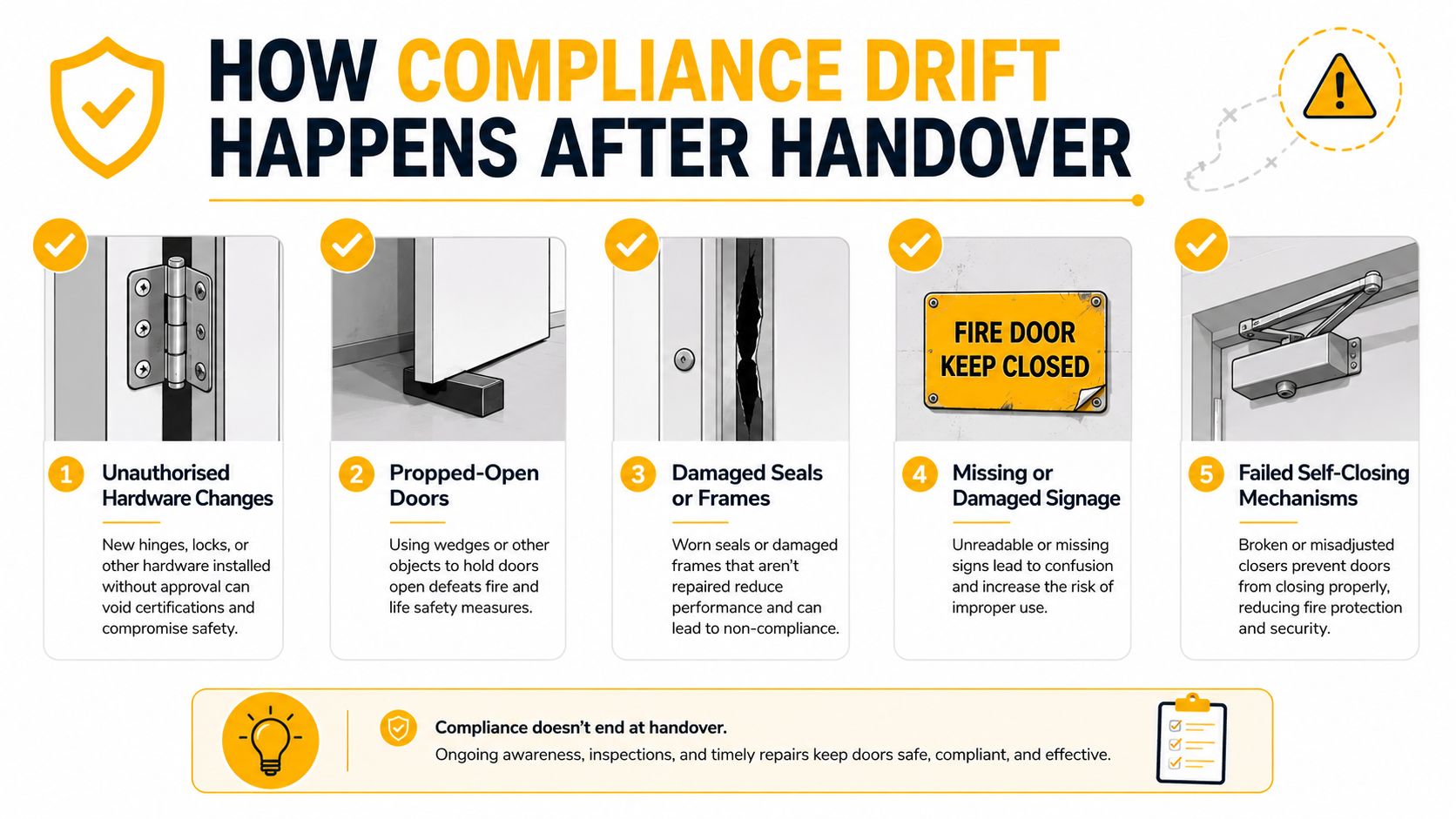
FDAA's technical material, cited in the brief, highlights faults that show up repeatedly in the field, including excessive gaps, doors that don't self-close or self-latch, missing ID tags, and modifications made after certification. Queensland Fire and Emergency's guidance also keeps the focus on traceability through AS/NZS 1905.1 tagging details, which has to remain readable and connected to the installed doorset.
Common causes are usually mundane:
- Unauthorised hardware changes. A new hinge, lock, or closer that wasn't part of the tested set can break the assembly.
- Propped-open doors. Security wedges and hold-open habits defeat the whole compartmentation function.
- Damaged seals or frames. Once the edge protection is compromised, the door's performance drops.
- Missing or damaged signage. If the identification is gone, the door becomes harder to verify.
- Failed self-closing mechanisms. A door that doesn't return and latch isn't doing its job.
Why small changes create big problems
A maintenance team might replace one part thinking it is a like-for-like fix. In fire door work, that assumption causes a lot of the grief. The tested assembly depends on exact compatibility, so a replacement closer, latch, or hinge can change how the leaf swings, closes, and seals, even if the part looks suitable on the shelf.
A door can drift out of compliance without any dramatic failure. One site has a closer that shuts too hard and shakes the latch loose. Another has a latch that catches only if the door is pushed with extra force. I have also seen painted seals, swollen edges, and frames altered by other trades after handover, all of which affect performance long before an audit picks it up.
If the door was fine at handover but is failing now, the issue typically stems from how it has been maintained since installation, rather than from the original purchase decision.
That is why post-installation checks matter so much. A door usually does not fail in one obvious moment. It slips out of tolerance through wear, repair work, and day-to-day misuse, then shows up as a compliance problem only when someone finally measures it properly.
Maintenance Obligations and Inspection Schedules
Queensland's maintenance standard is simple in principle and unforgiving in practice. Under QDC MP 6.1, fire safety installations have to perform to a standard no less than what they were originally required to meet. If a fire door starts slipping away from that benchmark, the maintenance system has already fallen behind.
For a service reference on maintenance practices, see AS 1851 maintenance guidance.
What a real inspection should check
A proper fire door inspection isn't a quick glance at the leaf. It should cover the perimeter gaps, the closer action, the latch action, the presence and legibility of the tag, the condition of hinges and locks, and any signs of unapproved modification. If the door has been painted shut, wedged, or fitted with extra hardware, that needs to be logged and addressed.
Documentation matters just as much as the physical condition. Keep records of what was checked, what was found, what was fixed, and when the remedial work happened. That record becomes your defence in an audit, and it also helps the next technician understand the door's history.
A simple maintenance rhythm
- Monthly visual check. Look for obvious damage, gaps, signage issues, and doors that are being held open.
- Functional testing. Confirm the closer returns the door and the latch engages properly.
- Professional audit. Have a competent technician verify the assembly against the approved configuration and tagging details.
- Record and remediate. Log the defect, fix it, then confirm the door still self-closes and latches.
The point is continuity. A compliant door at handover is useful, but a compliant door next year is what protects the building owner.
Choosing a Fire Door Service Provider in South East Queensland
A good provider does more than supply a door leaf. They understand installation tolerances, can verify the tested assembly, and can keep the records straight when the building changes hands or the maintenance plan gets handed from one manager to another. That's what matters when compliance drift is the risk.
A legitimate provider should hold the licences relevant to the work, including QBCC licensing for building work, security provider licensing for related access systems, and electrical licensing for integrated hold-open devices or electromagnetic locks. They should also be able to cover supply, installation, testing, documentation, and ongoing maintenance without bouncing you between trades.
For a service overview, the provider's commercial fire door and compliance services should show whether they can handle the full chain, not just the sale.
In South East Queensland, local response matters. A technician who already works across North Brisbane, Moreton Bay, the Sunshine Coast, Somerset, and Ipswich can usually get back on site faster when a surveyor, insurer, or building manager wants a problem fixed before it spreads into a wider audit issue.
Practical rule: choose the team that can prove the door is still compliant after the first service call, not just at installation.
If your fire doors haven't been checked since handover, or you've already had a note from a surveyor, Celtic Fire & Security can inspect, test, repair, and maintain the doorsets as part of a broader commercial compliance program. Visit Celtic Fire & Security to arrange a site visit and get the doors on your building back into a traceable, serviceable state.
No responses yet