
You're usually not thinking about a fire hydrant flow test until a handover is looming, an annual maintenance date is due, or a certifier asks for proof that the hydrant system can perform under load. On the morning of the test, it stops being a line on a compliance schedule and becomes a live site event. Water authority notices have gone out, access has to be clear, and everyone wants to know the same thing. Will the hydrant supply hold up when the outlet is opened properly?
In Queensland, that answer doesn't come from pipe size on a drawing or from assumptions about the street main. It comes from a controlled test on the day, with readings taken at the right hydrant, in the right sequence, and recorded on the right paperwork. If the site is straightforward, the test is quick. If the site has hidden valve issues, poor access, neighbouring demand, or disposal problems, it can expose them fast.
Table of Contents
- What a Fire Hydrant Flow Test Actually Is
- Pre-Test Checks and Site Preparation
- Running the Fire Hydrant Flow Test on Site
- Reading the Results Against the AS 2419.1 Benchmark
- Common Reasons Flow Tests Fail
- Recording Results and Meeting Compliance Obligations
- What to Do After a Failed or Borderline Result
What a Fire Hydrant Flow Test Actually Is
A fire hydrant flow test is a practical check of the water supply available to the hydrant system under real flowing conditions. Technicians arrive with a pressure gauge, a flow-measuring setup, outlet gear, hoses where needed, and the fittings to safely discharge water while readings are taken. The point isn't to confirm what the plans say should happen. The point is to verify what the network delivers that day.
On a Queensland commercial site, the scene is familiar. There's often a notification from the water authority on the desk, a site contact waiting to open hydrant cabinets or perimeter gates, and a bit of concern about whether the outlet nearest the problem area is really the worst point hydraulically. That concern matters, because the result depends on using the correct test point.
It's a flow and pressure check, not just a water release
The test involves opening one or more hydrants in a controlled way and recording pressure at the nominated test hydrant while water is flowing elsewhere in the system. That gives you two things that matter in practice: how much water can be moved, and what pressure remains available while it's moving.
Queensland procedure is very specific. The official commissioning and periodic-testing procedure requires the flow test to be performed on the most hydraulically disadvantaged hydrant, with the measuring device opened to 10 litres per second and the residual pressure recorded at the flowing hydrant. If the system requires 20 or 30 litres per second, additional disadvantaged hydrants are tested concurrently at 10 litres per second each, and the system must achieve the performance required by AS 2419.1, as outlined in the Queensland hydrant flow testing procedure.
That's why a proper test can't be reduced to “we opened a hydrant and water came out”.
Why Queensland sites treat it as a compliance event
The paperwork behind the test is tied directly to Queensland compliance. Queensland's hydrant commissioning and maintenance forms state that the relevant form is used for both commissioning water-based fire systems and maintenance testing requirements, and explicitly link that testing to the Building Act 1975 and Queensland Development Code Mandatory Part 6.1, as shown in the Form 70 hydrant and sprinkler report.
Practical rule: If the site can't show a compliant test record, the question isn't whether the hydrant looked substantial. The question is whether anyone can prove the water supply performed when checked properly.
For facility managers juggling annual obligations across multiple assets, it helps to think of hydrant flow testing the same way you'd think about other scheduled fire protection servicing work. It's a field test that confirms whether the installed system still matches the risk it was designed for.
Pre-Test Checks and Site Preparation
The test itself is the short part. The preparation is what stops the day from going sideways.
A Queensland technician normally starts with documents before touching a valve. The approved plans, hydraulic design information, prior test records, and any earlier Form 70 on file tell you what the system is supposed to do and where the likely disadvantaged point sits. If there's been a fit-out change, boundary work, or a recent main repair nearby, that changes how carefully the test points need to be checked.
Paperwork and notifications first
Before the gear comes off the vehicle, confirm these items:
- Scope against drawings: Match hydrant locations, feed direction, and nominated test points against the approved plans and the current site layout.
- Authority notification: Notify Queensland Urban Utilities, Unitywater, or the relevant local water authority where required. If the hydrant sits on a kerb line or trafficable edge, lane control or traffic management may also need to be booked.
- Previous records: Check the last report for recurring defects, known weak outlets, disposal constraints, or comments about simultaneous demand.
- Site coordination: Warn nearby tenants, loading dock staff, and any contractor working on adjacent services that pressure conditions may fluctuate during the event.
If the property manager has current emergency diagrams and block information ready, coordination is easier. On larger sites, that often ties back to how well the fire block plans have been kept current.
Physical checks before any discharge
After the paperwork, the technician works the line physically. That means locating hydrants, identifying isolating valves in the run, checking that outlets are accessible, and confirming there's no obvious damage or unauthorised fitting affecting the test.
A few issues repeatedly waste time on Queensland sites:
- Partially closed valves: Often left that way after plumbing, civil, or landscaping works.
- Silt caps or outlet obstructions: These can interfere with proper setup and skew what you think the hydrant is doing.
- Cars, bins, bollards, or stock pallets: If the outlet can't be accessed cleanly, the reading process gets compromised.
- Pump influence: On sites with pumps or boosters connected elsewhere in the system, those need to be isolated from the test arrangement if the objective is to assess main supply rather than pump support.
A hydrant test can look like a water-main problem when it's really a valve problem inside the boundary.
Calibration, discharge path, and safety
The gear matters. The pressure gauge, pitot setup or flow-measuring arrangement, caps, adaptors, and any hose used to manage discharge all need to be in serviceable condition and suitable for the outlet being tested. If the gauge has been knocked around in the back of a ute for months, the confidence in the reading drops with it.
Safety checks are just as practical as the compliance checks:
- Confirm discharge water routing so water won't flood entries, pits, or tenancy thresholds.
- Set PPE requirements for the crew, including eye and hand protection.
- Warn downstream users and nearby occupiers that opening the line may cause temporary pressure drop or discoloured water.
- Check disposal space because full-flow water has to be managed safely on site or to drainage where suitable.
The disposal issue gets underestimated. If the site can't safely handle the water volume, the test can stall before the first meaningful reading is taken.
Running the Fire Hydrant Flow Test on Site
Once the prep is right, the on-site sequence is fairly disciplined. Good technicians don't rush the first reading. They build the test layout, confirm the fittings are seated properly, bleed air, and make sure everyone on site knows which hydrant is the flow point and which one is carrying the pressure reading.
Setting the layout
There are usually two jobs happening at once. One hydrant is arranged as the flow hydrant, where water will be discharged and measured. Another is the test hydrant, where the pressure gauge is fitted so the crew can watch what happens to system pressure while water is moving.
Both points need to be identified correctly before the first valve turns. If the wrong hydrant is selected as the test point, the report may still look tidy, but the result won't mean much.
Static pressure first
The first useful number is the static pressure. That's the pressure at the test hydrant before any water is flowing.
The technician records that baseline because it tells you whether the main is charged sensibly at that time and gives context for every reading that follows. If static pressure already looks weak, attention immediately shifts to mains condition, supply authority issues, or a restriction somewhere upstream.
A careful operator also notes site conditions around that reading. Time of day matters. So does visible activity in nearby buildings, because simultaneous use elsewhere can influence how the main behaves once demand is introduced.
Opening the flow hydrant and stabilising discharge
After the static reading is taken, the flow hydrant is opened and the discharge is allowed to settle. Depending on the system requirement, the first run may be through a single outlet and later runs may step the demand up by bringing additional outlets or additional disadvantaged hydrants into play.
Queensland guidance from Fire and Emergency Services states that AS 2419.1:2021 sets the minimum requirements for hydrant design and performance, and that each required feed hydrant outlet must be capable of discharging at least 10 litres per second, regardless of location, according to the QFES feed hydrant performance guidance.
While water is flowing, the technician watches several things at once:
- Residual pressure at the test hydrant
- Measured discharge at the flowing outlet
- Stability of the stream
- Unexpected vibration or surging
- Any sign of cavitation, debris, or discolouration
- Behaviour of tanks, pumps, or associated gauges if visible
This is the part site managers usually remember, because it's noisy, visible, and it can briefly interrupt normal movement around the property.
What the crew is really looking for
They're not just chasing a single pass number. They're reading behaviour.
If the pressure drops sharply the moment the outlet is opened, that suggests a restriction or weak supply response. If the stream hunts, pulses, or throws debris, there may be a valve issue, sediment, or disturbance from recent works. If static pressure recovers quickly after closure, that tells a different story than a sluggish recovery.
Queensland government guidance also notes that the release of water on each hydrant usually takes 1 to 3 minutes, but can extend to up to 10 minutes depending on the hydrant's condition, as stated in the Queensland hydrant flow testing fact sheet. On commercial sites, that short window still has operational consequences, especially when several hydrants on one street are tested the same day.
When a site manager says, “It was only a few minutes,” that can be true and still mean loading access, water use, and nearby tenancies felt the impact.
Closing down and checking recovery
At the end of each run, the flow hydrant is closed in a controlled way and the technician confirms the pressure settles back appropriately. Recovery matters because it helps distinguish a temporary draw effect from a more persistent system issue.
The field notes taken here often decide how easy the later review will be. If the crew has logged the order of openings, the stabilised readings, visible water condition, and any unusual behaviour, the final assessment is far more reliable than a bare set of numbers on a sheet.
Reading the Results Against the AS 2419.1 Benchmark
The hard part for most site managers isn't watching the test. It's reading the report afterwards and understanding whether the result is acceptable or only looks close enough.
For Australian hydrant systems, the practical benchmark is clear. The feed hydrant residual pressure is 200 kPa in all states and territories except NSW, where the minimum is 150 kPa, and NSW Fire and Rescue also states the hydrant being tested must flow at not less than 10 L/s, as summarised in this Australian hydrant flow test reference. On Queensland work, that makes the 10 L/s flow point and the residual pressure check the centre of the assessment.
What the readings mean on paper
The report normally starts with static pressure, then moves to residual pressure under flow, then compares those figures against the design expectation for that hydrant arrangement. If the required flow is achieved and the residual pressure remains above the relevant threshold, the outlet is in a defensible position.
Where a calculation is used to assess flow at the benchmark pressure, you may also see the flow relationship expressed as Q2 = Q1 × √(ΔP2/ΔP1). That isn't there to make the report look technical. It helps interpret what the system can support at the target pressure based on the measured pressure drop.
AS 2419.1 flow test result thresholds
| Reading | Acceptable Value | Fail Indicator |
|---|---|---|
| Flow at tested outlet | 10 L/s or system demand achieved through concurrent disadvantaged hydrants at 10 L/s each where applicable | Flow can't be maintained at the required outlet arrangement |
| Residual pressure at feed hydrant | 200 kPa in Queensland practice | Residual pressure falls below the required benchmark |
| Test point selection | Most hydraulically disadvantaged hydrant used | Easier hydrant used, so result doesn't represent worst-case performance |
| Water disposal arrangement | Test water safely catered for | Full-flow disposal can't be managed, so valid testing can't be completed |
A clean pass is more than one good-looking line item. The test point has to be the right one, the flow arrangement has to match the system requirement, and the pressure has to hold where it matters.
Borderline results need judgement
A borderline result can be trickier than a clear fail. The site may appear operational, but one weak hydrant can pull the whole system into doubt if it's the disadvantaged point and the design relies on it. Technician notes become important here, especially where flow direction, simultaneous discharge, or an unusual water-main condition influenced the outcome.
For managers who regularly deal with hydrant maintenance and compliance records, it's worth staying close to current AS 2419.1 fire protection requirements. The difference between a sound result and a vulnerable one is often buried in how the test was set up, not in whether the stream looked strong from a distance.
Common Reasons Flow Tests Fail
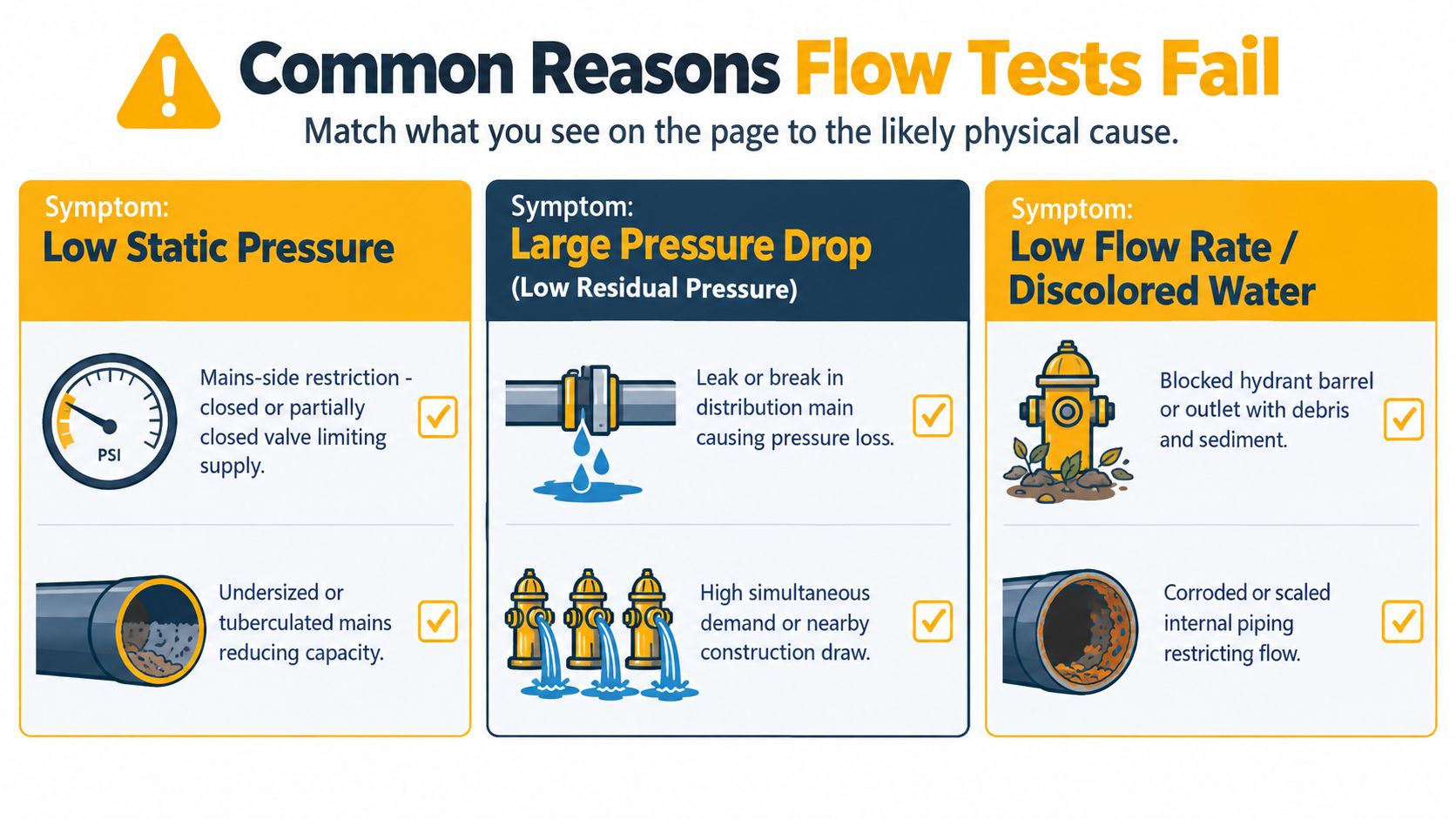
Most failed reports aren't mysteries. The reading usually points you toward the fault if you know how to group the symptoms.
This checklist is useful when you're looking at a result sheet and trying to work out whether the issue sits in the street main, at the boundary, or inside the site system.
Low static pressure
If the static pressure is poor before meaningful flow even starts, look upstream first.
- Boundary valve position: A closed or partly closed incoming valve can depress the whole result.
- Neighbouring demand: High draw-off nearby can leave the main looking weak at the exact time of the test.
- Main condition: Undersized mains, recent repairs, or debris movement in the network can all show up as low baseline pressure.
Low residual pressure or a steep pressure drop
If static pressure looks reasonable but falls away too fast once the outlet is opened, the issue may be on the system side.
A branch valve may be partly shut. An isolating valve may be faulty. Sediment may be restricting the line. On many commercial Queensland sites, a single closed isolating valve is the most common finding when a result doesn't make sense against the installed system.
A report that says “low residual” often means the water was there until the system was asked to do real work.
This short video is a handy visual refresher on how discharge and pressure behaviour are assessed in the field.
Low flow or poor outlet condition
Some failures sit right at the hydrant itself:
- Corroded threads or damaged fittings can affect how test gear seats and how the outlet performs.
- Debris in the barrel or outlet can interfere with flow.
- Pump not in service where relevant to the configured system can leave the test relying on a supply arrangement the design didn't intend.
- Unauthorised fittings or caps can create restriction or setup issues.
What doesn't work is assuming every weak result means the water authority is at fault. Often the fix is much closer to the cabinet.
Recording Results and Meeting Compliance Obligations
Once the water stops flowing, the value of the test depends on the record. A hydrant flow test that isn't documented properly is difficult to defend later, whether the question comes from a certifier, an auditor, an insurer, or the building owner.
The field readings are normally transferred onto Form 70, the Hydrant and Hydrostatic Test Report, with enough detail that another competent person can understand what was tested and what was found. That includes hydrant identifiers, the date, the relevant site details, the technician's licence details, and the readings taken on the day.
What gets recorded
A useful Form 70 entry doesn't just say pass or fail. It captures the context of the result.
- Core readings: Static pressure, residual pressure, and the measured or calculated flow result.
- Hydrant identification: Which outlet was the test point and which outlet or outlets were flowed.
- Authority and site references: Notification details where relevant, plus anything affecting access or disposal.
- Defects observed: Valve faults, obstructions, damaged fittings, discoloured water, or any issue that may have influenced the result.
Why the form matters after the day is over
Queensland's hydrant commissioning and maintenance forms link the testing process directly to the Building Act 1975 and Queensland Development Code Mandatory Part 6.1. That means the report isn't just an internal worksheet. It supports the compliance position of the building and its fire water supply record.
Keep the report with the site fire safety records, not buried in someone's inbox. Audits rarely give much notice.
The record also creates continuity from one maintenance cycle to the next. If a hydrant has shown gradual deterioration, repeated discolouration, or recurring pressure loss, the trend is easier to spot when each test has been documented properly. That's often what lets a manager act before a routine annual test turns into a serious compliance issue.
Lodgement and retention
The completed form is signed by the relevant licence holder or competent person responsible for the work, then retained as part of the site's fire safety maintenance documentation. On sites where multiple contractors are involved, this is also the point where responsibilities need to be clear. The plumber, hydrant technician, pump technician, hydraulic consultant, and building manager may all touch the same issue, but only one report set should stand as the formal record of what occurred.
If there's a dispute later, clean paperwork matters as much as clean readings.
What to Do After a Failed or Borderline Result
A failed result isn't the end of the process. It's the point where you stop guessing and start isolating the actual fault.
The first practical move is to retest at another hydrant downstream of the original test point, where that makes sense for the system layout. That helps rule out a single bad asset, damaged outlet, or local obstruction. If the second hydrant also can't achieve 10 L/s, the problem usually sits upstream in the supply path, valve arrangement, or supporting equipment rather than at one outlet.
The next actions that usually pay off
Don't order repeat testing over and over without changing anything. If the first result is weak and the second supports it, bring in the right trade for the likely cause.
- Check valve positions thoroughly: Not just the obvious cabinet valve. Trace the run.
- Arrange pump review where relevant: A pump technician can confirm whether the pump set is available and performing as intended.
- Reduce avoidable demand during the retest: Isolate non-essential draw-off points if the site setup allows it.
- Clear identified restrictions: Damaged caps, debris, seized valves, and obstructed fittings should be rectified before the next run.
- Escalate to hydraulic review if needed: Where the issue appears to be capacity rather than a local defect, an engineer should assess remediation options.
Borderline results deserve caution. If a system only just scrapes through, the right discussion is about operational risk and design intent, not whether the paperwork can be made to look convenient. In practice, that often means involving the certifier and whichever contractor is carrying the hydrant testing scope. Providers such as Celtic Fire & Security can perform hydrant flow testing for un-pumped systems and document the field findings, but a genuine capacity problem may still require hydraulic engineering, pump work, or pipework changes.
Think in terms of audit trail
Every corrective action should be tied back to the original result. If you reopen valves, clean a line, retest a different outlet, or commission further hydraulic investigation, record it against the same issue chain. That keeps the maintenance history clean and makes the next annual cycle far easier to manage.
A messy remediation process often causes more long-term trouble than the failed test itself.
If your site needs a fire hydrant flow test in Queensland, Celtic Fire & Security handles hydrant testing for un-pumped systems, along with the field documentation that supports ongoing compliance records. If you want the test coordinated properly from site prep through to reporting, visit Celtic Fire & Security and line up a booking before your next deadline catches up with you.
No responses yet