
The call usually comes after a failed test, a chirping alarm, or a property handover deadline. A facility manager knows the building needs attention, but the first quote that arrives only says “supply and install smoke alarms”, with no device schedule, no test evidence, and no clear answer about what happens after the crew leaves.
That's where businesses get exposed. A smoke alarm installation service should leave more than a device fixed to a ceiling. It should leave a defensible detection layout, tested interconnection, identified assets, signed documentation, and a maintenance path that still makes sense when a landlord, insurer, auditor, or fire-safety officer asks for proof.
Table of Contents
- What a Smoke Alarm Installation Service Actually Covers
- How the On-Site Assessment Works
- QLD Standards and AS 3786-2014 Compliance Checks
- Site Readiness Checklist Before the Crew Arrives
- Reading Quotes and Checking Licences
- Ongoing Maintenance as a Documented Lifecycle
- Maintenance Questions Business Owners Actually Ask
What a Smoke Alarm Installation Service Actually Covers
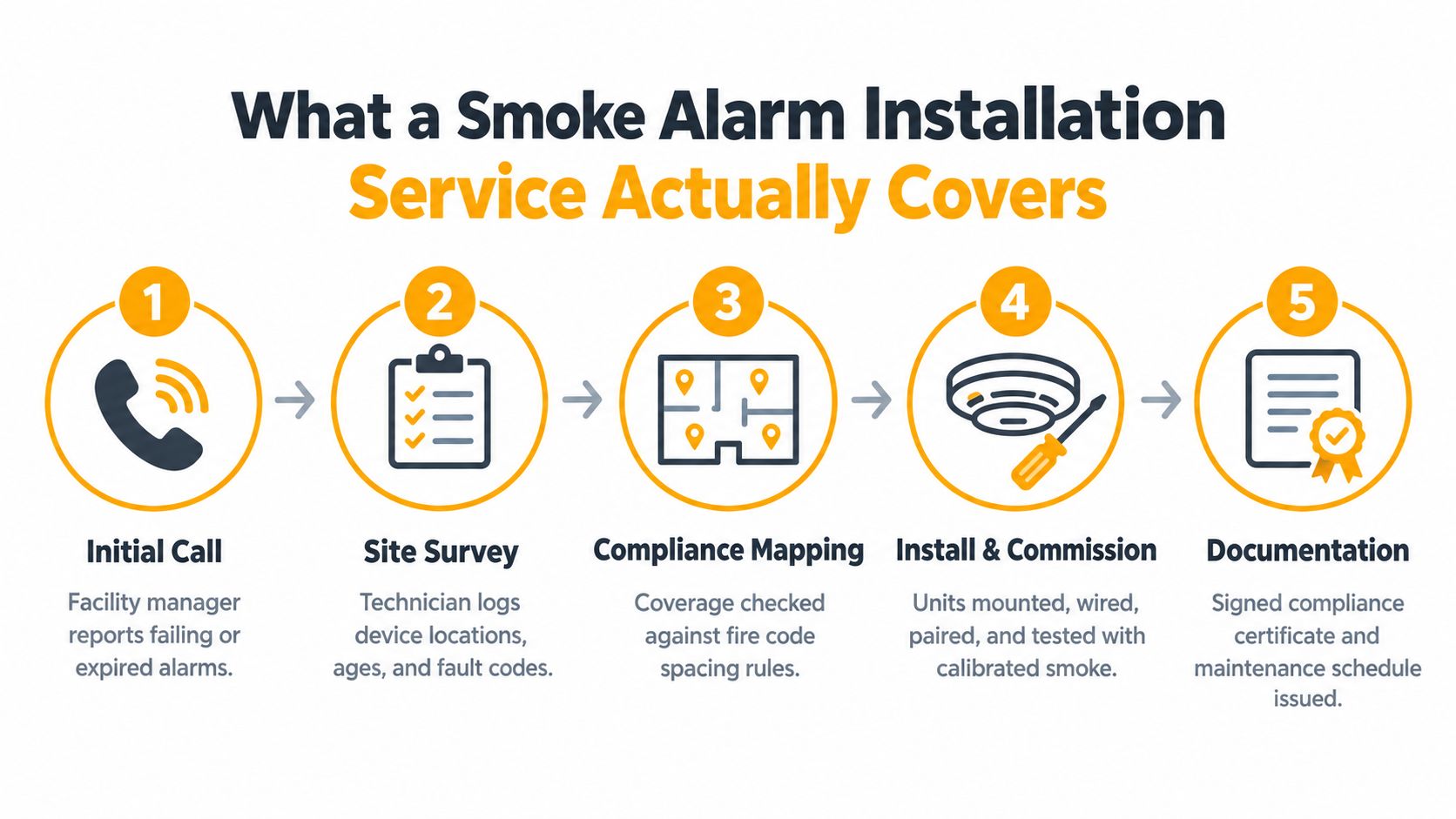
A typical first call starts with a fault description. The manager might report that several alarms are past their service life, a tenant has altered a partition, or one unit sounds without triggering the rest. A useful intake call records the building use, access conditions, existing fire systems, known faults, ceiling access, and whether the site includes sleeping accommodation or areas where occupants may have difficulty hearing a conventional sounder.
The scheduled visit then turns that information into a site record. A technician checks the existing devices, identifies their type and age, traces interconnection where possible, examines power arrangements, and compares the installed coverage with the current layout. In Queensland, required residential coverage is location-specific. Alarms are required on every storey, in every bedroom, and in hallways connecting bedrooms with the rest of the dwelling, with alternative positioning rules where a hallway or bedroom is absent, as set out by the Queensland Fire Department's smoke-alarm guidance.
The device is only one part of the job
For a commercial property, the service may include a coverage design, supply of AS 3786-2014 compliant photoelectric alarms, hardwired interconnection, wireless interconnection where suitable, and integration with an existing fire panel or emergency warning and intercom system. The correct solution depends on the building, the alarm system already installed, access constraints, and the way the premises is occupied.
A proper handover folder should normally identify:
- Installed assets: Device type, location reference, serial or identifying details, and installation date.
- Commissioning evidence: Test results, interconnection results, fault findings, and corrective actions.
- Compliance documents: The applicable certificate or compliance record completed by the responsible licensed contractor.
- Maintenance information: Testing responsibilities, service intervals, replacement requirements, and the next review date.
The installation cost is only the opening chapter of that lifecycle. A business that receives a ceiling-mounted device without a register or test record has bought hardware, not a complete smoke alarm installation service. The difference becomes obvious when a device fails later and nobody can establish which unit it is, when it was installed, or whether the rest of the system was tested with it.
How the On-Site Assessment Works
Assessment day should follow a recognisable order. The technician meets the duty manager, confirms access and isolation arrangements, reviews available floor plans, and asks what has changed since the alarms were installed. A drawing that shows an open office may no longer match a site divided into offices, storerooms, treatment rooms, or sleeping areas.
Start with the building, not the catalogue
The physical walk comes next. The technician checks ceiling construction and height, air movement from mechanical ventilation, cooking or steam sources, dusty work areas, plant rooms, corridors, and likely sleeping locations. These details affect detector positioning and nuisance-alarm risk. A unit placed beside an air outlet or too close to cooking activity may be technically present but poorly suited to the environment.
The coverage plan is developed against the actual building rather than a generic floor sketch. Dead-air areas, enclosed rooms, changes in level, access routes, and the location of other fire equipment all matter. The technician also decides whether 240-volt hardwired units, wireless interconnected units, or a combination is appropriate. Hardwired equipment can provide a dependable permanent arrangement, but it may require electrical access, shutdown coordination, and additional cabling. Wireless equipment can reduce disruption in some buildings, but it still needs suitable signal performance, power management, testing, and documented commissioning.
Practical rule: A replacement alarm should never be specified before somebody has checked what the building is used for today.
Choose the sensing technology carefully
Queensland dwellings must use photoelectric smoke alarms that comply with AS 3786-2014, must not contain an ionisation sensor, must be less than 10 years past their manufacture date, must operate when tested, and must be interconnected. These statutory performance requirements make product selection, age verification, functional testing, and interconnection testing separate checks, not one tick box, as explained by the Queensland Fire Department's smoke-alarm reform information.
A commercial assessment may also consider multi-sensor equipment where the building conditions justify it. The technician should explain why a particular head is being used, what nuisance risks it addresses, and whether the selected unit can communicate with the existing panel or warning system.
The visit should finish with a findings report, marked-up plans or location schedule, cable-route notes, identified access work, and a draft quote. Businesses should ask when that pack will arrive. A clear written record issued promptly is more useful than a verbal promise made from a ladder.
QLD Standards and AS 3786-2014 Compliance Checks
A compliant installation is more than a new alarm fixed to the ceiling. Queensland's reforms moved properties towards interconnected photoelectric systems, with staged requirements beginning on 1 January 2017. Full compliance for existing dwellings is required by 1 January 2027, so a service completed in late 2026 should record both the current condition and any work needed before that final deadline. Queensland's installation guidance states that, from 1 January 2017, every Queensland residence must have interconnected photoelectric smoke alarms.
On a commercial site, the technician checks the installed system against the building's use and the applicable requirements. The inspection should cover alarm technology, AS 3786-2014 product marking, manufacture date, location, power supply, interconnection, test response, and compatibility with any connected fire-safety equipment. Each item needs a recorded result, defect, or reason it does not apply.
The historical context supports disciplined checking. In the 2013–14 financial year, Australian fire agencies attended 384,017 emergency incidents, including 101,867 fire-related incidents and 19,524 structure fires. Structure fires represented 84 incidents per 100,000 people, while 98 fire deaths were recorded nationally, a rate of 4.3 deaths per million people, according to the Australian Parliament report on fire safety and smoke alarms. The report records household alarm coverage of 94.1% in New South Wales, 96.6% in Queensland, and 94.0% in Western Australia in 2013–14, compared with approximately 70% to 82% in 2004–05. Coverage improved, but a fitted device alone does not prove that a site is protected today.
| Requirement | Standard or source | What the technician verifies | Evidence produced |
|---|---|---|---|
| Photoelectric selection | Queensland requirements and AS 3786-2014 | Alarm type, product marking, manufacture date, and site suitability | Device schedule and product details |
| Location and coverage | Queensland Fire Department guidance | Required storeys, bedrooms, connecting hallways, and exit paths | Marked-up plan or location register |
| Interconnection | Queensland smoke-alarm reforms | Activation of one alarm causes the linked alarms to sound | Commissioning and interlink test record |
| Operation | Queensland statutory requirements | Test response, power condition, backup supply, and visible faults | Dated results and defect list |
| Lifecycle control | Site procedures and maintenance requirements | Responsible person, service method, actions, and replacement tracking | Maintenance plan and asset register |
The audit test is straightforward: can a facilities manager identify what was installed, where it sits, and how it performed without calling the original technician? A practical guide to photoelectric smoke alarms can support product discussions, while the service record provides the site-specific proof.
Site Readiness Checklist Before the Crew Arrives
Delays often come from access, not from the alarm work. A crew may arrive ready to test an interconnected system, only to find that a secure tenancy is locked, ceiling tiles can't be removed, or staff weren't told that an electrical circuit needs to be isolated.
Use this preparation sheet the day before the visit. The responsible person can tick each item before the technician arrives.
| Preparation item | Responsible person | Pass or fail check on arrival |
|---|---|---|
| Access keys, swipe cards, and alarm-panel access | Facility manager or duty manager | Technician can reach every alarm, panel, switchboard, and secure room |
| Ceiling access and tile removal arrangements | Facilities team | Required access equipment and replacement tiles are available |
| Tenancy and secure-room escorts | Property or operations manager | An authorised escort is present for occupied or restricted areas |
| Current floor plans | Facility manager | Drawings are available and broadly match the current layout |
| Switchboard labels and isolation information | Electrical or facilities contact | Relevant circuits are identified and isolation can be coordinated |
| RCD and electrical safety arrangements | Electrical contractor or site manager | The electrical work can proceed under the site's safety procedures |
| Existing fire records | Building manager | Previous test results, defect notices, and certificates are available |
| Asbestos and hazardous-material information | Property owner or manager | The crew receives the site register and any access restrictions |
| Furniture below proposed alarm positions | Tenant or operations team | Ladders and equipment can be used without moving avoidable obstructions |
| Staff notification | Operations manager | Occupants know about testing noise and any planned power interruption |
| After-hours contact | Site coordinator | One person can approve access, isolation, and urgent decisions |
What helps the technician work accurately
The most useful documents are the current floor plan, existing alarm schedule, previous defect reports, and records showing changes to partitions or use. If the site has a fire panel or emergency warning system, the technician should know who can place it into test mode and who receives alarm signals.
Don't remove alarms before the crew arrives. Leave the system intact so faults, missing units, incorrect interconnection, and unsuitable locations can be assessed. A clean site with clear access produces a better result than a rushed visit where the installer can only reach the obvious devices.
Reading Quotes and Checking Licences
A credible quote tells you what will be installed and how the contractor will prove it works. A cheap quote often hides the device count, access assumptions, cabling, certification, testing, or the cost of returning to correct a fault.
For Queensland work, check the installing contractor's QBCC licence. If the project includes 240-volt hardwired work, confirm the electrical licence of the person carrying out that work, along with any supervision arrangements that apply. Interconnected or monitored systems may also involve cabling work, so ask whether the required cabler registration and system responsibilities are covered.
A quote should identify the alarm model, its AS 3786-2014 status where applicable, quantity, labour, cable or wireless components, testing, commissioning, compliance paperwork, travel, warranty terms, and any ceiling or access exclusions. If the quote says only “smoke alarm system, supply and install”, purchasing has no reliable basis for comparing providers.
| Quote element | Credible provider | Red flag |
|---|---|---|
| Device count | Lists each alarm or clearly states the system quantity | Lump sum with no number of devices |
| Product details | Names the model, sensing type, standard reference, and power arrangement | “Approved alarm” with no model |
| Interconnection | Explains hardwired, wireless, panel, or warning-system connection | No explanation of how alarms communicate |
| Labour and access | Separates installation, testing, commissioning, and access assumptions | Extra charges appear only after work starts |
| Certification | States which compliance or commissioning documents are supplied | No promise of a handover record |
| Licence details | Identifies the relevant contractor and electrical responsibilities | No licence numbers or vague subcontracting |
| Warranty | States equipment and workmanship coverage | Warranty mentioned verbally only |
Indicative Australian commercial pricing can vary widely with access, cabling, system integration, and the number of devices. The figures in a quote should therefore be treated as a scope signal, not a guarantee that the cheapest option is suitable. A quote for four alarms in a small tenancy is not directly comparable with a monitored warehouse fit-out.
Before accepting, ask for the smoke alarm compliance certificate information relevant to the proposed work. Reject any proposal that avoids licence details, omits testing, or treats documentation as an optional extra.
Ongoing Maintenance as a Documented Lifecycle
Maintenance fails when it becomes a battery-swap exercise. A responsible manager needs to show what was tested, which device was tested, what faults were found, what was changed, and who closed the corrective action.
The first document is the asset register. It should identify the make, model, serial or asset reference, installation date, precise location, power arrangement, interconnection group, and expected replacement point. Queensland requirements include a maximum age condition for dwelling alarms, so manufacture-date and replacement tracking belong in the register, not in a technician's notebook.
The second is the routine test log. It records the inspection and test activity, results, faults, cleaning, power or backup condition, and outstanding actions. Where AS 1851-2012 routine service requirements apply to the site or system, the service record should use the relevant routine table and identify the person who completed the work.
Four records that keep the system accountable
- Asset register: Maintains the identity and location of every alarm.
- Routine test record: Shows what happened during scheduled inspection and testing.
- Change record: Captures replacements, altered layouts, sensitivity concerns, nuisance alarms, and corrective work.
- Monthly site log: Records the responsible person's button-test activity and any defect reported between service visits.
The monthly entry matters because an alarm can be operational at handover and unreliable later. Australian research cited in the parliamentary material estimated that installing alarms in every room of every dwelling could reduce fatalities by 17% to 30%. That finding supports a broader point for commercial properties: coverage, placement, operation, and maintenance need to be managed together, rather than assumed from the presence of a device.
A scheduled service should update the register, close completed defects, note inaccessible areas, and set the next action. The cost belongs in the operating budget. A business that budgets only for installation may later face an avoidable scramble when a landlord, insurer, or auditor asks for records. A documented preventive maintenance plan gives the site a repeatable process instead of a collection of invoices.
Accessibility also belongs in that process. Fire and Rescue NSW notes that people who are deaf or have severe hearing loss may not hear conventional alarms and identifies visual strobes and vibrating pillow pads as specialised alternatives. Australian Building Codes Board research reports that a 520 Hz low-frequency signal is six to ten times more effective at waking people with upper-frequency hearing loss than a conventional 3–5 kHz signal, while warning that it may still be inadequate for people with profound hearing loss. A risk assessment may therefore require layered audible, visual, vibrating, and evacuation measures, followed by testing with affected occupants.
Maintenance Questions Business Owners Actually Ask
How often should the system be checked?
The answer depends on the building, the equipment, the applicable maintenance regime, and the site's risk profile. A responsible person may complete routine user checks, while a qualified technician carries out the scheduled inspection, testing, cleaning, defect assessment, and documentation required for the system.
Don't treat a successful button test as a complete service. It doesn't prove that every alarm is correctly located, interconnected, clean, within its service life, or communicating with a panel. Book the next service window before the current visit is closed, then keep the signed record with the site fire documents.
Can any staff member press the test button?
A nominated site representative can usually carry out the routine user check if they've been shown the correct procedure and understand how to report a fault. That person shouldn't open a 240-volt alarm, alter wiring, bypass an interconnection, or reset a monitored system without the required authority and competency.
The practical split is straightforward. Staff can observe, test as instructed, record, and escalate. Licensed and appropriately qualified technicians diagnose electrical or system faults, replace components, commission the system, and issue the relevant service evidence. Put the responsible person's name in the logbook and confirm the escalation contact.
What will an inspector or auditor ask to see?
Expect a request for the asset register, recent test results, open and closed defect records, certificates, service reports, and evidence that corrective work was completed. They may also compare the records with the physical building, especially where partitions, tenancy use, sleeping areas, or access routes have changed.
A tidy folder is useful, but it must match the site. If the register says an alarm is in a corridor and the alarm is inside a storage room, the paperwork creates another problem. Walk the records against the building after significant layout changes and update the location schedule.
What does replacement involve?
A hardwired photoelectric head and a basic battery-powered unit aren't interchangeable jobs. The technician may need to isolate power, verify the backup supply, confirm the interconnection group, test the replacement with the other units, and update the asset register. A battery unit may be quicker to exchange, but it still needs correct product selection, placement, testing, and record updates.
Get the contractor to separate the alarm, labour, call-out, testing, and documentation in the quote. If the price only covers the device, ask who is responsible for commissioning and the next maintenance entry. Celtic Fire & Security supplies, installs, tests, and maintains commercial smoke and heat alarm systems across North Brisbane, Moreton Bay, the Sunshine Coast, Somerset, and Ipswich.
Book a site assessment with Celtic Fire & Security to review alarm coverage, interconnection, licensing, and the documentation your Queensland business needs. Ask for a written scope that covers installation, commissioning, asset records, compliance paperwork, and the next scheduled maintenance action.
No responses yet