
Only 51.7% of inspected Queensland building premises were compliant at first inspection in 2017–18, so a fire alarm system inspection is not a pass-or-fail visit. It's a documented process that must identify defects, assign responsibility, confirm repairs and verify that the system is ready to respond.
A panel showing “normal” doesn't prove that every detector works, every interface has restored correctly or every maintenance record is complete. In commercial buildings, compliance depends on the condition of the equipment, the accuracy of the documentation, the site's access arrangements and what happens after the technician finds a problem.
Table of Contents
- Understanding Queensland Fire Alarm Compliance Realities
- The Documentation and Preparation Phase
- Conducting Physical Inspections and Function Tests
- Reducing False Alarms Through Systematic Analysis
- Documentation and Defect Management Requirements
- When to Call Licensed Fire Alarm Technicians
Understanding Queensland Fire Alarm Compliance Realities
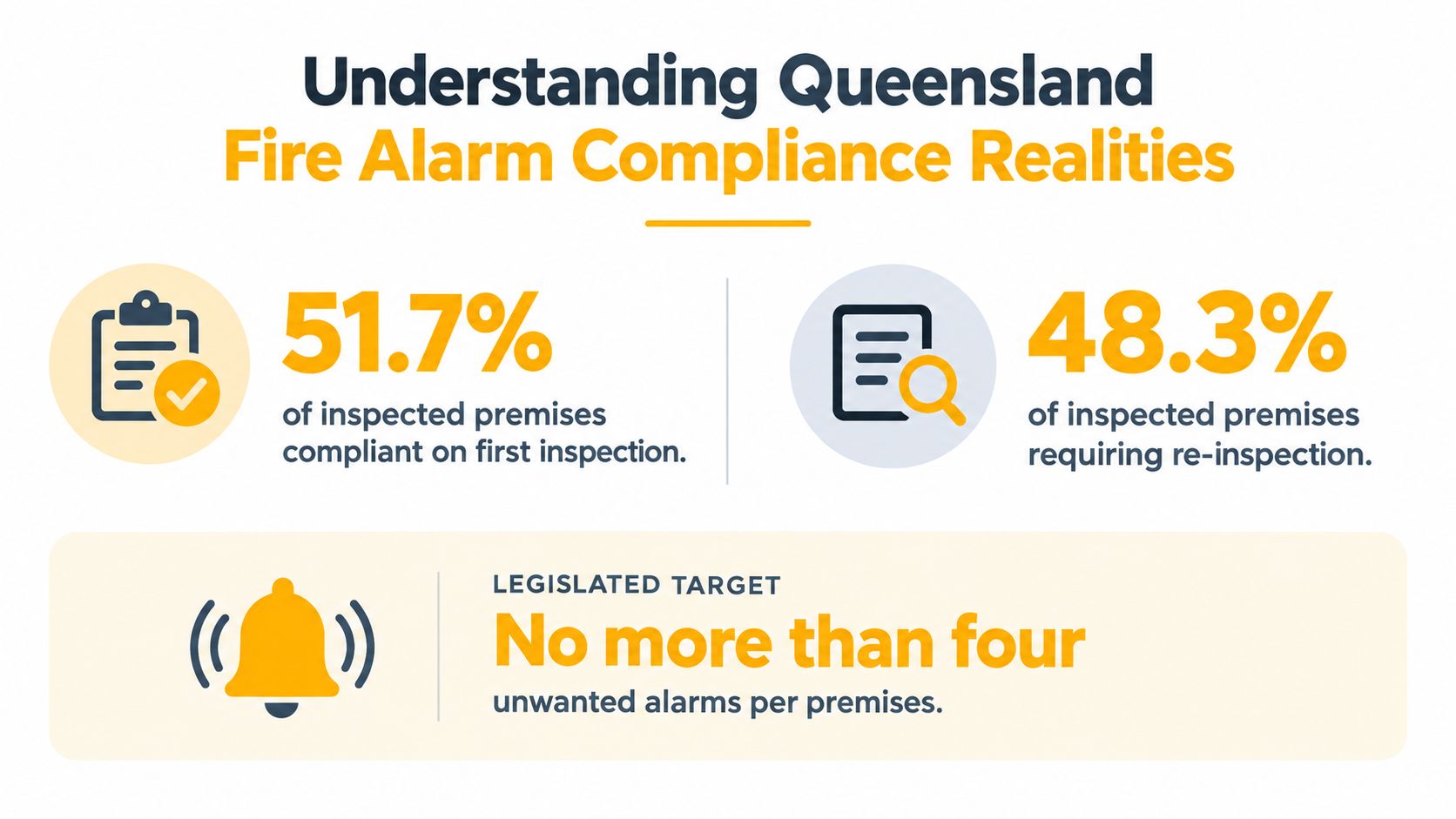
Queensland's official fire-safety data gives facility managers a useful reality check. In 2017–18, 51.7% of inspected building premises were deemed compliant at their first inspection, only narrowly above the 50% performance target reported by Queensland Fire and Emergency Services in its performance reporting. The same measure reached 55.8% in 2019–20, still leaving a substantial proportion of premises requiring further action before compliance could be established.
That gap matters because having an inspection appointment isn't the same as achieving a compliance outcome. A building owner may have a recently installed alarm system, yet the inspection can identify disabled detectors, inaccessible equipment, unresolved panel faults, missing records, failed alarm signalling or interfaces that don't operate as approved. The system may have been installed correctly and still be non-compliant today because building use, tenancy layouts, construction work or maintenance practices have changed.
Compliance is a process, not a sticker
The approved fire-safety schedule, system documentation, maintenance records and defect closeout evidence need to tell the same story. If the asset register lists devices that aren't present, or the installed system includes equipment absent from the records, the technician can't confidently verify the scope of protection.
A practical commercial fire alarm system guide should therefore be treated as a starting point, not a replacement for site-specific inspection and testing. The governing Australian Standard, manufacturer instructions, occupancy risk and Queensland obligations determine the task set and frequency.
Practical rule: A service sticker proves that someone attended. It doesn't prove that every defect was repaired or that the system is operationally ready.
Queensland's inspection results also show why facility managers should schedule inspections before formal regulatory attention, keep records in a controlled system and track open defects until retesting confirms closure. A first visit that identifies a fault isn't necessarily a failure of the maintenance provider. It can be a valuable finding, provided someone owns the repair and verifies the result.
The legislated unwanted-alarm benchmark adds another layer. Queensland's target is no more than four unwanted alarm activations per alarm-signalling equipment connection per year, so a technically functioning system can still create a reliability problem if environmental triggers and signalling behaviour aren't investigated.
The Documentation and Preparation Phase
Preparation determines whether an inspection produces useful evidence or a list of avoidable findings. Before the technician arrives, the facility manager should assemble the documents that define what the system is supposed to protect and how it has been maintained.
Start with the approved fire-safety schedule, fire-engineering documentation, relevant plans, prior service reports and the current maintenance register. Queensland inspectors assess whether fire-safety measures match approved plans, fire-engineering reports, the National Construction Code and applicable Australian Standards. The Queensland guidance on prescribed fire safety installations also places responsibility on the building occupier to ensure inspection and testing are completed by an appropriately qualified person.
Build an accurate system picture
Reconcile the asset register against the installed equipment before testing begins. Walk the site and identify:
- Control equipment: Fire indicator panels, repeater panels, graphic annunciators and alarm-signalling equipment.
- Initiating devices: Smoke detectors, heat detectors, beam detectors, aspirating detection points and manual call points.
- Notification appliances: Bells, sounders, speakers, visual indicators and devices serving accessible areas.
- Interfaces: Lift controls, air-conditioning shutdowns, fire dampers, access-control releases, doors and other approved building services.
- Supporting equipment: Batteries, power supplies, cabling, isolators, monitoring paths and remote notification equipment.
Mark inaccessible devices, locked rooms, restricted tenancies, high-level equipment and areas affected by construction. An access limitation shouldn't be buried in a technician's notes. Record the location, reason for the restriction, person responsible for access and the proposed return date.
Confirm isolation control
Isolation records deserve particular attention. Ask who authorised each isolation, why it was required, when it started and how restoration will be confirmed. A zone left isolated after a contractor's work can leave an apparent “normal” panel status misleading, particularly where staff don't understand the difference between a fault, supervisory condition and isolation.
Make prior reports available in chronological order. Look for repeated device identifiers, recurring faults, overdue repairs, battery concerns and service notes that say “monitor” without a later result. A repeated defect should trigger a decision about root cause, not another identical service entry.
For commercial premises, maintenance records should show what was inspected, what was tested, what failed, what action was assigned and how completion was verified. The AS 1851 maintenance framework is the relevant reference for commercial fire-alarm maintenance, while Queensland guidance identifies monthly testing by an appropriately qualified person for the fire indicator panel and alarm-signalling equipment. Frequency and task scope must still be matched to the system, manufacturer instructions and site risk.
Conducting Physical Inspections and Function Tests
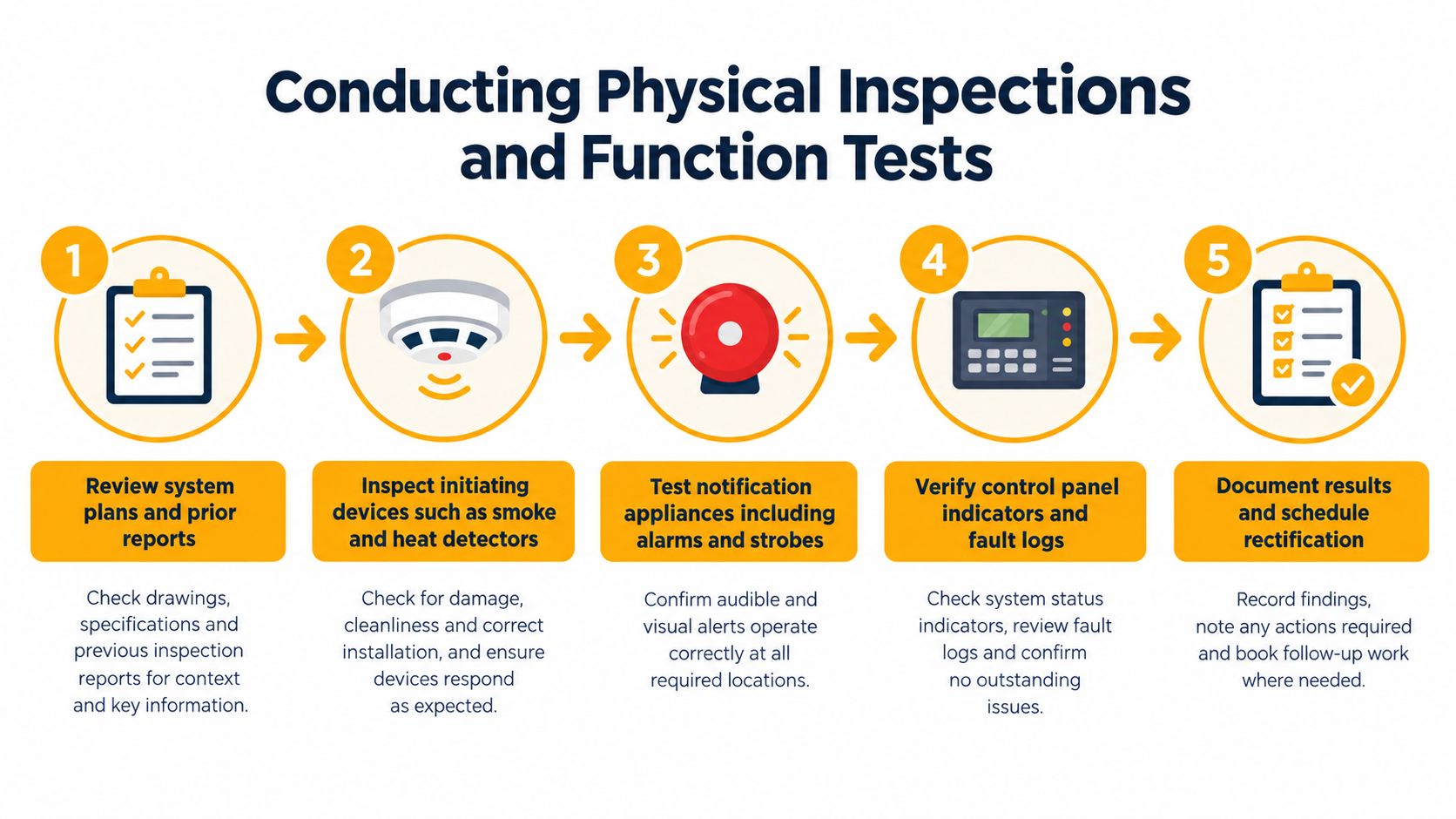
A physical inspection should follow a controlled sequence rather than an informal walk-through. Begin by reviewing the approved plans, prior reports, event history and current isolation register. This gives the technician a working map of the system and highlights devices or zones that need closer attention.
Test devices methodically
Inspect the condition, location and accessibility of each relevant initiating device. Check smoke and heat detectors for contamination, damage, obstruction, unsuitable positioning and signs of moisture or building work. Manual call points should be accessible, clearly identified and free from damage. Don't rely on a small sample unless the governing maintenance requirements specifically permit that approach. The practical benchmark is to test the relevant devices systematically using manufacturer-approved methods.
Notification appliances need the same discipline. Confirm that sounders, bells, speakers and visual indicators operate in their intended areas. A device that activates at the panel but can't be heard or seen where occupants work isn't providing effective notification.
Technicians should also inspect:
- Power and batteries: Confirm mains supply, charger condition, battery status, connections and backup operation.
- Cabling and enclosures: Look for damage, loose connections, corrosion, unauthorised alterations and poor protection.
- Control equipment: Review normal status, fault indicators, supervisory conditions, isolation controls and event history.
- Alarm signalling: Confirm that an alarm reaches the monitoring destination, is acknowledged correctly, is logged and can be reset.
- Building interfaces: Verify doors, lifts, HVAC shutdowns, fire dampers, access-control releases and other approved interfaces respond as intended.
A local panel test isn't enough. The panel can show an alarm while a monitoring path fails, a lift interface doesn't respond or an isolated circuit remains unavailable. After testing, restore every isolation and confirm the panel returns to the intended normal condition.
A reset button is not a closeout. The technician must confirm the cause, the response, the restoration and the record.
The final functional check should include remote notifications and any connection to alarm-signalling equipment. Record the device identifier, location, test method, result and defect description. “Detector failed” isn't sufficient. State whether it was contaminated, inaccessible, damaged, incorrectly positioned, unable to signal or affected by another system condition.
For practical background on device servicing, see this guide to smoke detector service.
The following video illustrates the type of systematic equipment review facility teams should expect during a service visit.
Reducing False Alarms Through Systematic Analysis
False-alarm reduction is a reliability task, not a cosmetic improvement. Queensland reported 2.4 unwanted alarm activations per alarm-signalling equipment connection in 2023–24, against a legislated target of no more than four, according to Queensland Fire and Emergency Services performance data. A system can pass a sounder test and still perform poorly if the inspection doesn't identify why particular detectors repeatedly activate.
Start with the event history before triggering devices. List repeat activations by detector, zone, time and operating condition. A device that activates during kitchen production, dusty construction, high airflow or cleaning activity presents a different diagnostic problem from a detector that activates randomly in a stable office.
Separate device faults from site conditions
The technician should examine the detector and its environment together. Common investigation points include:
- Contamination: Dust, insects, residue and building materials can affect detector behaviour.
- Moisture: Steam, condensation and water ingress may create recurring activations or faults.
- Air movement: HVAC discharge, extraction systems and pressure changes can move vapour or particles across a sensing chamber.
- Work activities: Construction dust, sanding, welding, cooking vapour and cleaning products can produce predictable triggers.
- Detector selection: The installed technology may not suit the current room use, temperature, airflow or contamination level.
- Isolation practice: Poorly controlled isolations can conceal faults, interrupt protection or leave the system in an unintended state.
- Housekeeping: Stored materials, temporary partitions and changed furniture layouts can affect access and detector performance.
The right response isn't to reduce sensitivity automatically or leave a troublesome zone isolated. Those actions may quiet the alarm while weakening the building's protection. Instead, establish whether cleaning, relocation, programming, ventilation changes, a different approved detector type or a change to contractor procedures addresses the cause without compromising detection.
A repeat activation should have a root-cause entry, not just a replacement part number. Record the original device, surrounding conditions, corrective action and post-repair verification. Where the building has changed through renovation or a new tenancy, test the system again after the work and review whether the approved design still matches the occupied space.
Use trends to improve maintenance
One activation may need investigation. A pattern demands management attention. Compare event history with contractor schedules, occupancy changes, cooking periods, seasonal moisture, air-conditioning operation and access-control modifications. This turns the fire alarm system inspection into an operational review of how the building is being used.
A preventive maintenance plan should include recurring alarm analysis, cleaning requirements, environmental observations and retest dates. The report should state the alarm frequency per connection, recurring device identifiers, suspected cause, corrective action and verification date. A pass/fail statement alone hides the information facility managers need to prevent the next unwanted activation.
Documentation and Defect Management Requirements
The inspection report becomes valuable only when someone can use it to close the defect. Every finding should be specific enough for a manager, contractor and future technician to understand the condition without returning to the site to clarify the note.
Queensland's Building Fire Safety Regulation 2008 requires corrective action or repairs identified during maintenance to be completed no later than one month after the issue is identified, unless the occupier has a reasonable excuse, as explained in the Queensland legislation. The occupier remains responsible for ensuring the cycle is managed, even when a contractor performs the technical work.
Create a defect register that drives action
A useful register should contain:
| Field | What to record |
|---|---|
| Asset and location | Device identifier, zone, level, room and access details |
| Condition | Exact fault, impairment or non-conformance observed |
| Life-safety risk | Immediate, significant or routine priority, with the reason |
| Temporary control | Isolation management, fire watch, access restriction or other approved measure |
| Owner | Person or organisation authorised to arrange the repair |
| Due date | Required completion date and any approved reason for delay |
| Completion evidence | Work order, technician report, photograph or replacement record |
| Retest result | Date, person, method and confirmation that the system restored correctly |
Classify defects by consequence, not inconvenience. A missing label and a disabled detection zone shouldn't receive the same treatment. If a monitored connection isn't transmitting, or a critical zone remains isolated, escalate the issue immediately and document the temporary protection agreed with the responsible party.
Assign responsibility in multi-tenant buildings
The occupier, owner, body corporate, strata manager and facility manager may each control a different part of the response. Put the responsible party beside every defect. “Notify landlord” is not a closeout owner. Record who approved the work, who will provide access, who will pay or authorise the repair and who will arrange retesting.
A certificate or service sticker doesn't replace defect evidence. The file should show the original finding, the action taken and the result after repair. For inaccessible equipment, retain the access request and rescheduled inspection record rather than treating the device as tested.
Closeout standard: If the report can't show who acted, what changed and how the technician verified restoration, the defect remains open.
At completion, reconcile the defect register against the final report and annual occupier statement. Confirm that isolations are cleared, alarms and interfaces operate normally, records are stored centrally and unresolved items have a documented explanation and control. This workflow protects the building's compliance position and gives the next technician reliable information.
When to Call Licensed Fire Alarm Technicians
A facility team can usually perform visual checks, report panel faults, keep access paths clear and confirm that contractors have signed the site register. Those tasks support maintenance, but they don't replace inspection and testing by an appropriately qualified person under Queensland requirements.
Consider a retail tenancy with a detector repeatedly activating after a fit-out. Staff can report the time, location and work activity. A licensed technician should determine whether contamination, airflow, detector selection, programming, cabling or an altered layout is responsible, then test the remedy and document the result.
The same applies when a monitored system has recurring unwanted alarms, a zone is isolated, the panel shows persistent faults, batteries require replacement, or interfaces with lifts, HVAC, doors or fire dampers need verification. System modifications, extensions and commissioning also require competent design review, installation, testing and records under the applicable Australian Standards and licences.
Celtic Fire & Security provides commercial smoke and heat alarm testing and maintenance, including panel checks, device testing, response verification and service recording. The company also supports scheduled preventative maintenance across North Brisbane, Moreton Bay, the Sunshine Coast, Somerset and Ipswich.
Property managers should compare providers on more than attendance price. Ask whether the report identifies each tested asset, records defects clearly, assigns closeout responsibility, confirms alarm transmission and includes retest evidence. That documentation is what turns a site visit into a managed compliance outcome.
Book a documented fire alarm system inspection with Celtic Fire & Security and ask for a defect register that records priorities, owners, due dates and retest evidence. Their team can help Queensland businesses test commercial alarm systems, investigate recurring unwanted alarms and maintain records aligned with applicable Australian requirements.
No responses yet