
In Queensland, emergency lighting is regulated fire-protection work requiring six-monthly full-duration discharge tests of at least 90 minutes, performed by an appropriately licensed electrical mechanic and maintained in accordance with AS/NZS 2293.2. A fitting that passes a quick timer test can still fail the building's required illumination performance or leave the owner with an inadequate compliance record.
The problem usually appears during a power outage, not during a routine walk-through. The exit signs are glowing, the corridor looks ready, and the maintenance sticker is current. Then the mains supply drops during a fire drill and several fittings go dark because their batteries, chargers or control components failed without warning.
That's why Queensland facility managers need to treat emergency lighting as a life-safety system, not ordinary building lighting. The interval matters, but the test method, illumination performance, licensing and evidence matter just as much.
Table of Contents
- Why Emergency Lighting Testing Matters More Than You Think
- The Core Australian Standards and Queensland Legislation
- How the Six-Monthly Test Cycle Actually Works
- The Gap Between Testing Intervals and Full Compliance
- Who Is Legally Allowed to Perform These Tests in Queensland
- Building Your Annual Compliance and Documentation Plan
- Protecting Your Business with Proven Safety Standards
Why Emergency Lighting Testing Matters More Than You Think
A typical fault remains invisible while normal power is available. An emergency luminaire may look bright, show a healthy indicator light and respond to a brief test switch, while its battery has insufficient capacity to support evacuation. The same problem can affect an illuminated exit sign, a charger or a control component.
During a power failure, those hidden defects become immediate route hazards. Workers and visitors need to recognise exits, negotiate changes in level and move past obstacles without relying on normal lighting. Queensland guidance describes emergency lighting as a life-safety measure supporting the safe evacuation of workers, while WorkSafe Queensland's workplace lighting guidance explains the role of battery-backed fittings and evacuation signage during a power failure.
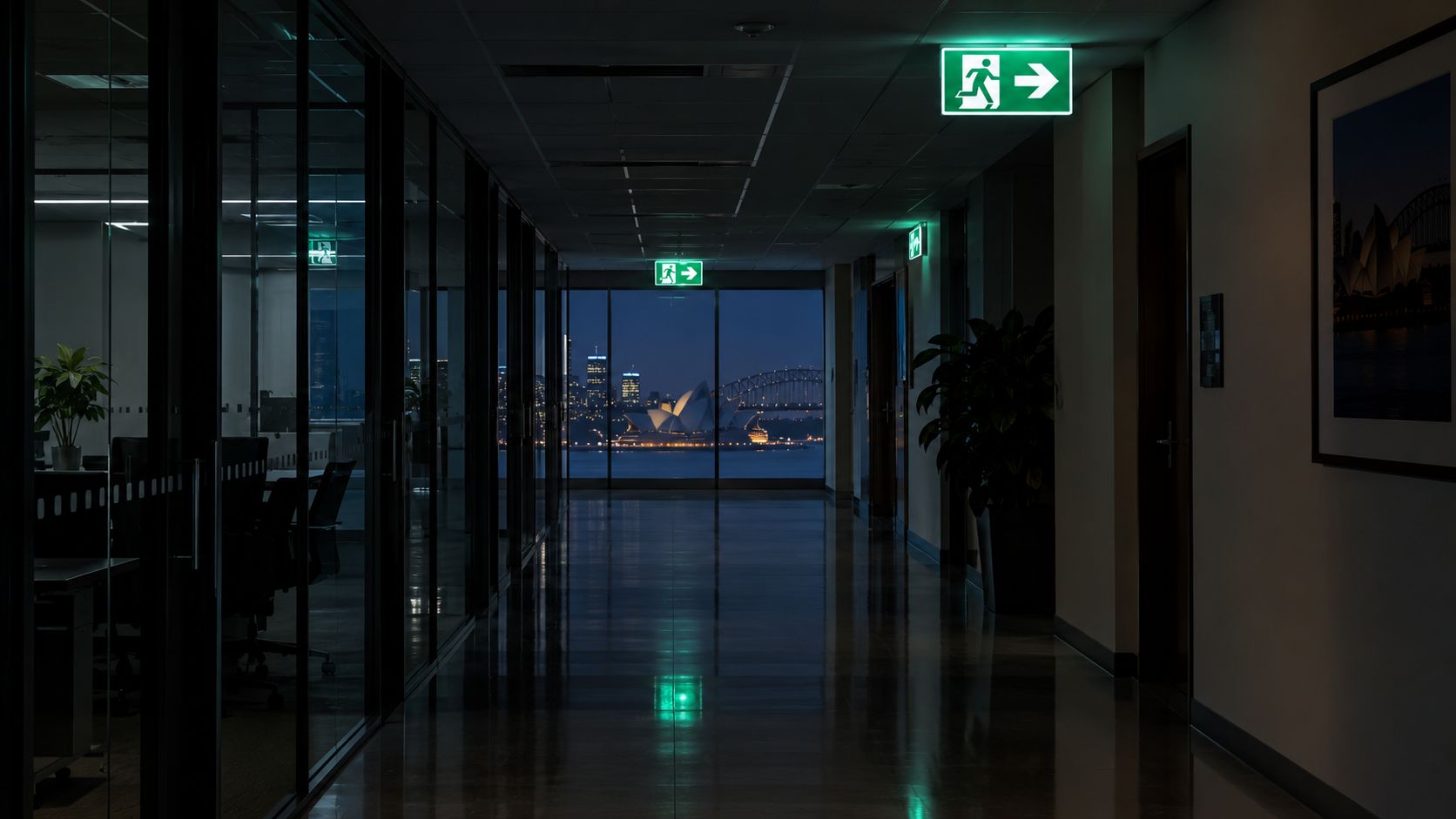
A glowing fitting can still be a failed fitting
Queensland's Building and Construction Commission treats emergency lighting as a regulated fire-protection installation, rather than ordinary building illumination. QBCC defines it as lighting designed and constructed to show an exit or evacuation route during a fire, including associated exit signage. It also identifies inspecting and testing emergency lighting as a defined authorised scope of work under its fire-protection licensing framework. The QBCC emergency-lighting licensing information sets out that distinction.
A short functional check only answers a narrow question: did the fitting activate? It doesn't prove that the battery will maintain useful output throughout the required emergency period, that the route has adequate illumination, or that every fitting was tested and recorded.
Practical rule: Treat every emergency luminaire and exit sign as an individually accountable safety asset, not as part of an assumed group.
The strongest maintenance programmes identify fittings by location, test the complete installed load and record failures through to rectification. That approach takes more organisation than pressing a test button, but it produces evidence that a facility manager can use during an audit, contractor handover or incident investigation.
The Core Australian Standards and Queensland Legislation
Queensland's baseline is a combination of Australian Standards, the National Construction Code and state licensing obligations. Each source answers a different question, so combining them into a single generic “fire inspection” can leave important gaps.
AS/NZS 2293.1 addresses the design and installation of emergency-lighting and exit-sign systems. It determines how the system should support the evacuation route, including the placement and design of emergency luminaires and exit signs. AS/NZS 2293.2 addresses maintenance and testing. Queensland government guidance identifies AS/NZS 2293.2 as the maintenance and testing standard for emergency evacuation lighting systems.
Emergency lighting shouldn't be hidden inside a general AS 1851 maintenance schedule. In Queensland, emergency and exit lighting is maintained under AS/NZS 2293.2 rather than AS 1851, while AS/NZS 2293.1 deals with design and installation. A facility manager therefore needs a separate emergency-lighting regime, even where other fire systems are maintained under a broader programme.
For a practical explanation of the site process, see this guide to emergency light testing. The important management question is whether the contractor's scope covers the whole installed system, including exit signage, battery operation, route conditions, defects and records.
The Queensland compliance chain
The legal and technical responsibilities work together:
- System design and installation: Confirm the installed arrangement against the applicable design requirements, building approval and system documentation.
- Maintenance and testing: Apply AS/NZS 2293.2, including the required discharge testing and fault follow-up.
- Work authorisation: Use a person holding the relevant Queensland electrical and fire-protection authority for inspecting and testing.
- Evidence: Retain a fitting-by-fitting record showing what was tested, what failed and what was done about it.
QBCC's licensing framework specifically recognises emergency-lighting inspection and testing as fire-protection electrical work. Queensland legislation also requires the person performing the work to prepare a record of inspection and testing results, unless a separate certificate applies. The Queensland legislation covering fire-protection electrical activities is the appropriate reference for the licensing and recordkeeping obligation.
A fitting can pass normal mains observation and still contain a failed battery or charger. That's why a report stating only “tested satisfactory” is weaker than a register tied to floor plans, fitting identifiers and defect close-out evidence.
How the Six-Monthly Test Cycle Actually Works
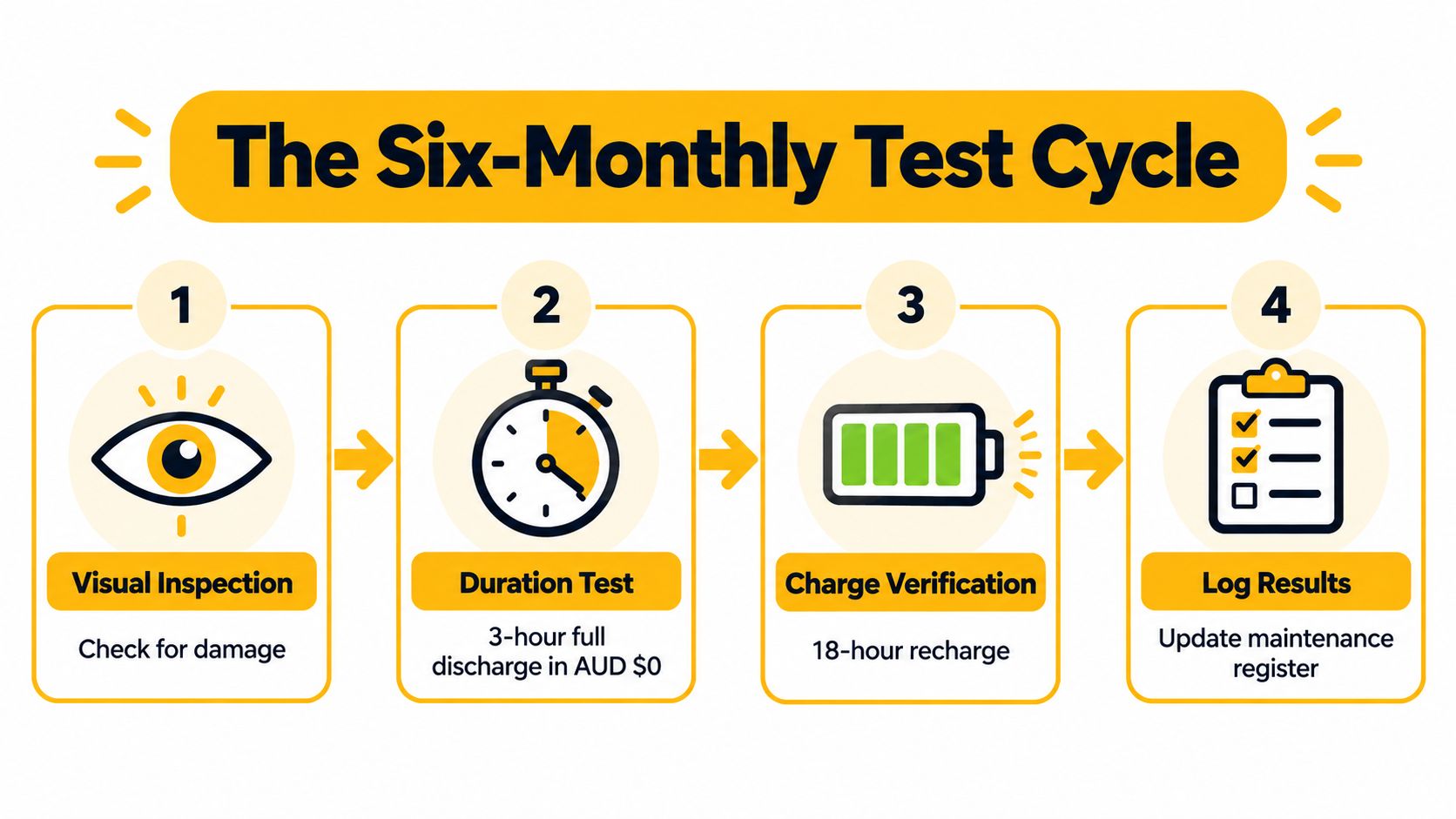
The six-monthly test is a battery endurance exercise. It simulates a mains failure, transfers emergency fittings to battery operation and checks whether the installed load remains effective for the required duration. It isn't equivalent to confirming that a lamp illuminates for a few seconds.
Guidance associated with AS/NZS 2293 describes emergency luminaires and exit signs as commissioned with emergency power for at least 120 minutes, while the in-service performance requirement is generally at least 90 minutes, unless a building regulation specifies a shorter period. Queensland's current compliance assessment must therefore consider the applicable building requirements, approval history and system documentation, not just a contractor's timer setting. The AS/NZS 2293 guide published by Hochiki Australia provides the relevant technical context.
What the technician should verify
Before the discharge begins, the tester should confirm that the system hasn't suffered a recent interruption. Guidance associated with AS/NZS 2293 recommends checking that mains power has not been interrupted during the preceding 16 hours, because an earlier outage may leave batteries partially discharged and distort the result.
The site visit should then establish the system condition and test coverage:
- Identify every fitting. Include emergency luminaires and illuminated exit signs, not only units close to a test switch or distribution board.
- Inspect the physical installation. Check for damage, obscured signs, deterioration, loose components and route changes that affect visibility or hazard coverage.
- Interrupt normal supply. Use the approved test method to transfer the fittings to emergency power.
- Run the required discharge period. Record the start time and observe whether each fitting remains illuminated for the applicable duration.
- Assess failures properly. Early extinction, materially reduced output or non-operation is a failed result, not a pass with a note.
- Restore and verify recharge. Confirm normal operation returns and document battery, charger, lamp or control repairs.
- Retest corrected fittings. A repair isn't complete until the affected fitting has been verified.
The scale is easy to underestimate. A building with 80 emergency fittings requires 160 scheduled six-monthly fitting checks each year, before visual inspections, fault retesting and repairs are counted. That makes a reliable asset register more useful than a paper form with a single site-level tick.
For scheduling principles, facility managers can also review how often emergency lighting should be tested. A planned outage window is usually less disruptive than discovering a failed system during an unplanned power interruption.
The report should show each fitting's identifier and location, start time, result, failure details and corrective action. If a battery fails early, the record should make clear whether the site replaced the battery, repaired the charger, replaced the fitting or arranged further investigation.
The Gap Between Testing Intervals and Full Compliance
A six-monthly test interval is not the same thing as a complete compliance outcome. The interval tells you when the endurance test is due. It doesn't, by itself, prove that the building meets every applicable illumination, design or approval requirement.
Queensland guidance has historically described six- and 12-month testing, including a simulated power failure and a 60-minute operating check. The current NCC 2025 provisions require specified systems to achieve the applicable illumination levels and operate for at least 90 minutes. The Queensland government inspection and maintenance guidance helps explain why facility managers must examine the building-specific requirement rather than rely on a timer setting alone.
What a timer proves, and what it doesn't
| A discharge test can demonstrate | A discharge test alone doesn't demonstrate |
|---|---|
| The emergency circuit transfers to battery operation | That illumination levels meet the applicable NCC requirement |
| A fitting remains illuminated for the test duration | That every route hazard receives adequate light |
| A battery, charger and lamp operate under simulated outage conditions | That the system matches the approved building design |
| A listed defect has been observed | That unresolved defects have been formally closed |
This distinction matters most in older premises. A building may carry legacy approvals while newer NCC provisions influence the way current performance is assessed. The facility manager needs to establish the occupancy classification, approved fire-safety documentation, installed system standard and applicable test duration before deciding that a result is sufficient.
The same applies to photoluminescent exit signs. The NCC specifies a dedicated charging source providing at least 100 lux at the sign face, with a colour temperature of at least 4000 K. During a power failure, the sign must provide at least 30 millicandelas per square metre for no less than 90 minutes. The NCC photoluminescent exit-sign specification treats these as pathway-specific requirements, not universal assumptions for every emergency luminaire.
A passing timer is evidence of endurance. It isn't a substitute for checking the building's required illumination performance and approval conditions.
Queensland guidance also requires maintenance results to be recorded in the onsite Fire Safety Management Plan. The practical result is a two-part test of compliance: the equipment must perform, and the evidence must show what happened.
Who Is Legally Allowed to Perform These Tests in Queensland
The person who presses the test switch matters. Queensland licensing rules classify inspecting and testing emergency lighting systems as regulated fire-protection work. QBCC licensing information distinguishes this activity from certification work and identifies the relevant inspection-and-test class.
For commercial premises, the tester should hold an electrical mechanic licence with the relevant fire-protection authorisation for inspecting and testing emergency lighting. An ordinary maintenance arrangement that says “the electrician checked the lights” may not answer whether the worker held the appropriate authority for the specific regulated activity.
Vet the service provider before the visit
Ask the contractor to confirm:
- Scope of authorisation: Does the person performing the work hold the relevant Queensland electrical and fire-protection authority?
- Test coverage: Will the technician test every emergency luminaire and exit sign, rather than a sample?
- Report structure: Will the report identify locations, fitting results, failures, rectification and tester details?
- Safety controls: Does the method address isolation, energised equipment and access control?
- Defect management: Will failed fittings receive corrective action and verification testing?
Testing may involve electrical connections, fault diagnosis or verification around live equipment. WorkSafe Queensland states that testing electrical equipment is electrical work and can only be performed by a licensed electrical worker. Where energised equipment is involved, Queensland requirements include a documented risk assessment by a competent person, a safe work method statement, consultation with the workplace controller and a clearly marked, accessible isolation point. The WorkSafe Queensland electrical testing guidance also addresses controlled access, suitable tools and personal protective equipment, and when a safety observer is required.
The practical trade-off is straightforward. A cheaper visit that produces a vague site-level tick may appear efficient, but it leaves the owner with weak evidence and uncertain coverage. A properly scoped visit takes longer because the technician identifies assets, monitors performance and records exceptions.
A compliant record should demonstrate both competence and accountability. It should identify who performed the work, what authority applied, what the technician tested, what failed and how the responsible person managed any remaining risk.
Building Your Annual Compliance and Documentation Plan
Facility managers usually don't struggle because the standard is unavailable. They struggle because the testing calendar, asset register, contractor scope and Fire Safety Management Plan sit in separate places.
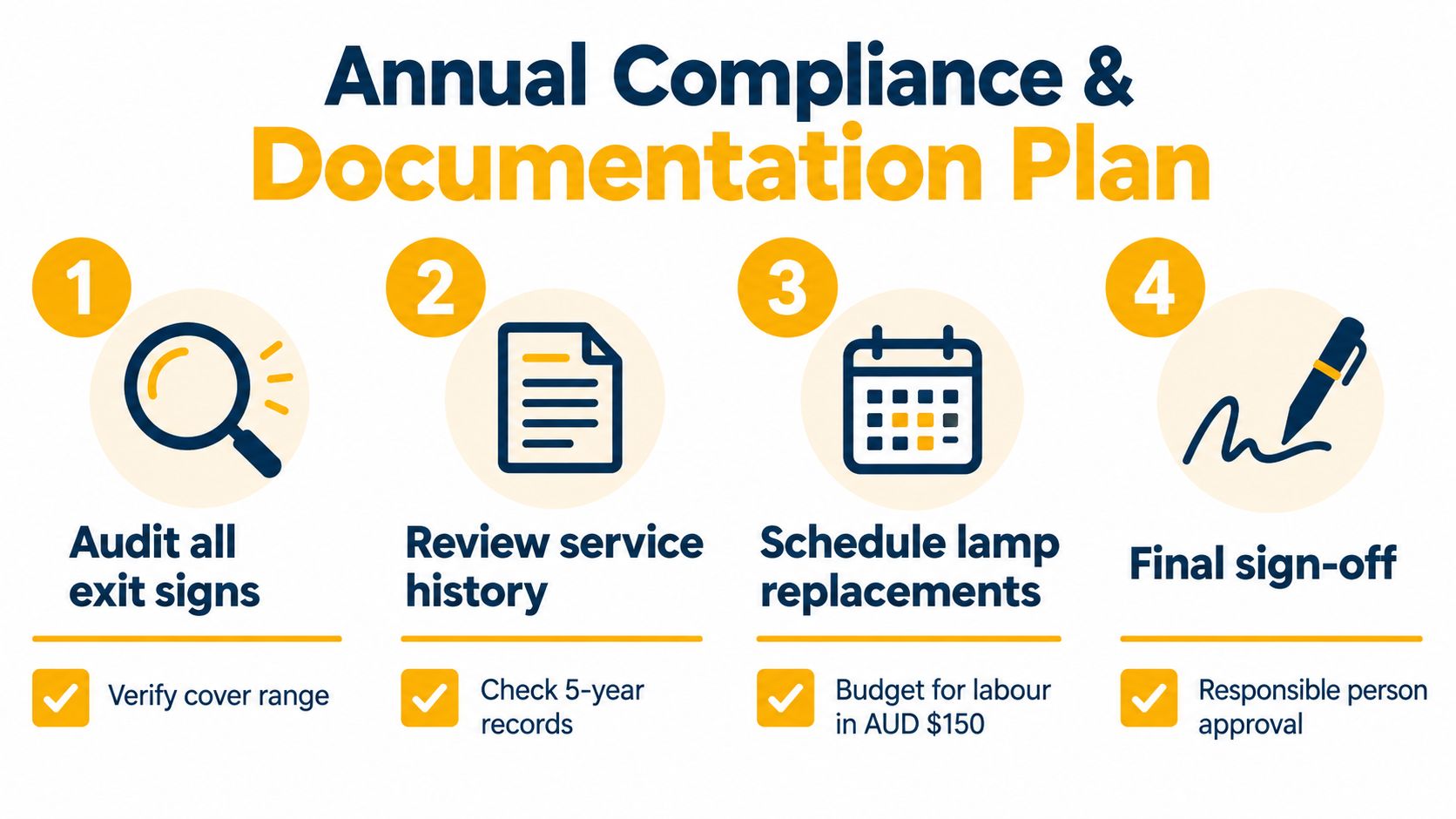
Build one annual control that connects those records. Schedule the six-monthly discharge tests, allow time for recharge and repairs, and maintain a current register that a new contractor can understand without starting from scratch.
The register should answer five questions
- Which premises and areas were covered? Record the site identity, building areas and relevant floor plans.
- Which fittings were tested? Use individual identifiers for emergency luminaires and exit signs.
- When and how was each fitting tested? Include the test date, start time, duration and result.
- What failed? Describe early extinction, reduced output, non-operation, damage or route obstruction.
- What happened next? Record the corrective action, responsible person, completion status and verification result.
Make the plan survive contractor changes
Keep the records in the onsite Fire Safety Management Plan, as Queensland guidance requires maintenance results to be recorded there. Retain battery replacement history, defect close-out evidence, fitting locations and the applicable building documentation so the next contractor, owner or auditor can trace the system's history.
A useful register isn't necessarily complicated. A spreadsheet or digital maintenance platform works if it links each fitting to a location and preserves the original result, repair record and retest. A polished report with no fitting identifiers is less useful than a simple register that shows exactly which unit failed and whether it was verified afterwards.
Use a preventive maintenance plan to coordinate emergency lighting with other site obligations, but keep the AS/NZS 2293.2 regime visible as its own task stream. Before approving a contractor invoice, check that the report contains the premises, date, fitting coverage, duration, tester details, failures and corrective action.
Recordkeeping test: If another competent technician couldn't locate the fitting, understand its last result and confirm the defect close-out, the record isn't complete enough.
Protecting Your Business with Proven Safety Standards
Emergency lighting earns its value during the few minutes when normal systems are unavailable. A reliable programme gives workers and visitors a visible evacuation route, while a traceable report gives the business a defensible maintenance history.
The strongest arrangements combine four controls: correct system design, six-monthly endurance testing, appropriately licensed technicians and fitting-level documentation. They also account for the building's approval history and current illumination obligations instead of treating a test sticker as the whole answer.
For a business in North Brisbane, Moreton Bay or the wider South East Queensland region, the practical priority is to know what is installed and what the last test proved. That means checking emergency luminaires and exit signs, reviewing defects, confirming authorisation and keeping the Fire Safety Management Plan current.
A contractor can supply a report, but the facility manager still owns the decision to address failures and retain the evidence. When the programme links testing, repairs and records, it reduces audit uncertainty and gives occupants a system that is more likely to perform when the mains supply fails.
Celtic Fire & Security provides emergency and exit lighting testing, maintenance and compliance reporting for commercial premises, with documented records covering test operation, battery performance, illumination and exit visibility. Visit Celtic Fire & Security to arrange a site review and build a testing programme suited to your Queensland property.
No responses yet