
You've been asked to buy fire extinguishers for a new fit-out, or an inspection has found the ones on site aren't suitable. The quick option is to order a few red cylinders and get them off the list. The better option is to match equipment to the actual hazards, install it where people can reach it, and have a service plan before the order goes in.
On a QLD site, the purchase is only one part of the job. The extinguisher, its location, its markings and its maintenance records all need to make sense together. That's what makes it a working safety control rather than a cylinder that happens to be on the wall.
Table of Contents
- Why the Right Extinguisher Matters on a QLD Site
- Australian Fire Classes and the Agents That Match Them
- Sizing, Placement and the QLD Minimums You Should Plan Around
- Comparing the Common Extinguisher Agents
- Lithium-Ion Risks Most Buying Guides Miss
- Servicing, Records and the AS 1851 Maintenance Cycle
- Buying from a Licensed Local Provider in South East Queensland
Why the Right Extinguisher Matters on a QLD Site
A bakery owner might order a general-purpose extinguisher for the kitchen, only to find it's not suitable for the cooking-oil risk. A warehouse manager might install a unit beside a switchboard, but discover during a site review that its agent doesn't suit the likely fire or that it's blocked by stored stock. The cost isn't just replacing equipment. It can mean rework, disrupted operations and an unresolved safety issue.
That's why I tell business owners to treat a fire extinguisher as a documented control, not a catalogue purchase. You need to know what hazard the unit is intended to address, why its rating and agent were selected, where it belongs and who will keep it serviceable.
Australian office-fire evidence shows why the right portable extinguisher matters for first response. A government review of 2,355 office fires recorded between 1998 and 2004 found portable extinguishers were used in 11% of incidents, compared with 5% for hose reels. Occupants were four times more likely to successfully extinguish an office fire with a portable extinguisher than with a hose reel, according to the Australian Government review of office fire hose reel requirements.
That evidence is about response to small fires, not permission to stay and fight a dangerous one. Evacuate if conditions are unsafe. Only attempt to use an extinguisher when the fire is appropriate to the equipment, you're trained, and you have a clear way out.
Think beyond the cylinder
A commercial buyer should budget for installation, visible signage, commissioning details and scheduled servicing, not just the purchase price. Australian workplace guidance says extinguisher selection must reflect the risks present, with requirements covering installation, number, location and type. Product design and markings are addressed by AS/NZS 1841.1:2007, while routine servicing is covered by AS 1851.
For a QLD business, that means checking the Australian fire classes, applying AS 2444 to selection and placement, and planning for AS 1851 servicing. Those decisions determine whether the extinguisher is fit for the site and ready when someone needs it.
Australian Fire Classes and the Agents That Match Them
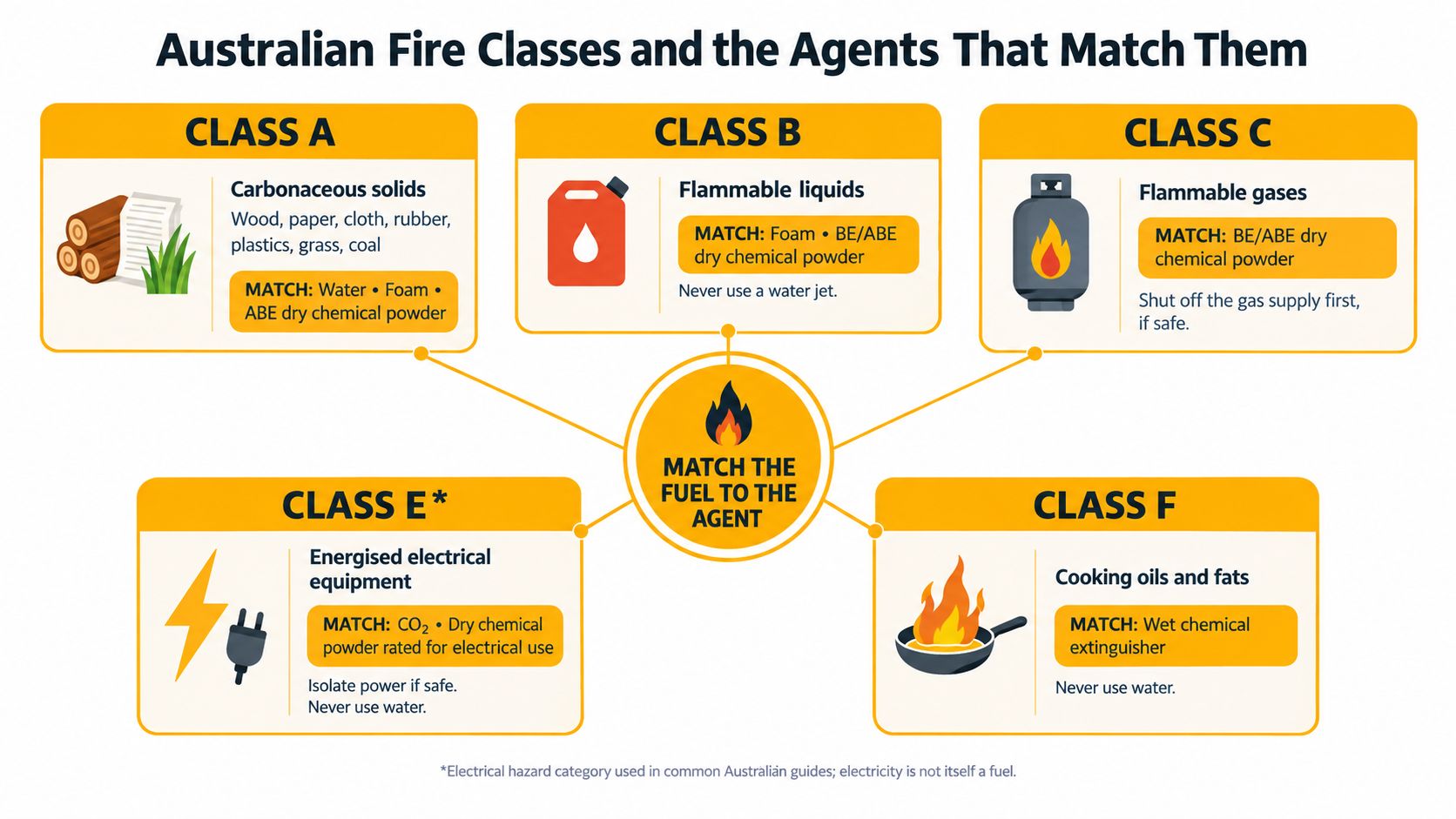
Start with the fuel, not the extinguisher colour or the word “electrical” in a supplier's description. Queensland Fire Department identifies the Australian fire classes by the material burning. Electricity isn't an Australian fire class because it's an ignition or shock hazard, not the fuel itself.
Match the agent to the fuel
- Class A covers carbonaceous solids such as wood, paper, cloth, rubber, plastics, grass and coal. Water-based extinguishers are generally intended for these ordinary combustibles. Foam may suit selected Class A risks when the site also has a compatible Class B hazard.
- Class B covers flammable and combustible liquids, including petrol, kerosene, oil, tar, paint and wax. Foam or dry chemical powder may be suitable, depending on the specific risk and extinguisher rating.
- Class C covers combustible gases such as LPG, butane, propane, LNG and acetylene. Don't treat the extinguisher as a substitute for isolating the gas supply where that can be done safely.
- Class D covers combustible metals, including sodium, potassium, magnesium and aluminium shavings. This is a specialist hazard. Don't assume a general-purpose unit is suitable.
- Class F covers cooking oils and fats. A commercial kitchen with deep fryers needs equipment selected for that hazard, commonly a wet chemical extinguisher.
For electrical equipment, identify what's burning and account for shock risk. ABE dry chemical powder is commonly used where ordinary combustibles, flammable liquids or energised electrical equipment may be involved. Carbon dioxide is often selected for electrical and some flammable-liquid risks. Never use a conductive water stream on energised equipment.
For a fuller explanation of the Australian options, see this guide to fire extinguisher types in Australia. Use it as a starting point, then have the actual site risks and layout assessed before ordering.
Sizing, Placement and the QLD Minimums You Should Plan Around
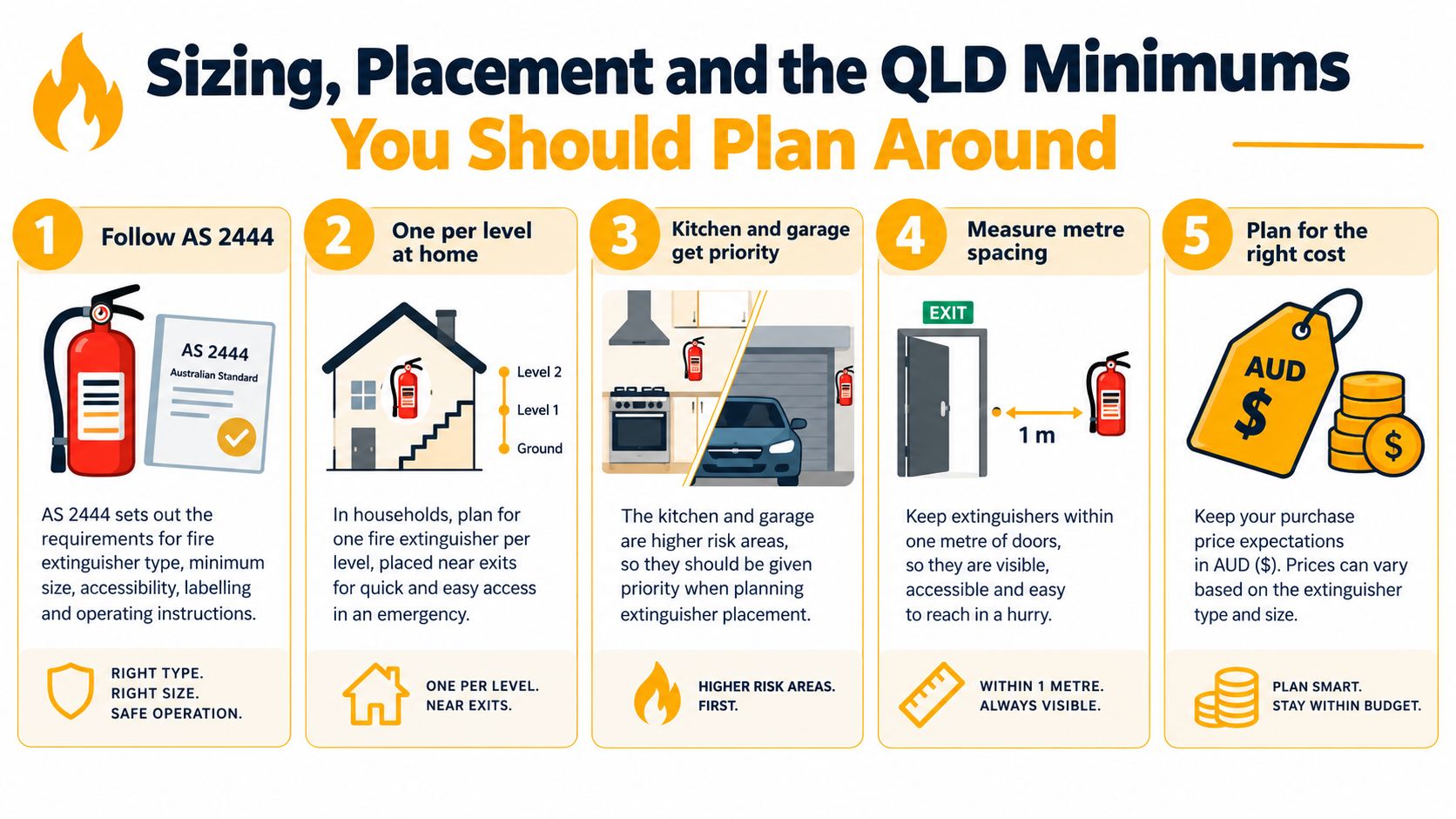
A suitable agent in the wrong place is still a poor purchase. AS 2444 deals with extinguisher type, minimum size, placement, accessibility, labelling and operating instructions. The unit needs to be appropriate for the hazard and reachable along a normal travel path, especially near exits.
Queensland guidance says extinguishers or their location signs should be visible from up to 20 metres in all directions of approach. Keep units clear of stock and equipment, protect them from deterioration such as corrosion, and make sure a person approaching the hazard can identify the extinguisher without searching through a room.
Check the site-specific requirements
QLD requirements can be more specific than a general site plan. At a service station, the dispensing area must have at least two 9 kg ABE dry chemical powder extinguishers, positioned so they're clearly visible in the direction of approach. That requirement comes from the Queensland service station operators checklist. A smaller household unit stored in an office won't meet that stated minimum.
Storage and transfer of liquids also affect the purchase. At non-residential and non-farm premises, Queensland guidance calls for a suitable portable extinguisher readily accessible and adjacent to a minor storage area when more than 100 litres of flammable liquids or more than 1,000 litres of combustible liquids are stored, or when flammable liquids are decanted. If liquids are stored in the open and decanted or transferred within 5 metres of the storage, an extinguisher must also be provided. Check the Queensland guide to flammable and combustible liquids against your actual storage arrangement.
Before you request a quote, write down the fuels, storage locations, any decanting points, access routes and likely mounting positions. Then ask the supplier to specify the extinguisher type, rating, size, signage and installation location against that list. For practical placement considerations, consult this guide to fire extinguisher installation, then confirm the plan for your premises under AS 2444.
Comparing the Common Extinguisher Agents
A price list won't tell you whether an agent suits your fuel, creates a cleanup problem or could expose someone to electrical danger. Compare the options by hazard fit first, then consider residue, access and ongoing maintenance. The right mix for a workshop is unlikely to be the right mix for a kitchen.
| Agent | Best Fit Classes | Electrical Safe | Residue / Cleanup | Typical QLD Site |
|---|---|---|---|---|
| Water | Class A | No, not on energised equipment | Wet cleanup; can damage stock and equipment | Office or storage area with ordinary combustibles and no electrical exposure at the fire |
| Foam | Selected Class A and B risks | Depends on product and conditions; don't assume it's suitable for energised equipment | Wet residue and cleanup | Premises with compatible solid-material and flammable-liquid hazards |
| Dry chemical powder, ABE or BE | ABE suits a mix including Class A, B and electrical-risk applications; BE suits selected B risks | Commonly chosen for electrical-risk applications, subject to product instructions | Powder can spread and require extensive cleanup | Automotive workshop or fuel-dispensing area |
| Carbon dioxide | Electrical and some Class B risks | Commonly selected for electrical risks | Little residue, but may not control every surrounding fuel | Plant area or equipment room |
| Wet chemical | Class F | Follow product instructions and isolate electrical hazards | Wet cleanup | Commercial kitchen with cooking oils and deep fryers |
Consider what happens after discharge
Dry chemical powder can be a sensible choice in a workshop with mixed hazards, but it can coat machinery, stock and equipment. That cleanup can extend downtime even if the fire is controlled. Carbon dioxide leaves little residue, but it isn't a universal replacement for an agent suited to the fuel.
Water is straightforward for suitable Class A risks and a poor choice around energised equipment. Wet chemical is a better fit for cooking oils and fats, so a kitchen shouldn't be equipped on the assumption that a general-purpose powder extinguisher covers every hazard.
Trade-off to price in: The cheapest cylinder may cost less at purchase and more in disruption if it's the wrong agent for the room. Ask what the agent can safely control, what it leaves behind and whether staff can use it without losing their escape route.
Lithium-Ion Risks Most Buying Guides Miss
A lithium-ion battery incident isn't just an ordinary electrical fire. Batteries can enter thermal runaway, and a damaged battery can reignite. A bigger portable extinguisher doesn't remove the need to isolate the hazard, cool it appropriately, evacuate when necessary and involve emergency responders.
This risk can turn up in an e-bike or e-scooter charging area, a warehouse storing battery stock, a hospitality venue with battery-powered equipment, an office with UPS cabinets or a waste-handling area. Queensland Fire and Emergency Services has issued a dedicated lithium-ion incident snapshot, and Fire and Rescue NSW has reported battery-related incidents in the state. The point for a Queensland buyer isn't to treat every battery as an emergency. It's to stop assuming that a standard electrical-risk extinguisher is a complete battery-fire plan.
Build the response around the battery risk
Start by identifying what batteries are on site, how many are present, where they're charged or stored, and whether damaged units can be separated. Then decide how staff will recognise a problem, who can isolate equipment safely, where people should evacuate, and when they must call emergency services. Don't put an extinguisher so close to a charging area that someone has to approach a dangerous battery to reach it.
The extinguisher still matters for surrounding combustibles or an early-stage incident where trained staff can act safely. It doesn't make a large, damaged or actively venting battery safe to tackle. Put detection, separation, staff instructions and emergency escalation in the purchase and site plan, rather than treating the cylinder as the whole answer.
The following video offers another visual introduction to the battery-fire issue. Use it as general context, not as a substitute for site-specific emergency procedures.
Servicing, Records and the AS 1851 Maintenance Cycle
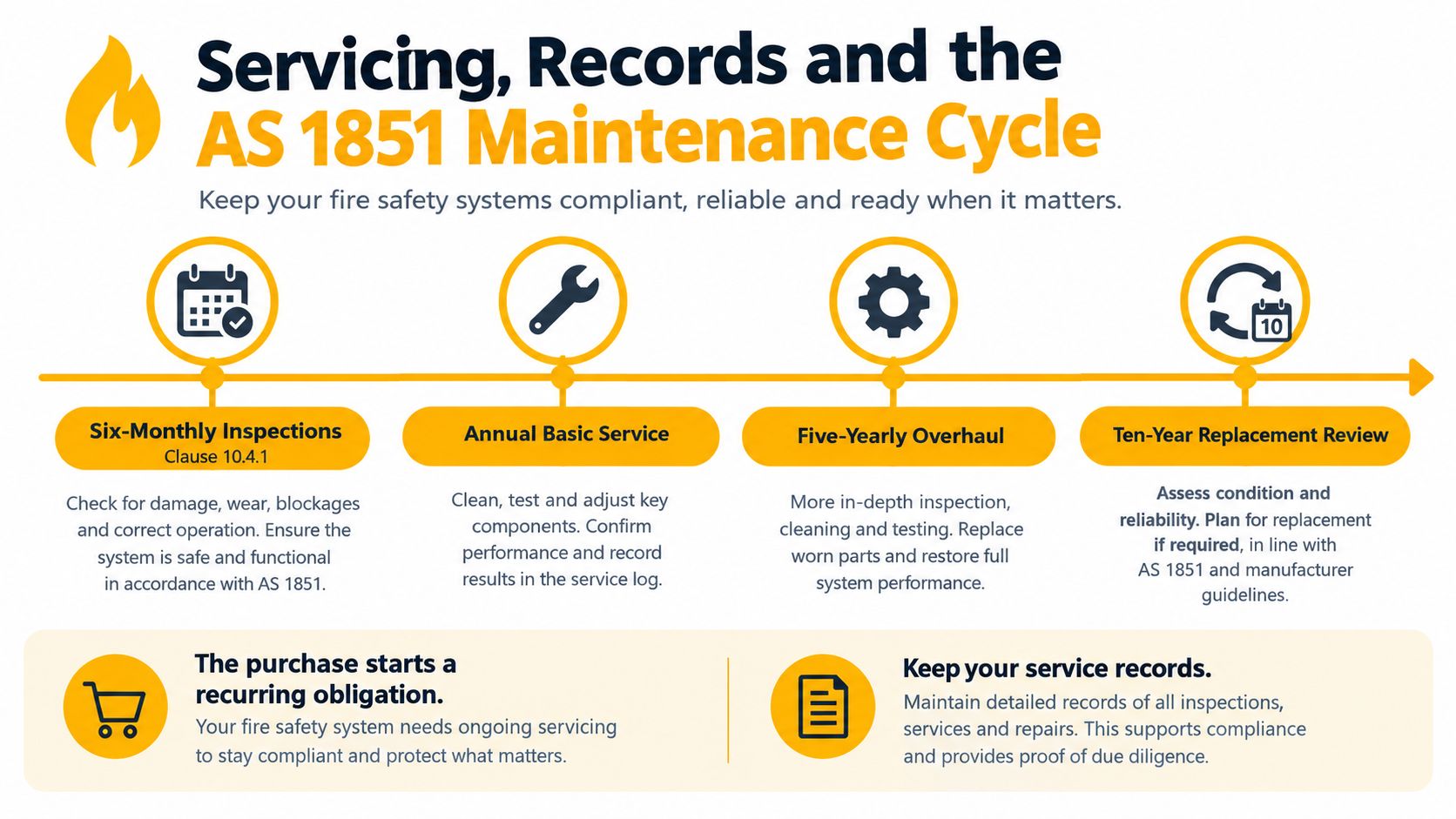
Buying a compliant extinguisher doesn't keep it compliant on its own. AS 1851-2012 sets a recurring service framework for fire-protection systems and equipment, including portable extinguishers. The purchase order should name who will inspect the units, how service records will be kept and how the business will handle defects.
Queensland guidance requires prescribed extinguishers to be maintained by an appropriately qualified person. Keep the service documentation with the site's fire-safety records, not in an email thread that disappears when staff change.
Put the intervals in the asset register
Under AS 1851, the routine framework includes six-monthly, yearly and five-yearly service intervals. Clause 10.4.1 specifies six-monthly routine servicing for fire extinguishers. The required work depends on the interval and equipment, so use a qualified service provider rather than treating a visual glance as a completed service.
At each service, make sure the business can identify which extinguisher was checked, when the work occurred and what action was taken if a defect was found. Keep a record of scheduled servicing and resolve defects promptly. A unit that's missing, inaccessible, damaged or unsuitable doesn't provide a dependable first-response control, even if its label looks current.
Practical rule: Put every extinguisher on the site asset register, record its location and service history, and assign someone to follow up overdue work.
For an overview of the relevant Australian maintenance requirements, see this guide to fire extinguisher testing requirements in Australia. Make servicing part of the procurement decision. A supply-only purchase without an ongoing inspection arrangement can leave the business with equipment that's present but not ready.
Buying from a Licensed Local Provider in South East Queensland
Send a supplier a proper hazard profile, not a request for “some commercial extinguishers”. Include the fuels and chemicals stored on site, battery charging or storage areas, cooking hazards, electrical equipment, likely extinguisher locations and any existing service records. Ask the supplier to identify the proposed extinguisher type, rating and size, plus mounting, signage, commissioning details and the ongoing maintenance arrangement.
Check that supplied portable extinguishers meet AS/NZS 1841.1:2007 and have the appropriate markings and documentation. Confirm who will install and service them, and that the work falls within the provider's applicable Queensland licences. For building-related fire-safety work, that may include QBCC licence 1183612; electrical work involving fixed wiring or interconnected alarms requires the relevant electrical licence. Where security systems overlap with the job, check the appropriate security provider licensing as well.
A local provider can also coordinate servicing across multiple sites, which is useful when one business operates in North Brisbane, Moreton Bay, the Sunshine Coast, Somerset or Ipswich. Celtic Fire & Security supplies, installs, tests and maintains commercial fire extinguishers and other fire-protection systems across those South East Queensland regions.
Before you approve the order, confirm that the quote includes:
- Hazard matching: Each extinguisher is selected for the actual fuel and site risk.
- Placement: The proposed mounting positions and signs follow the site layout and AS 2444.
- Compliance details: The units carry appropriate AS/NZS 1841.1:2007 markings and come with commissioning documentation.
- Ongoing care: The service provider and record-keeping arrangement are clear before installation.
Ask Celtic Fire & Security to assess your site hazards, supply and install suitable commercial extinguishers, and set up documented servicing across South East Queensland. Get a site-specific recommendation before you order, so your equipment, placement and maintenance plan work together.
No responses yet