

You're finishing a fit-out in North Brisbane, or taking over a Sunshine Coast tenancy, and someone asks where the fire extinguishers are going. There's a clear patch of wall near reception, a bracket in the delivery box and pressure to get the premises open. Before anyone drills, check what the equipment needs to protect, how people will reach it and who will receive the installation records.
Table of Contents
- Why Queensland Extinguisher Installation Is More Than Mounting a Bracket
- Matching Extinguisher Class to the Real Hazards on Site
- Siting Extinguishers Along Escape Paths Under AS 2444
- Mounting Heights, Brackets and Signage in Millimetres and Metres
- Commissioning the Extinguisher So Auditors and Insurers Are Happy
- From Installation to Ongoing Compliance Under QDC MP 6.1
- When a Licensed Queensland Installer Is the Right Call
Why Queensland Extinguisher Installation Is More Than Mounting a Bracket
A mounted extinguisher isn't a completed fire-safety installation. The useful handover is a matched piece of equipment, in a justified location, securely installed and supported by records that someone in the business can maintain.
The physical equipment is only part of that outcome.

Start with an installation scope
When you arrange to install fire extinguishers, ask the contractor to explain the proposed coverage before quoting brackets and cylinders. A useful scope connects the equipment schedule to the actual tenancy, not just the building's address.
- Hazard assessment: Identify what could burn and which equipment is suitable.
- Location plan: Show where occupants can reach each unit without entering the hazard.
- Physical installation: Confirm mounting, identification and access.
- Acceptance and handover: Record the installed assets, inspection outcome and servicing responsibilities.
There's good reason to take selection and location seriously. An Australian regulatory assessment of portable extinguishers concluded that properly selected and located extinguishers could provide equivalent or higher occupant life-safety performance than hose reels in the building contexts examined. That's not permission to replace existing equipment without assessment.
Practical rule: Buy an installation outcome, not simply a cylinder attached to a wall.
For a facilities manager, the acceptance question is straightforward: can the installer justify what's been provided and leave enough information for the next person to manage it? A neat bracket won't answer that question. A documented equipment schedule, installation check and assigned follow-up responsibility will.
Matching Extinguisher Class to the Real Hazards on Site
Start with the fuel, not the extinguisher colour band. An office kitchen, solvent storage cupboard and server room don't become equivalent hazards because they share a tenancy.
The selection process starts with a room-by-room assessment.
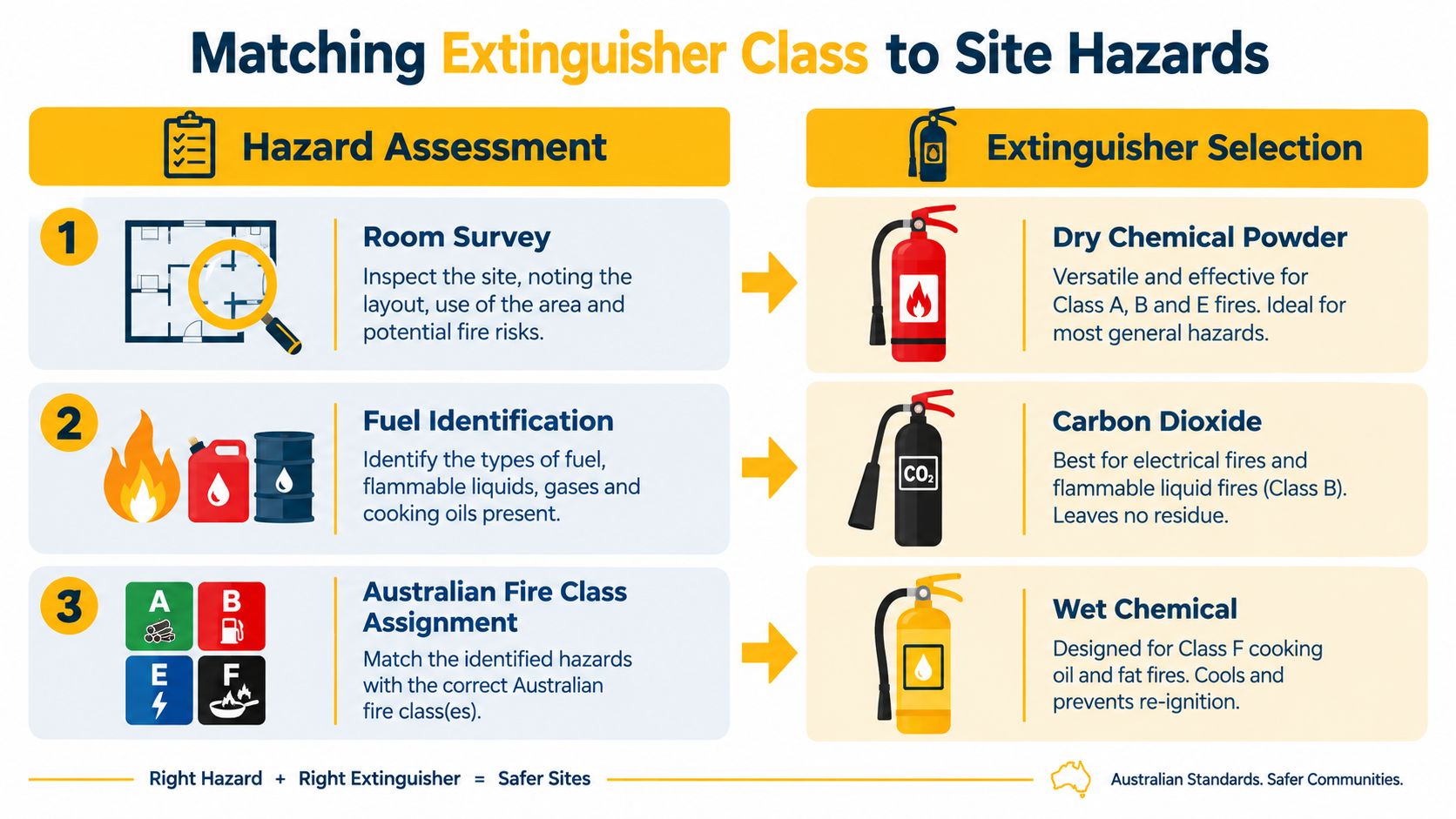
Survey the work, not just the floor plan
Walk through rooms, storage areas, work processes and access routes. Ask what staff use and store, including materials brought out only during cleaning, maintenance or production.
Then assign the relevant Australian fire classification and select an extinguisher with a suitable agent and rating. AS 2444 selection and location guidance connects equipment selection to fire classification, rating and the potential hazard, including:
- Class A: Ordinary combustibles.
- Class B: Flammable liquids.
- Class E: Energised electrical equipment.
- Class F: Cooking oils and fats.
Don't stop the survey at those categories. Flammable gases and combustible metals also need to be identified and assessed rather than assumed to be covered by a general-purpose unit.
ABE dry chemical powder, carbon dioxide, wet chemical and water extinguishers are different tools. Their suitability needs to be checked against the actual classification and rating on the equipment. The comparison of Australian fire extinguisher types is useful when reviewing a proposed equipment schedule.
Work through the kitchen and office separately
Consider a small commercial kitchen using cooking oils. A suitably rated Class F wet chemical extinguisher is the relevant selection to assess for that cooking hazard. Its location belongs at the kitchen entrance rather than beside the appliance, with final siting checked by the installer.
An adjoining office presents a different selection problem. Paper and packaging introduce ordinary combustible hazards, while a server room requires assessment of energised electrical equipment. A suitably rated Class E carbon dioxide extinguisher is an appropriate option to assess for that electrical hazard, but that doesn't automatically resolve protection for every combustible material in the room.
These are worked selection examples, not a substitute for inspecting the premises. Ask the contractor to write down the hazard each proposed extinguisher addresses and explain any limitations.
The following video provides a visual companion to the equipment discussion.
One extinguisher for everything isn't a sound purchasing rule. A multi-class unit may suit several identified hazards, but its suitability must be demonstrated rather than inferred from the word “multipurpose”.
Siting Extinguishers Along Escape Paths Under AS 2444
Mark proposed positions on a floor plan before drilling. Moving a pencil mark is simpler than relocating a mounted unit, repairing the wall and updating the equipment register.
Location matters in real incidents. A national database recorded 2,355 office fires between 1998 and 2004, with extinguishers used in 11% of incidents compared with 5% for hose reels, according to the ARUP assessment of fire protection in office buildings. Those historical figures support treating accessibility as an operational concern, not just a drawing annotation.
The siting review should follow the routes people use.
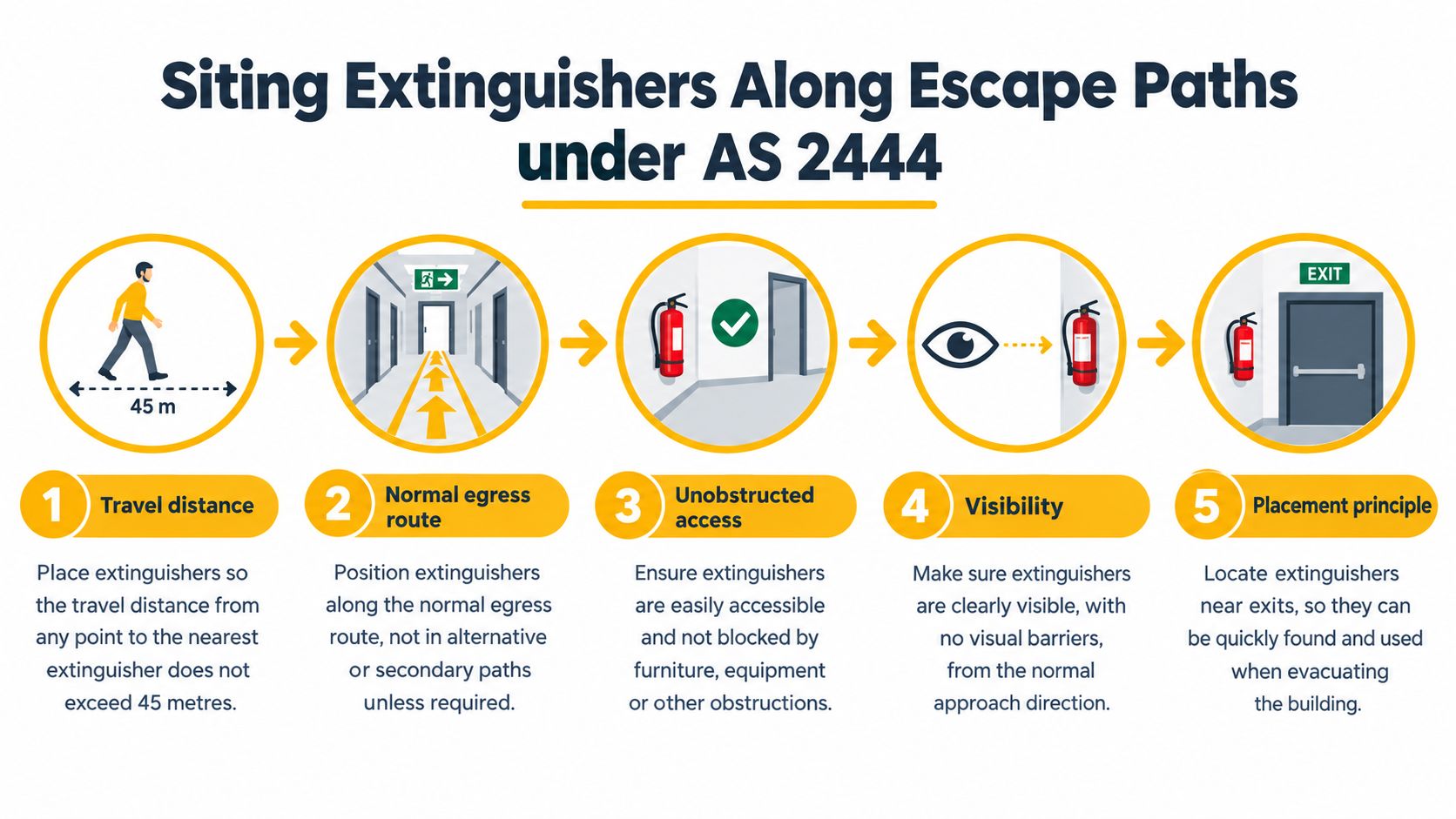
Read the plan as an occupant would
Put the hazard locations, doors, partitions, storage racks and normal access routes on the same plan. Then have the installer assess distribution and applicable travel distances against AS 2444.
Don't measure a straight line through a wall or across shelving. The useful check is the route a person can walk. A position that looks central on paper may be awkward to reach once furniture, stock and access restrictions are considered.
- Trace the walking route: Include doors, counters, corridors and other permanent obstacles.
- Check normal access: Assess the premises as staff operate it, not as an empty shell.
- Keep the approach clear: Don't nominate a position that depends on moving deliveries first.
- Review changed layouts: Ask for reassessment when partitions, processes or storage arrangements change.
Avoid applying a single remembered distance to every extinguisher. The installer needs to check the relevant hazard, equipment rating and distribution requirements rather than use a generic spacing rule.
Keep access on the safe side of the hazard
The kitchen entrance example illustrates the distinction between being near a hazard and being trapped within it. The intended user shouldn't have to pass the fire to retrieve the extinguisher.
A convenient storage position isn't necessarily a usable emergency position.
Apply the same reasoning to an Ipswich workshop or Moreton Bay warehouse. A unit behind a normally open door, inside a restricted work area or beyond stacked pallets may be close to the hazard but poorly accessible.
Before approving the plan, walk every proposed approach with the contractor. Look from the corridor, doorway and workstation, not just from directly in front of the nominated wall. Ask what happens when the premises are fully occupied and stock is at its normal level.
Mounting Heights, Brackets and Signage in Millimetres and Metres
Don't approve mounting dimensions from an uncited internet diagram. The applicable installation requirements, equipment instructions and site conditions need to be checked together.
The distinction between standards matters here. AS 2444 addresses selection and location; QDC MP 6.1 provides Queensland's maintenance framework. Treating the latter as a standalone bracket-height specification confuses installation detailing with ongoing maintenance obligations.
Use a verified mounting schedule
The references cited here don't establish a defensible universal handle-height range for light and heavy extinguishers. Rather than invent millimetre figures, require the installer to enter the applicable dimensions and their basis in the installation schedule.
Australian mounting reference for portable extinguishers
| Extinguisher class / type | Approx. handle height (mm) | Signage bottom edge above floor (m) | Notes |
|---|---|---|---|
| ABE dry chemical powder | Installer to verify and document | Confirm applicable Queensland detail | Match mounting arrangement to selected unit and supporting surface |
| Class E carbon dioxide | Installer to verify and document | Confirm applicable Queensland detail | Check equipment-specific mounting and handling requirements |
| Class F wet chemical | Installer to verify and document | Confirm applicable Queensland detail | Coordinate mounting with the approved kitchen approach |
| Class A water | Installer to verify and document | Confirm applicable Queensland detail | Confirm hazard suitability before approving the mounting location |
This is a verification table, not evidence of compliance by appearance. Don't divide units into arbitrary weight bands or assume identical brackets are suitable for every cylinder.
For an Australian signage comparison, CFA's workplace extinguisher guidance specifies signs visible from up to 20 m in all directions and positioned at least 2 m above floor level. That's a Victorian benchmark, not a substitute for confirming Queensland requirements or evidence that the same dimension necessarily refers to a sign's bottom edge.
Check the mounting as a complete assembly
The installer should consider the extinguisher, bracket, fixings and supporting surface together. Ask how the selected arrangement suits the unit and whether occupants can remove and return it without awkward handling.
- Bracket compatibility: Confirm the bracket suits the supplied extinguisher.
- Support and fixings: Have the installer verify the mounting surface and fixing arrangement.
- Physical access: Check that nearby doors, furniture or protective enclosures don't obstruct removal.
- Sign visibility: Assess the sign from each normal approach after the fit-out is complete.
A cabinet can be useful where the site requires protection for the equipment, but it introduces another access detail to assess. Review fire extinguisher and cabinet arrangements before ordering an enclosure that makes the unit harder to identify or retrieve.
Ask for the final mounting dimensions in writing. A visual walkthrough can reveal obvious problems, but it can't replace verification against the applicable installation requirements.
Commissioning the Extinguisher So Auditors and Insurers Are Happy
Commissioning is the point where the contractor demonstrates that the installation matches the agreed design and records what was handed over. It shouldn't consist of attaching a service label and leaving an invoice.
Use the equipment inspection as an acceptance checklist.
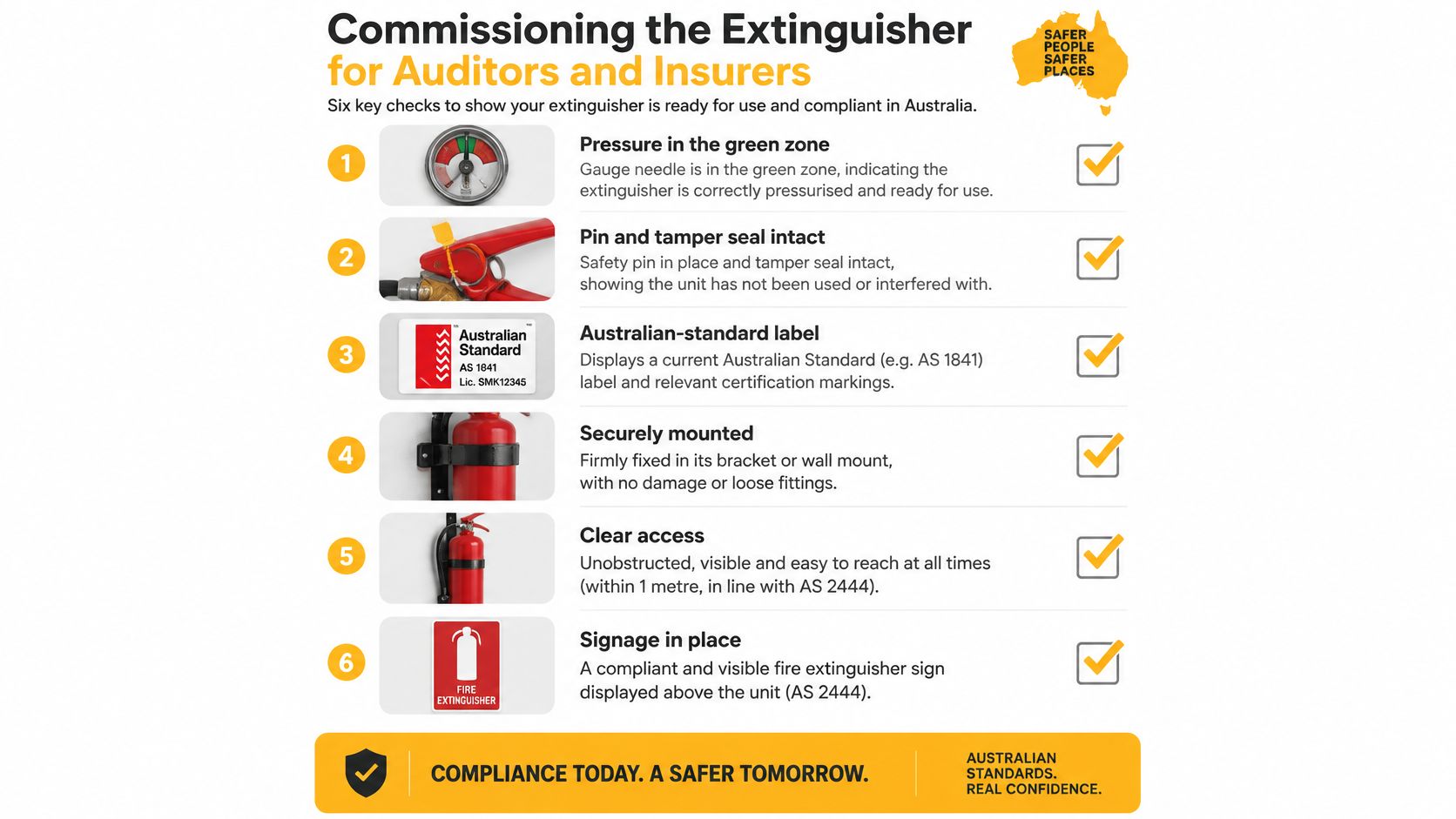
Inspect the installed asset
Ask the appropriately qualified person to check the unit in its final location, rather than inspect it on the floor before mounting.
- Identity and suitability: Match the installed type, classification and rating to the approved equipment schedule.
- Condition: Examine the extinguisher and check the pressure or indicator condition where applicable.
- Pin and seal: Confirm they're present and intact.
- Labels: Check that operating information is legible and the equipment can be identified.
- Mounting and retrieval: Verify secure support and usable access.
- Location identification: Confirm the installed sign remains visible from the intended approaches.
Don't apply a gauge-based check to equipment without a gauge. The acceptance record should reflect the actual extinguisher and the inspection method applicable to it.
Receive records that can be traced
Queensland's fire-safety installation guidance requires prescribed installations in applicable buildings to be maintained, inspected and supported by records. Build that record trail when the asset enters service, not when someone later requests evidence.
The handover pack should contain the installation or commissioning documentation applicable to the work, an asset register, the equipment locations, inspection results and outstanding actions. Each register entry should identify the asset, its type, classification, position and service history.
Handover test: Someone who didn't attend the installation should be able to identify each asset and understand its recorded status.
Request correction of missing or ambiguous records before accepting the job as complete. A cylinder described only as “extinguisher near office” is difficult to trace if the tenancy later changes.
For an insurer, confirm any policy-specific documentation requirements directly. No contractor can responsibly promise that a neat installation or commissioning certificate guarantees claim acceptance. The practical objective is a verifiable installation record, not an unsupported assurance that every reviewer will be satisfied.
From Installation to Ongoing Compliance Under QDC MP 6.1
The handover needs a named recipient with authority to arrange servicing and approve repairs. In a multi-tenant property, sending the paperwork to a general reception inbox doesn't establish who will act on it.
For Class 1b and Class 2–9 buildings, Queensland's fire-safety maintenance advisory notes describe the qualified-person maintenance framework, applicable six-monthly, yearly and five-yearly activities, the annual occupier's statement and two-year maintenance-record retention. They also explain that a tag, invoice or summary report alone isn't an acceptable maintenance record and that defect rectification needs supporting evidence.
Allocate the work before the installer leaves
A practical responsibility schedule should identify the people handling these tasks:
- Landlord or strata contact: Coordinate shared-building assets and access arrangements where these fall within their management role.
- Tenant contact: Manage access and report changes or obstructions within the tenancy.
- Facilities manager: Track service appointments, inspection reports and defect closure.
- Statement coordinator: Gather the records required for the occupier's statement.
These are proposed management arrangements, not a declaration that every lease allocates duties identically. Confirm the building's actual responsibilities rather than assuming the landlord handles everything.
Under the Queensland building fire-safety provisions cited for occupier duties, identified repairs or corrective action generally must be completed within one month, unless the occupier has a reasonable excuse. Record the action taken and retain evidence of completion.
Use a site-specific maintenance schedule rather than treating every service visit as interchangeable. The guide to Queensland fire extinguisher testing requirements can help frame the discussion with your maintenance provider.
When a Licensed Queensland Installer Is the Right Call
“Anyone can attach a bracket” isn't a sufficient basis for appointing a commercial installer. The job includes assessing provision, selecting equipment, confirming location and documenting the completed work.
Queensland guidance on application of the fire-safety standard states that, for the buildings covered, where assessed floor area exceeds 300 m² and extinguishers aren't already provided, they must be installed by a QBSA-licensed contractor to AS 2444. It identifies the work as self-assessable, meaning a council building permit isn't required under that guidance, not that compliance is optional.
Check the scope: Self-assessable work still needs the right contractor and installation outcome.
The document uses the historical QBSA terminology. Check the contractor's current QBCC licence scope for the proposed fire-protection work; security-provider and electrical licences relate to different work and don't replace that check. A straightforward replacement still warrants confirmation that the existing provision remains suitable.
Celtic Fire & Security supplies, installs, tests and maintains commercial fire extinguishers across North Brisbane, Moreton Bay, the Sunshine Coast, Somerset and Ipswich. Visit Celtic Fire & Security to discuss a site assessment, installation and documented handover, together with a maintenance plan for the equipment after commissioning.
No responses yet