
The chirp usually starts at the worst possible time. In a North Brisbane office, it might be the alarm above the reception desk interrupting a morning briefing, or a ceiling unit in a tenancy corridor waking staff before the first shift. The instinct is to remove the battery or twist the detector off the base, but that can leave the building without compliant fire detection.
A hard-wired alarm still has a backup power source, so connection to 240 V mains power doesn't rule out a low battery, an ageing alarm, or a fault in the interconnected circuit. Queensland homes must use photoelectric, interconnected smoke alarms, and the Queensland Fire Department's smoke alarm guidance explains that activation of one alarm should sound the others.
Table of Contents
- What the Chirp Is Telling You
- Starting With the Backup Battery
- Recognising End-of-Life Warnings
- Wiring and Interconnected System Checks
- When to Call a Licensed Technician
- Getting Back to Quiet and Staying Compliant
What the Chirp Is Telling You
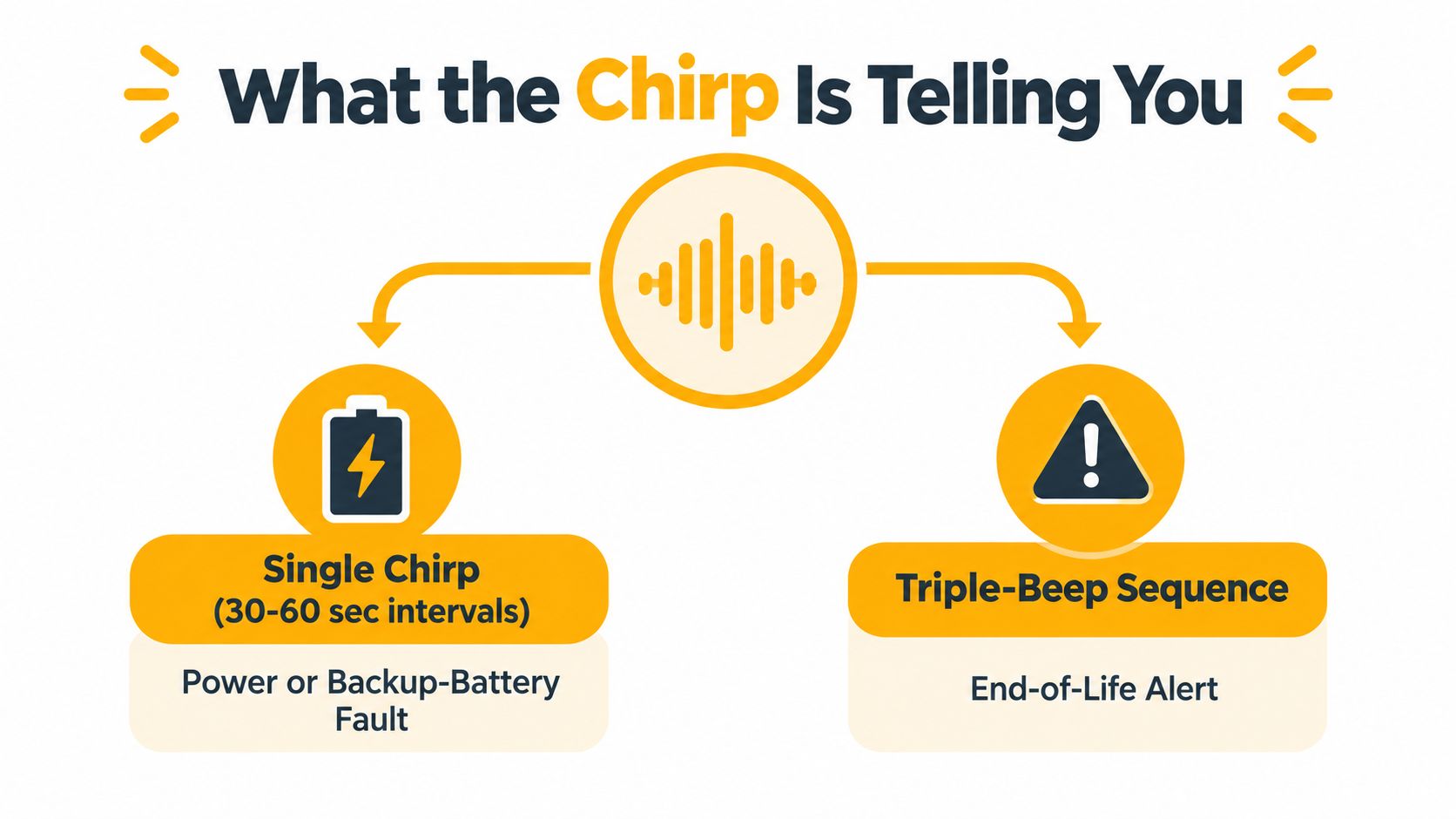
A chirp at regular intervals is a fault indication, not background noise. In Australian installations, one sharp chirp every 30 to 60 seconds commonly points to a weak backup battery or an ageing alarm, according to Australian hard-wired smoke alarm troubleshooting guidance. A continuous alarm tone requires a different response. If smoke or heat may be present, evacuate, call for help, and investigate only from a safe location. Do not silence a genuine alarm before everyone is safe.
Start by counting the interval, then record three checks:
- The pattern: A regular single chirp usually relates to power, the backup battery, or alarm age. Other sequences can identify a sensor fault or end-of-life warning specific to the model, so follow the manufacturer's instructions.
- The date: Find the manufacture date or code on the housing. Compare it with the 10-year replacement benchmark covered in the next section rather than treating a new battery as a complete fix.
- The indicator light: Check the green mains LED against the manufacturer's stated behaviour. An absent or abnormal light can indicate interrupted supply or a wiring fault.
In a North Brisbane office, record the alarm location, sound pattern, date code, and LED condition on the defect list. That information helps a licensed electrician isolate the problem and gives a facilities manager useful evidence for a Queensland compliance or insurer inspection.
Practical rule: Leave the chirping alarm on the defect list until the cause is identified, the warning function is restored, and the installation remains compliant.
Use this order for diagnosis: backup battery, end-of-life, a wiring fault affecting one head, then an interconnected-loop fault. The first checks are accessible maintenance. The later checks may involve fixed wiring and should be handled by a licensed electrician. For technology and placement context, see this guide to photoelectric smoke alarms.
Starting With the Backup Battery
On a hard-wired detector with a replaceable backup cell, the battery is the sensible first check. Queensland guidance allows alarms to be connected to mains power or supplied by a non-removable 10-year battery, and a mains-powered alarm can still chirp when its backup source is weak or the supply has been interrupted, as explained by Queensland electrical guidance on chirping alarms.
For a replaceable battery model, use a controlled process:
- Isolate the alarm circuit. At the switchboard, turn off the circuit breaker supplying the alarms. A wall switch doesn't provide the same isolation and usually isn't relevant to the alarm circuit.
- Remove the alarm head carefully. Twist the head counter-clockwise from its mounting plate. Leave the wiring pigtail attached. Don't pull on the cable or disturb terminals.
- Inspect the battery compartment. Remove the old cell and check the terminals for green corrosion, looseness, or damage. If light corrosion is present and the manufacturer permits cleaning, use a small amount of isopropyl alcohol on a cotton bud and allow the area to dry fully.
- Fit the specified cell. Use the exact chemistry and format stated on the detector label, such as a 9V alkaline or a sealed lithium cell where that is what the model requires. Don't substitute a different battery just because it fits.
- Refit and restore power. Reconnect the battery, twist the alarm back onto its plate until it locks, then restore the breaker. Confirm the green mains indication returns and use the test button according to the manufacturer's instructions.
A healthy battery replacement should give at least 12 months of quiet operation before another battery-related chirp, based on the Australian maintenance guidance referenced in this battery replacement article. If the sound returns inside two weeks, stop treating it as a routine battery change. The alarm may be beyond its service life, the battery connection may be defective, or the circuit may have another fault.
AS 3786:2014 remains the relevant Australian Standard reference for smoke alarms, but replacing a battery doesn't by itself prove Queensland compliance. The alarm still needs to be the correct photoelectric type, interconnected where required, correctly powered, and within its service life. In a commercial premises, record the work and retain the details for the site's maintenance file.
Recognising End-of-Life Warnings
On a North Brisbane office call-out, an alarm may keep chirping after its backup battery was replaced. A detector installed during a 2014 tenancy fit-out can still give one chirp every 30 to 60 seconds, with its red indicator pulsing. That pattern often points to the detector's internal end-of-life warning, rather than another flat battery.
Use the model's fault indicators to confirm the diagnosis. Some manufacturers print a date code in YYMM format on the rear label, while others use a month and year or a separate batch mark. Record the code and compare it with the model's stated service life. The 10-year replacement point remains relevant under Australian smoke alarm requirements, but the manufacture date, not the tenancy fit-out date, determines whether the head is aged. A later installation can contain an older alarm.
Compare the sound with the date
Photoelectric and ionisation alarms use different sensing arrangements, and warning tones vary between manufacturers. A multi-function head may use a repeating sequence for sensor failure or end-of-life, while another model uses a regular single chirp. The manual for the exact model is more dependable than a generic sound chart.
| Chirp Pattern | Likely Cause | Next Step |
|---|---|---|
| Single chirp every 30 to 60 seconds | Low backup battery or end-of-life | Check the battery, then assess the model's age and fault indicators |
| Repeating warning sequence | Model-specific sensor or end-of-life warning | Read the manufacturer's indicators and arrange assessment |
| Continuous alarm tone | Smoke or heat detected | Evacuate, call emergency services if required, and do not treat it as a maintenance chirp |
If the sound continues after a correctly fitted battery, replace the alarm rather than repeatedly resetting it. In Queensland dwellings, the owner, landlord, or relevant body corporate generally carries the replacement responsibility, not the tenant who reports the fault. For commercial premises, record the alarm's model, date code, fault pattern, and replacement decision in the maintenance file. That evidence supports building audits, insurer enquiries, and Queensland compliance checks.
Wiring and Interconnected System Checks
Interconnected alarms change the diagnosis. One head may chirp while another device, the shared supply, or an interconnect conductor causes the fault. Listen across the office first, then map the pattern by room, tenancy, and storey. This avoids randomly silencing alarms and helps identify a system-wide problem.
If every alarm chirps together, suspect a shared condition such as a mains interruption, interconnect fault, or several alarms reaching the same age. If only one head chirps, focus on that alarm, its battery, base, or local wiring. Record the affected locations for the maintenance file, particularly where a building audit or insurer review may follow.
What you can observe safely
Inspect each alarm without opening fixed wiring:
- Green LED behaviour: Compare the indicator with the model instructions. A normal mains indication supports the supply being present. An absent or abnormal light needs investigation.
- Switchboard status: Check whether the relevant breaker has tripped. Reset it only when there is no burning smell, visible damage, or continuing electrical fault.
- Alarm condition: Look for a loose head, damaged mounting plate, discolouration, or contamination around the unit.
- System response: Use the approved test function to confirm that interconnected alarms respond together. Do not disconnect one alarm to test the others.
On some hard-wired systems, the interconnect conductor is commonly identified by a white or orange wire, but colour alone is not proof. A loose terminal can leave one alarm operating locally while preventing the group from sounding together. You may inspect for a visibly loose connection only with the power isolated and without touching conductors. Live ceiling wiring, improvised continuity tests, and bypassing the interconnect are tasks for a licensed electrician.
Queensland requirements call for photoelectric interconnected alarms in homes that sound together when one activates, as explained in the official smoke alarm information. In an office, confirm the installed arrangement also matches the approved system and site requirements. A replacement head must be compatible with the base, wiring, and interconnection. A visually similar alarm can operate by itself while leaving the wider system non-compliant, creating problems for the QBCC, an insurer, or a building audit.
When to Call a Licensed Technician
Some observations end DIY troubleshooting immediately. Burning plastic, brown or black discolouration around the base, a chirp that began after a power surge or lightning strike, and water staining near the ceiling rose all suggest more than a depleted battery. Water and damaged electrical connections are particularly poor combinations above a ceiling, where an apparently small fault can affect insulation, other circuits, or the alarm loop.
Call a licensed electrician or suitably qualified fire-protection technician if:
- The mains indication stays absent: Resetting the breaker doesn't restore the expected green LED.
- Several heads chirp together: A shared supply or interconnect fault needs proper testing.
- The alarm uses a sealed cell: A non-removable lithium battery means the complete alarm is replaced, not opened.
- The head won't seat correctly: A damaged base, incompatible replacement, or disturbed pigtail can compromise the system.
- The detector is at end of life: Replacement must preserve the approved photoelectric and interconnected arrangement.
Stop at the battery compartment. Work on 240 V supply conductors, interconnect wiring, bases, and hard-wired replacement is not a suitable extension of a household battery change.
Queensland's smoke alarm laws and QBCC requirements place compliance responsibilities on the relevant owner or property operator. In a rental dwelling, the lessor must ensure the required alarms are installed and maintained. In a commercial site, the facility manager should engage a contractor who can complete the work under the appropriate electrical and fire-protection arrangements, test the whole system, and document the result.
The service report matters. Keep the alarm model, location, manufacture date, work completed, test outcome, and technician details with the property records. For Queensland rentals, retain it with the lessor's annual compliance documentation. For offices, retail premises, and industrial sites, it supports the maintenance history and gives an auditor evidence that the chirp was investigated rather than merely silenced.
A scheduled smoke detector service should include the condition of the alarm, the backup source where applicable, functional testing, and confirmation that the interconnect still performs correctly. A technician can also identify whether the installed devices remain suitable for the building's current use and layout.
Getting Back to Quiet and Staying Compliant
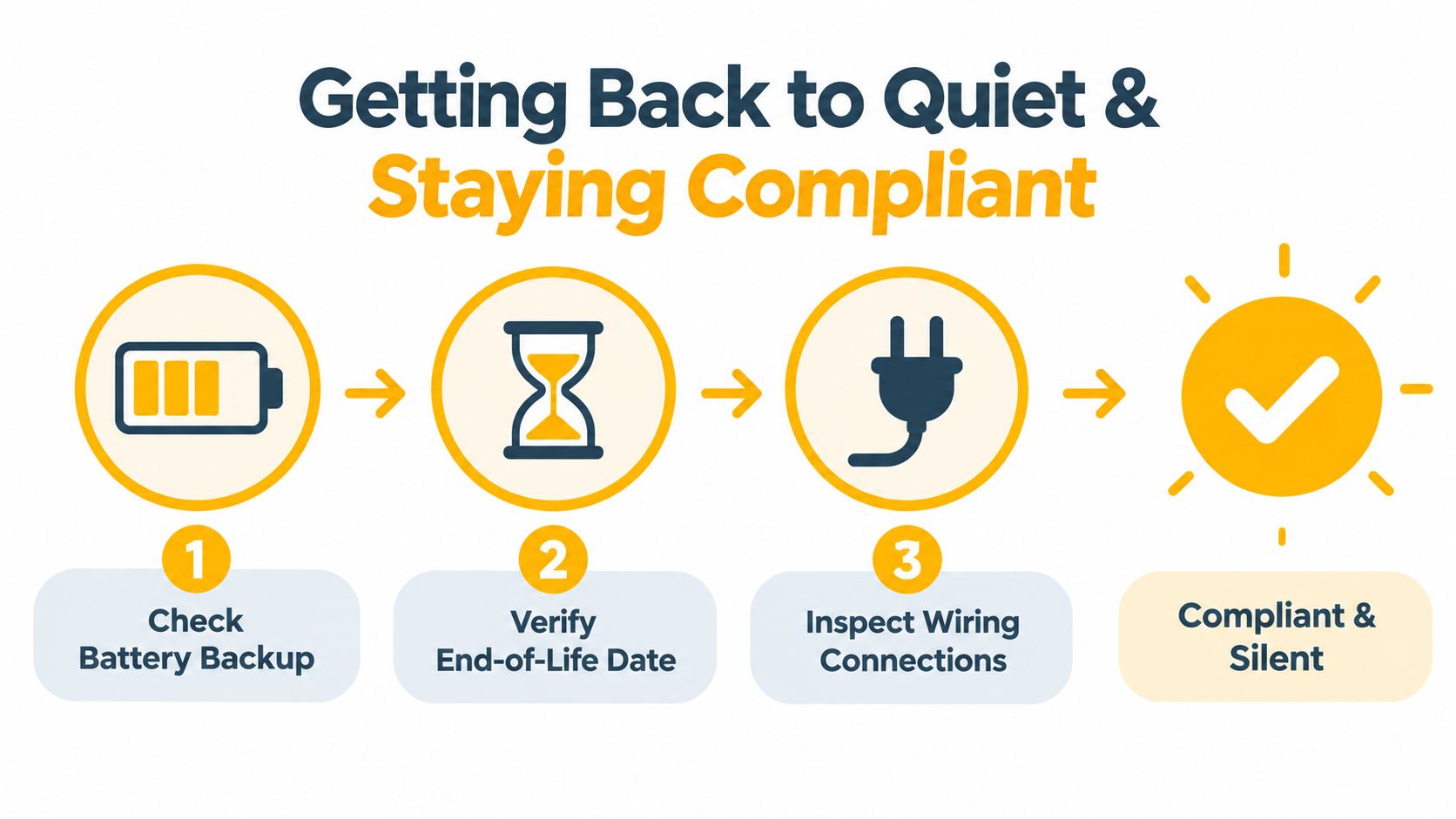
A quiet detector is only the first result. On a North Brisbane office call-out, the practical sequence is backup battery, end-of-life date, wiring, then the interconnected system. Battery replacement may be suitable for a building operator, but work on 240 V conductors, interconnect wiring, bases, or hard-wired replacement belongs with a licensed electrician. That division avoids unnecessary fault-finding while preventing repeated battery changes from masking an aged or damaged alarm.
Keep a register for every detector. Record its location, installation date, manufacture date, battery type, and the next planned maintenance or replacement action. This gives a body corporate, landlord, or facilities team one reliable record when similar chirps occur across several tenancies.
Use compliance as the final test
Queensland's smoke alarm requirements are the practical starting point, but the records and responsibilities depend on the property type and applicable transition arrangements. A detector that stops chirping has not automatically passed a building audit.
For rentals, track the staged compliance deadlines running through 2027 and retain the service report with the model, location, manufacture date, test outcome, work completed, and technician details. That file supports QBCC compliance checks and insurer questions. In an office, retail site, or industrial property, it also shows that the fault was investigated, the system was tested, and electrical work was completed by the appropriate person.
Schedule an annual smoke detector service before the next late-night call-out. The technician should inspect and clean each alarm, check the power and backup arrangements, perform a functional test, verify interconnection, and issue a service record. The inspection can also identify devices that no longer suit the building's use or layout.
For a North Brisbane or Moreton Bay property, arrange servicing before an alarm fails. Celtic Fire & Security supplies, installs, tests, and maintains smoke alarms and related fire-protection systems across North Brisbane, Moreton Bay, the Sunshine Coast, Somerset, and Ipswich.
Celtic Fire & Security can investigate hard-wired smoke detectors chirping, replace compatible alarms, test interconnected systems, and provide documented maintenance for commercial properties and rentals. Visit Celtic Fire & Security to arrange a local service call and keep the site quiet, functional, and ready for its next compliance check.
No responses yet