

A tenant fit-out is nearly complete in a Brisbane office. The ceiling grid is clean, the lighting layout is coordinated, and the designer doesn't want exposed sprinkler heads interrupting the finished appearance. Then a contractor asks whether the concealed units can be painted to match the ceiling. That decision looks minor, but it can affect the sprinkler assembly, future inspections, and the evidence needed to demonstrate ongoing compliance.
Concealed fire sprinkler heads solve a genuine architectural problem. They provide a discreet finish in offices, retail premises, hospitality venues, and other commercial spaces. They don't remove the need for engineering, coordination, testing, or maintenance. In practice, the biggest risk isn't usually the decision to conceal the head. It's treating concealment as if it makes the equipment maintenance-free.
Table of Contents
- What Are Concealed Fire Sprinkler Heads
- How Concealed Sprinklers Work
- Australian Standards and Compliance
- Concealed vs Exposed Sprinkler Heads
- Installation and Selection Tips
- Maintenance and Long-Term Care
What Are Concealed Fire Sprinkler Heads
A property manager comparing two fit-out options often sees a straightforward choice. Exposed sprinkler heads are visible below the ceiling and usually easier to identify during inspections. Concealed fire sprinkler heads sit behind a decorative cover plate, giving the ceiling a more uniform appearance. In a customer-facing venue, that visual difference can matter to the designer, tenant, and owner.
A concealed unit isn't an ordinary sprinkler hidden by a piece of ceiling material. In Australia, AS 2118-based guidance defines it as a spray sprinkler fully recessed into a concealed housing, with a cover plate assembly that releases at or before the sprinkler's operating temperature. AS 2118.1 remains the core Australian reference for the design, installation, and commissioning of automatic fire sprinkler systems. Its version history also shows active maintenance, with AS 2118.1:2017 published with Amendment 1 incorporated and Amendment 2 published on 17 July 2020, as outlined in Australian guidance on automatic sprinkler head types.

Why commercial sites choose them
The main benefit is architectural integration. A cover plate can sit flush with a plasterboard or suspended ceiling, reducing visual clutter around lighting, air-conditioning diffusers, speakers, and other services. That suits reception areas, restaurants, hotel spaces, retail interiors, and offices where the ceiling forms part of the customer experience.
The trade-off begins after handover. An exposed head is obvious to a painter, electrician, ceiling contractor, or tenant. A concealed head can disappear into the background, especially when the ceiling is repainted or modified. That makes site records, product identification, and trade coordination more important, not less.
Practical rule: conceal the head for appearance, but never conceal its location, product details, inspection requirements, or maintenance history.
The cleanest installation is one where the cover plate remains an approved part of the complete assembly, the ceiling layout has been coordinated before construction, and future contractors know not to alter the plate or obstruct the discharge area. A concealed finish works well when the building team treats it as a life-safety component with an architectural finish, rather than as a ceiling accessory.
How Concealed Sprinklers Work
The mechanism is simple to describe, but the parts must work together. A concealed sprinkler assembly generally comprises the sprinkler body, a heat-responsive operating element, a water outlet and deflector, a recessed housing, and a decorative cover plate. The cover plate hides the sprinkler from view during normal conditions, while the operating element remains positioned to respond to heat.
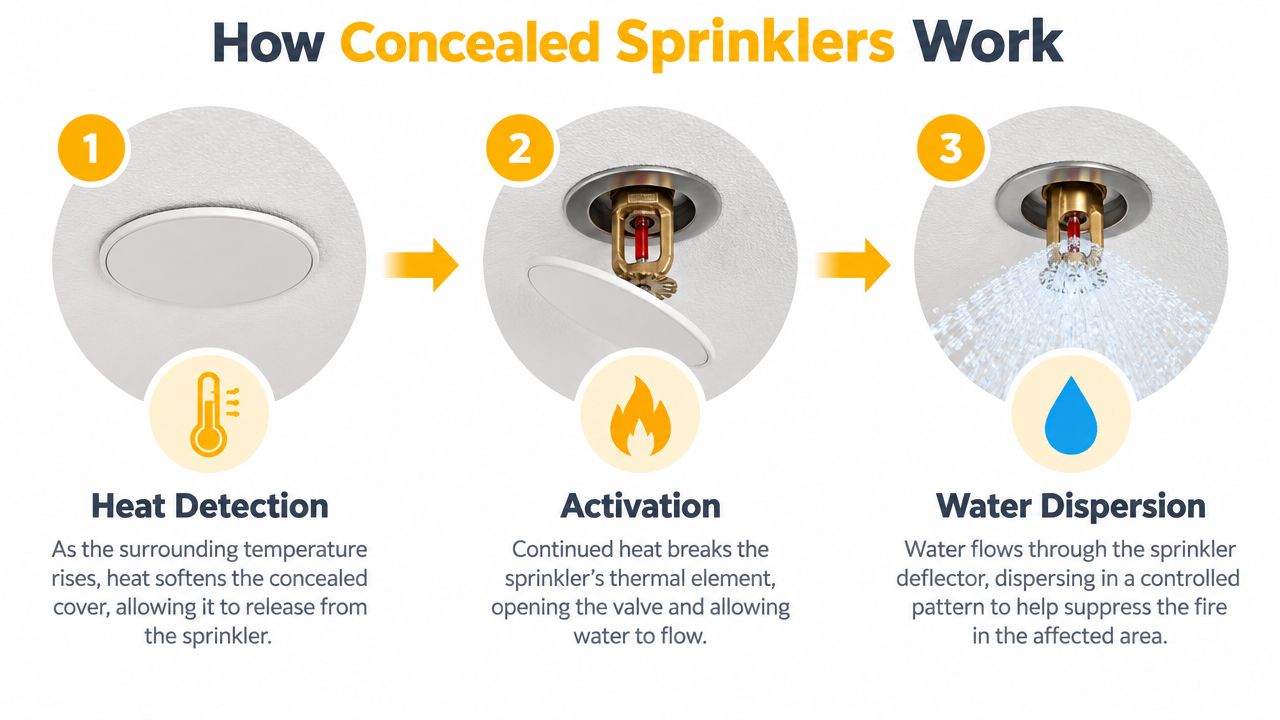
The activation sequence
Heat reaches the assembly. A fire creates a hot layer below the ceiling. The concealed cover plate is designed to release at or before the operating temperature of the sprinkler, rather than remaining fixed in place as the heat increases.
The cover plate releases. The plate falls away or otherwise separates from the housing, exposing the sprinkler. This first movement is essential because the deflector and discharge path must be clear before water can be distributed.
The sprinkler operates. Once the heat-sensitive element reaches its operating condition, the waterway opens. Pressurised water reaches the deflector, which spreads the discharge across the intended pattern below the ceiling.
The cover plate isn't the device that controls the water flow. It provides concealment until the sprinkler can respond. The heat-sensitive element controls operation, while the deflector shapes the water distribution. If a contractor uses an incompatible plate, fixes the plate in place, or paints over the assembly, the tested relationship between those components may no longer be reliable.
Why the ceiling finish matters
A concealed head depends on its surrounding ceiling remaining as designed. Thick coatings, unauthorised decorative treatments, impact damage, corrosion, or sealants around the plate can affect release. Nearby lights, bulkheads, signs, storage, and air-conditioning changes can also alter the clearance and distribution conditions the designer assessed.
The practical lesson is to identify the exact product and assembly before work starts. A replacement cover plate isn't automatically suitable because it has the same colour or diameter. The sprinkler, housing, and cover plate must remain compatible with the listed or certified assembly and the approved system design.
Concealed heads are also heat-operated devices, not smoke detectors. They respond when the heat at the sprinkler reaches the relevant operating condition. That makes correct placement, unobstructed discharge, suitable temperature selection, and proper hydraulic design central to performance.
Australian Standards and Compliance
In Queensland, a concealed sprinkler installation should be assessed through the applicable building approval, fire-safety design, and Australian Standards pathway. AS 2118.1 is the central reference for many commercial automatic sprinkler systems, while the National Construction Code adopts AS 2118.1, AS 2118.4, and AS 2118.6 for sprinkler systems through Specification 17, as set out in the NCC requirements for fire sprinkler systems.
That framework matters during a new build, refurbishment, change of use, and tenant fit-out. The selected sprinkler can't be chosen solely from a catalogue because head type, response characteristics, discharge pattern, temperature rating, spacing, and hydraulic performance all interact.
Spacing and clearance are design matters
Australian practice cited in AS 2118.1 guidance requires at least 500 mm of clear space below sprinkler deflectors. For high-piled combustible stock, the clearance increases to 1,000 mm. Standard spray head coverage is stated as up to 12 m², with a maximum spacing of 4.0 m between heads, subject to the relevant design conditions and system classification, as described in NCC Specification E1.5A guidance.
These figures shouldn't be used as a rough ceiling-marking exercise. Beams, bulkheads, shelving, light fittings, ductwork, fans, and changes in ceiling height can affect the layout. A competent designer must confirm the applicable arrangement rather than assuming every room can use a simple grid.
Quick-response sprinklers also can't be treated as interchangeable with normal-response heads. The NCC states that quick-response sprinklers may be installed only where they're suitable for the application and the system has been specifically designed to accommodate them. Their shorter reaction time and different discharge characteristics mean that changing the head type during a fit-out can require design and compatibility verification.
Occupied ceilings aren't the same as concealed spaces
This distinction causes repeated confusion on commercial sites. A concealed sprinkler head usually refers to a head recessed into a finished ceiling in an occupied area. A concealed space refers to a void, such as the space between a ceiling and roof, under a floor, or between a ceiling and the floor above.
NSW Planning guidance states that not all concealed spaces require sprinkler protection. Protection depends on the applicable Australian Standard and the building context, so a visible head below a finished ceiling doesn't automatically resolve the engineering question for the void above it. If the void contains services, storage, insulation, or other combustible material, it needs a separate review.
That review should sit alongside the project's fire block plan documentation, ceiling coordination, access provisions, and service penetration details. The right answer isn't “install everywhere” or “omit everything”. It's to document why each space is or isn't protected under the applicable compliance pathway.
Concealed vs Exposed Sprinkler Heads
A concealed head offers a cleaner ceiling. An exposed head offers easier visibility. Neither configuration is automatically superior for every Brisbane, North Brisbane, or Moreton Bay site.
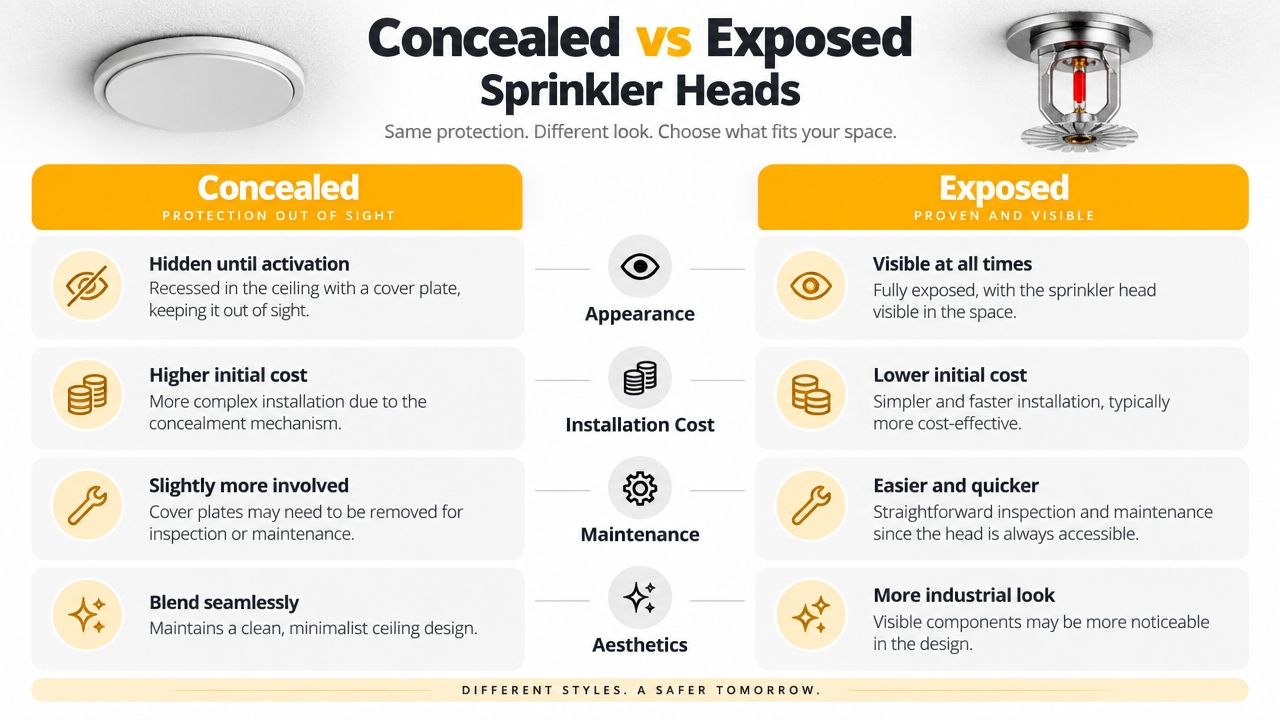
| Consideration | Concealed head | Exposed head |
|---|---|---|
| Appearance | Flush, discreet finish suited to design-led interiors | Visible device and pipework, depending on the installation |
| Installation | Requires accurate coordination between ceiling and sprinkler trades | Often more forgiving where pipework and structure remain visible |
| Inspection | Location and condition can be less obvious to occupants and contractors | Easier to identify during routine visual checks |
| Maintenance | Cover plate, finish, and compatible replacement parts need close control | Physical damage and obstruction are more immediately apparent |
| Cost | May involve additional coordination and specialist components | Can be simpler where appearance isn't a priority |
The visual advantage is real. In a restaurant or office reception area, reducing exposed services can support the intended finish. Concealed systems also avoid the impression that the ceiling is unfinished.
The maintenance disadvantage is less obvious. If a tenant moves out and another contractor repaints the ceiling, an exposed sprinkler is likely to attract attention. A concealed cover plate may be rolled over, filled, damaged, or covered by a new feature without anyone recognising that the fire system has been altered.
The cheapest option at fit-out isn't necessarily the easiest option to manage over the building's life.
Cost should therefore be assessed across design, installation, access, replacement, documentation, and future alterations. A concealed system can be the right choice where appearance carries genuine value and the owner has a disciplined maintenance process. It works poorly where ceiling work is frequent, site records are weak, or contractors aren't briefed about the sprinkler layout.
Exposed heads aren't maintenance-proof either. They can be struck, obstructed, corroded, or displaced. Their advantage is visibility, not immunity. The decision should reflect the building's occupancy, ceiling construction, tenant turnover, service access, and capacity to control later works.
Installation and Selection Tips
Product selection should start with the approved design, not with the finish sample. A supplier or designer needs the occupancy conditions, ceiling type, hazard information, pipework arrangement, required response characteristics, operating temperature, and intended cover plate finish before confirming a concealed assembly.
Start with the compliance pathway
For domestic applications, WMTS-486:2016 defines a concealed ceiling fire sprinkler head as a recessed sprinkler with a factory coating, paint, or plating for decorative purposes. That definition is important because it describes a certified product feature, not a finish that a painter can reproduce on site. The Australian overview of fire sprinkler products and WaterMark considerations provides the relevant product context.
Queensland domestic sprinkler guidance points to AS 2118.4 and AS 2118.5 for residential sprinkler systems. Commercial projects may follow a different part of the AS 2118 series and a different building approval pathway. Don't apply a domestic product specification to a commercial installation because the head looks suitable.
A practical selection process looks like this:
- Confirm the building use: Identify whether the project involves a home, office, retail tenancy, hospitality venue, warehouse, strata area, or another occupancy.
- Check the adopted standard: Confirm which AS 2118 part and NCC provisions apply before ordering hardware.
- Match the complete assembly: Verify that the sprinkler, recessed housing, and cover plate are designed and certified to work together.
- Coordinate the ceiling: Mark heads against lights, diffusers, beams, bulkheads, access panels, signage, and ceiling changes.
- Protect the specification: Record the manufacturer, model, temperature rating, finish, response type, and installation requirements in the project file.
Control the site handover
The installation isn't finished when the cover plates look even. The commissioning record should identify the installed products and confirm that the system has been tested under the applicable requirements. Keep those documents available for the building owner, facility manager, and future contractors.
Ceiling trades need a clear instruction that they must not paint, seal, drill, hang from, or obstruct the cover plates. If the finish changes, use an approved product or replacement process. Don't let a well-intentioned decorator turn a certified factory finish into an unverified site modification.
Where other fire equipment is being installed during the same fit-out, coordinate the work rather than treating each trade in isolation. The requirements for a commercial fire hose reel installation don't replace sprinkler design requirements, but coordinated documentation reduces the risk of one service blocking or damaging another.
Maintenance and Long-Term Care
A concealed system can look untouched while its performance is being compromised. The risk appears during repainting, ceiling repairs, tenant churn, lighting upgrades, air-conditioning work, and storage changes above suspended ceilings.
Australian residential sprinkler guidance warns that painting over a concealed-head cover plate can affect activation performance. It also states that damaged or painted-over heads or cover plates must be replaced immediately, as explained in Australian residential sprinkler care guidance.
Build maintenance around visibility gaps
A competent inspection should look beyond whether the cover plate appears present. The technician and facility manager should consider:
- Cover condition: Check for paint, impact damage, corrosion, gaps, distortion, or unauthorised sealant.
- Clearance: Look for new lights, signs, partitions, ductwork, storage, or other obstructions near the discharge area.
- Ceiling changes: Compare the current ceiling and services with the approved layout and system records.
- System condition: Investigate leaks, valve position issues, pressure changes, alarms, or other signs that could affect readiness.
- Replacement control: Use the correct compatible assembly rather than a visually similar cover plate.
Long-term verification also needs a documented plan. Australian maintenance material refers to representative sampling across different environments, including concealed spaces, after long service periods. It states that a representative sample of not less than 14 sprinklers is tested after 25 years and then every 10 years, as referenced in the earlier Australian guidance.
That approach changes the facility manager's question. It isn't only “Are concealed heads installed?” It's “Can we identify them, access them, inspect them, and demonstrate that the system remains suitable after years of building work?” A scheduled fire protection service programme should preserve those records and flag alterations before they become compliance problems.
Celtic Fire & Security supplies, installs, tests, and maintains commercial fire protection systems, including sprinkler-related compliance support, alarms, hydrants, hose reels, extinguishers, and emergency lighting. If your Brisbane, Moreton Bay, Sunshine Coast, Somerset, or Ipswich site has concealed heads affected by a fit-out or overdue inspection, contact Celtic Fire & Security to arrange a practical review and documented maintenance plan.
No responses yet