
A facilities manager in South East Queensland can do everything that appears sensible, purchase a certified reel, place it near an exit, and book routine servicing, then discover during a fit-out review that the hose path no longer reaches the required floor area. A pallet, tenancy wall, security gate or storage cabinet can turn a compliant installation into an obstructed one without anyone removing the reel.
That's why the fire hose reel Australian standard question needs a practical answer rather than a single document name. The reel, its installation and its ongoing maintenance sit under different standards, while Queensland adds regulatory and licensing obligations. The useful approach is to identify the problem first, then apply the standard that governs that part of the system.
Table of Contents
- Why the Fire Hose Reel Australian Standard Question Has Three Answers
- The Three Standards at a Glance and How They Split Responsibility
- AS/NZS 1221 Covers the Reel Unit, Not the Site
- AS 2441 Installation Rules and the Key Dimensions
- Siting Fire Hose Reels Inside the 40 Metre Coverage Radius
- AS 1851 Maintenance Requirements and the 2026 Shift
- Queensland Rules, QDC MP 6.1, and the QBCC Pathway
- Compliant on Paper Versus Operationally Usable on Site
- Which Standard Answers Your Problem
- Compliance Records to Keep for Every Reel
- Where to Read the Standards in Full
- Common Questions from Facilities Teams
Why the Fire Hose Reel Australian Standard Question Has Three Answers
A business owner asking, “Which Australian Standard applies to my hose reel?” is usually dealing with one of three tasks:
- Choosing or replacing the reel unit
- Installing, relocating or commissioning the system
- Inspecting, testing or repairing an existing asset
Those tasks are related, but they aren't interchangeable. AS/NZS 1221:1997 addresses the design, construction and performance of the fixed or swing-arm reel itself, as described in the Australian/New Zealand product-standard reference. AS 2441-2005 addresses installation, including distribution and location. It was published on 1 November 2005, later reconfirmed in 2018, and superseded AS 2441-1988, according to Standards Australia's AS 2441-2005 record.
Ongoing service belongs to AS 1851, applied with Queensland's own essential-safety-measure requirements. Queensland Fire and Emergency Services states that prescribed fire hose reels must be maintained in accordance with QDC MP 6.1 by an appropriately qualified person, as set out in its fire safety maintenance advisory notes.
Practical rule: Start with the work being performed, not the equipment label. Product, installation and maintenance questions lead to different standards.
This split matters during ownership changes, tenancy upgrades and audits. A reel can meet its product standard while the site arrangement fails AS 2441, or the installation can be sound while the maintenance evidence is incomplete.
The Three Standards at a Glance and How They Split Responsibility
The simplest way to manage the standards is to assign each one a job. That gives a procurement officer, project manager or facilities coordinator a clear starting point before engaging a contractor.
| Standard | Scope | Primary User | Key Output |
|---|---|---|---|
| AS/NZS 1221:1997 | Design, construction and performance of fixed and swing-arm fire hose reels intended for one operator | Manufacturer, supplier and procurement team | A suitable, compliant reel unit |
| AS 2441-2005 | Distribution, location and installation of fire hose reels | Designer, installer, certifier and facilities manager | A correctly positioned and connected system |
| AS 1851 | Inspection, testing and routine maintenance of fire protection equipment | Service provider, building owner and compliance manager | Evidence that the installed asset remains serviceable |
AS/NZS 1221:1997 doesn't decide where a reel belongs in a building. AS 2441 doesn't replace the product requirements for the drum, hose or nozzle. AS 1851 doesn't approve a new layout just because a technician can operate the reel during a service visit.
The division is functional, not optional. A single compliance-schedule line saying “fire hose reel serviced” may show that a visit occurred, but it won't necessarily prove that the product, installation and maintenance obligations have each been addressed.
For a commercial premises, the workflow should read as a sequence: specify a suitable product, install it under AS 2441, then maintain the complete asset under AS 1851 and the applicable Queensland framework. That sequence also helps identify responsibility when a defect appears. A failed nozzle may be a product or maintenance issue, while poor access is usually an installation or operational-control issue.
AS/NZS 1221 Covers the Reel Unit, Not the Site
AS/NZS 1221:1997 is the Australian/New Zealand product standard for fire hose reels. It covers the reel's design, construction and performance, including fixed and swing-arm arrangements intended for use by one operator. In practical procurement terms, it helps a buyer compare a reel assembly against the relevant product benchmark before it reaches the building.
The product boundary is important. The standard doesn't answer where the reel should be mounted, how many units a building requires, whether the hose path reaches the risk, or how the asset is serviced after handover. Those questions sit elsewhere.
What procurement should confirm
A procurement review should identify the actual reel model and its supporting documentation rather than relying on a generic catalogue description. Check that the supplied unit is the model covered by the compliance information, and retain the manufacturer's records with the site asset register.
The reel assembly may include:
- Drum and frame, which must suit the intended fixed or swing-arm arrangement
- Hose and nozzle, matched to the reel's approved configuration
- Valve and inlet connection, compatible with the planned installation
- Identification and markings, allowing the installed unit to be traced back to its product information
A product mark is useful evidence, but it isn't a site certificate. A reel bearing the appropriate product-standard identification can still be placed behind stock, connected to unsuitable pipework or left with a seized valve.
A certified component is only one part of a compliant fire hose reel system.
For owners, the practical control is to connect purchasing, installation and servicing records. If the product is replaced, record the new model and confirm that the existing bracket, pipework, cabinet and operating arrangement remain suitable. Don't allow the product-standard check to become a substitute for a site inspection.
AS 2441 Installation Rules and the Key Dimensions
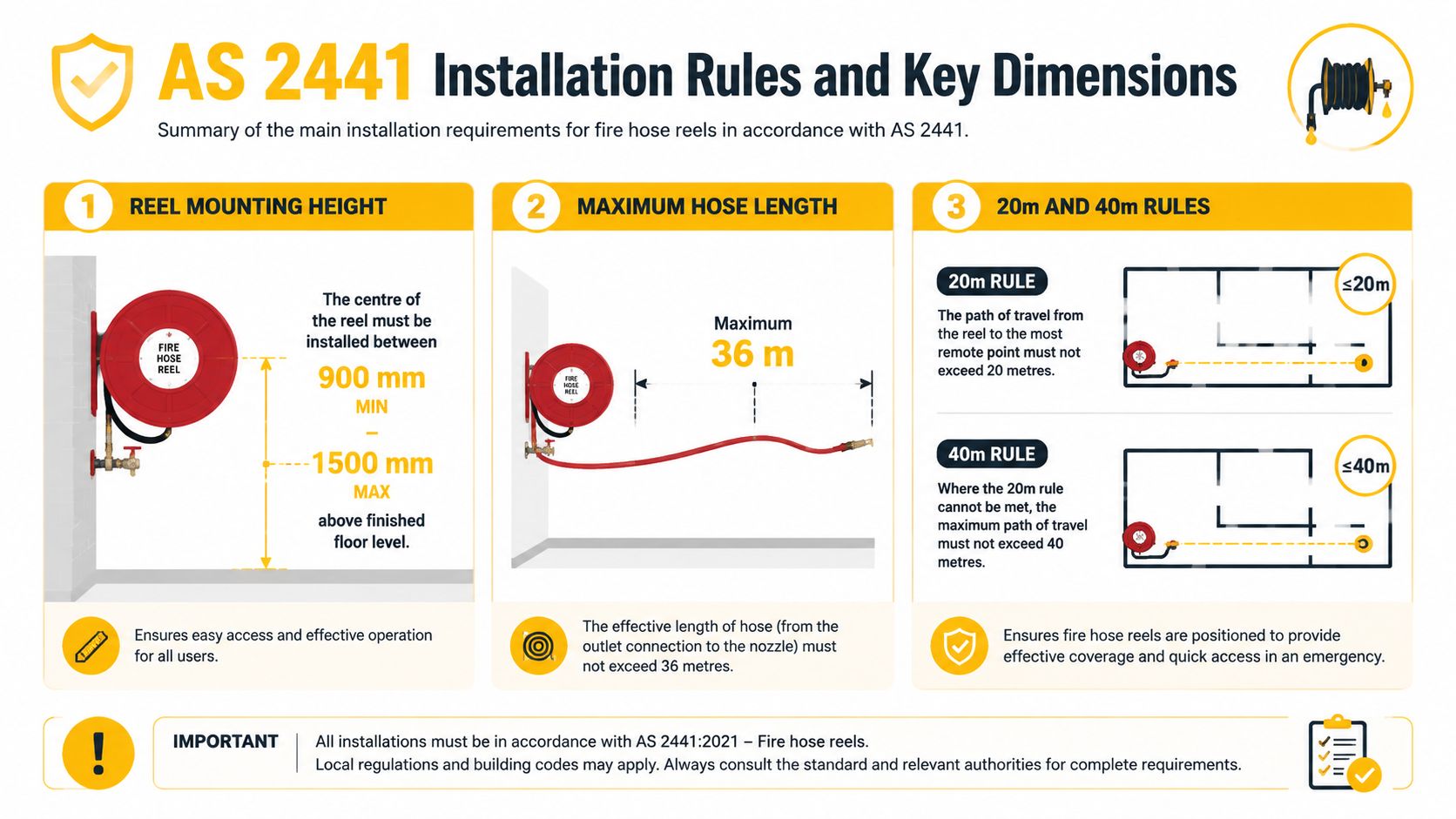
AS 2441-2005 turns a compliant reel unit into a usable building installation. It addresses distribution, location and installation, so the assessment must follow the reel's position, hose route and surrounding construction, not just the supplier's catalogue.
The standard's coverage method uses a 36 metre hose and a 4 metre water-stream allowance, giving a nominal 40 metre coverage radius. The Australian installation guidance for AS 2441 summarises this calculation, but the result still depends on the route available at the finished site.
Measure the installed arrangement
Set the spindle between 1400 mm and 2400 mm above the floor. The reel rim requires at least 100 mm clearance from obstructions. These AS 2441 dimensions must be checked against the completed wall, cabinet, door swing and nearby equipment, rather than measured from an unfinished layout.
At commissioning, verify:
- Hose reach, including the practical route an occupant would take
- Spindle height, measured from the completed floor level
- Rim clearance, checked against cabinets, walls, shelving and equipment
- Access and visibility, including signage from the normal approach path
- System connections, including isolation arrangements, compatible pipework and water supply
A reel can sit neatly inside a cabinet and still be difficult to deploy. A door may open across the hose path, or a security device may block access during an incident. These are installation failures in practical terms, even when the listed dimensions appear correct.
Record photographs and field measurements with the installation documents, then arrange acceptance testing through appropriately qualified fire-system personnel. The completed record should describe the installed arrangement, not merely confirm that a reel was delivered. That evidence supports later decisions when walls, doors or storage change.
Siting Fire Hose Reels Inside the 40 Metre Coverage Radius
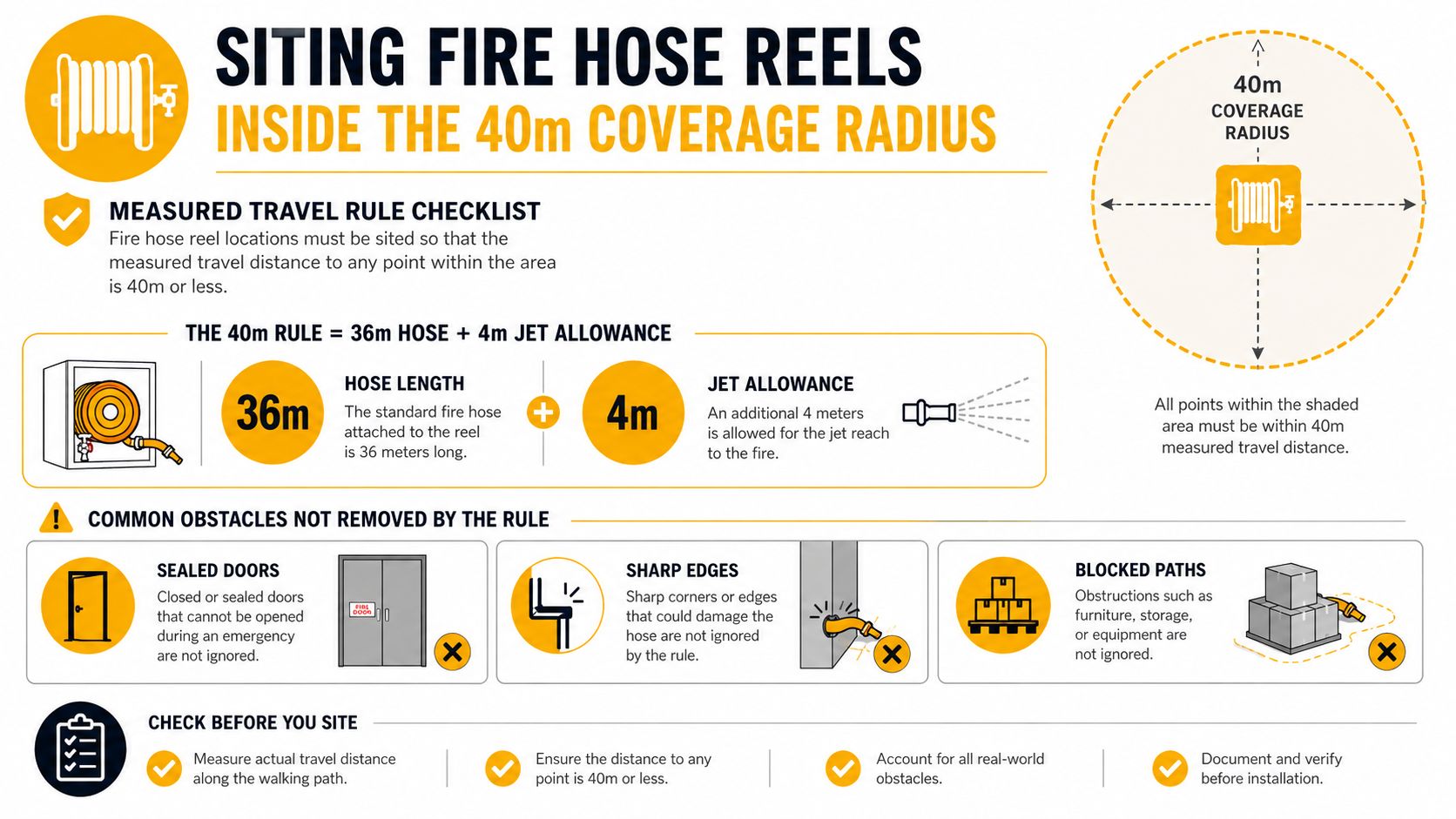
A reel may appear correctly placed on a floor plan while the hose cannot reach the intended area during an incident. The 40 metre allowance is a measured travel rule. It depends on a person pulling the hose through a clear, practical route and directing the water stream towards the relevant space.
Begin at the reel and walk the route under normal operating conditions. Open doors as they would be used, allow for stock and equipment, and check access points that may be locked or controlled. Sealed doors, sharp edges, machinery, shelving and stored goods can defeat the coverage shown on an architectural drawing.
Follow the hose path during the site walk
Position the reel where it is visible, accessible, near an exit and along a normal path of travel. Avoid locations behind locked gates, inside obstructed cupboards or beyond the fire area itself. The operator must be able to reach and deploy it without passing through the hazard.
Check for:
- Retail stock and hospitality equipment, including bins, trolleys and temporary displays
- Industrial obstructions, such as racks, machinery and stored materials
- Fit-out changes, including new partitions, mezzanines and relocated access points
- Security hardware, which may restrict access while leaving the reel visible
- Environmental hazards, including heat, chemicals and sharp edges that can damage the hose
The Queensland budget-accommodation provision illustrates this principle for that specific building class. It requires the hose to be fitted to the reel and laid around partitions or physical barriers so it reaches the applicable parts of the storey. It should not be treated as the general rule for every building. Apply the relevant installation requirements and confirm the route against the actual site. The fire hose reel guidance for Australian buildings provides a further practical reference for equipment access and siting.
If a fit-out removes the route, relocate the reel or provide additional equipment. Do not accept an old coverage drawing without checking the changed building conditions. Record the route and any limitations for the facility manager, so later storage, partitions or security changes can be assessed before they affect access.
AS 1851 Maintenance Requirements and the 2026 Shift
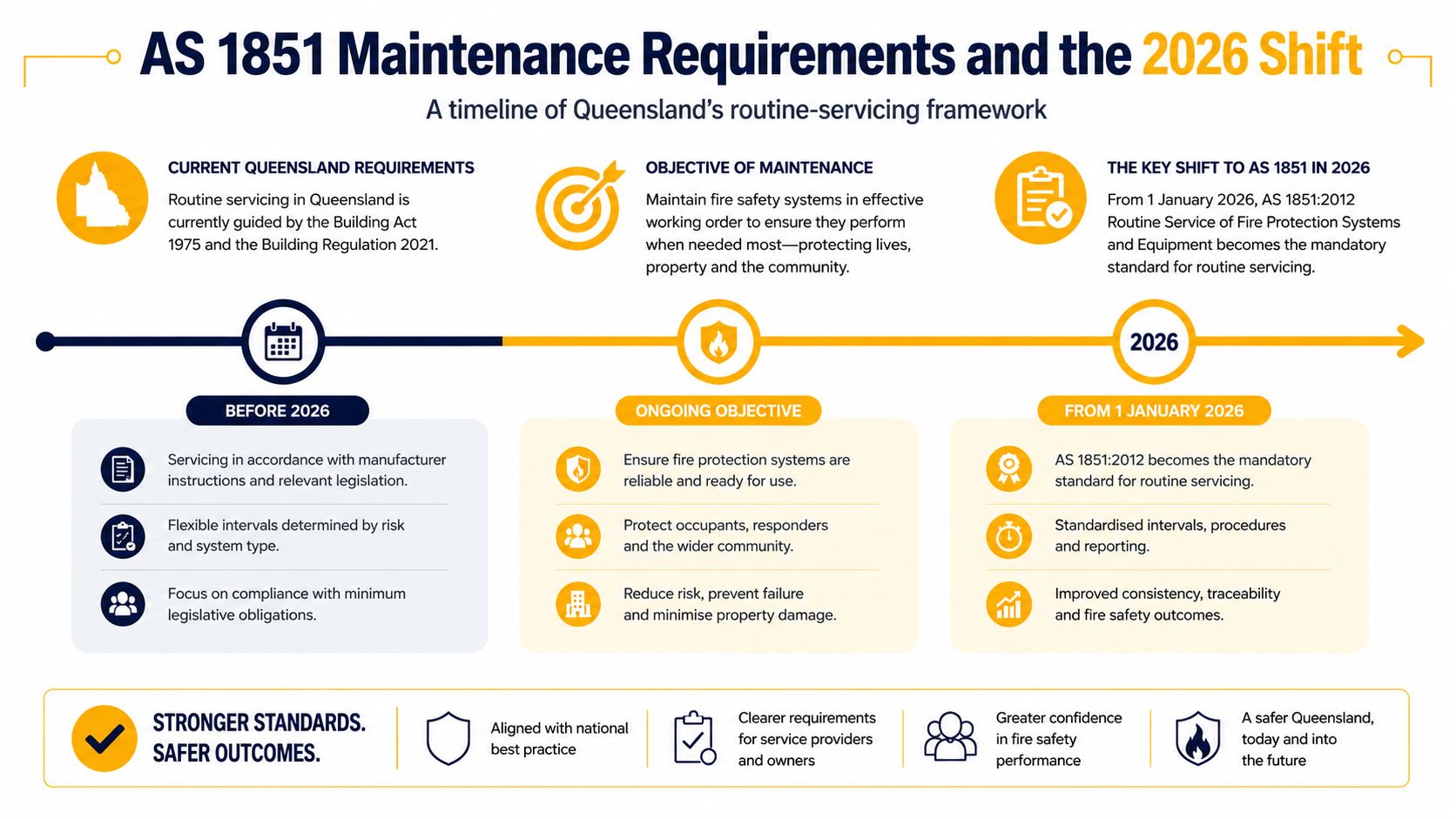
A reel can look complete and still fail a service check. AS 1851 focuses on keeping the installed equipment ready for use, so a technician examines the reel, hose, nozzle, valve, bracket, water supply, signage and access. The service record should identify the asset and location, then show the inspection date, result, defects, corrective action and responsible technician.
Queensland adds a timing and competency question. Current guidance states that prescribed fire hose reels must be maintained under QDC MP 6.1 by an appropriately qualified person. Current 2026 materials identify 13 February 2026 as the date from which AS 1851 maintenance becomes mandatory for essential fire safety measures, as discussed in this Australian fire hose reel standards guide.
What the maintenance record must show
A register is useful when a facility manager can answer three points quickly: which reel was checked, what the technician found, and how each defect was handled.
Record findings such as:
- Blocked access, missing signs or a cabinet that does not open correctly
- Hose deterioration, leaks, kinks or damage caused by fittings and sharp edges
- Valve and nozzle faults, including leaks, seizure or poor operating condition
- Supply problems, including inadequate flow or an isolation arrangement that staff cannot identify
- Site changes, where the current layout no longer matches the approved installation
An annual service does not replace the required routine inspection cycle. Confirm the applicable AS 1851 edition, Queensland forms, intervals and local interpretation with the appointed fire contractor. Keep commissioning, installation, maintenance and repair records together, and have the contractor reconcile the asset register with the approved essential-safety-measures schedule. Facilities teams can also use this guide to plan fire protection services and keep the maintenance cycle aligned with site responsibilities.
Queensland Rules, QDC MP 6.1, and the QBCC Pathway
Queensland adds a regulatory layer beyond the three technical standards. QDC MP 6.1 and related building requirements affect how essential safety measures are documented, maintained and managed. Queensland Fire and Emergency Services guidance also informs maintenance expectations for prescribed hose reels.
Budget accommodation has a specific compliance trigger. Where the building floor area is greater than 500 m², the hose reel system must follow the Australian Standard applicable when it was installed. The provision also requires enough hose reel coverage for occupants to undertake an initial attack safely. This requirement is distinct from the general siting assessment covered earlier. Refer to the Queensland Government provision for budget accommodation buildings when checking whether the threshold and installation-standard requirement apply to the building.
Licensing is a separate question. The Queensland Building and Construction Commission framework recognises a fire hydrants and hose reels certification pathway. That places relevant installation and service work within a regulated licensing category, as set out in the Queensland licensing regulation.
| Instrument | Scope | Who it affects |
|---|---|---|
| QDC MP 6.1 | Essential safety measure requirements and maintenance framework | Building owners, managers and service providers |
| Queensland Fire and Emergency Services guidance | Maintenance expectations for prescribed hose reels | Owners and appropriately qualified maintenance personnel |
| Queensland licensing framework | Recognised fire hydrants and hose reels work category | Contractors, licensees and project managers |
Facility managers should retain installation evidence, service records and site-specific documentation. A visual check alone cannot confirm that the work followed the correct Queensland compliance and licensing pathway.
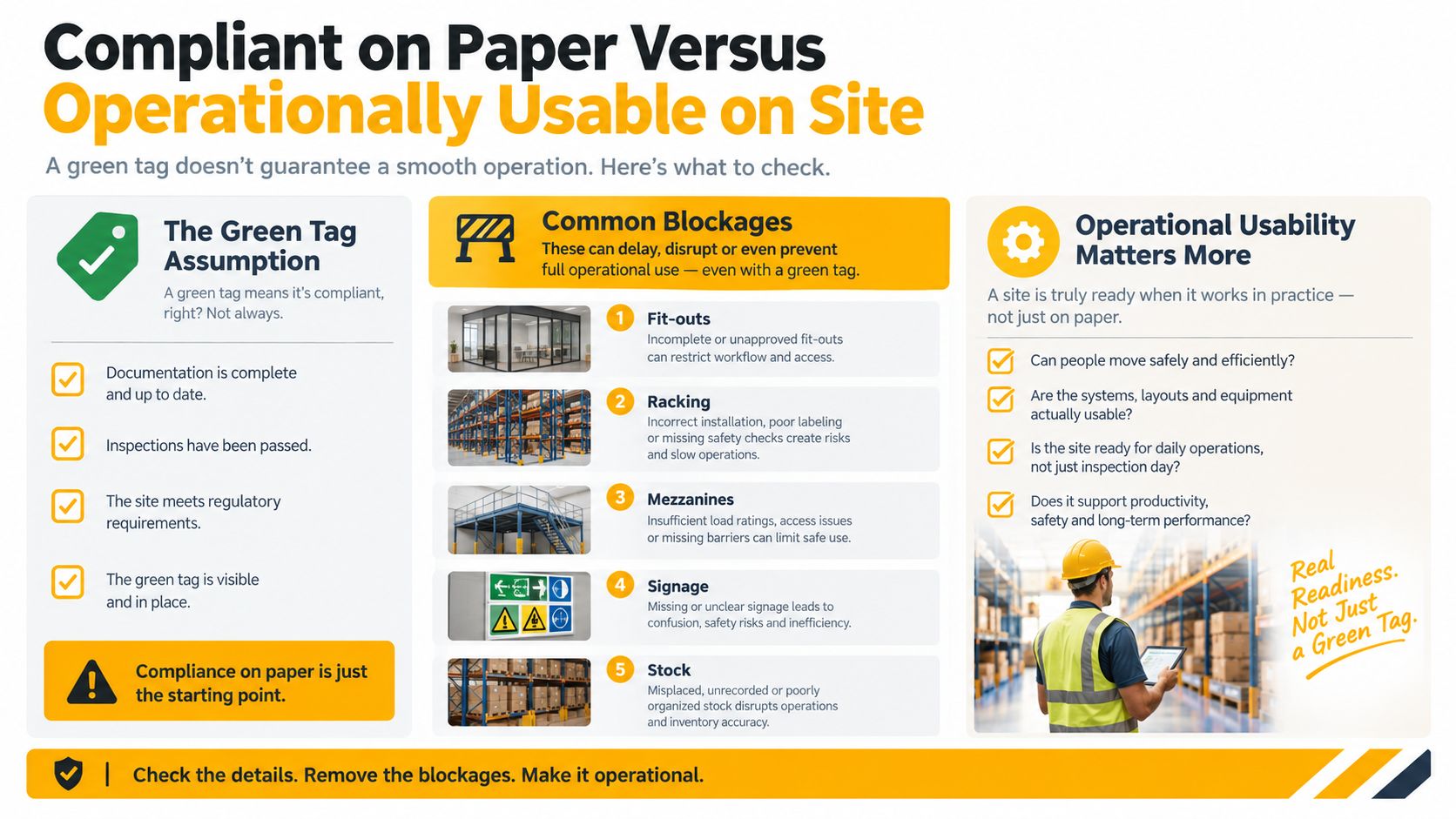
Compliant on Paper Versus Operationally Usable on Site
A green service tag doesn't guarantee that a person can use the reel when the building is busy. The most persistent failures often appear after handover, when stock, racking, mezzanines, signage, new partitions or security hardware change the operating environment.
A reel can pass a maintenance inspection and still be difficult to reach during an evacuation. A pallet may block the cabinet. A new wall may interrupt the hose route. A sign may be hidden behind a display. These aren't theoretical defects for retail, hospitality and industrial premises. They're ordinary consequences of treating fire equipment as part of the original fit-out rather than as a live operational asset.
Run an operating-hours check
Walk the floor during normal activity, not only after the site has been cleared for a contractor. Confirm that staff can identify the reel, reach the handle, pull the hose without snagging and move towards the intended coverage area without passing through the fire.
Treat access as a daily housekeeping responsibility, not a once-only commissioning detail.
Compare the current floor plan with the installation record. If the layout has changed, have the coverage route reassessed under AS 2441 rather than relying on the old approval drawing.
The following video provides a visual reference for operational readiness:
Which Standard Answers Your Problem
Use the problem as the triage point. This stops teams from sending every question to the maintenance contractor or assuming that a product certificate resolves a site issue.
- Buying a new reel: Begin with AS/NZS 1221:1997. Confirm the actual product and its approved configuration before purchase.
- Installing or relocating a reel: Apply AS 2441-2005. Check distribution, access, dimensions, signage, connections and the measured hose route.
- Servicing or proving ongoing readiness: Use AS 1851 alongside the Queensland maintenance framework. Review defects, testing, records and corrective actions.
- Checking a Queensland design trigger: Refer to QDC MP 6.1 and the applicable building provisions. Don't assume a generic floor-plan rule answers a site-specific question.
- Selecting a contractor: Confirm the relevant QBCC fire hydrants and hose reels licensing pathway for the work being performed.
- Preparing audit evidence: Assemble the product record, installation documentation and maintenance history. A service label without supporting records leaves responsibility unclear.
The sequence is straightforward: product first, installation second, maintenance third, with Queensland obligations applied throughout. If the question concerns a changed wall layout, it's an installation issue even if the reel was serviced recently. If it concerns a damaged hose on an unchanged system, it may be a maintenance issue, but the replacement still needs to suit the approved product and installation arrangement.
Compliance Records to Keep for Every Reel
A Queensland site should be able to identify each reel without searching through unrelated building files. Use a unique asset identifier and connect the physical label to the digital register.
Keep these records together:
- Asset register entry: Record the model, location, installation information and product-standard evidence for the reel.
- Installation documentation: Retain the AS 2441 installation or commissioning record, including relevant testing, signage and coverage information.
- Maintenance history: Keep AS 1851 inspection and service reports, defect notices, corrective actions and technician details.
The register should be organised by reel identifier, not only by building or tenancy. That approach makes ownership changes, relocation reviews and contractor handovers easier to manage.
A current fire safety schedule reference can also help the facilities team reconcile hose reels with the wider essential-safety-measures record. Retain the complete history for the period required by the site's statutory, insurance and contractual obligations, and ask the responsible compliance adviser to confirm those retention requirements.
Where to Read the Standards in Full
The full text of AS 2441, AS 1851 and related Australian Standards should be obtained through authorised standards channels, including the Standards Australia store and SAI Global's Infostore. AS/NZS 1221:1997 is distributed through the joint Australian and New Zealand standards system.
Queensland-specific requirements should be checked against the current Queensland Government building and legislation material. QDC MP 6.1 and related provisions are available through Queensland Government sources, while QFES publishes advisory notes and fact sheets for fire safety maintenance interpretation.
For licensing questions, use the current QBCC information and confirm that the contractor's licence scope matches the work. Standards are technical documents, so a facilities manager should use the full text for design, certification or dispute decisions and ask a suitably qualified practitioner to interpret clauses that affect a complex building.
Common Questions from Facilities Teams
Does a new tenant fit-out require more than a routine service?
If the work changes wall layouts, signage, doors, egress paths or the physical hose route, arrange an AS 2441 installation review. An AS 1851 service alone won't confirm that the altered layout still provides the required coverage.
Can our regular plumber replace a damaged hose?
Not automatically. In Queensland, work on a charged hose-reel system should be assigned to a contractor whose QBCC licensing scope covers fire hydrants and hose reels. The replacement also needs to be compatible with the approved reel assembly and installation.
Are plastic hose reels banned?
The material alone doesn't answer the compliance question. A modern plastic reel may be acceptable where the specific model is covered by the applicable product compliance information. Check the actual unit, not a general assumption about plastic equipment.
What should we provide to an insurer or auditor?
Prepare the asset register, installation or commissioning evidence, AS 1851 maintenance records, defect close-outs and current statements required for the building. Keep the documents together and make sure each record identifies the same reel and location.
Celtic Fire & Security supplies, installs, tests and maintains fire hose reels and related commercial fire protection systems across North Brisbane, Moreton Bay, the Sunshine Coast, Somerset and Ipswich. Visit Celtic Fire & Security to arrange a site review, confirm the correct Australian Standard pathway and organise documented maintenance for your premises.
No responses yet