

You've likely seen this happen. A new tenancy finishes its fit-out, the extinguishers are on the wall, everyone assumes the job's done, and the first inspection picks up the same problems: wrong type near the hazard, unit mounted too high, access blocked by stock, no clear location sign, or no service records set up after handover.
That's why fire extinguisher installation in Queensland isn't just a wall-mounting exercise. It's a compliance task tied to building use, hazard type, accessibility, and ongoing maintenance. If the extinguisher can't be reached quickly, can't be identified easily, or doesn't suit the fire risk in that area, it can fail both an audit and the people relying on it.
Table of Contents
- Why Correct Fire Extinguisher Installation Matters in Queensland
- Site Assessment Before You Choose an Extinguisher
- How to Choose the Right Extinguisher Type and Size for Australian Classes
- Mounting and Placement Requirements That Pass Audit
- Commissioning Labelling and Handover Documentation
- Maintenance Schedules and Tips to Keep Your Installation Compliant
Why Correct Fire Extinguisher Installation Matters in Queensland
A tenancy opens on a Monday. By Friday, the kitchen has grease on the walls, pallets are stacked in front of the rear exit, and a forklift has already clipped one extinguisher bracket in the loading area. The installation looked fine at handover. Two months later, it is already harder to access, harder to service, and closer to failing inspection.
That is the part many owners and fit-out teams miss. Correct fire extinguisher installation in Queensland starts with compliance, but it also has to hold up under the way the site will run.
AS 2444 remains the core installation standard for portable fire extinguishers in Australia. The current reference point for most commercial work is AS 2444-2001, which sets the baseline for selection, location and distribution in buildings (AS 2444 preview). On site, that affects more than the initial set-out. It affects whether an extinguisher stays visible, reachable and suitable for the hazard after the tenancy settles into normal use.
Installation quality shows up later
A poor install often passes the eye test on day one. The problems show up after the site gets busy.
In Queensland conditions, lifecycle planning matters straight away. Coastal salt air shortens the life of cylinders, brackets and signage if the wrong materials are used or the unit is mounted in exposed positions. Commercial kitchens coat nearby equipment with grease, which affects labels, visibility and service condition. Warehouses and plant rooms create impact risk from trolleys, cages and forklifts, and that means more bracket damage, bent handles and early replacement.
Those are installation decisions, not just maintenance problems.
A compliant layout also has to work with the fire safety obligations that apply to the building. Portable extinguishers form part of the prescribed fire safety installations that must be maintained and kept serviceable under Queensland's fire safety framework, and maintenance then follows AS 1851 through the life of the asset (Queensland Development Code MP 6.1).
What passes audit and what fails
Installers see the same pattern over and over. Sites fail because the extinguisher was placed for fit-out convenience instead of long-term use.
Common failures include:
- an extinguisher exposed to weather or salt when a better protected position was available
- a unit near a kitchen line that is quickly coated in grease and hard to identify
- brackets fixed where pallets, stock or parked equipment block access
- cylinders mounted in traffic paths where knocks and corrosion drive early replacement
- no clear allowance for routine servicing under AS 1851, including access for inspection and record keeping
The trade-off is simple. The cheapest mounting position at install is often the expensive one over the next few years. A slightly different location, a cabinet, a corrosion-resistant bracket, or protection from vehicle traffic usually costs less than repeated callouts, defect notices and premature replacement.
Good installation gives the extinguisher the best chance of being usable in an emergency and still serviceable at the next inspection. In Queensland, both matter.
Site Assessment Before You Choose an Extinguisher
A tenancy can look straightforward at handover and still fail six months later. I see it on shop fit-outs and warehouse refurbishments across Queensland. The extinguisher is technically installed, but a display goes in front of it, grease builds up on the cabinet near the cookline, or a forklift clips the bracket in the loading area. The problem started before the unit was chosen. The site was never assessed properly.
A proper assessment starts with how the space is used day to day, how people exit, and what will affect access and serviceability over time under AS 1851.
Walk the building the way the site actually operates
Start at the main entry and walk the tenancy as staff, contractors and visitors will use it. Follow normal travel paths, then follow the egress routes. Check where a person under stress would expect to find first attack equipment, and check whether that position will still be visible once stock, furniture, cages or promotional displays are in place.
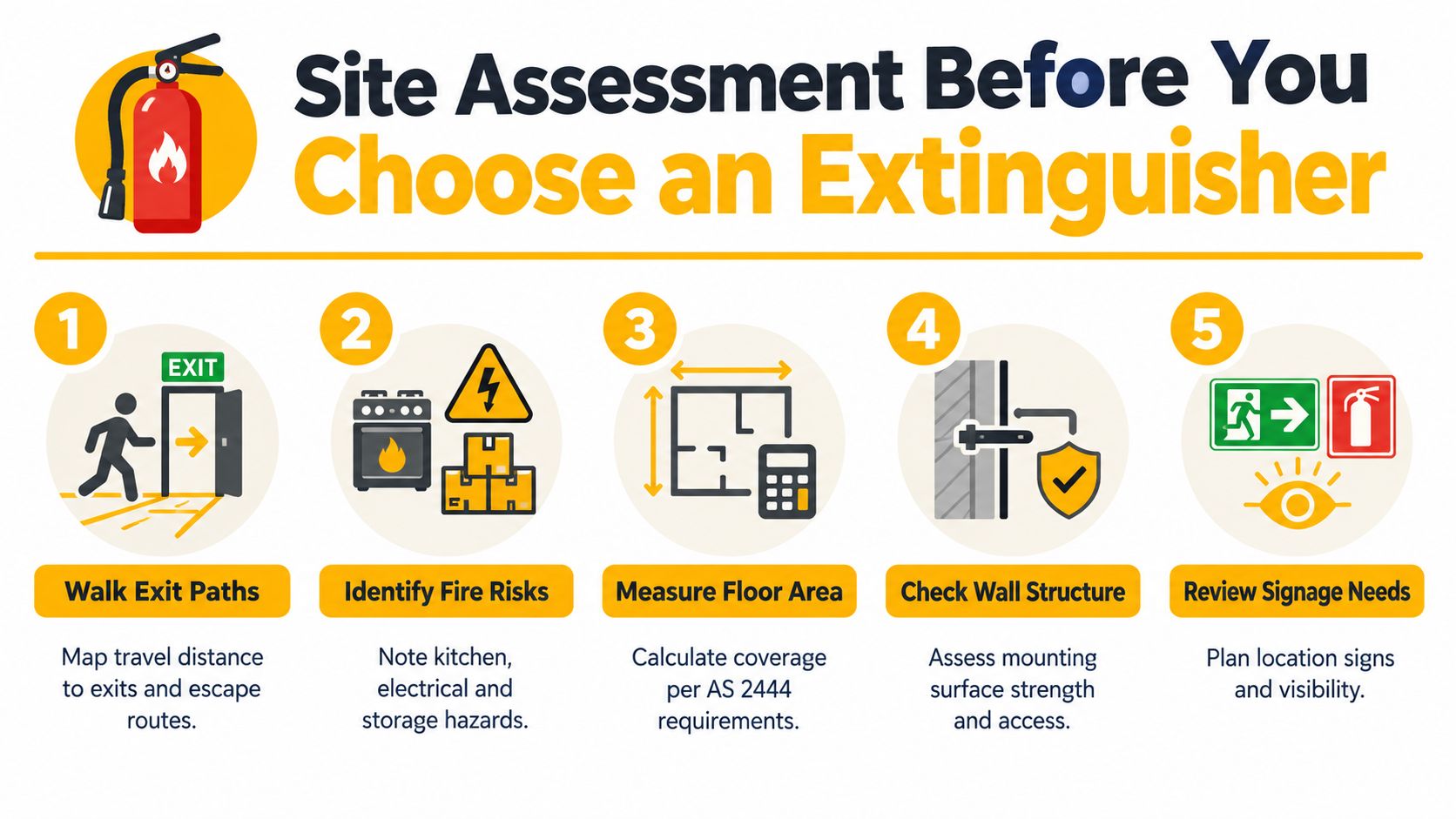
Mark up a simple site plan as you go. Include:
- Exit doors and travel routes that influence where occupants will look first
- Hazard locations such as kitchens, switchrooms, plant rooms, workshops, storage areas and loading zones
- Likely obstructions including racking, point-of-sale joinery, cool rooms, roller shutters and stacked goods
- Mounting options such as masonry, plasterboard, columns, posts or cabinet locations
- Exposure conditions including salt air, washdown, grease, dust, UV and vehicle traffic
That last point gets missed regularly. In Queensland, environment drives cost.
Break the tenancy into risk zones
A site survey works best when the building is split into practical zones instead of treated as one open area. Admin space, a server or electrical room, a cookline, and a goods-in bay each create different fire classes, different access issues, and different servicing problems.
Typical zones include:
- Office and admin areas, where ordinary combustibles and live electrical equipment sit together
- Retail floors, where visibility matters and stock movement can block access without warning
- Commercial kitchens and back-of-house areas, where cooking media, heat and grease contamination shorten service life
- Warehouses and industrial spaces, where dust, impact risk and traffic exposure often determine whether a bracket, cabinet or guard is the better choice
The right location on paper is not always the right location for the next five years. A coastal café may need a more protected mounting point and corrosion-resistant hardware. A warehouse extinguisher near a roller door might stay compliant longer in a cabinet or behind a barrier if forklifts work that edge all day. A kitchen unit mounted too close to the grease source usually turns into a cleaning and identification issue at service time.
Check the factors that affect compliance later
The assessment should also test whether the extinguisher can be inspected, identified and reached without delay. AS 2444 sets the framework for selection and location, and the Building Fire Safety Regulation 2008 supports the need for extinguishers to be installed in accessible positions on exit routes, near hazards, and available for use and maintenance within the building's fire safety measures framework (Queensland Building Fire Safety Regulation 2008).
On site, that means checking more than distance. Sightlines matter. Door swings matter. So do cleaning regimes, washdown overspray, bracket fixings, wall strength, and whether a service technician can get to the unit without shifting stock or asking for a scissor lift.
I also check what the site will look like after operations settle in. A clean new tenancy rarely stays clean. Retailers add floor stacks. Kitchens add shelving. Warehouses add cages and pallets. If the chosen position only works on day one, it is the wrong position.
A good assessment ends with a clear hazard map, likely extinguisher points, and notes on exposure conditions that will affect servicing frequency, corrosion, readability of signage and replacement timing. That is what prevents rework, repeat defects and early cylinder replacement.
How to Choose the Right Extinguisher Type and Size for Australian Classes
Once the site hazards are mapped, the next job is matching the extinguisher to the fire class present. A lot of expensive mistakes happen. A unit can be mounted perfectly and still be wrong for the risk beside it.
In Australia, commercial sites generally work around Class A, B, C, E and F hazards. The selection has to make sense for the process in that space, not just for the building as a whole. If you need a broader refresher on common unit types used locally, this guide to fire extinguisher types in Australia is a useful reference point.
Match the extinguisher to the actual hazard
An office with paper, packaging and powered equipment often suits a different approach from a kitchen line or plant room. A café can have front-of-house spaces that look low risk, while the cookline behind the counter clearly needs protection for cooking media fires.
Here's the practical way to approach it.
| Extinguisher Type | Australian Class | Best For | Typical QLD Site Example |
|---|---|---|---|
| Water | Class A | Ordinary combustibles such as paper, timber and furnishings | Small office tenancy or admin area |
| Foam | Class A and B | Combustibles and flammable liquids where suitable | Workshop with stored liquids |
| Dry Powder ABE | Class A, B and E | Mixed general commercial risks including electrical equipment | Retail shop, office, warehouse dispatch area |
| CO2 | Class E | Energised electrical risks where clean discharge matters | Server nook, switchroom, comms cabinet area |
| Wet Chemical | Class F | Cooking oils and fats | Café kitchen, restaurant cookline, food court tenancy |
What works in practice
For many small commercial tenancies, ABE dry powder is the utility player because it covers common mixed risks found in offices, retail and general work areas. That doesn't make it the automatic answer everywhere. In electrical rooms, some operators prefer a cleaner discharge option because dry powder residue can create major clean-up issues after use. In kitchens, a wet chemical unit is usually the right answer where cooking oils and fats are part of normal operations.
The practical trade-off is usability. Heavier units can improve coverage, but they still need to be handled by real people under pressure. In a workplace with casual staff, high turnover or limited training, a technically suitable extinguisher that nobody can confidently lift, aim and operate isn't a smart installation decision.
Selection errors that cost money later
Three patterns come up often on audits and service calls:
- One extinguisher type used everywhere even though the site has distinct hazards
- Kitchen risks protected by the wrong unit because someone treated the kitchen like a normal office area
- Electrical areas protected only by what was convenient to mount nearby
The right extinguisher is the one that matches the fuel load in that location and can be reached without delay. Convenience isn't a selection method.
The best installations are usually simple. General coverage for general areas. Specific protection where the hazard demands it. No guesswork, no imported class references, and no copying what another tenancy used next door.
Mounting and Placement Requirements That Pass Audit
A lot of installation failures start the same way. The extinguisher was in the right spot on the plan, then the tenancy opened, stock arrived, doors started swinging, and the unit became half-hidden, hard to grab, or easy to damage. That is the gap auditors pick up fast.
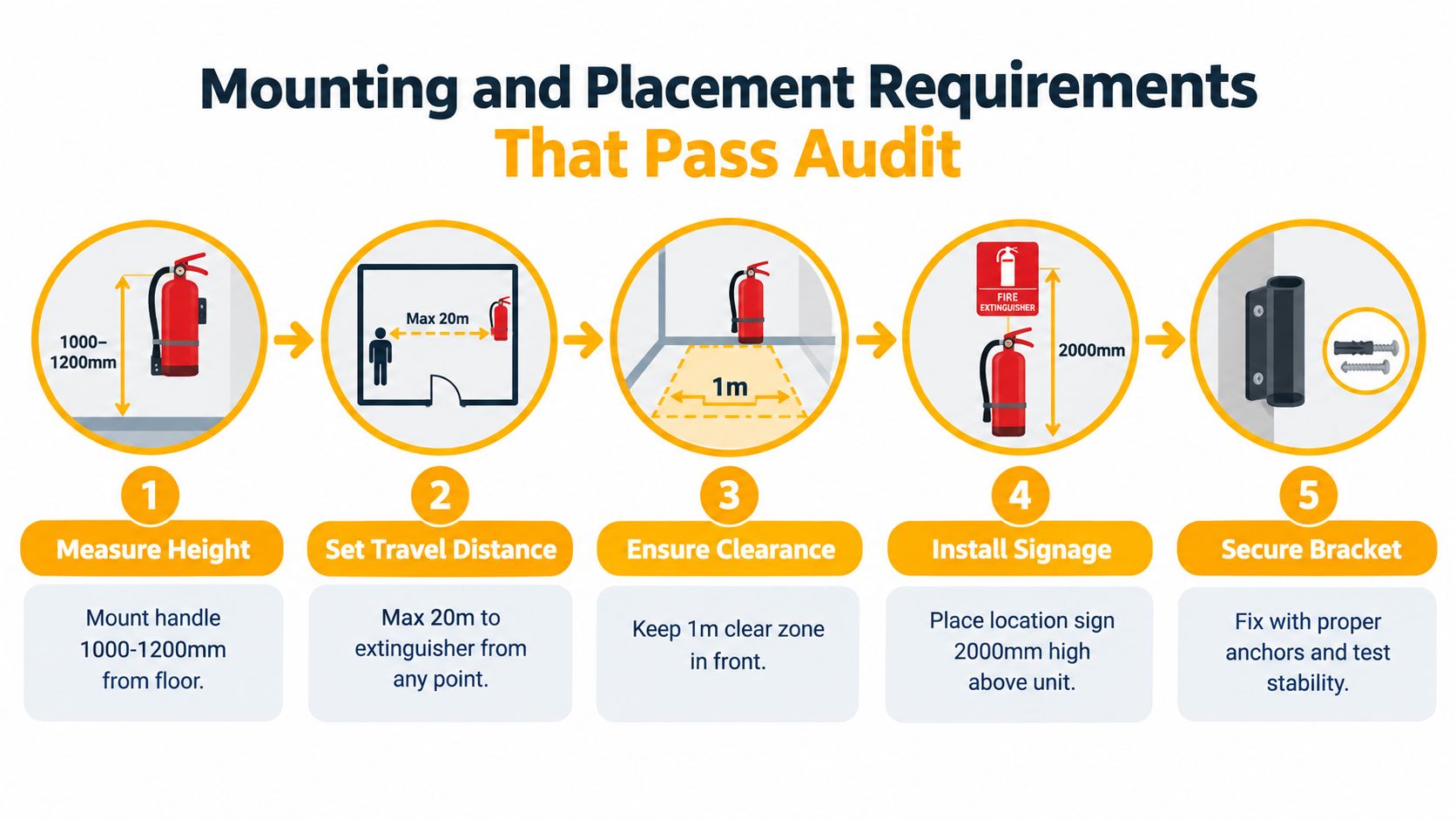
Mounting has to work in the operating environment, not in an empty room. The basic checks are straightforward. The extinguisher needs to be visible, reachable, securely fixed, and positioned so a person can get to it without moving into the fire area. In normal commercial installs, the handle is set no higher than 1200 mm above finished floor level, the base stays at least 100 mm above the floor, and the identification sign is mounted above the unit where it can still be seen once the fit-out is fully in use. A practical summary of those mounting conventions is set out in this AS 2444 guidance summary.
What actually passes on site
On Queensland jobs, I look past the tape measure first. Height matters, but access and survivability matter just as much over the life of the installation. A bracket fixed to a plasterboard nib in a warehouse might look fine at handover and fail after a few months of knocks. A unit mounted near a roller door in a coastal suburb can start showing corrosion earlier than the client expected. A cabinet outside a kitchen can collect grease film and become harder to inspect cleanly during routine service under AS 1851.
Placement affects maintenance cost. It also affects replacement timing.
A clean internal corridor usually suits an open wall bracket. A washdown area, loading dock, school walkway, or exposed car park often needs more protection around the unit. In those cases, cabinet choice is part of installation planning, not an afterthought. This guide on fire extinguisher and cabinet choices is a useful reference when the question is open bracket versus enclosed protection.
What auditors notice first
These are the checks that regularly decide whether a location holds up under inspection:
- Mounting height is correct, with the handle and base set within accepted installation limits
- The extinguisher is immediately accessible, with no stored goods, bins, displays, or door swings blocking approach
- The sign is visible from normal travel paths, not hidden by shelving, joinery, or an open leaf
- The location makes sense for retreat, so a person can reach the unit without being forced further into the hazard area
- The fixing method suits the surface and site use, especially on masonry, steel columns, external walls, and high-traffic warehouse zones
- The unit is protected where needed, without making operation slower or harder for staff
Poor placement usually comes from one of two mistakes. Someone installs for appearance, or someone installs for convenience. Neither helps at audit time.
Install for the site in service, not the room on day one.
Queensland conditions change good locations into expensive ones
This is the part many installers skip. The cheapest mounting point is not always the lowest-cost installation over five years.
Near the coast, salt air attacks cylinders, brackets, pins, and cabinet hardware faster than inland sites. In commercial kitchens and food tenancies, grease settles on handles, hoses, signage, and cabinet windows, which makes routine inspection slower and dirtier and can push earlier replacement of worn components. In warehouses and back-of-house retail areas, repeated contact from cages, pallets, and floor scrubbers shortens bracket life and damages cylinders if the unit sits in the traffic line.
None of that changes the core mounting rules. It changes where a sensible installer puts the unit so AS 1851 servicing stays manageable and the extinguisher does not age out early from avoidable exposure.
Here's a short demonstration resource that shows the kind of physical placement issues people often miss during fit-out.
Common siting mistakes
These are the failures that come up again and again:
- Behind doors, where the extinguisher disappears as soon as the door is opened
- At the far side of the hazard, which forces the user to move toward the fire instead of away from it
- On walls that become storage edges, where boxes, trolleys, or displays end up parked in front
- On exposed external walls without considering corrosion or weathering
- On columns and corners in forklift or pallet traffic without impact protection
- Inside rooms with no clear external indication, so approaching staff do not pick up the unit quickly in an emergency
Good placement is usually obvious once the job is done properly. Staff can see the extinguisher, reach it without delay, and keep it serviceable without fighting the building layout every six months.
Commissioning Labelling and Handover Documentation
A mounted extinguisher isn't a finished job. The installation is only complete when the unit is identified properly, recorded properly, and handed over in a way that supports future inspections and maintenance.
That final step gets neglected more often than it should, especially on small fit-outs where the builder or tenant is in a hurry to open.
Commission the install properly
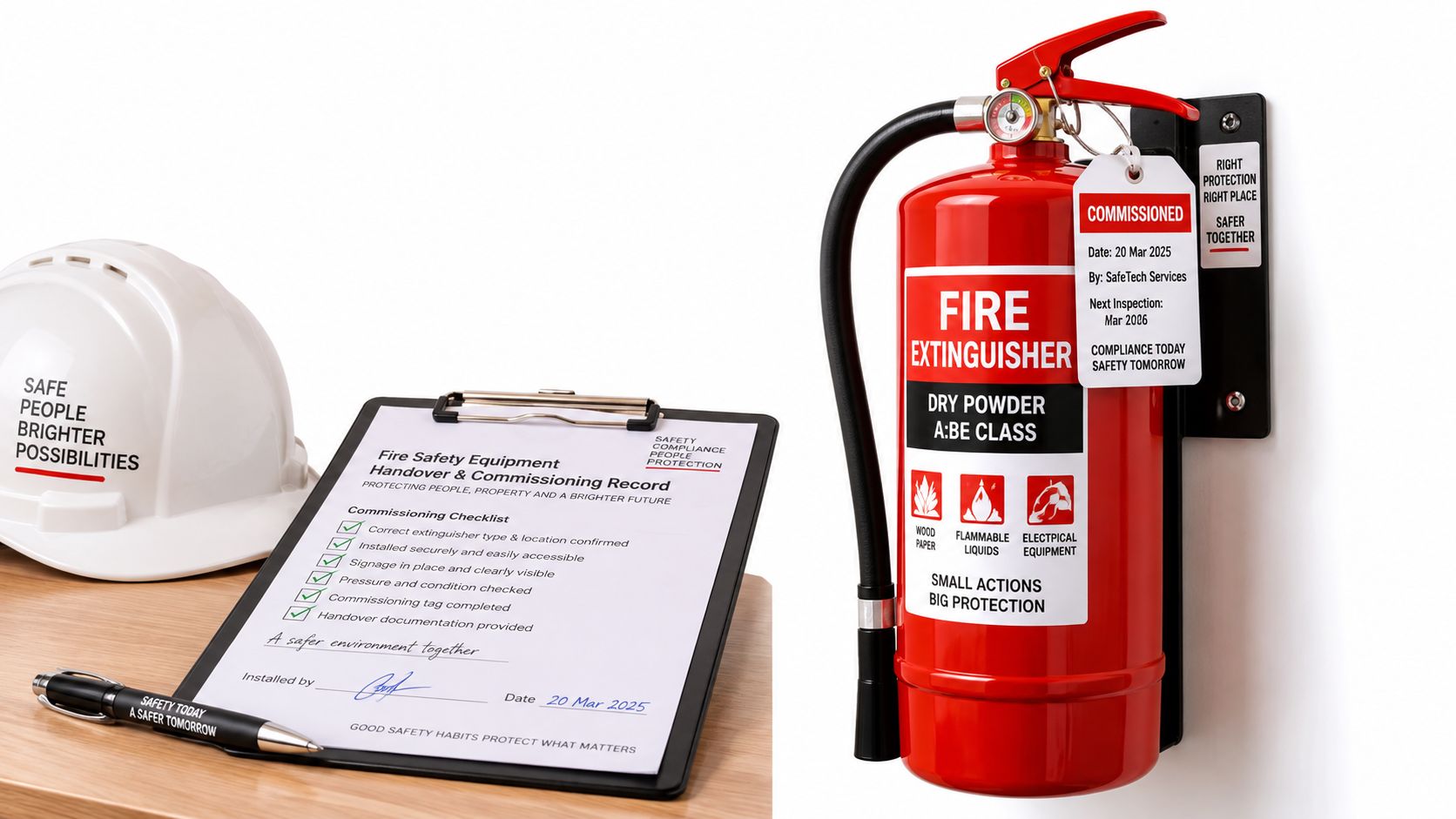
At commissioning, check the basics in the operating environment, not just against the plan:
- Confirm the unit matches the hazard in that location
- Check visibility from normal approach paths and not only from directly in front
- Verify the bracket or cabinet is secure and suited to the wall or support structure
- Make sure the location sign is installed correctly and can still be seen once shelving, displays or doors are in use
- Record the asset so it enters the site's maintenance system
Documentation is what proves the job was done
Queensland and Australian practice links installation to ongoing maintenance rather than a one-off fit-out. Portable extinguishers are maintained under AS 1851-2012, which specifies routine inspection, testing, preventive maintenance and survey for fire protection systems and equipment (AS 1851 product listing).
That means the handover should leave the client with a usable record set, not just an invoice. On commercial premises, that usually includes:
- Asset register entries identifying each extinguisher location
- Service commencement details so the unit enters the maintenance schedule
- Photographic records of final installed position
- Location references that make future inspections quicker for facility managers and strata teams
What makes future inspections easier
Sites run better when the documentation matches what's on the wall. If location labels, plans and photos all line up, six-monthly servicing is straightforward. If nothing matches because the fit-out changed after install, every routine inspection takes longer and defects get missed more easily.
For businesses that want supply, installation, testing and ongoing records handled under one provider, Celtic Fire & Security offers those services for commercial premises across North Brisbane, Moreton Bay, Sunshine Coast, Somerset and Ipswich under current licences. The value is practical rather than flashy. One job trail from install through maintenance is easier to manage than splitting it across different contractors.
Maintenance Schedules and Tips to Keep Your Installation Compliant
The cost of fire extinguisher installation shows up after handover. Not in the bracket or the sign, but in how easy the unit is to inspect, service and keep protected from the environment around it.
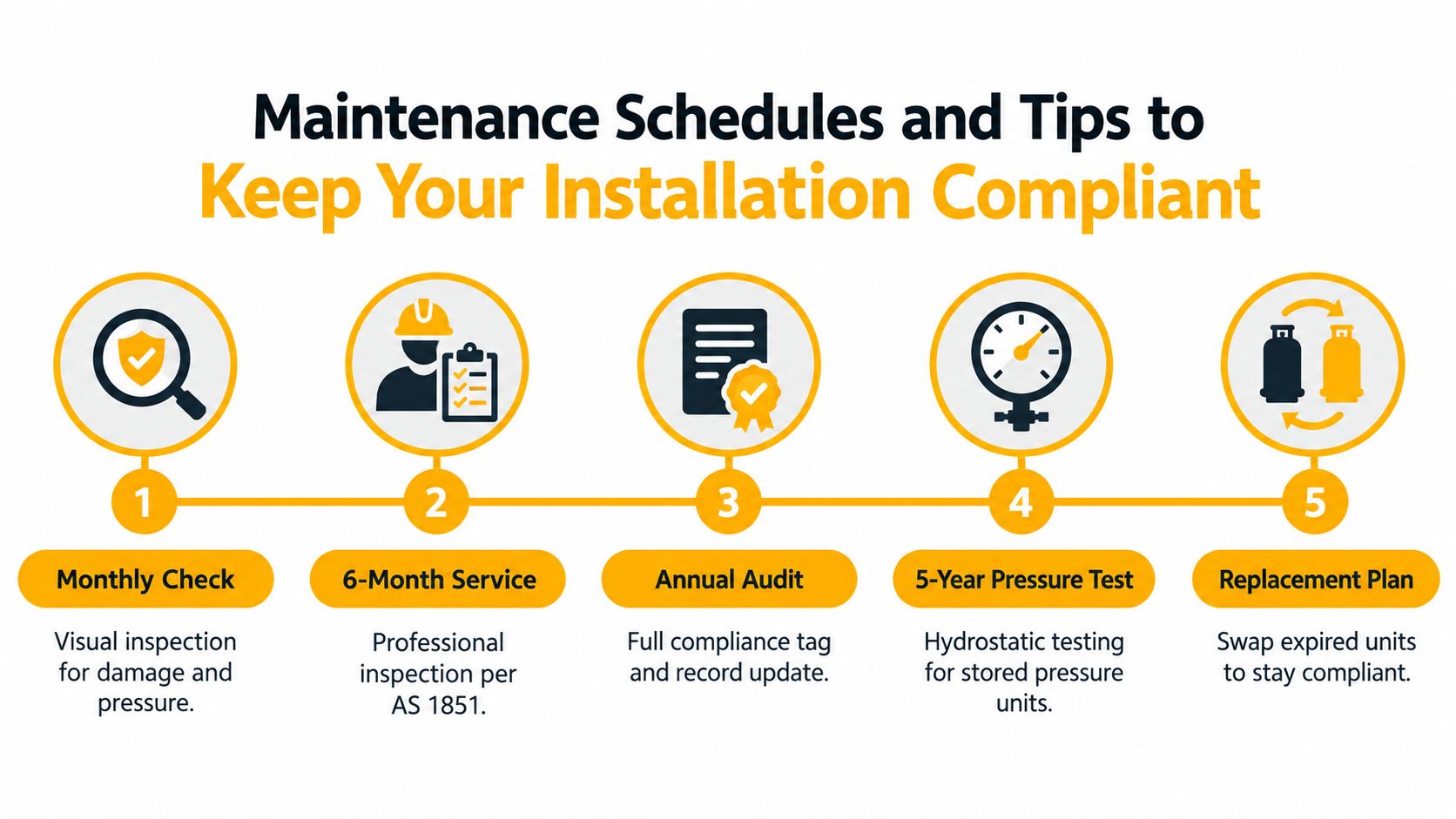
Australian guidance is clear that extinguishers don't just get installed and forgotten. Once they're on the wall, they move into a defined maintenance rhythm under AS 1851. Government and industry guidance in Australia states that portable extinguishers must be inspected every six months after installation, with annual detailed servicing and five-yearly hydrostatic testing or overhaul forming the recurring benchmark (Tasmania fire extinguisher guide).
A visual schedule helps site managers keep that cycle in view.
Queensland conditions change the lifecycle
Installation decisions affect cost. A unit in a clean office corridor is easier to keep serviceable than one mounted near salt air, forklift traffic, grease vapour or abrasive dust. Queensland guidance aimed at owners also notes that pressure testing intervals can shorten in aggressive or corrosive environments, which matters for coastal and industrial locations (Queensland fire safety management guide).
That's why lifecycle-aware planning matters. The cheapest install position can become the most expensive service position if technicians can't access it easily, if signage keeps getting damaged, or if the cylinder and fittings are exposed to conditions that speed up deterioration.
Install where the extinguisher can survive the site, not just where it fits on day one.
Keep the service cycle simple
Australian servicing guidance also states that all extinguishers must be inspected at six-month intervals, some units without a pressure gauge may need to be weighed to confirm contents, and extinguishers must be emptied, pressure tested and refilled every five years (extinguisher servicing guide).
For busy commercial premises, the practical routine is:
- Check access regularly: Don't let stock, bins, carts or furniture creep into the access zone.
- Watch the environment: Salt, grease and dust don't wait for the next major refit.
- Protect vulnerable locations: Cabinets, bollards or revised mounting positions can reduce repeat damage.
- Keep records current: Outdated tags and missing records can sink an otherwise sound installation.
- Use scheduled maintenance, not reactive call-outs: A planned program catches issues before an audit or an emergency does.
For businesses comparing providers or setting up a schedule, this guide to fire extinguisher maintenance gives a useful overview of what ongoing servicing involves.
A compliant installation is the starting point. The sites that stay compliant are the ones that treat access, records and servicing as part of the installation decision from the beginning.
If you need fire extinguisher installation done properly for a fit-out, audit rectification, or a site that's hard on equipment, Celtic Fire & Security can supply, install, test and maintain extinguishers for commercial premises across South East Queensland under the relevant licences and Australian Standards. For practical advice on placement, cabinets, servicing access and ongoing compliance, visit Celtic Fire & Security.
No responses yet