
A tenant reports a smoke alarm beeping just before the morning shift starts. The facilities manager silences the immediate nuisance, then opens the site logbook and finds that the last three scheduled entries are missing. The alarm may be working, but the building's evidence trail isn't.
That distinction matters in Queensland. Smoke alarms maintenance is not only about pressing a test button or changing a battery. It's about showing who held the duty, who carried out the work, what they found, and how defects were closed. A commercial fire safety audit examines that chain of responsibility as closely as the device on the ceiling.
Table of Contents
- Why Commercial Smoke Alarms Maintenance Matters in Queensland
- Core Maintenance Schedule and Test Frequencies
- Record Keeping and Log Books That Pass an Audit
- Coordinating Certified Servicing Under AS 1851
- Troubleshooting Common Smoke Alarm Faults
- When Maintenance Is Not Enough and Replacement Is Due
- Putting Your Maintenance Program Into Practice
Why Commercial Smoke Alarms Maintenance Matters in Queensland
The building owner, operator, or other responsible duty holder carries the fire safety obligation. That legal responsibility is separate from the technician who attends site. A technician can test an alarm, record a defect, and recommend replacement, but the duty holder still needs to make sure the work is authorised, completed, documented, and retained.
Queensland tenancy rules make this practical responsibility clear in residential settings. Owners and property managers must test alarms within 30 days before a tenancy starts or is renewed, replace flat or nearly flat batteries within that same period, and give tenants 48 hours' notice before entering for installation, testing, maintenance, or replacement work. Tenants must test and clean alarms at least once every 12 months during the tenancy. These obligations are set out in the Queensland Residential Tenancies Authority smoke alarm guidance.
Commercial premises require a broader operational view. The system must be maintained in the condition required by its design, approval documents, occupancy type, and applicable standards. The main reference points are:
- AS 1851, for routine servicing of fire detection and protection systems.
- AS 3786, for smoke alarm units.
- AS 1670.1, for fire detection and alarm system installation in commercial buildings.
- The National Construction Code, including deployment requirements that determine how many alarms, detectors, and interconnections the building should have.
Practical rule: A signed test record is evidence of maintenance. It isn't a substitute for correcting a failed alarm.
The scope of maintenance depends on the original installation. A building with a panel-controlled detection system, interconnected alarms, or a mixed-use layout can't be managed like a small standalone tenancy. The responsible person needs an asset register, a controlled logbook, clear access arrangements, and a contractor process that links defects to close-out evidence.
This approach also prevents a common mistake. A panel showing no active fault doesn't prove every field device has been individually tested, cleaned, identified, and confirmed suitable for the space. The rest of this guide focuses on the working mechanics, including test frequencies, logbook custody, contractor handover, fault decisions, and age tracking.
Core Maintenance Schedule and Test Frequencies
A dependable programme gives each task a fixed owner and cadence. Manufacturer instructions still matter, but the maintenance plan should also reflect the applicable Australian Standard, the building's fire safety obligations, and the type of alarm system installed.
Monthly checks
Press the test button on every alarm, not just the first unit in a corridor. Confirm the sounder operates, check that the indicator light behaves as expected, and inspect the alarm for obstruction, dust, cobwebs, impact damage, or paint overspray from nearby fit-out work.
For interconnected systems, verify that the connected alarms respond as designed. A single local sound can hide a failed interconnection, a disconnected unit, or an incomplete alteration. Record the result against a specific location or device identifier rather than writing only “site tested”.
Queensland fire guidance supports monthly testing by pressing the test button. The Queensland Fire Department smoke alarm guidance also states that alarms that fail testing must be replaced, rather than left in service while someone waits for the next routine visit.
Six-monthly cleaning and inspection
Dust is a maintenance issue, not merely a housekeeping issue. Clean the alarm housing and vents with a low-suction vacuum or another manufacturer-approved method. Don't spray chemicals into the unit, flood the casing with liquid, or dismantle a sealed device without the required procedure.
Inspect standalone alarms for battery condition and confirm that hard-wired units have their backup supply maintained. Check mounting, wiring access, labels, and the physical condition of the device. In accommodation and other higher-risk building contexts, Queensland guidance can require six-monthly visual inspection and cleaning as part of the applicable regime.
Annual servicing and age review
An annual service should include a documented functional assessment appropriate to the system, any required simulated smoke or approved aerosol test, interconnection checks, and a review of the manufacture date. Confirm that alarms remain within the 10-year replacement horizon, as Australian and Queensland guidance generally requires alarms to be replaced after that period. The Fire and Rescue NSW maintenance guide provides the Australian maintenance benchmarks for monthly testing, cleaning, battery care, and end-of-life replacement.
| Cadence | Task | Responsible person | Standard reference |
|---|---|---|---|
| Monthly | Push-button test, visual inspection, device identification, and record entry | Trained in-house officer or appointed service provider | AS 1851, AS 3786, site procedure |
| Six-monthly | Clean vents and housing, inspect condition, check power and backup supply | In-house team or qualified contractor, depending on system | AS 1851, manufacturer instructions |
| Annual | Documented functional service, system review, age verification, and defect assessment | Qualified fire protection contractor where required | AS 1851, AS 3786, AS 1670.1 |
| At end of service life | Remove and replace the alarm, then update the register | Duty holder with competent installer or contractor | Queensland requirements and AS 3786 |
Some sealed lithium units have a defined battery replacement cycle, while other devices require replacement of the complete alarm. The register should identify the model so the team doesn't treat every battery warning as if it came from the same product type.
Record Keeping and Log Books That Pass an Audit
A Brisbane medical centre had a current-looking logbook when an audit began. The pages contained dates and broad descriptions, but the technician's licence or registration details were absent. The work may have been completed, yet the record couldn't clearly establish who performed it or what authority supported the service.
That kind of gap is avoidable. A useful entry lets another person trace the alarm without relying on memory or a contractor's inbox.
What each entry should show
Record the date and time, the alarm identifier, the test method, the result, the person who performed the work, and any corrective action. The identifier might be a zone number, device serial number, room description, or another reference that matches the site register.
A sound entry should answer these questions:
- Which alarm was checked? Use a location and device reference, not only “all alarms”.
- How was it checked? State whether the test was a push-button test, functional test, cleaning inspection, or another approved method.
- What happened? Mark the result as pass, fail, or defect requiring follow-up.
- Who did the work? Include the person's name and licence or registration details where applicable.
- What was fixed? Record the defect, action taken, replacement details, and close-out date.
An in-house maintenance entry and a contractor's service report should support each other. The logbook remains the day-to-day record, while an Annual Fire Safety Statement is a separate statutory declaration or certificate process. The statement doesn't replace the underlying evidence.
The smoke alarm compliance certificate guidance is useful when reviewing the distinction between certification and supporting maintenance documentation.
Gaps that create audit trouble
Auditors often question missing credentials, absent cleaning records, vague “tested and passed” wording, and records stored away from the premises. A panel printout can also be insufficient if it doesn't demonstrate that individual alarms were examined and tested.
A logbook should allow the auditor to follow one alarm from its location, through its test history, to any replacement or defect close-out.
Keep the current logbook on site or make it immediately available to the person inspecting the building. Store contractor reports with the relevant monthly entries, not in a separate folder that nobody can locate during an inspection.
Coordinating Certified Servicing Under AS 1851
Routine checks and qualified servicing are different activities. A trained facilities officer may carry out the site's scheduled visual checks and push-button tests, while a qualified contractor services a commercial detection system under the applicable AS 1851 regime.
The required arrangement depends on the building class, system type, occupancy risk, and essential safety measures. A panel-controlled commercial smoke detection system should be serviced by a qualified contractor. Queensland guidance identifies AS 1851 as the detailed maintenance reference for commercial smoke detection systems, while building-specific procedures can impose additional inspections.
Allocate the work before the visit
The facilities manager should define who can perform each task, what training or licence is needed, and which records must be produced. Where a hard-wired system interfaces with a 240 V supply, the electrical component must be handled by an appropriately licensed person. Fire protection competency, including FPAS accreditation where applicable, should be checked against the service scope rather than assumed from a generic maintenance title.
A contractor report should identify the standards applied, the equipment inspected, the test method, the result, and each outstanding defect. It should also cross-reference the relevant Essential Safety Measures register so the report and site records describe the same system.
| Building class | Service frequency | Required log entry |
|---|---|---|
| Standalone domestic-style alarms in a commercial tenancy | Follow the approved site and manufacturer regime, with routine checks recorded | Individual location, test result, power condition, cleaning, and defects |
| Commercial premises with panel-controlled detection | Qualified contractor attendance under the applicable AS 1851 regime | Panel and field devices tested, standards referenced, defects and close-out |
| Accommodation or higher-risk premises | Monthly testing with additional visual inspection and cleaning where the applicable guidance requires it | Device-level results, cleaning record, contractor details, and corrective action |
| Mixed-use or altered premises | Frequency determined by the approved system, occupancy, and fire safety obligations | Updated asset register, commissioning or alteration evidence, and service history |
Unsigned pages, missing detector identifiers, and descriptions such as “tested and passed” without a method are weak evidence. So is a report that lists the panel but not the field devices.
For practical planning, a facility manager can use a documented commercial fire protection service process that sets access windows, tenant notifications, isolation controls, and report handover requirements. Ask for the digital report and a hard-copy duplicate where the site filing system requires both, then review and sign the report promptly.
Troubleshooting Common Smoke Alarm Faults
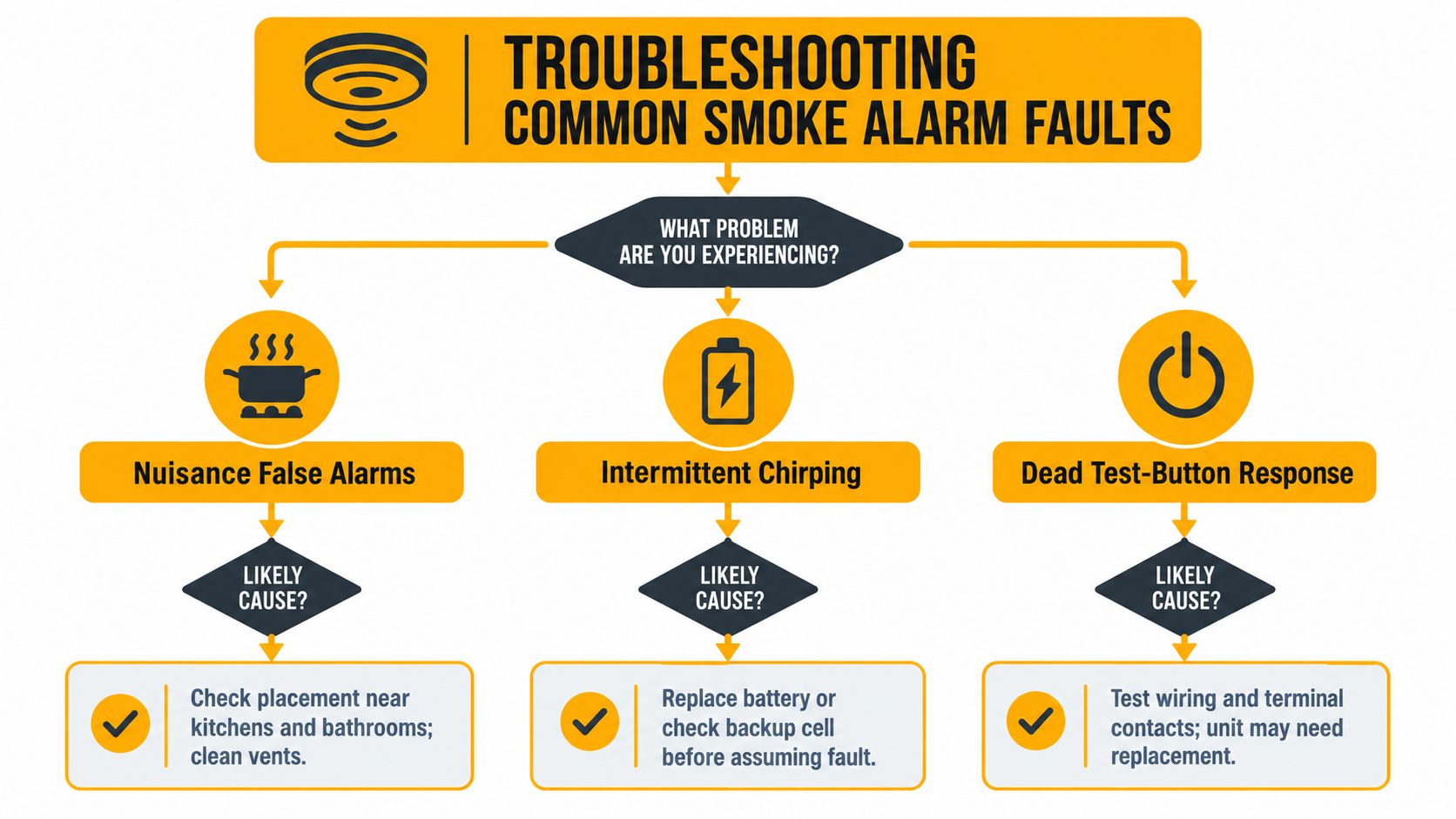
Most fault calls fall into three groups: nuisance alarms, intermittent chirping, and a test button that produces no response. Start with the environment, then inspect the device, then decide whether the unit can remain in service.
Nuisance false alarms
First check whether steam from a staff kitchen, aerosols, dust from grinding, or another temporary condition is reaching the detector. Confirm the alarm's position against the approved layout and inspect the vents for contamination. Clean the unit using the approved method and check the manufacturer's hush function if the model provides one.
If the alarm continues after cleaning, inspect the LED pattern and compare it with the manufacturer's datasheet. A recurring false alarm may indicate contamination, sensitivity drift, incorrect placement, or a damaged unit. Don't permanently disable the alarm to stop complaints.
Intermittent chirping
A chirp may indicate a low battery, a backup supply issue, or an end-of-life condition. Sealed lithium models don't have a removable battery for routine replacement, so the correct action may be replacement of the complete alarm. Check the model, battery arrangement, date of manufacture, and documented LED pattern before choosing the remedy.
Dead test-button response
Check the supply, terminal connections, isolating devices, and mounting contacts on a hard-wired system. For a standalone unit, check the battery arrangement and clean the alarm before repeating the approved test. If the alarm still fails, mark it failed, isolate the risk only under an approved procedure, and arrange replacement.
Queensland guidance applies a simple outcome rule. An alarm that doesn't operate when tested must be replaced, and an alarm beyond its service life shouldn't be repaired back into service. Record the failed test, removal, replacement model, manufacture details, and final test.
For recurring nuisance alarms, the practical distinction between cleaning, relocation, and replacement is covered in this guide to a smoke alarm that keeps going off.
When Maintenance Is Not Enough and Replacement Is Due
Replacement belongs inside the maintenance programme. It shouldn't appear as an emergency capital project only after an auditor finds an expired alarm or a failed test.
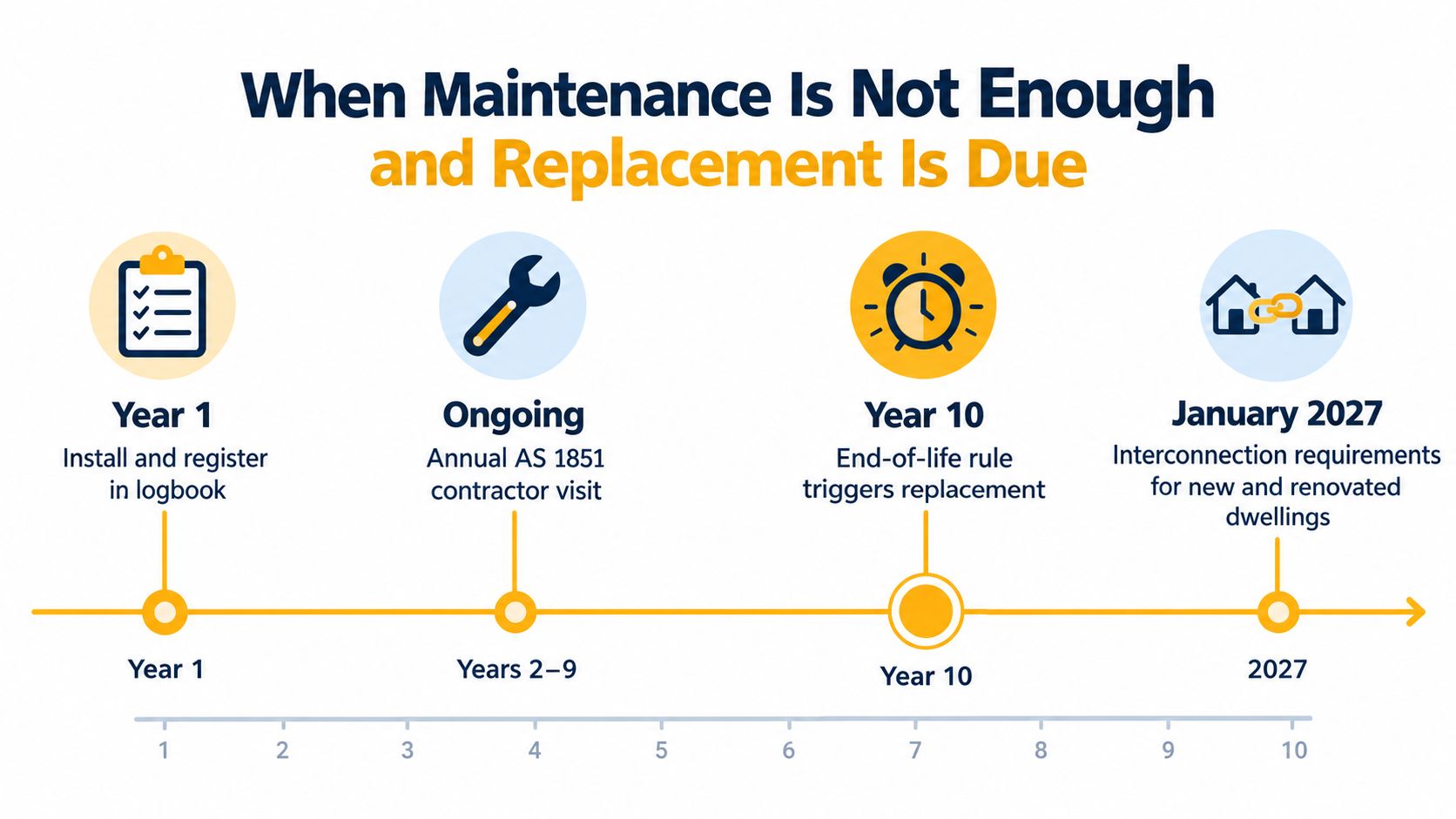
Queensland legislation requires a domestic dwelling owner to replace a smoke alarm within 10 years after its manufacture date. Queensland Fire Department advice also identifies alarms older than that period, and alarms that fail testing, as replacement items. The Queensland legislation covering smoke alarm obligations should be checked alongside the current approved design and occupancy requirements.
Track age from the start
Record the manufacture date stamped on the alarm or base. Add the installation date to the asset register, then create a forward calendar reminder before the replacement cut-off. That gives the procurement team time to confirm the model, the electrician or fire contractor, access requirements, and any interconnection changes.
Replacement can be triggered before the end-of-life date. Yellowed housings, physical damage from trades, repeated false alarms after cleaning, and failed functional or sensitivity checks all warrant a documented decision. The entry should explain why the alarm was removed and identify the replacement installed.
Configuration matters as much as age. Australian fire research notes that the number, location, and interconnection of alarms influence fire safety outcomes, and Queensland materials require leased dwellings to use photoelectric, interconnected alarms that are less than 10 years old and powered by hard-wiring or a non-removable 10-year battery. The Australian smoke alarm research paper helps frame why a test of one isolated device isn't always enough to confirm suitable coverage.
Queensland materials also state that by 1 January 2027, alarms must be interconnected and photoelectric in the relevant dwelling applications. Treat that date as a planning checkpoint for new work, renovations, and affected existing premises, rather than waiting for a rushed compliance project.
Putting Your Maintenance Program Into Practice
A workable programme has one owner, one register, and one place where the current evidence can be produced. The in-house maintenance officer should hold the site logbook, keep the alarm register updated, and countersign each completed check. The responsible building manager should review failed entries and make sure defects are assigned rather than left as open notes.
Set the first working day of each month as the push-button test date. Record each alarm individually, then escalate any failed unit immediately. Schedule the six-monthly clean alongside an established facilities cycle, such as a planned building services inspection, so the task isn't forgotten when staff change.
Use clear hand-off points
The in-house team should identify access restrictions, tenant complaints, visible damage, and failed routine tests. The contractor should confirm the service scope, isolate panels safely where required, test the relevant system, identify the standard or procedure used, and return a report that matches the asset register.
A defect is not closed because a contractor has emailed that replacement is required. It closes when the replacement or repair decision has been completed, the result has been tested, and the logbook contains the action and date. Set a written response target for urgent defects and monitor it through the facilities register.
Book the annual contractor service in advance, then carry out a fixed January review of every manufacture date, installation record, and upcoming replacement requirement. Include the 1 January 2027 interconnection planning point where it applies. This calendar rhythm turns compliance from a last-minute search for paperwork into ordinary site management.
The evidence standard is simple. An auditor should be able to select an alarm, find its location, see its recent test history, confirm who performed the work, and follow any defect through to close-out without searching through personal email accounts or off-site folders.
Celtic Fire & Security supplies, installs, tests, and maintains smoke and heat alarms for commercial premises, with scheduled preventative maintenance and compliance documentation for sites across North Brisbane, Moreton Bay, the Sunshine Coast, Somerset, and Ipswich. Review your alarm register, logbook, and upcoming replacement dates, then contact Celtic Fire & Security to arrange a documented assessment and maintenance plan.
No responses yet