
Queensland commercial fire extinguisher requirements are governed by AS 2444 for selection and placement, AS 1851 for maintenance, and a mandatory six-monthly inspection cycle by an appropriately qualified technician. A five-year pressure test also applies when a portable extinguisher's manufacture stamp is older than five years.
That makes the common “buy it, hang it, forget it” approach dangerously incomplete. The extinguisher on the wall may look ready, yet the business can still fail an audit if the unit was selected for the wrong hazard, obstructed by stock, missing its maintenance tag, or overdue for testing.
The most reliable approach is to treat each extinguisher as part of a documented lifecycle. Select it against the risk, install it where people can reach and see it, arrange scheduled servicing, and retain evidence that the work occurred. Queensland businesses that manage only the installation are managing the most visible part of compliance, not the part most likely to expose gaps later.
Table of Contents
- The Reality Behind Commercial Fire Extinguisher Requirements
- Australian Fire Classes and Placement Standards
- Navigating Queensland Regulatory Frameworks
- The Critical Maintenance and Servicing Schedule
- Extinguisher Selection by Hazard Type
- Recordkeeping and Professional Service Requirements
The Reality Behind Commercial Fire Extinguisher Requirements
A fire extinguisher is not compliant just because it is red, charged, and mounted on a wall. In Queensland, commercial premises must manage prescribed fire safety installations through ongoing inspection, maintenance, tagging, and recordkeeping. The purchase is the beginning of the process.
The placement benchmark comes from AS 2444, which covers the selection and location of portable fire extinguishers and fire blankets. Victoria's fire authority also states that extinguishers should be installed in line with AS 2444 and positioned so they're clearly visible from up to 20 metres in all directions, with practical locations near exits and accessible circulation areas. See the Australian guidance on commercial extinguisher placement for the visibility principle and installation context.
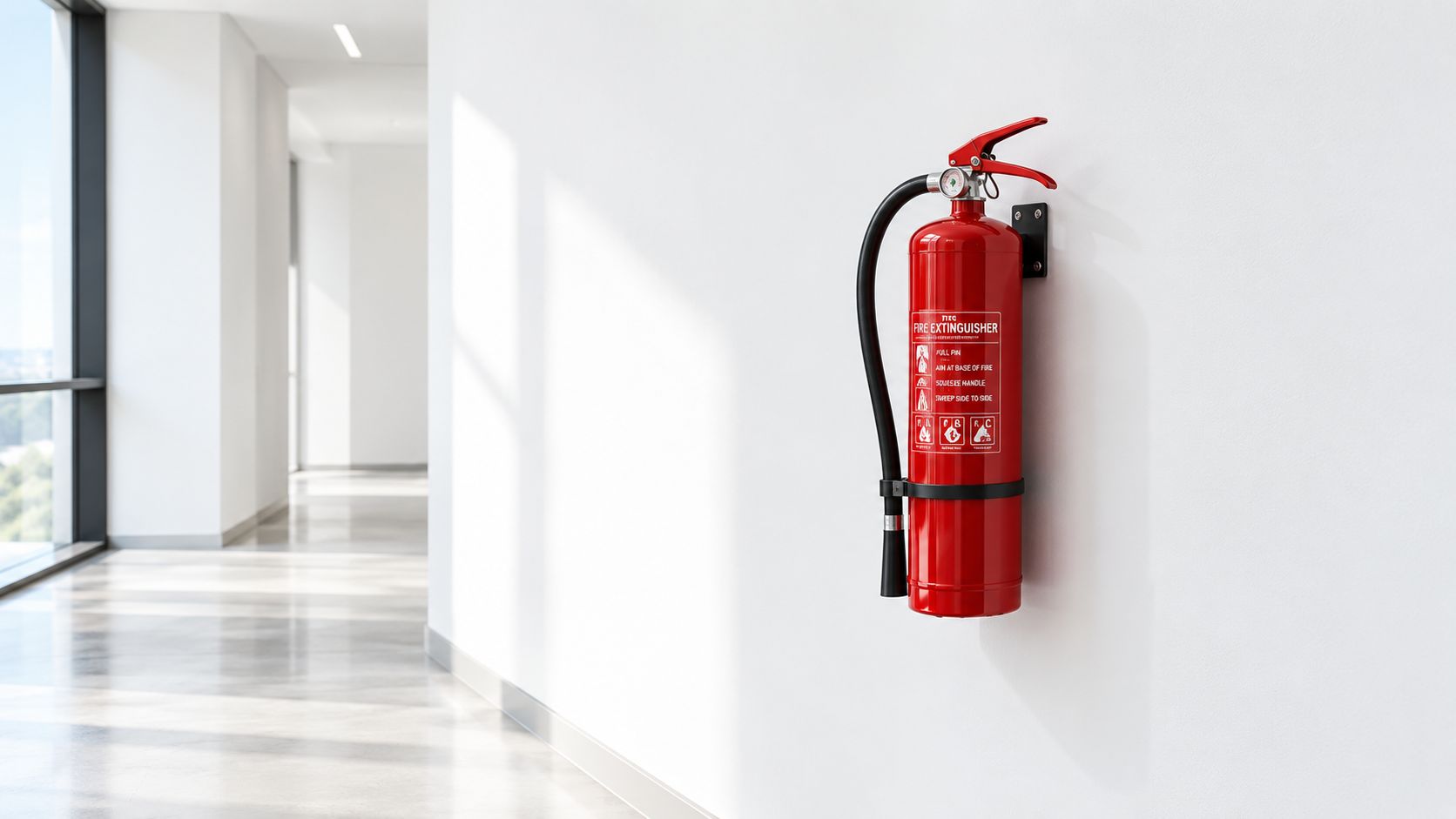
The wall-mounted unit is only one part of the system
A compliant program answers several separate questions:
- Was the extinguisher selected correctly? Its type and rating must suit the hazard in that area.
- Can people reach it quickly? Storage, partitions, displays, vehicles, and equipment must not block access.
- Can occupants identify it immediately? Visibility, signage, and suitable positioning matter during a stressful incident.
- Has it been serviced on schedule? A missed inspection can leave the business unable to demonstrate that the unit was checked.
- Can the business produce evidence? Tags, invoices, and service summaries support audit readiness and tenancy handovers.
These controls work together. A correct extinguisher in an inaccessible location is a failure of practical protection. A visible extinguisher with no maintenance evidence is a documentation failure. A fully serviced unit that doesn't match the hazard is a selection failure.
Compliance is a recurring operating task
Queensland guidance treats portable extinguishers in commercial buildings as prescribed fire safety installations. That means facility managers should build servicing into the site's recurring maintenance calendar instead of relying on memory or waiting for a building inspection.
The historical development of AS 2444 reinforces this point. Standards Australia records that the standard was first published in part as AS 2444-1981, followed by editions in 1982, 1985, 1990, and 1995, showing that the placement framework has been refined over decades rather than appearing as a recent administrative requirement.
Practical rule: If your compliance file contains only purchase invoices, your program is incomplete.
The six-month service cycle and the five-year pressure-testing milestone deserve particular attention. They're the points most likely to be missed when a business treats extinguishers as static equipment rather than safety assets that require planned intervention.
Australian Fire Classes and Placement Standards
Selection starts with the material that could burn, not with the extinguisher a supplier happens to have in stock. Australian fire classes identify the hazard, while AS 2444 informs the selection, rating, location, and distribution of the portable equipment intended to address it.
Australian classes include Class A for carbonaceous solids, Class B for flammable and combustible liquids, Class C for combustible gases, Class D for combustible metals, and Class F for cooking oils and fats. Queensland Fire and Emergency Services sets out these Australian classifications in its fire extinguisher information.
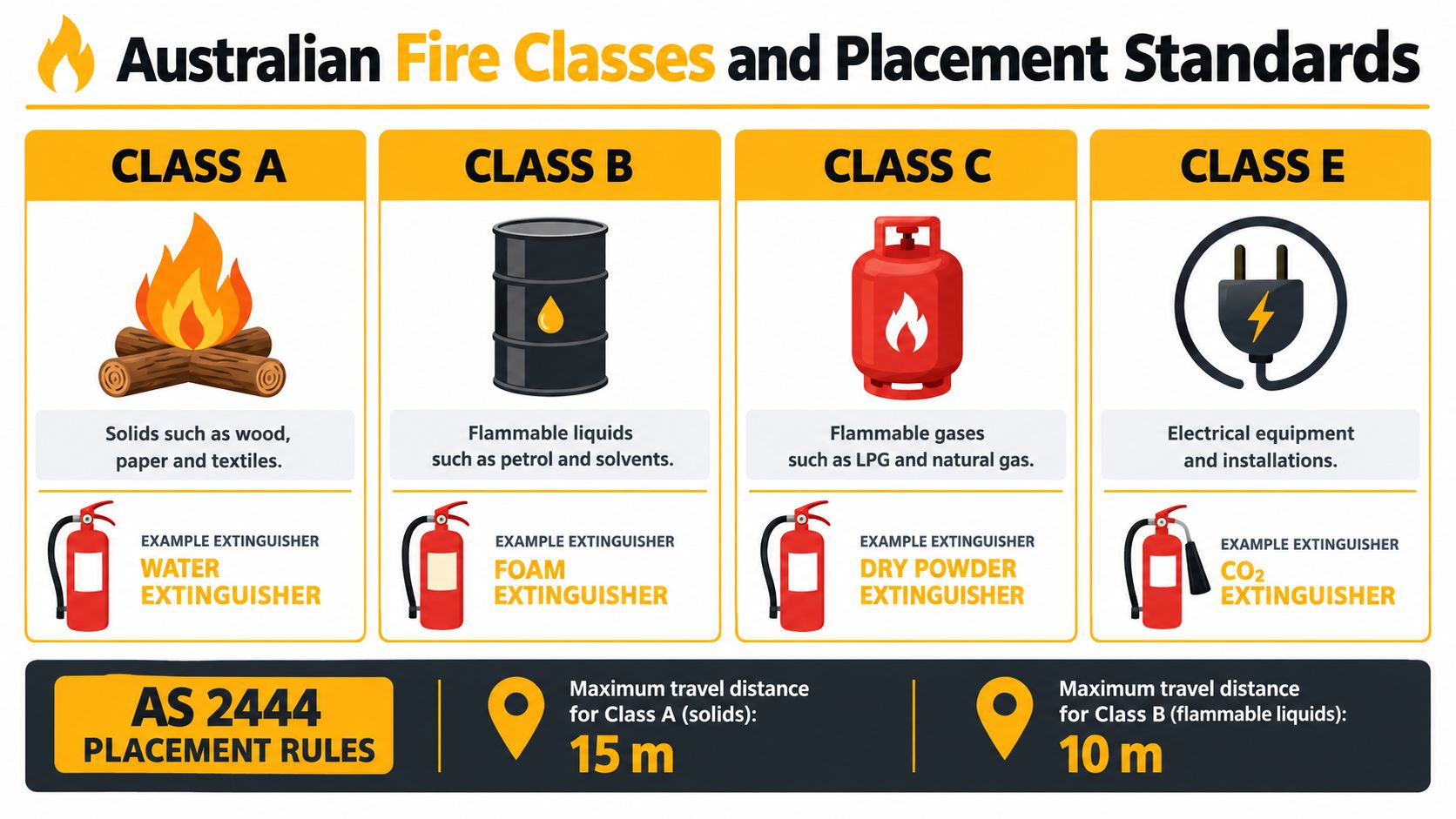
Match the agent to the hazard
A general office may contain paper, cardboard, timber furniture, and other carbonaceous solids. That points the selection process towards the Class A risk, while electrical equipment must be considered as part of the actual fire scenario and the suitability of the extinguishing agent.
A workshop or storeroom handling solvents, fuels, paints, or other flammable liquids requires assessment for Class B hazards. A commercial kitchen needs specific consideration of Class F cooking oils and fats. Treating the kitchen as an ordinary office area is poor risk management, even if both rooms have similar floor space.
Combustible gases and metals require specialist assessment. The correct decision depends on the substance, quantity, layout, and likely fire development, not on a generic “one extinguisher per room” formula.
For a practical overview of fire extinguisher types used in Australia, compare the equipment with the hazards present on your site rather than selecting by colour alone.
Positioning turns selection into protection
AS 2444 links equipment choice with travel distance, hazard classification, and the size and rating of the extinguisher. Victoria's guidance says units should be clearly visible from up to 20 metres in all directions, with placement near exits and in accessible circulation areas. That makes corridors, exit paths, and normal movement routes better candidates than concealed corners behind stock or machinery.
Ask three practical questions during a walk-through:
- Could an occupant identify the extinguisher immediately?
- Could they reach it without moving goods or passing through a hazard?
- Does the unit serve the risk in that zone, rather than merely occupy wall space?
The answer must be based on the premises as it operates. A warehouse layout changes when shelving is added. A retail store changes when promotional displays move. A kitchen changes when cooking equipment or oil storage changes. Reassess the placement whenever the hazard or traffic pattern changes.
Navigating Queensland Regulatory Frameworks
Queensland compliance sits across several connected layers. The National Construction Code provides the broader building framework, the Queensland Development Code MP 6.1 addresses fire safety installations, and Australian Standards provide the technical rules used for selection, installation, and maintenance.
For portable extinguishers, the practical chain is clear. AS 2444 helps determine what equipment belongs in each hazard area and where it should be placed. Queensland's fire safety framework then requires prescribed installations to be commissioned and maintained to the required standards. The state's guidance on prescribed fire safety installations points to AS 1851-2012 Section 10 for the maintenance regime applying to portable and wheeled extinguishers.
What prescribed installation status means
A prescribed fire safety installation is not an optional item bought for reassurance. It is equipment that forms part of the building's fire safety arrangements and must be maintained so it remains serviceable.
For a business occupier, that creates a practical duty:
- Maintain the equipment, rather than treating installation as the final task.
- Use an appropriately qualified person for the relevant work.
- Keep service evidence, so the business can demonstrate what was checked and when.
- Coordinate changes, including fit-outs, new storage, altered work areas, and changes in occupancy.
AS 1851 deals with the maintenance side, while AS 2444 deals with selection and location. Neither standard should be used in isolation. A technician can service an extinguisher perfectly, but that service won't correct a unit selected for the wrong hazard or positioned where occupants can't access it.
Why the hierarchy matters to managers
Facility managers often inherit mixed records from landlords, tenants, contractors, and previous service providers. That fragmentation creates uncertainty about which units belong to which hazard, whether a replacement preserved the required rating, and whether the current maintenance cycle is still traceable.
The right response is not to collect more disconnected certificates. It is to maintain a site register that identifies each unit, its location, its hazard purpose, its service dates, and the evidence associated with the work. For a deeper operational view, review the Queensland fire extinguisher testing requirements alongside the building's existing fire safety documentation.
The Critical Maintenance and Servicing Schedule
The maintenance lifecycle has two milestones that businesses must keep separate: the routine inspection cycle and the age-based pressure test. Confusing them is a common reason equipment remains on the wall while falling outside the required servicing framework.
Queensland guidance requires portable extinguishers in commercial buildings to be inspected, tagged, and punched at least every six months by an appropriately qualified person. The same guidance identifies six-monthly, yearly, and five-yearly testing as applicable maintenance intervals under the Queensland framework. The Queensland maintenance options guidance explains the inspection, tagging, and recordkeeping expectations.
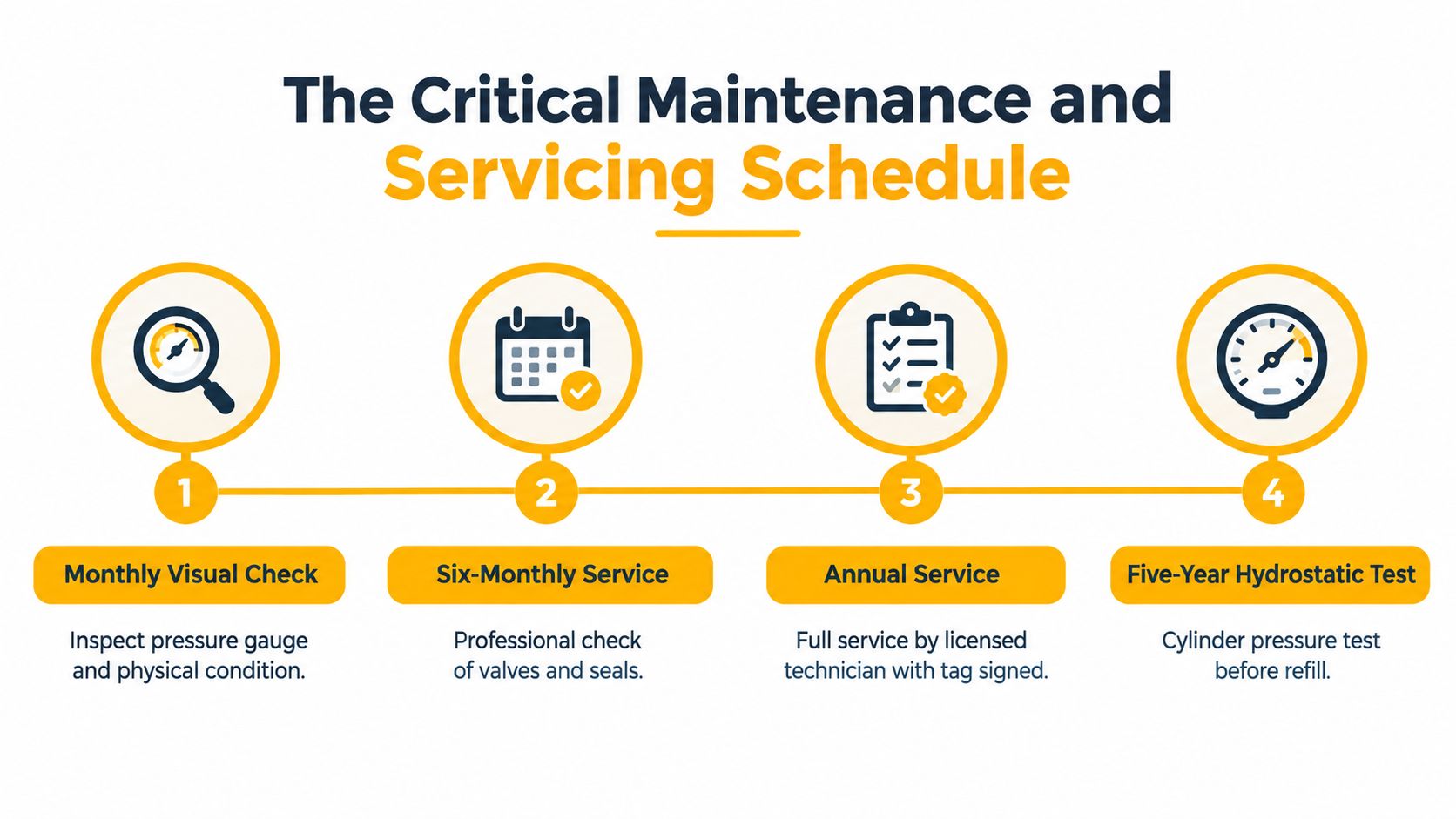
Six-monthly servicing is the operational baseline
At the six-month inspection, the appropriately qualified person should assess the extinguisher's condition and serviceability, including matters such as access, charge, seals, and signs of damage or interference. The unit must be tagged and punched as required, with supporting service evidence issued for the site file.
This is not a quick visual glance by a staff member. A monthly internal walk-through can identify obvious obstruction, damage, or movement, but it doesn't replace the prescribed service carried out by a qualified person.
Book the service before the due date, not after it. A missed cycle can create a gap that is difficult to explain during an audit, especially when the business has no record showing that the equipment was checked during the relevant period.
Five-year pressure testing is a separate event
Queensland advisory material states that a portable extinguisher with a manufacture stamp older than five years must undergo hydrostatic pressure testing by an approved tester under Australian Standards. The Queensland fire safety management advisory notes identifies this five-year threshold and the associated maintenance evidence.
Pressure testing is more than a standard service visit. It tests the cylinder's ability to withstand pressure, and the extinguisher may need to be removed from service for the work. Plan for continuity so a site isn't left without suitable protection while equipment is away for testing or recharge.
Use a register that records:
- Manufacture information: Capture the stamp or other identifying details needed to identify the five-year milestone.
- Service dates: Record six-monthly and other applicable service events separately.
- Tag status: Confirm the unit has been tagged and punched as required.
- Outcome: Note whether the extinguisher remained in service, required recharge, or needed further action.
- Evidence location: Store the maintenance tag, invoice, or summary report where the responsible manager can retrieve it.
The commercial extinguisher maintenance guide should be used as a practical reference when building a servicing calendar around these separate obligations.
Extinguisher Selection by Hazard Type
A single extinguisher specification rarely suits every room in a commercial property. The correct approach is to map the hazard by zone, then confirm the type, rating, distribution, and location against AS 2444.
| Commercial area | Dominant Australian fire class | Selection focus | Management priority |
|---|---|---|---|
| Office space | Class A, with equipment-related risks assessed separately | Suitable protection for carbonaceous solids and the actual equipment present | Keep units visible, reachable, and clear of furniture or stored materials |
| Commercial kitchen | Class F for cooking oils and fats, with other kitchen hazards assessed | Select equipment intended for the cooking oil and fat risk | Position protection so staff can reach it without moving towards the fire |
| Workshop or flammable-liquid store | Class B for flammable and combustible liquids | Match the extinguisher to the liquid hazard and site conditions | Control storage, access routes, and the location of ignition sources |
| Gas storage or use area | Class C for combustible gases | Obtain a specific assessment for the gas and installation | Confirm placement supports safe approach and rapid access |
| Metalworking area | Class D for combustible metals | Use specialist selection based on the metal and process | Don't substitute an ordinary unit without a documented risk assessment |
The table is a starting point, not a substitute for a site assessment. A workshop may contain solids, liquids, gases, and electrical equipment at the same time. A kitchen may include cooking oils, packaging, cleaning products, and gas appliances. The extinguisher strategy must reflect the combination of risks and the way workers use the space.
The office is not the default for every business
Offices often receive standardised equipment packages because their hazards appear familiar. That approach becomes unsafe when the premises includes a server room, workshop, kitchenette, storage area, loading zone, or maintenance room. Each area needs its own hazard logic.
For a commercial kitchen, Class F is the critical Australian classification for cooking oils and fats. The wrong agent can fail to control the fire and can create additional danger if staff use unsuitable equipment. For a workshop, Class B exposure requires attention to the actual liquids stored and used, not merely the room's label.
The extinguisher should follow the hazard map, not the supplier's standard bundle.
Reassess the selection after a renovation, equipment replacement, new storage arrangement, or change in business activity. A unit that was appropriate for an empty tenancy may be inappropriate after the tenant introduces production equipment or flammable materials.
Recordkeeping and Professional Service Requirements
Good records are the proof that turns a maintenance claim into a defensible compliance position. Queensland guidance identifies the maintenance tag, invoice, or summary report as acceptable evidence of servicing, so the business should make sure those records are complete, legible, and connected to identifiable equipment.
A register should show more than a contractor's visit date. It should allow a manager, auditor, building owner, or incoming tenant to determine what was serviced, where it was located, what work occurred, and whether any follow-up remained outstanding.
Build a register that someone else can understand
At a minimum, organise the file around:
- Unit identification: Record the location and identifying details for each extinguisher.
- Hazard allocation: Note the Australian fire class or risk the unit is intended to address.
- Installation information: Keep the placement decision, signage information, and any relevant design documentation.
- Service history: Record six-monthly, yearly, and five-yearly work as applicable.
- Maintenance evidence: Keep the maintenance tag together with the invoice or summary report.
- Defect tracking: Document damaged, discharged, inaccessible, or removed equipment and the corrective action.
- Handover information: Make the register usable when a property manager, tenant, or contractor changes.
Don't rely on photographs alone. A photograph may show that a unit existed, but it won't establish what a qualified person checked or whether the service was completed on the required cycle. Store photographs as supporting evidence, not as the maintenance record itself.
The Queensland framework also reinforces the importance of records through annual essential services reporting. A business that cannot locate its maintenance evidence may struggle to demonstrate that the installation was maintained, even when the equipment is physically present.
Use appropriately qualified service providers
Queensland guidance requires prescribed portable extinguishers to be maintained by an appropriately qualified person. Fire protection servicing is licensed work under the QBCC, so the business must confirm that the provider is legally permitted and suitably qualified to perform the relevant work. The Queensland fire safety management advisory notes specifically addresses the difference between having equipment installed and maintaining the evidence, tagging, access, and serviceability needed for ongoing compliance.
That distinction matters during procurement. The cheapest quotation may cover a basic visit but leave the business with unclear documentation, no integrated register, or poor control of overdue pressure testing. A lower purchase price can become expensive when units require replacement, recharge, urgent retesting, or corrective relocation because the original job didn't address the full lifecycle.
Fragmented contractors create avoidable gaps
Many businesses divide responsibility between the installer, a general maintenance provider, a landlord, and a separate testing contractor. Each party may complete its own task, yet nobody owns the complete compliance picture.
A single accountable provider can coordinate:
- Risk assessment and equipment selection, linked to the premises and its hazard zones.
- Installation and signage, including practical access and visibility.
- Scheduled six-monthly inspections, with tags and service evidence.
- Five-year pressure-testing dates, identified before equipment becomes overdue.
- Corrective work, including recharge, replacement, relocation, or access changes.
- Documentation, assembled for managers, owners, audits, and handovers.
This model doesn't remove the occupier's responsibility. It makes responsibility easier to manage because one service relationship can expose gaps across the lifecycle instead of leaving the business to reconcile disconnected invoices.
Celtic Fire & Security supplies, installs, tests, and maintains commercial fire extinguishers, and provides scheduled fire protection and security services across North Brisbane, Moreton Bay, the Sunshine Coast, Somerset, and Ipswich. Its work includes maintenance documentation and support for commercial premises operating under applicable Australian Standards and Queensland licensing requirements.
Management standard: Don't ask only whether the extinguisher was serviced. Ask whether you can prove which extinguisher was serviced, what was checked, and when the next action is due.
Review your register now. Confirm every unit has a clear location, a suitable hazard allocation, a current maintenance tag, and an identifiable next service date. If the manufacture stamp is older than five years, escalate the pressure-testing question rather than waiting for the next routine visit.
If your Queensland business needs a documented extinguisher program, Celtic Fire & Security can assess your commercial hazards, arrange compliant installation, complete scheduled servicing, and support maintenance records for ongoing audit readiness. Visit Celtic Fire & Security to request assistance across North Brisbane, Moreton Bay, the Sunshine Coast, Somerset, or Ipswich.
No responses yet