
The cheapest fire extinguisher quote is rarely the cheapest way to stay compliant. A low per-unit price usually covers only a routine visit, while Queensland commercial premises must plan for recurring servicing, interval work, repairs, records and, eventually, a much more demanding pressure-test event. If you budget from the advertised inspection rate alone, the invoice will catch up with you later.
For facility managers, the useful question isn't “What does one extinguisher cost to inspect?” It's “What will this asset cost across the full Australian servicing cycle, and what evidence will I have when an auditor, insurer or regulator asks for it?” That shift changes how you compare contractors and how you protect the site.
Table of Contents
- The Hidden Reality of Per-Unit Servicing Quotes
- Benchmarking the Five-Year Compliance Cycle
- Site Variables That Influence Your Final Invoice
- Deciding Between Recharging and Full Replacement
- Meeting Queensland Record-Keeping Obligations
- Securing Value Through Preventative Maintenance Plans
The Hidden Reality of Per-Unit Servicing Quotes
A per-unit rate is a task price, not a complete compliance budget. In Queensland, appropriately qualified people must inspect fire extinguishers every six months, while AS 1851 also sets annual examination and longer-cycle servicing requirements. The inexpensive line on a quote may cover only the technician's routine visit.
That visit can include checking the extinguisher's location, accessibility, physical condition, pressure indication, hose, nozzle, seal and service tag. It may exclude discharge, internal examination, agent replacement, hydrostatic pressure testing, repairs, transport, disposal and temporary replacement equipment. Defects or inaccessible units can add further charges.
Practical rule: Treat the per-unit rate as one line in the maintenance schedule, never as the total cost of ownership.
The five-year intervention deserves separate attention because it changes the work and the invoice. Contents may need to be removed, the cylinder pressure-tested and fresh extinguishing agent supplied. Those tasks are materially different from checking a gauge, seal and service tag during a routine visit. The benchmark source for this distinction is the Australian regulatory-impact analysis for fire safety equipment servicing.
A low routine quote is misleading if it omits the rest of the service schedule. Ask the contractor to identify the work included at each AS 1851 interval, along with charges for failed units, parts, transport, access problems, documentation and replacement. The quote should make clear whether major servicing is performed on site or requires removal to a workshop.
Access conditions can also affect labour. Extinguishers spread across buildings, stored behind locked doors or installed in difficult plant areas take longer to inspect and may require return visits. A contractor may charge separately for correcting missing tags, relocating obstructed units or supplying replacement equipment while a cylinder is tested.
Before accepting a unit rate, compare it with the wider fire extinguisher testing cost for the site and the timing of major services. A five-year compliance budget should show the full maintenance sequence, not just the cheapest first visit.
Benchmarking the Five-Year Compliance Cycle
The cheapest extinguisher service quote can hide the largest compliance cost. The five-year cycle matters because a routine visit checks the unit, while a major service may require the cylinder to be emptied, pressure-tested and refilled. The Australian benchmark applies to one 2.5 kg ABE dry-chemical extinguisher, so use it as a planning baseline, not a universal quote for every extinguisher, site or contractor.
| Service Interval | Benchmark Task Price (AUD) | Key Tasks Performed |
|---|---|---|
| Six-monthly service | AUD 6.60 | Routine service under the Australian framework |
| Annual service | AUD 6.60 | Annual examination and scheduled maintenance |
| Five-yearly service | AUD 90.00 | Remove contents, pressure-test cylinder and supply new extinguishing agent |
At AUD 90.00, the five-yearly task is approximately 13.6 times the AUD 6.60 individual routine-service price. That difference reflects physical work, not merely a longer inspection. Depending on the extinguisher design and service requirements, the technician may need to clean, recharge, repressurise and leak-test the unit after pressure testing.
Turning task prices into a usable budget
Over five years, the listed frequencies produce ten six-monthly inspections, five annual services and one five-year service. Using those benchmark task prices, the direct expenditure is approximately AUD 156.60 per extinguisher across the cycle. The calculation follows the published frequencies and benchmark prices in the Australian Government benchmark document cited above.
Amortised across the cycle, that equals approximately AUD 31.32 per extinguisher per year before travel, administration, replacement parts, disposal, access constraints and GST. A separate Australian industry explanation presents the same lifecycle concept as approximately AUD 25.32 per extinguisher per year under its stated assumptions, as described in the Australian industry maintenance-cost analysis. Treat both figures as budgeting guides, not market quotations. Ask the contractor whether annual work is charged separately and how overlapping interval tasks are allocated.
For twenty comparable extinguishers, the indicative direct benchmark is about AUD 506.40 per year before additional charges, with approximately AUD 1,800 concentrated in the five-year service year, according to the Australian industry maintenance-cost analysis. The source is used here to support the portfolio illustration, but the invoice can still change where travel, repairs, replacement, access or separate annual charges apply.
What the schedule means operationally
Separate ordinary servicing years from the pressure-test year in the budget. If the extinguishers were installed or last serviced together, several major services may arrive in the same year and create a sharp cash-flow increase. Staggering future service or replacement dates may spread that cost where operationally appropriate, but it cannot justify skipping or delaying a required interval.
Queensland compliance depends on the complete servicing schedule, not on multiplying one low-cost visit across several years. Use the Queensland testing requirements for commercial premises when building an asset register that records each unit, type, location, service history and next required interval.
Site Variables That Influence Your Final Invoice
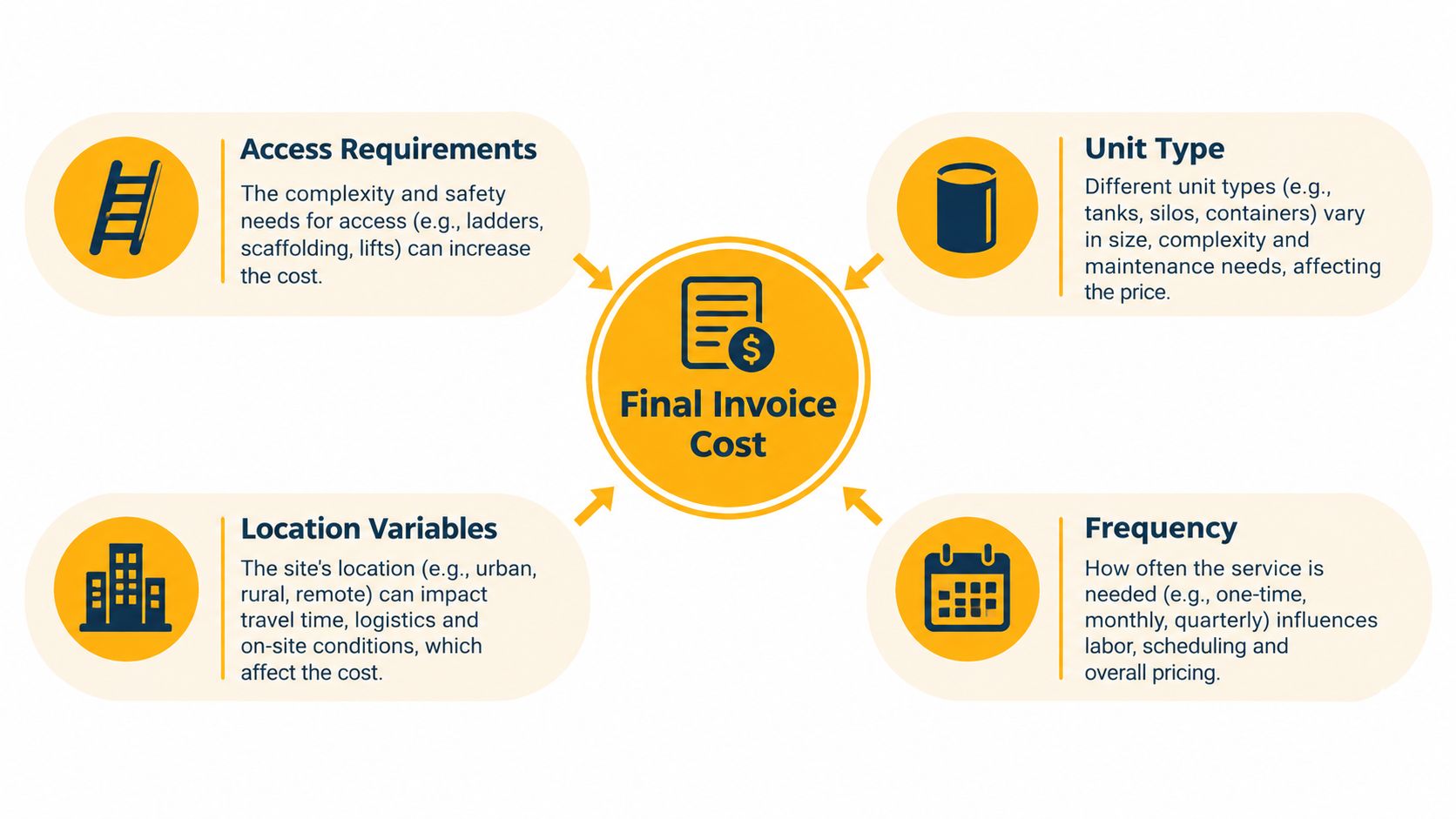
Two sites with the same number of extinguishers can receive very different quotes. The technician isn't pricing cylinders in a warehouse. They're pricing the time, travel, access, equipment, paperwork and risk involved in servicing assets across a working commercial property.
Start with the site map
A compact office where every extinguisher is accessible from one central route is simpler to service than a property with units spread across tenancies, plant rooms, warehouses, roofs or restricted areas. Locked rooms, high mounting points, production zones and busy hospitality areas add handling time. If a technician can't reach an asset, the visit may end with a defect or incomplete service rather than a compliant result.
Number and distribution matter together. A larger inventory can make the per-unit rate more efficient because the attendance is spread across more assets, but only if the units can be serviced in an organised sequence. Regional travel across North Brisbane, the Moreton Bay Region, the Sunshine Coast, Somerset or Ipswich can also affect call-out and travel charges, particularly when the site sits away from a regular service route.
Prepare the site before the appointment:
- Confirm access: Arrange keys, permits, escorts and access to restricted plant or tenancy areas.
- Clear equipment: Remove stock, furniture or stored materials blocking brackets, signs and extinguishers.
- Provide the register: Give the technician the current asset list, service history and known defects.
- Coordinate tenants: Make sure retail, hospitality and industrial occupants know when units will be removed or handled.
- Request a complete quote: Separate attendance, routine servicing, interval work, parts, disposal, reporting and replacement equipment.
Fire class and extinguisher medium change the economics
An office may use water, foam or ABE powder for relevant Class A risks, while a commercial kitchen may need wet-chemical Class F protection for cooking oils and fats. NSW Fire and Rescue's portable fire extinguisher information for businesses explains how Australian fire classes and suitable media vary by hazard.
That difference affects more than the label. Wet-chemical units can require specialist agent handling and components, while ABE powder, water, foam and carbon dioxide equipment have different inspection and recharge considerations. Industrial premises may also need a mixed inventory based on the materials and processes present, so comparing a generic “per extinguisher” price can hide the actual scope.
A proper quotation should identify the Australian fire class, medium, capacity in kilograms or litres and whether testing, recharge, replacement and disposal are included. The cheapest quote often becomes expensive when the contractor discovers that the site contains specialist units, damaged brackets, missing signage or assets that need temporary replacement during service.
Deciding Between Recharging and Full Replacement
A discharged extinguisher isn't automatically a replacement, and an old-looking extinguisher isn't automatically worth saving. The decision should follow the cylinder's condition, service history, design, test result and future reliability, not the technician's preference or the lowest immediate invoice.
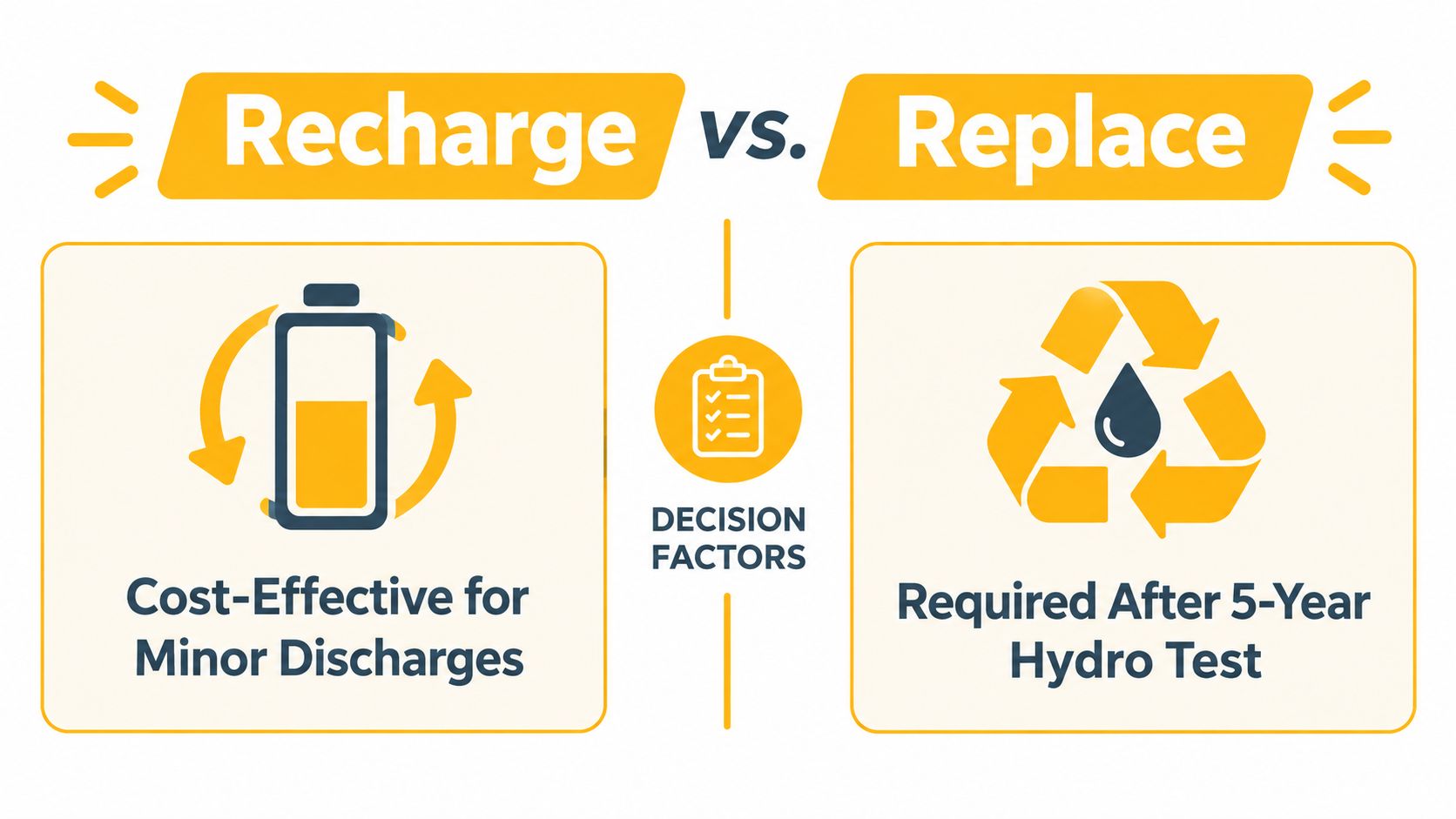
Recharge is often sensible after a minor discharge when the cylinder passes inspection, the valve and hose remain serviceable, the body shows no unacceptable corrosion or damage, and the unit has a credible service history. The work still needs to restore the extinguisher to a serviceable condition and produce the required documentation.
Replacement becomes the safer commercial decision when the cylinder fails pressure testing, has significant corrosion, has damaged threads or valves, lacks a reliable history, has recurring defects or no longer suits the hazard. A unit can appear charged and still be unsuitable for service. Queensland guidance requires the scheduled inspection program, not merely a gauge reading or an apparently full cylinder.
Compare the whole decision, not one invoice
| Consideration | Recharge the existing unit | Replace the unit |
|---|---|---|
| Cylinder condition | Suitable where inspection finds no critical damage | Appropriate where corrosion, damage or failed testing affects integrity |
| Service history | Useful when records are complete and defects are controlled | Valuable when history is missing or repeated faults occur |
| Site suitability | Retains the existing Australian fire-class solution | Can standardise equipment for the actual hazard |
| Future reliability | Depends on the condition and age of the asset | May provide new equipment and current warranty support |
| Immediate cost | May be lower for a sound unit after discharge | Higher upfront, but can avoid repeated refurbishment |
A five-year service can expose internal deterioration that wasn't visible during routine visits. The training framework for Australian extinguisher maintenance recognises more extensive inspection, testing and preventive maintenance at defined AS 1851 intervals, including three-yearly, five-yearly and six-yearly work depending on the equipment and servicing requirements. The CPPFES2021A unit information explains why routine inspection and major preventive maintenance shouldn't be priced as the same task.
Ask for evidence before authorising replacement: Require the itemised reason, the failed test or defect description, and photographic evidence where practical.
For property managers and body corporate committees, blanket replacement recommendations deserve scrutiny. Ask whether every proposed unit has the same defect, whether an alternative repair is permitted, whether the replacement matches the hazard and mounting arrangement, and whether disposal is included. A transparent technician should be able to explain the safety reason and the financial consequence without presenting replacement as an automatic outcome.
Meeting Queensland Record-Keeping Obligations
Physical servicing is only half of the compliance job. In Queensland, the occupier must retain detailed maintenance records for each prescribed fire safety installation, including fire extinguishers. A tag without a traceable report may not give the building manager enough evidence to demonstrate what happened, who completed it or whether defects were addressed.
The Building Fire Safety Regulation 2008 requires records to identify the installation, state the maintenance date, briefly describe the work, identify the appropriately qualified person and licence number where applicable, confirm compliance with QDC MP 6.1, and record maintenance results plus repairs or other corrective action.
The record must follow the asset
A compliant maintenance workflow should connect the physical extinguisher to its paperwork. That means the asset location, service date, work completed and result should be clear enough for another responsible person to understand without relying on the technician's memory.
Queensland Fire and Emergency Services recognises a maintenance tag together with an invoice or summary report as acceptable maintenance evidence. The Fire Safety Management Tool advisory notes also reinforce the importance of appropriately qualified service inspections every six months.
A useful record set includes:
- Service tag: Shows the current service status on or beside the extinguisher.
- Maintenance report: Identifies the asset, date, work completed and result.
- Defect notice: Describes corrosion, pressure loss, damaged hoses, blocked nozzles, missing signage or other corrective work.
- Repair history: Records what was repaired, when it was completed and whether the asset was returned to service.
- Qualification details: Identifies the person who performed the work and the relevant licence information where applicable.
Documentation is part of the service
A low-cost visual check that leaves no traceable evidence can create a false saving. The occupier still carries the record-keeping responsibility, even when a contractor performs the physical inspection. That matters in tenanted buildings, managed properties and strata arrangements where responsibilities can become unclear after a defect or missed visit.
Reporting also supports cost control. An asset register helps identify which units need routine inspection, which are approaching major interval work and which should be replaced because repeated repairs no longer make commercial sense. Without those records, managers may pay for duplicate visits, lose track of pressure-test dates or discover defects only after an audit.
The price of professional servicing therefore includes more than a technician touching the cylinder. It includes identification, assessment, tagging, reporting and a defensible history of corrective action. That administrative layer is part of maintaining compliance, not an optional premium.
Securing Value Through Preventative Maintenance Plans
A structured preventative maintenance plan is more useful than chasing a new per-unit quote every time an inspection becomes due. The plan should cover the full asset register, map the AS 1851 servicing intervals, identify Queensland record requirements and show what happens when a unit fails, needs recharge or requires replacement.
Consolidating related services can also reduce fragmented coordination. A commercial provider may schedule extinguisher servicing alongside smoke and heat alarms, emergency and exit lighting, fire blankets, hose reels, hydrants or security systems where the scope and qualifications are appropriate. That doesn't make every combined visit automatically cheaper, but it can reduce duplicated attendance, improve access planning and give the facility manager one coordinated reporting trail.
Build the plan around assets and risk
A useful plan begins with a site assessment rather than a generic rate card. Record each extinguisher's location, Australian fire class, medium, capacity, service history and next scheduled interval. Then separate predictable routine work from events that need a reserve budget, such as pressure testing, agent replacement, failed cylinders, damaged brackets or missing signage.
For a small office, the priority may be simple scheduling and reliable records. Hospitality sites need closer attention to wet-chemical Class F equipment and kitchen access. Industrial and warehouse operators may need coordinated work across separated areas, different hazards and restricted operating zones. Property managers should also clarify whether tenants, landlords or body corporate arrangements are responsible for access, defects and authorising replacement.
The provider agreement should state:
- Scope: Which assets and systems are included in each visit.
- Frequency: Six-monthly inspections, annual examinations and applicable major intervals.
- Inclusions: Labour, travel, tagging, reports, parts, agent, disposal and temporary equipment.
- Escalation: How defects are photographed, priced and approved.
- Records: Where reports are stored and how the manager retrieves them for an audit.
- Coverage: Which locations are included and whether regional travel conditions apply.
Prevent emergencies with planned decisions
Preventative maintenance isn't just a way to spread invoices. It gives the site time to make considered decisions before an extinguisher becomes unavailable or a compliance issue appears during an inspection. A scheduled replacement can be planned around access and stock availability, while an emergency response often adds disruption and pressure to approve work quickly.
A local provider with fire protection and related security capability can also reduce the number of contractors a facility manager must coordinate. Celtic Fire & Security provides commercial extinguisher testing and maintenance, along with smoke and heat alarms, emergency and exit lighting, fire hose reels, hydrants, security alarms, CCTV and locksmith services. Its preventative maintenance plan can be assessed against the site's assets, required intervals and reporting needs.
The right plan won't promise a flat cost where the equipment itself creates variable work. It will make those variables visible, schedule them properly and show the manager what the site is paying for. That is a more reliable measure of value than a headline unit price.
Celtic Fire & Security provides scheduled fire extinguisher inspections, interval servicing, asset-level reporting and replacement recommendations for commercial premises across North Brisbane, Moreton Bay, the Sunshine Coast, Somerset and Ipswich. Visit Celtic Fire & Security to request a site assessment and a transparent maintenance quotation that separates routine work, major servicing, defects and replacement.
No responses yet