
The email has arrived: the insurer wants recent fire hydrant records, a fire warden is asking questions, and a Queensland Fire and Emergency Service inspection may be close. Somewhere in the maintenance folder is a one-line invoice saying “hydrant tested”. It feels useful until someone asks which hydrant was tested, what pressure it achieved, which standard applied, and whether the five-yearly work is also current.
That's where fire hydrant testing certification becomes more than a form. In Queensland, the certificate is evidence of a defined activity on a defined date. It doesn't replace the building's maintenance cycle, Fire Safety Management Plan, occupier statement, or the records needed to show that the system remains at its required performance level.
Table of Contents
- Why a Hydrant Test Certificate Alone Won't Cover You
- Australian Standards, Queensland Forms, and What Each Test Actually Certifies
- Running the Annual Flow Test the Way an Auditor Expects
- What a Failed Flow Test Actually Tells You
- Who Can Legally Issue Hydrant Test Certification in Queensland
- Building an Audit-Ready Record, Not Just a Certificate
Why a Hydrant Test Certificate Alone Won't Cover You
A hydrant certificate can be perfectly genuine and still leave a compliance gap. A flow-test report proves what the technician measured at the tested outlet. It doesn't automatically prove that every inspection, defect repair, hydrostatic test, tag, logbook entry, or occupier obligation has been completed.
Queensland's framework places responsibility for prescribed fire safety installations on the building occupier. The occupier must ensure that installations are maintained by an appropriately qualified person and inspected and tested at the intervals required by QDC MP 6.1. Maintenance means the inspection, testing, or repair needed to keep the installation operating at its original performance level and in accordance with relevant Australian Standards. The Queensland Building Fire Safety Regulation 2008 also requires the occupier to prepare an occupier statement at the intervals specified by QDC MP 6.1.
The document proves one job, not the whole building
AS 1851-2012 uses a four-interval service structure for fire-protection systems and equipment: monthly, six-monthly, yearly, and five-yearly. For hydrant systems, the practical baseline is generally a six-monthly inspection, an annual flow or water-supply-proving test, and a more extensive five-yearly service where the system and applicable obligations require it. The cycle is described in Queensland fire hydrant testing guidance.
A certificate should identify the date, system, test type, measured results, defects, corrective actions, and competent person. A tax invoice normally identifies only the commercial transaction. It may show that someone attended the property, but it doesn't show what was measured or whether the result was compared with the approved design.
Practical rule: Treat every certificate as one piece of evidence in the building's compliance file, not as the file itself.
The records also have different jobs:
- Flow-test certificate: Records a particular flow and pressure test, including the outlet tested and results.
- Form 72 maintenance record: Captures prescribed inspection and maintenance information, although it doesn't cover every requirement under the applicable Standards.
- Annual occupier statement: Supports the occupier's statutory declaration of fire-safety maintenance at the required interval.
- Fire Safety Management Plan file: Holds the ongoing logbook entries, tags, defect evidence, reports, and supporting records.
If an auditor opens your folder, they'll want a traceable sequence. They should be able to connect the installation to the service date, the technician, the readings, the design benchmark, the defect response, and any retest. A request to inspect your fire-safety systems can expose missing evidence quickly, particularly in multi-tenant buildings where the owner, body corporate, occupier, and contractor each hold part of the information.
Australian Standards, Queensland Forms, and What Each Test Actually Certifies
The first mistake is choosing a form before identifying the work. AS 2419.1-2021 governs hydrant-system design and commissioning, while AS 1851-2012 governs routine service. Those standards overlap in the records a technician should produce, but they don't create the same obligation for every test.
Fire Rescue Victoria's hydrostatic testing and maintenance guidance states that AS 2419.1-2021 requires hydrostatic testing when a fire-hydrant system is first commissioned, including systems without a fire-brigade booster connection. It also explains that hydrostatic testing commonly occurs at five-year intervals as part of ongoing maintenance. However, AS 1851-2012 doesn't require routine hydrostatic testing of a hydrant system without a brigade booster connection when it's treated as a feed-hydrant system under essential-safety-measures maintenance.
That distinction matters around Moreton Bay and Ipswich, where commercial premises may use un-pumped feed-hydrant systems. A five-year hydrostatic test shouldn't be applied blindly. The approved design, system classification, maintenance pathway, and applicable obligation decide the scope.
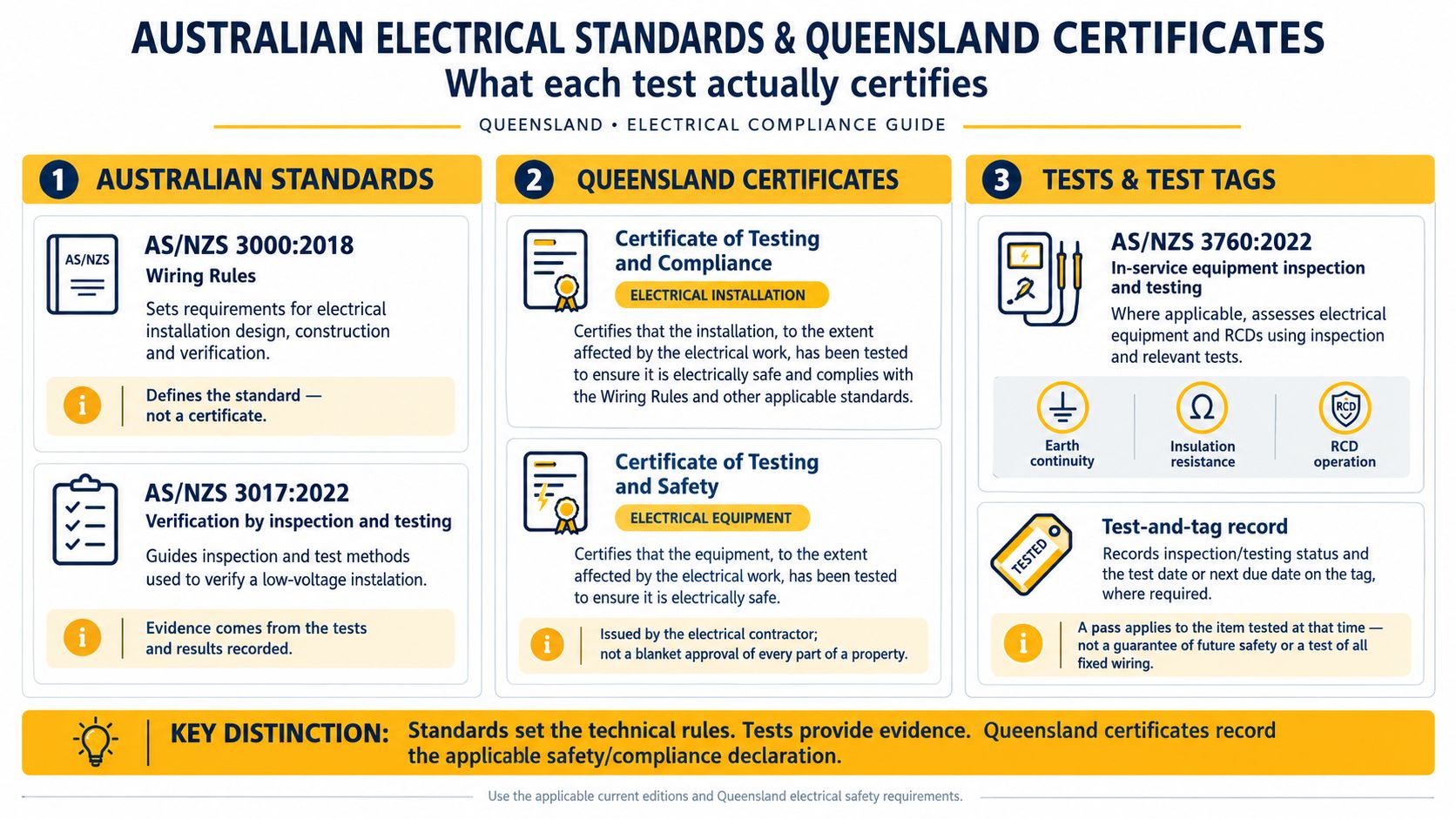
Which Standard or Form Applies to Each Test Type
| Test type | Governing standard | Queensland form | What it proves |
|---|---|---|---|
| Commissioning test | AS 2419.1-2021 and approved design | HPW commissioning documentation, including Form 70 where applicable | The newly installed or altered system was tested against its approved design, including required initial hydrostatic testing |
| Six-monthly inspection | AS 1851-2012 and applicable QDC pathway | Form 72 and prescribed inspection record where applicable | The scheduled inspection and maintenance checks were completed and defects were recorded |
| Annual flow test | AS 1851-2012, approved design, and Queensland maintenance procedure | Form 72 and supporting service report | The hydraulically disadvantaged outlet achieved the required flow and residual pressure against design criteria |
| Booster testing | AS 1851-2012, AS 2419.1, and approved system documentation | Form 72 or applicable prescribed record | The booster arrangement and connected hydrant system were tested within the relevant scope |
| Five-yearly hydrostatic test | AS 2419.1 for commissioning, AS 1851-2012 where maintenance requires it | Form 72 and supporting hydrostatic report | The relevant pipework and system components withstood the stated test pressure and duration |
Queensland government forms combine AS 2419.1 section 10.3 requirements with AS 1851 section 4 routine testing. The Queensland Form 72 material is useful for identifying the required record structure, but the form doesn't turn every test into the same test.
For an un-pumped feed-hydrant system, start with the approved design and system classification. Confirm whether the work is commissioning, routine inspection, annual hydraulic performance testing, or hydrostatic testing. Then select the record that identifies the actual scope. A document that says “hydrant passed” is too vague to defend.
For more background on system components and arrangements, see fire hydrant systems, but always verify the installed system against its own approved documentation.
Running the Annual Flow Test the Way an Auditor Expects
An annual flow test isn't a quick open-and-shut exercise at the easiest hydrant. Queensland's mandatory method starts with the most hydraulically disadvantaged hydrant, normally the outlet expected to experience the greatest hydraulic loss or the least favourable pressure condition.
The Queensland commissioning and maintenance procedure requires the tester to use a rigorous pressure-and-flow procedure and record the relevant results. The test should demonstrate not only that water comes out, but that the required flow is delivered at the required residual pressure.
A repeatable field sequence
Confirm the system and design benchmark. Locate the approved design, hydraulic calculations, previous service reports, and any identified critical outlet. Don't select the nearest hydrant because it's convenient.
Identify the remote outlet. The technician should record the hydrant identification, location, and reason it represents the hydraulically disadvantaged point.
Check the test equipment. Fit a calibrated flow-measuring device or approved orifice arrangement. Record the device used and its calibration details in the service record.
Record static pressure. Take the pressure reading before opening the outlet, where the system and procedure require it. This helps distinguish available supply pressure from pressure remaining during flow.
Open to the required condition. Open the outlet to 10 L/s, or fully open the approved orifice arrangement, then record the achieved flow and residual pressure at the flowing hydrant.
Compare with the design criteria. The result isn't judged against a generic pass number. The measured flow and residual pressure must be compared with the system's approved design requirements.
What the report should show
A North Brisbane warehouse might have a single feed-hydrant at the rear boundary, furthest from the incoming water connection. The technician records the property, hydrant ID, static pressure, achieved flow, residual pressure, measuring device, date, and design benchmark. If the design requires the tested outlet to deliver the specified flow while retaining the specified residual pressure, the comparison belongs on the report. A bare “pass” doesn't show how the decision was reached.
The report should also state whether the test was affected by other demand, restricted access, abnormal supply conditions, or equipment limitations. If a reading is below the design criterion, the technician should record the likely cause only when evidence supports it. Guessing “blocked hydrant” without checking valves, strainers, tanks, pumps, and the public supply creates a poor record and sends the owner towards the wrong repair.
The auditor wants the critical outlet, the instrument, the readings, the benchmark, and the response to any shortfall. Flow rate alone is incomplete evidence.
Where the reading fails but no local defect is found, the tester should document the investigation and refer the matter to the water-service provider. The Form 72 record should show the initial result, defect or limitation, action taken, provider contact or investigation, and final retest result. If the system remains below minimum water-pressure requirements, the owner or occupier must also consider the Queensland Fire and Emergency Service notification pathway.
What a Failed Flow Test Actually Tells You
A failed reading is a diagnostic result, not a verdict that the hydrant itself is defective.
Consider a commercial warehouse near Caboolture. The annual test was taken at the remote hydrant, the equipment was calibrated, and the residual pressure remained below the approved design criterion at the required flow. The technician checked the visible outlet, accessible valves, and test arrangement. Nothing on the property explained the shortfall.
The Form 72 record didn't say “replace hydrant”. It recorded the outlet, flow, residual pressure, static pressure, device, design benchmark, and the fact that no local defect had been identified. The next step was escalation to the water service provider, as Queensland's official Form 72 guidance directs where results are inadequate and no onsite problem is found.
The investigation identified a partly closed council main valve. After the water authority corrected the valve position, the technician repeated the test and attached the retest evidence to the original record. The useful lesson isn't that every failed test has the same cause. It's that the certificate should preserve the diagnostic trail.
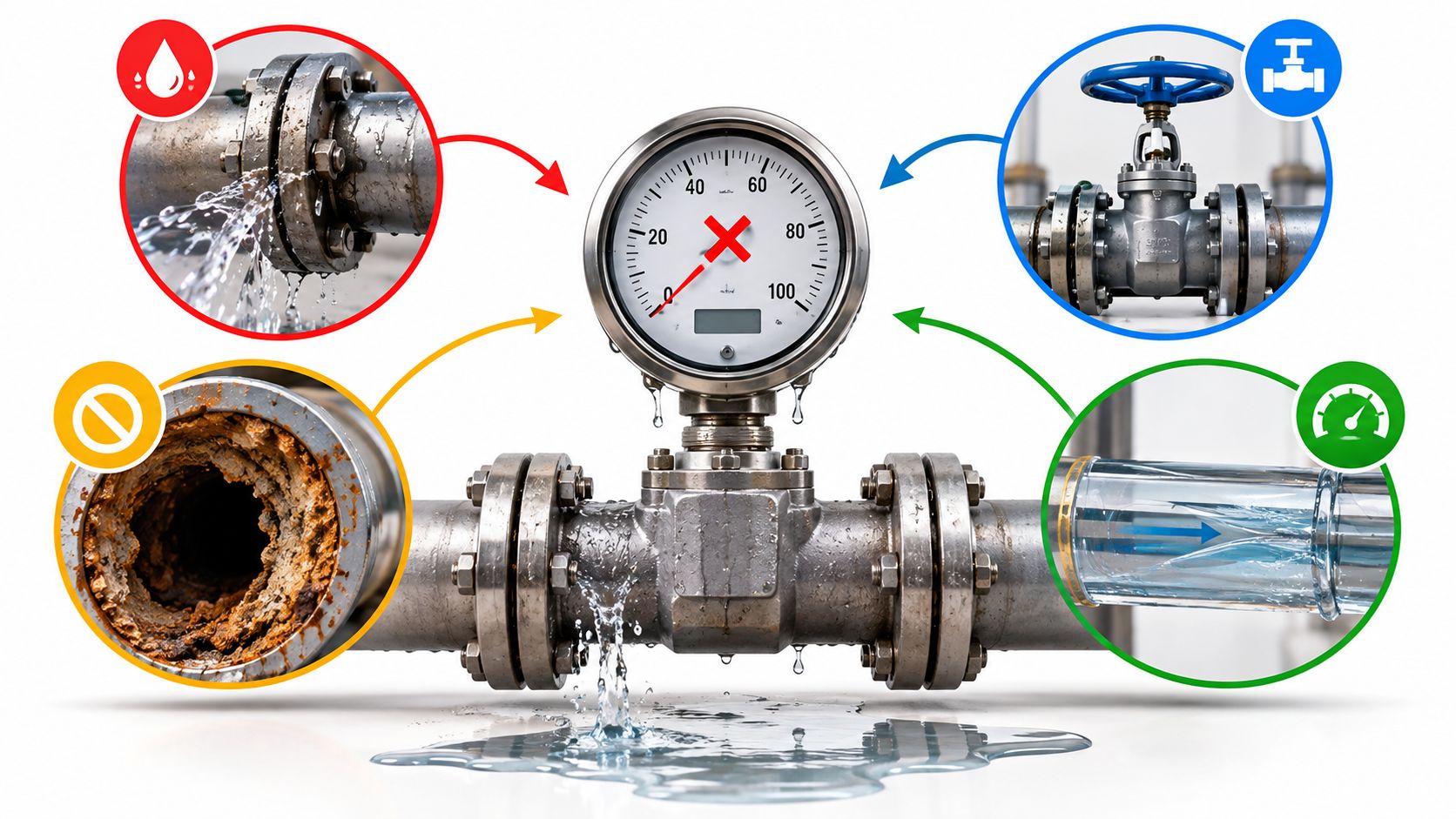
Causes worth checking before ordering major work
- Valves: A partly closed, damaged, or inaccessible valve can restrict the supply before it reaches the hydrant.
- Strainers and pipework: Obstructions, debris, corrosion, or altered site hydraulics can reduce available flow.
- Pumps and tanks: Pump performance, tank level, controls, and suction conditions matter where those components form part of the system.
- Simultaneous demand: Other water use during the test can affect the result and must be recorded.
- Public supply: A change in the water network can reduce the available pressure even when the onsite equipment is sound.
More testing isn't always the first remedy. Repeating the same test without checking the network, the valve state, or the test conditions only creates another identical failure. The correct response may be water-authority coordination, a documented interim risk response, corrective work, and a retest. If minimum pressure requirements aren't being met, the owner or occupier should contact QFES and keep evidence of that escalation with the maintenance record.
Who Can Legally Issue Hydrant Test Certification in Queensland
The person signing the report matters, but Queensland responsibility doesn't sit with one licence alone. Routine service must be performed by an appropriately qualified person, while the occupier remains responsible for ensuring the prescribed installation is maintained under the Building Fire Safety Regulation 2008.
For design, installation, alteration, and broader building work, the relevant QBCC licence and scope must be checked. Work involving electrical equipment associated with a booster or connected control arrangement may also require the appropriate electrical licence. A restricted electrical licence can be relevant to particular booster-related work, but it doesn't turn an electrician into a fire-hydrant specialist.
The practical question is not “Does this person hold a licence?” Ask whether the person has the qualification, experience, system knowledge, calibrated equipment, and quality process required for the work they're signing.
Who should not sign a hydrant certificate
An electrician with no fire-protection training shouldn't certify hydraulic performance merely because a gauge is fitted. An in-house maintenance worker shouldn't sign routine compliance records unless the business can demonstrate the person's competency and authorised scope. A sole trade with no documented quality process, no traceable readings, and no clear responsibility for defects creates an audit weakness even if the form looks professional.
A competent person should be able to identify the system type, select the correct test point, interpret static and residual pressure, use the correct test method, compare readings with design criteria, and record limitations. The report should also identify the person and business responsible for the service.
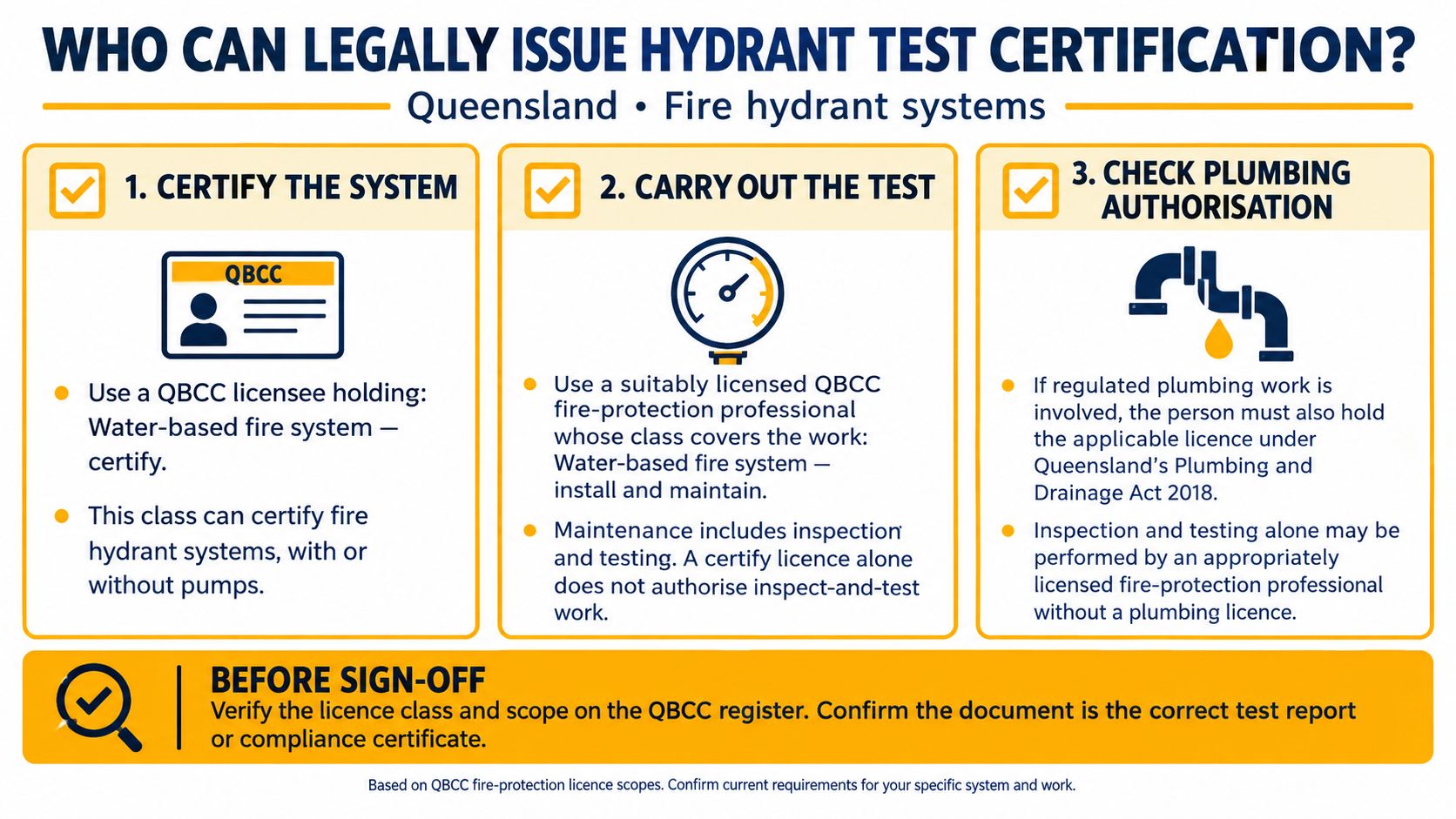
A quick verification checklist
Before accepting a certificate, check:
- Business identity: The contractor's legal business name and contact details are clear.
- QBCC scope: For construction, installation, alteration, or certification work, verify the relevant QBCC licence and scope.
- Electrical scope: For electrical or booster-related work, verify the electrical licence and the work covered.
- Competency evidence: Ask who performed the test, what training or competency supports the work, and who reviewed the report.
- Technical traceability: Confirm the report names the outlet, instrument, flow, pressure, design benchmark, defects, actions, and retest.
- Regional capability: Confirm the contractor understands Queensland forms and the system types common across North Brisbane, Moreton Bay, Sunshine Coast, Somerset, and Ipswich.
Celtic Fire & Security lists QBCC licence 1183612, electrical licence 89015, and security provider licences 4626868 and 4695612. Those details should still be checked against the current licence registers and matched to the actual scope of work. A licence number is useful evidence, but it isn't a substitute for a technically complete certificate.
Building an Audit-Ready Record, Not Just a Certificate
A contractor's receipt is not a maintenance record. Queensland guidance states that an invoice or tax receipt doesn't replace the detailed information an owner or occupier needs to retain with the building's Fire Safety Management Plan. A proper file should let another competent person understand what was tested, what failed, what was repaired, and what remains outstanding.
The Queensland owner and body corporate fire-safety guide makes the recordkeeping point clearly. Body corporates must retain maintenance records for two years with the Fire Safety Management Plan. The file should also support the occupier statement and show the difference between routine flow testing and five-yearly hydrostatic testing.
The minimum file contents
Keep these records together:
- Signed Form 72: Include the installation identity, date, test type, outlet, measured pressure and flow, tester, defects, corrective actions, and retest result.
- Prescribed inspection record and tag: Retain the inspection evidence and current tag referenced by QFES guidance.
- Fire Safety Management Plan logbook entry: Note the service date, scope, outcome, defects, responsible contractor, and follow-up date.
- Defect report: Describe the defect precisely, its location, risk implication, recommended action, and person responsible.
- Retest evidence: Attach the new readings and explain whether the retest followed onsite repair, water-authority work, or another corrective action.
- Hydrostatic report: File it separately from the annual flow record, with test pressure, duration, scope, limitations, and result where hydrostatic testing applies.
Queensland's fire safety maintenance advisory notes specifically distinguish the five-year hydrostatic obligation from periodic flow testing. A satisfactory annual flow result doesn't prove that a required hydrostatic test has been completed.
A simple record row
| Date | Installation and outlet | Test scope | Static pressure | Flow and residual pressure | Design benchmark | Defect or action | Retest |
|---|---|---|---|---|---|---|---|
| Service date | System ID and hydraulically disadvantaged hydrant | Annual flow, six-monthly inspection, or hydrostatic test | Recorded where applicable | Measured values and units | Approved design criterion | Defect, provider referral, or repair | Result and attached evidence |
Use a preventive maintenance plan to schedule the separate intervals, then keep the completed reports against the correct installation. Before an audit or insurance review, confirm that the folder contains the approved design, current Form 72, inspection record and tag, logbook entry, defect close-out, retest evidence, and applicable hydrostatic report. That file is far more defensible than a collection of invoices labelled “hydrant tested”.
Celtic Fire & Security provides hydrant and hydrant flow testing for un-pumped systems, with field documentation that supports the building's ongoing compliance records. If your North Brisbane, Moreton Bay, Sunshine Coast, Somerset, or Ipswich site needs a properly scoped test and an audit-ready report, contact Celtic Fire & Security to arrange an assessment.
No responses yet