
A facility manager usually notices a fire hose reel cover when the building looks untidy, the reel sits in a busy loading area, or coastal weather starts attacking exposed equipment. The wrong cabinet makes the problem worse. It can hide the location sign, obstruct the hose path, restrict the door, or force a technician to work around a locked enclosure during a routine inspection.
In Queensland, the cover isn't decorative joinery. It forms part of the access conditions around certified fire equipment. If it protects the reel without delaying operation, it helps. If it conceals, locks or obstructs the reel, it can contribute to an inspection failure under the installation, maintenance and fire-safety obligations applying to the site.
Table of Contents
- The Cover That Cost a QLD Facility Its Audit
- What a Fire Hose Reel Cover Does
- Materials, Specifications and Common Build Types
- Sizing, Location Signs and Installation Choices
- Maintenance, Inspections and Service Access
- Budgeting and Choosing a Compliant Supplier in QLD
- What Goes Wrong and How to Avoid It
The Cover That Cost a QLD Facility Its Audit
A Sunshine Coast commercial facility installed glossy lockable cabinets over its fire hose reels to make the entry look organised. The cabinets looked professional from a distance. The problem appeared during the maintenance check.
The doors swung inward, so a person standing at the cabinet had to move away before the reel could be reached. The location sign disappeared behind the glossy panel. The technician couldn't read the service information without a key, and stored items near the wall narrowed the approach even further. The cover had improved the appearance of the entry while making the emergency equipment slower to find, open and inspect.
That outcome is avoidable. AS 2441-2005 governs the distribution, location and installation of fire hose reels, while AS 1851-2012 sets inspection routines that include access, signage and operating components. Queensland's Building Fire Safety Regulation 2008 also places responsibility on the building occupier for maintaining fire-safety installations. The cover has to work within that arrangement, not sit outside it as a cosmetic product. The current installation standard is identified by Standards Australia's AS 2441 listing.
The practical rule: if a technician or building occupant needs a key, special tool, awkward movement or extra clearance to use the reel, the cover is the wrong cover.
A compliant fire hose reel cover must preserve the basics:
- Immediate access: The handle, nozzle, valve, hose and reel must remain usable.
- Visible identification: Required location signage can't be hidden by an opaque door or cabinet face.
- Inspection access: A technician must be able to check the reel, service information and maintenance marking without dismantling the enclosure.
- Clear deployment: The hose must pull out without catching on the cabinet, door or surrounding building fabric.
Treat the cabinet as safety equipment. A tidy appearance matters, but it comes after emergency access, inspection and reliable operation.
What a Fire Hose Reel Cover Does
A fire hose reel cover is only an enclosure. The certified fire equipment is the reel behind it. AS/NZS 1221:1997 applies to fixed and swing-arm hose reels intended for operation by one person. The standard was published on 5 November 1997 and reconfirmed in 2020. Its Australian lineage extends through AS A155-1966 and AS 1221-1991, and the 1997 edition combined the Australian and New Zealand standards AS 1221-1991 and NZS 4504:1981. That background is summarised in Queensland Fire and Emergency Services guidance.
That distinction matters during audits. A neat cabinet does not fix a bad reel location, poor service access, hidden signage or a deployment path that catches on the door frame. Under AS 2441-2005, AS 1851-2012 and Queensland's Building Fire Safety Regulation 2008, the cover has to protect the installation without changing how the reel is identified, accessed, inspected and operated.
Its job is straightforward. It shields the reel from impact, grime, rain, UV, corrosive air and casual tampering. In warehouses, shared commercial corridors and outdoor plant areas, that protection can stop avoidable damage and keep the equipment in serviceable condition for longer.
It also creates the most common failure point. Once the enclosure slows a person down, hides the reel sign, blocks the nozzle, restricts the valve handle or makes a technician remove panels to inspect the reel, it starts working against compliance instead of supporting it.
For Queensland sites, use a simple rule of thumb. If the cover changes the way the reel is reached, opened, read, tested or run out, expect trouble at inspection.
The reel still has to perform as installed. Queensland guidance notes a maximum hose length of 36 metres and, for the cited marina application, requires two hydraulically disadvantaged reels operating simultaneously to each deliver at least 0.63 litres per second at a running pressure of not less than 275 kilopascals. A cover must not interfere with the hose path, valve operation or the physical access needed to use the reel as intended.
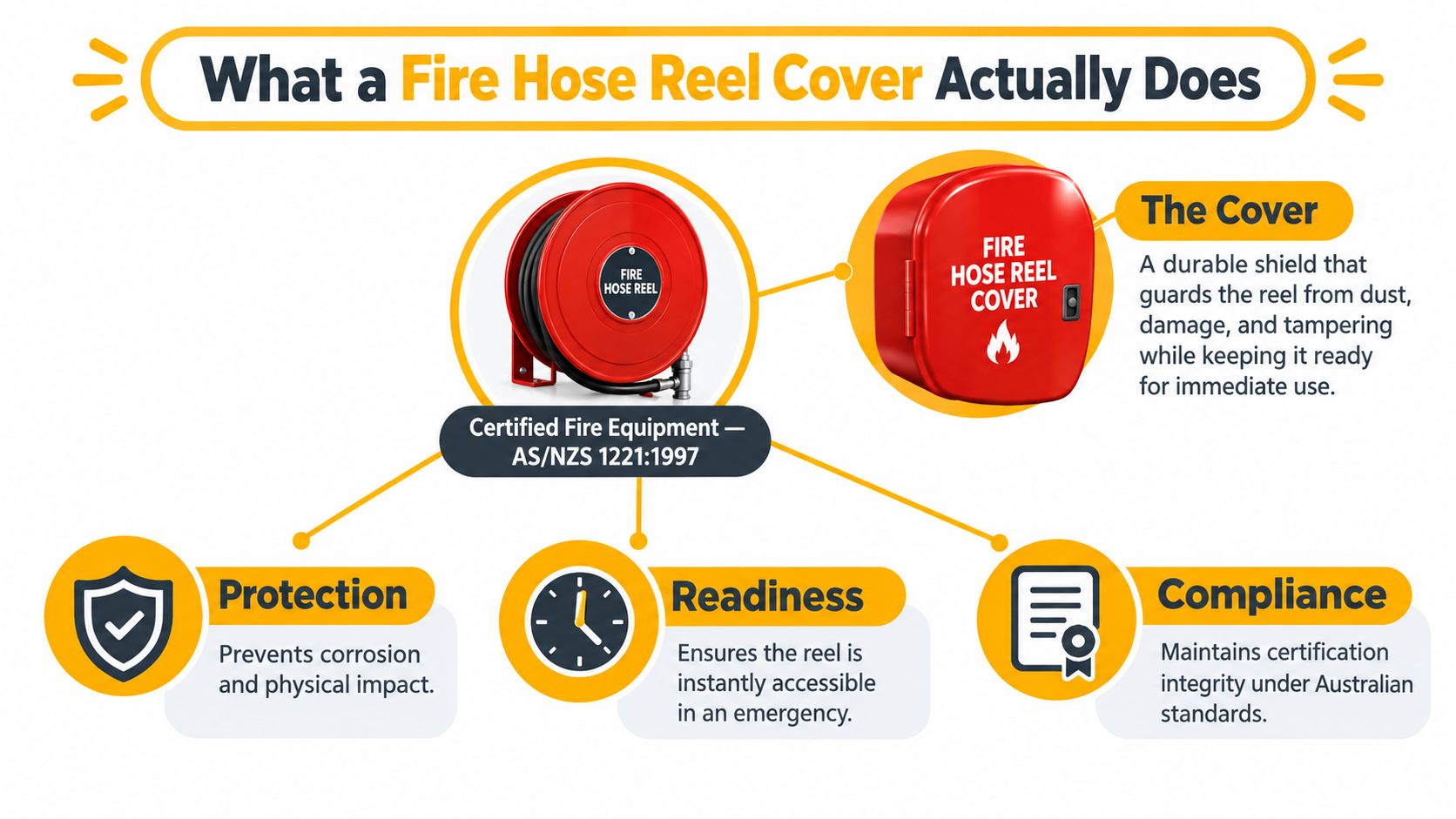
The cover protects, but doesn't redefine the reel
A suitable enclosure can reduce knocks from forklifts and stock movement, limit dust and weather exposure, and discourage interference in busy areas. Those are practical benefits. They do not change the compliance baseline.
The cover must still allow:
- One-person operation, consistent with the reel standard.
- Nozzle removal and valve operation, without awkward reach or obstruction.
- Full hose deployment, without snagging on cabinet edges, doors or nearby building elements.
- Clear signage, especially where the reel is recessed, concealed or set into a cavity.
- Routine inspection, including access to service marking and operating components, as outlined in Safe Queensland Fire's hose reel guidance.
Specify the cabinet around the reel, not instead of it. That is the difference between a cover that protects the installation and one that helps cause the defect notice.
Materials, Specifications and Common Build Types
Material selection should follow the site environment, not the colour of the wall. A fire hose reel cover in an exposed coastal location needs a different corrosion strategy from one inside a clean office corridor.
316 stainless steel is the strongest choice for harsh coastal or aggressive environments where corrosion resistance is a priority. 304 stainless steel suits many internal commercial areas, but it shouldn't be treated as the automatic answer for every exposed Queensland installation. Marine-grade aluminium is another practical option where low weight and resistance to outdoor conditions matter.
For indoor commercial sites, powder-coated zincanneal steel is often the sensible middle ground. It offers a durable finished surface and can be matched to the surrounding fit-out without paying for a marine-grade specification that the environment doesn't require. In food production, wash-down areas and coastal sites, the finish and hardware need closer attention because moisture and contaminants attack hinges, handles and fixings as well as the cabinet body.
Polycarbonate or acrylic viewing panels can help staff and technicians identify the reel without opening the door. They don't remove the need for a proper location sign, suitable door operation or direct access. A clear panel that is scratched, tinted, dirty or positioned behind reflected light may offer little practical benefit.
| Build type | Best fit | Check before approval |
|---|---|---|
| 316 stainless steel | Coastal, exposed or aggressive environments | Hardware, hinges and fixings should suit the same environment |
| 304 stainless steel | Internal commercial areas with moderate exposure | Confirm the site doesn't need a higher corrosion resistance |
| Powder-coated zincanneal steel | Indoor offices, retail and general commercial spaces | Inspect coating quality and protect damaged edges |
| Marine-grade aluminium | Outdoor installations where weight and weather resistance matter | Confirm compatibility with the mounting surface and fittings |
| Polycarbonate or acrylic panel | Visual checking and identification | Ensure it doesn't hide signage or maintenance information |
Read the product sheet, not just the brochure
A supplier should state the hinge arrangement, door swing direction, handle type and whether the cabinet locks. The specification should also identify any relevant IP rating, the signage panel arrangement, and whether the enclosure suits a recessed or surface-mounted reel.
Ask for the clear internal dimensions, not just the external cabinet size. The hose reel must sit correctly inside the enclosure, and the door must open without contacting the handle, nozzle or wall. If a product is marketed as compliant, ask what installation arrangement it was designed to support. The Australian fire hose reel standard overview is useful background when comparing supplier descriptions.
Don't pay for a feature panel that makes the equipment harder to use. Choose the material that protects the reel, then reject any design that compromises access.
Sizing, Location Signs and Installation Choices
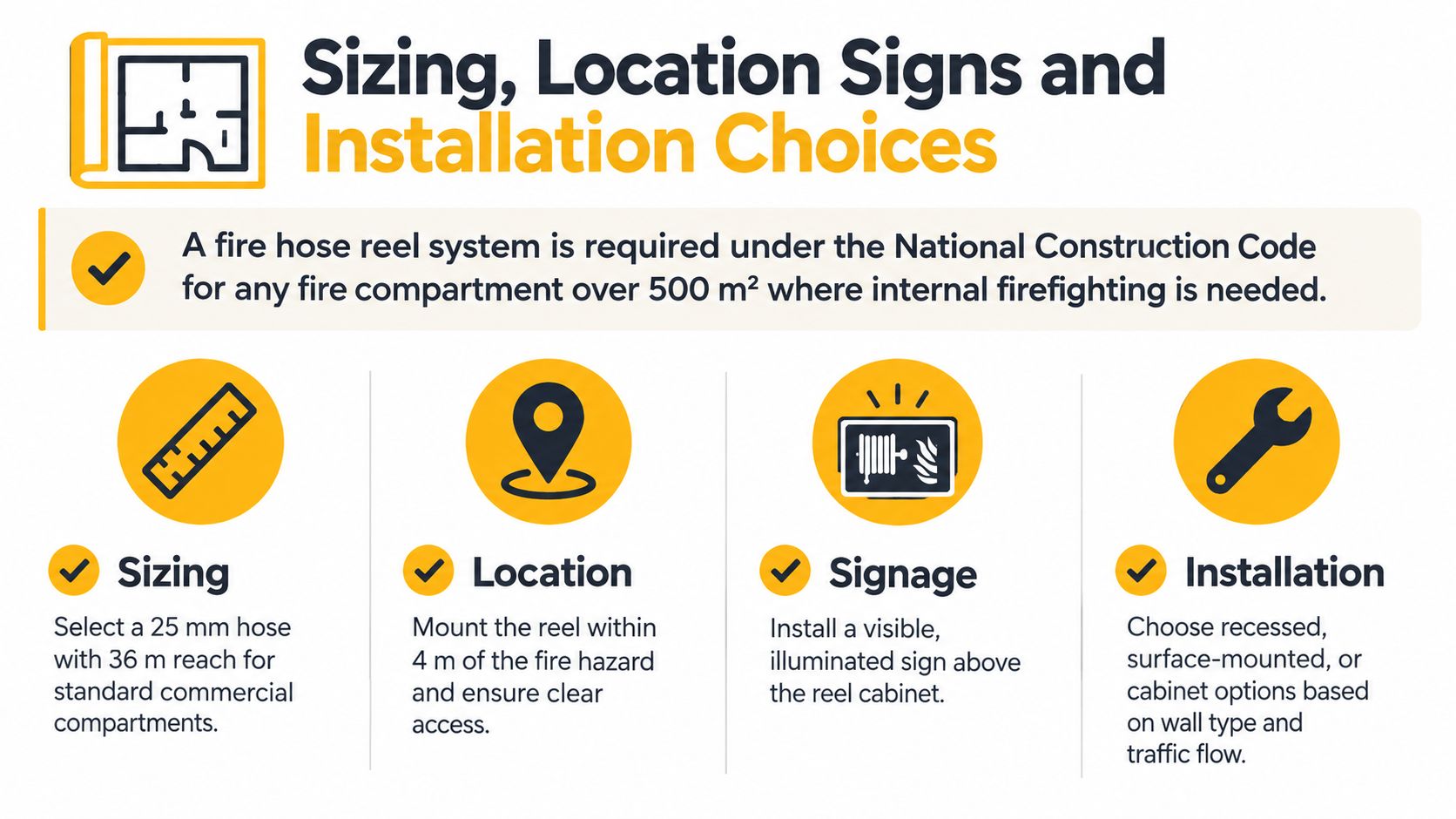
A hose reel cover passes inspection only if it leaves the reel where the system was approved to be. The National Construction Code requires fire hose reel systems where occupants need to undertake an initial fire attack. Where internal fire hydrants are not installed, a hose reel system is required to serve a fire compartment with a floor area greater than 500 square metres, as set out in the AS 2441 installation reference. In practice, that means most warehouses and retail halls over 500 m² carry reels, and any cabinet added later must not change the reel's approved position or coverage.
Start with the system, not the cabinet.
Confirm the coverage arrangement
AS 2441-2005 governs distribution, location and installation. Queensland guidance identifies a maximum hose length of 36 metres, so the cover has to suit the reel's position and reach. Shift the reel into a deeper cabinet, move it sideways, or restrict its swing, and you can break the coverage the layout was designed to provide.
The reel's location must stay obvious and easy to reach. Queensland guidance says a reel in a recess, cavity or obscure position needs a clearly visible location sign. A cover that hides that sign creates a real identification problem in smoke, poor light or a busy commercial space. Use the fire hose reel installation requirements check before you approve any cabinet against the existing layout.
Confirm the enclosure and approach
A recessed cabinet gives a neat finish, but the wall cavity has to accept the reel, pipework, door and operating movement. A surface-mounted cabinet is the better choice where the wall cannot take a recess, but it projects into the access area and needs careful placement in corridors, loading zones and plant rooms.
The door must open fully out of the operator's way. The Victorian Country Fire Authority states that cabinet doors must fully open during an emergency and that the area around the reel must stay clear of stock, bins, furniture and pallets. That principle applies directly to Queensland facility management, even though the CFA is a Victorian authority. The CFA fire hose reel guidance states the practical expectation plainly.
Use this site check before you sign off a quote:
- Coverage: Confirm the reel location and hose reach under the AS 2441 arrangement.
- Mounting: Confirm whether the wall supports a recessed or surface-mounted cabinet.
- Signage: Check that the location sign stays visible from the approach.
- Swing: Open the door fully and test the operator's standing position.
- Clearance: Remove stored goods and check that the hose path has no snag points.
- Records: Confirm the maintenance tag or service marking remains visible or easy to reach.
Maintenance, Inspections and Service Access
A cover that looks tidy but slows inspection is a bad choice. Under AS 1851-2012, hose reels follow six-monthly and yearly inspection routines, and the enclosure has to let the technician complete them without removing the cabinet or hunting for a key.
The six-monthly inspection covers access, signage, hose condition, nozzle, reel operation and valve seals. The yearly routine adds flow and pressure testing. Queensland guidance also expects protection from aggressive environments to be considered in line with AS 1221, which supports corrosion-resistant covers in exposed or harsh locations. These requirements are set out in the Queensland Fire and Emergency Services advisory notes.
What the technician needs to reach
During a six-monthly visit, the technician must see the reel, confirm the sign is visible, check the hose and nozzle, and test the reel and valve. A lockable opaque cabinet makes that slower and more awkward. If the door only opens part way, the reel may look accessible while the technician still cannot carry out proper operation checks.
For the yearly inspection, the cabinet must leave enough room for flow and pressure testing. If the cover forces the technician to disconnect fittings, remove fixed panels or work from a poor position, the installation is wrong.
Service access is part of the specification. If the technician can't inspect it without dismantling the cover, the cover isn't suitable for the installation.
Keep the Queensland records available
In Queensland, the occupier must keep prescribed hose reels maintained under Queensland Development Code MP 6.1, and servicing must be done by an appropriately qualified person. Queensland Fire and Emergency Services requires six-monthly and yearly service inspections. A maintenance tag, invoice or summary report on its own is not an acceptable maintenance record, even if it shows servicing happened. For the inspection routine in practice, see a full fire hose reel maintenance breakdown.
The cover also has to leave the reel's identification markings, service information and maintenance record easy to read. Do not accept a cabinet that makes the technician chase another department for a key, move stored goods or pull off a panel just to check the service details.
Budgeting and Choosing a Compliant Supplier in QLD
A compliant commercial cover can range from a few hundred to several thousand Australian dollars per location, depending on the product and installation. That isn't a fixed market price. Supply-only work costs less than supply and installation, while 316 stainless steel, recessed construction, custom finishes and difficult access increase the project scope.
Ask the supplier to separate the quote into cabinet supply, installation, alterations and ongoing service. Compare standard finishes with corrosion-resistant options, and check whether the proposed price includes new signage, wall repairs, pipework adjustment or disposal of the old enclosure.
Questions that expose a weak specification
- Standards: Which Australian Standards and installation requirements informed the design?
- Layout: Does the cover suit the reel's AS 2441 position and coverage arrangement?
- Access: Does the door open fully, and can the hose, nozzle, valve and handle be used immediately?
- Signage: Will the location sign remain visible from the normal approach?
- Records: Can the technician read the service marking and access the maintenance information?
- Evidence: What product documentation, testing information or certification supports the proposed design?
- Environment: Is the material suitable for the Sunshine Coast, coastal exposure, wash-down area or car park?
The best supplier can assess the existing reel, specify the enclosure, install it and maintain the complete assembly. That reduces the risk of a cabinet installer missing an issue that a fire technician would identify.
For sites across North Brisbane, Moreton Bay, Sunshine Coast, Somerset and Ipswich, request a written decision before approving the order. The decision should identify the mounting type, material, door operation, signage position, access clearance and service arrangement. A low quote that omits those details isn't a saving. It's an unresolved compliance risk.
What Goes Wrong and How to Avoid It
The assumption that any cabinet will do is wrong. A cabinet can fail the practical test even when the reel behind it is sound.
A locked cabinet delays first attack when staff can't find the key. Use a purpose-designed, readily openable enclosure that doesn't require a key or special tool in an emergency. A door that swings into the operator's position blocks access and can catch the hose. Use a door that opens fully and stays out of the deployment path.
A poor finish can deteriorate on a coastal wall, exposed car park or wash-down area. Specify stainless steel, marine-grade aluminium or another suitable corrosion-resistant arrangement where the site demands it. Don't select an internal powder-coated finish for an aggressive environment because it matches the building.
A glossy opaque panel can hide the location sign and service information. Use a clearly identified cabinet with visible signage and direct inspection access. Stored pallets, bins or furniture create the same outcome as a badly designed enclosure, so the area around the reel must remain clear.
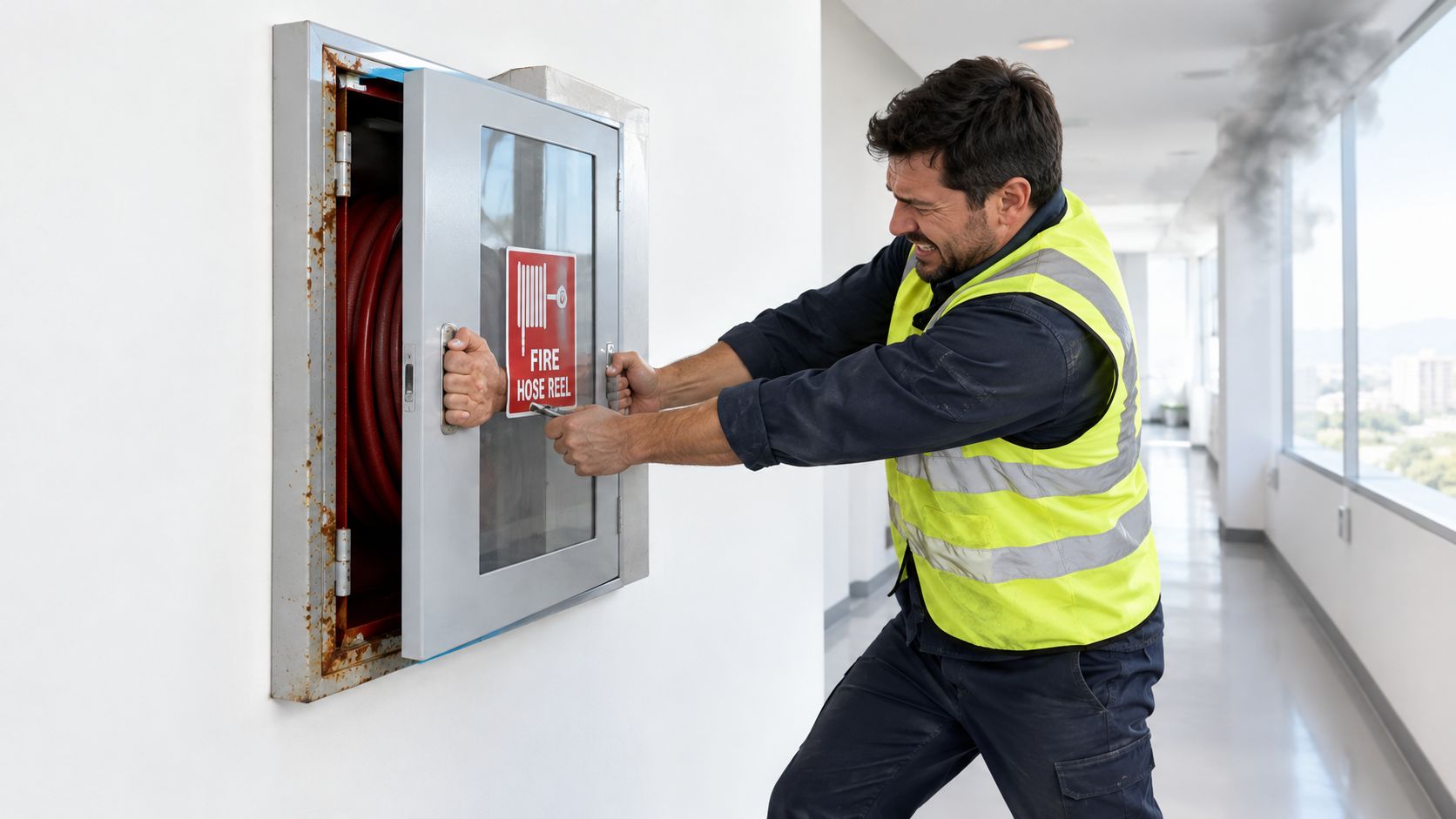
The Victorian CFA requires cabinet doors to fully open during an emergency and the area around a reel to remain clear. Queensland occupiers are expected to meet the same access principle under the Building Fire Safety Regulation 2008. The occupier carries the maintenance responsibility, so a cover that adds delay or obstructs service access creates a direct operational and audit risk. The Queensland fire-safety audit checklist also includes checking that hose reels are correctly maintained and stamped.
Specify the cover against the complete installation. Protect the reel, preserve access, keep signage visible, retain service records and work within AS 2441. Anything else is a design compromise that the next inspection may expose.
Celtic Fire & Security can assess, supply and install fire hose reel covers alongside hose reel testing, maintenance and compliance documentation across North Brisbane, Moreton Bay, the Sunshine Coast, Somerset and Ipswich. Visit Celtic Fire & Security to arrange a site assessment and specify a cover that protects the reel without creating the next audit problem.
No responses yet