
Keeping a hydrant visible and checking it for leaks is sensible advice. It's also incomplete. Fire hydrant inspection and maintenance must establish whether firefighters can reach the outlet, connect to it and obtain the water the system was designed to deliver. A tidy cabinet and a completed service sticker don't answer all those questions.
For Queensland facility managers, the practical job is to connect scheduled servicing with what changes between visits. Landscaping, parked vehicles, tenant alterations and water-supply problems can undermine readiness without making the hydrant look obviously defective.
Table of Contents
- Why a Visual Pass Is Not the Same as Operational Readiness
- The Regulatory Framework Queensland Owners Work Inside
- Monthly Six-Monthly and Annual Routines Explained
- Flow Testing and How to Read the Result
- Access and Environment Defects Most Checklists Miss
- Five-Yearly Hydrostatic Testing and Form 72 Records
- Putting It Together and When to Call a Technician
Why a Visual Pass Is Not the Same as Operational Readiness
A visual inspection tells you about the parts the inspector can see. It doesn't, by itself, establish the performance of the complete system under demand. An accessible outlet with no visible leakage can still sit downstream of an incorrectly positioned isolation valve or a compromised supply.
Queensland's fire-safety installation guidance places maintenance, testing and recordkeeping responsibilities on owners and occupiers. The useful interpretation for a facility manager is straightforward: arrange the work, understand the findings and make sure unresolved problems aren't lost between the service report and the next contractor visit.
Ask what was actually tested
When someone says the hydrants have been tested, ask what that means. Was it an inspection of accessible components, a measured performance test or verification of pressure-bearing integrity? Those activities answer different questions.
The system configuration matters too. Before assessing a report, establish whether you're managing an un-pumped installation or a system with associated pumps and tanks. A basic understanding of your building's fire hydrant system helps you ask about the right equipment rather than treating every outlet as a standalone fitting.
Practical rule: A service entry is useful only when you can identify the work performed, its result and what still needs attention.
Consider a hypothetical commercial tenancy change. The hydrant cabinet remains untouched, but the tenant introduces a locked gate along the approach route and changes the internal layout. The valve might still look serviceable, yet access and the assumptions behind the original installation now deserve review.
That doesn't automatically mean the system needs redesign. It means the facility manager should tell the contractor what changed instead of assuming that unchanged hardware means unchanged suitability.
Look for evidence rather than reassurance
A useful readiness review separates the questions:
- Condition: Are accessible fittings intact, correctly positioned and free of leakage?
- Performance: Do measured results satisfy the documented system requirements?
- Usability: Can firefighters find, approach and connect to the hydrant?
- Follow-through: Has someone taken responsibility for each outstanding defect?
These aren't interchangeable checks. A clean appearance cannot compensate for inadequate performance, and satisfactory performance cannot compensate for a blocked approach. Treat the service report as evidence to examine, not reassurance to file away.
The Regulatory Framework Queensland Owners Work Inside
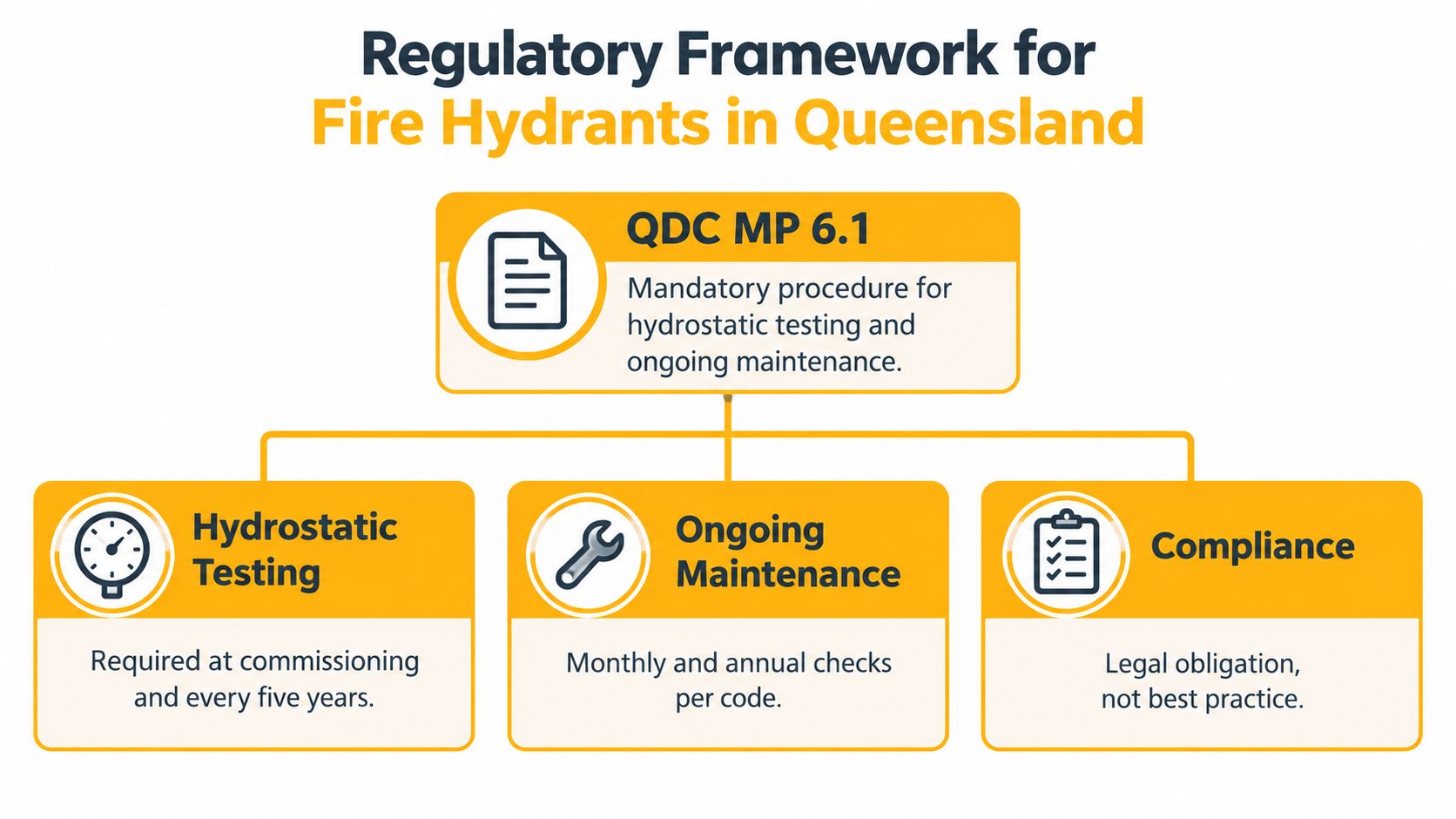
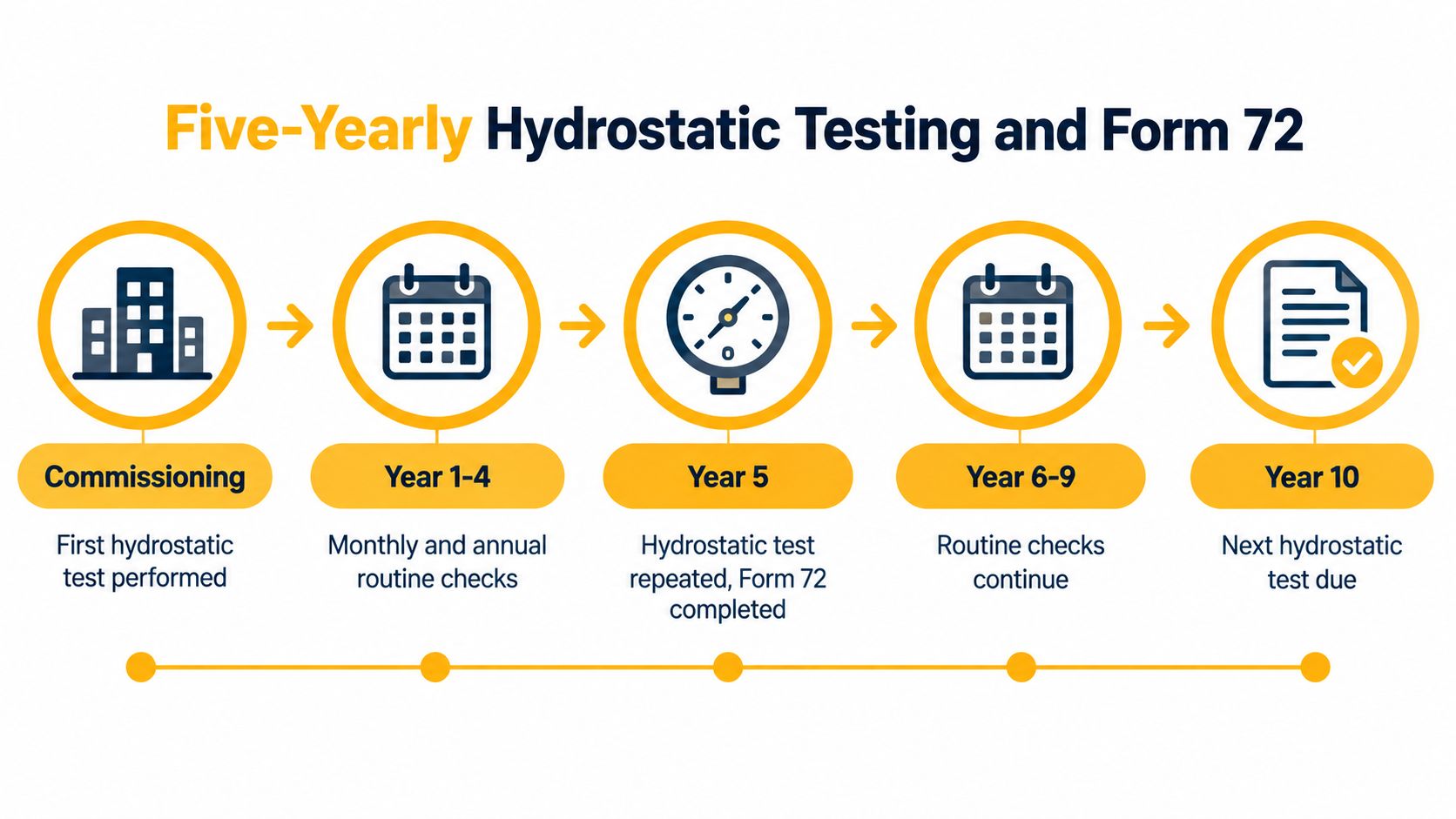
Queensland Development Code Mandatory Part 6.1, or QDC MP 6.1, establishes the legal procedure. Its commissioning, testing and maintenance requirements apply to fire-safety installations including hydrants and sprinkler systems; failing to follow the procedure is unlawful. It requires hydrostatic testing at commissioning and again as part of five-year maintenance in accordance with AS 1851-2012, as set out in the Queensland mandatory procedure.
For a building owner, that distinction matters when approving expenditure. Required maintenance isn't an optional improvement that can be deferred because the building hasn't had a fire.
The relationship between the mandatory procedure and the service program is shown below.
Keep the documents in their proper roles
The maintenance framework and the design context serve different purposes. AS 1851 concerns routine servicing, while AS 2419.1 provides the relevant hydrant-system context against which the installation and its requirements are considered.
| Document or evidence | Practical use for the facility manager |
|---|---|
| QDC MP 6.1 | Establish the applicable mandatory procedure |
| AS 1851 routine-service requirements | Define the scheduled inspection and testing scope |
| AS 2419.1 and system design records | Identify the installation's relevant design context |
| Completed maintenance records | Establish what was done and by whom |
Queensland's inspection guidance identifies AS 1851.4 when describing hydrant inspection and testing. Have the contractor identify the applicable routine-service requirements for your installation and translate them into a site-specific schedule. Don't substitute a generic checklist for that scope.
An un-pumped system and a pumped installation also need different planning. Where the installation relies on the mains supply without a pump set, the service program differs from one that includes mechanical and electrical pumping equipment.
Verify the person and the scope
Queensland guidance requires hydrants and associated pumps to be maintained by a contractor appropriately licensed for fire hydrants and fire hose reels. Verify that the licence covers the work you're commissioning, rather than assuming a general maintenance contractor can undertake it.
The person who performs or personally supervises the work must be identifiable in the maintenance evidence. A company logo on an invoice doesn't replace that accountability.
A practical purchasing approach is to request the service scope, applicable standards, reporting deliverables and defect-handling process before approving the quote. A cheaper visit that excludes necessary testing or leaves defects unexplained isn't an equivalent service.
Monthly Six-Monthly and Annual Routines Explained
“Tested” leaves a practical question unanswered: which tasks were completed, and what still needs attention? Build the calendar around the installation and its service requirements. Queensland's official guidance identifies monthly inspections for un-pumped systems, weekly inspection and testing of pump sets, and monthly, six-monthly, annual and longer-term activities within the structured hydrant inspection and maintenance regime.
Name the responsible contractor and the records expected after each service. Facility staff should monitor changing conditions between visits, including parked cars, landscaping and fit-out changes that affect access. That monitoring doesn't replace the licensed contractor's scheduled work.
Use this table to plan bookings, with the contractor confirming the precise tasks under the applicable AS 1851 service schedule.
| Interval | Typical Activity | What Gets Checked |
|---|---|---|
| Weekly, where a pump set supplies hydrants | Pump-system inspection and testing | Associated pump condition and operation under the applicable routine |
| Monthly, for un-pumped systems | Routine hydrant inspection | Valve position, leakage, accessibility and visible condition |
| Six-monthly | Scheduled additional servicing | Applicable valve, fitting and component checks specified for the system |
| Annual | Broader periodic inspection and testing | Applicable operational and mechanical checks, results and outstanding defects |
Before starting, the inspector should review system records, hydrant locations, isolation arrangements, pump configuration and previous maintenance findings. On site, the scope includes valves, cabinets, doors, signage, hose connections, caps, drains and surrounding clearance, together with relevant pumps, tanks and water supplies. Silt or ants around equipment deserve a recorded finding where they affect condition or access. A visible hydrant can still have an obstructed approach.
Each booking needs a defined scope.
Some tasks belong at particular intervals, so repeating the same checklist at every visit can leave scheduled work unaccounted for. Ask the contractor to show what each visit includes and how outstanding findings carry forward.
A valve in the wrong position, leakage at a fitting, damaged connections or inaccessible equipment needs an actionable work order. “Attention required” leaves the facility manager guessing about the consequence and response. Separate the finding from the action:
- Identify the asset: Use a consistent hydrant reference that matches the site plan.
- Describe the defect: State what is wrong, rather than recording only an unsatisfactory status.
- Assign the response: Identify who will arrange repair, investigate performance or remove an obstruction.
- Verify completion: Keep evidence that the corrective work was finished and checked.
Many programs lose continuity when responsibility passes between parties. The service contractor records an obstruction, the property manager assumes the tenant will remove it, and nobody confirms completion. Keep the finding open until the assigned response has been checked.
For pumped systems, retain a combined calendar showing the additional mechanical, electrical and water-supply responsibilities. A completed hydrant inspection doesn't establish that the pump-system routine was completed. Record both scopes so neither disappears behind a general service entry.
Flow Testing and How to Read the Result
“Tested” starts a conversation about performance. A facility manager needs to know what was measured, under which conditions, and against which design requirement before treating the result as evidence of operational readiness.
Take a hypothetical report showing lower flow than the previous comparable test while still meeting the documented design criteria. That warrants checking the comparison, rather than declaring the system defective or dismissing the change because it passed.

Read the measurements as a set. Static pressure is the pressure without test flow. Residual pressure is the pressure remaining while water flows, and flow rate is the water delivered under those conditions. A healthy static reading alone cannot establish delivery under demand.
The installation's documented requirements determine the comparison. A universal pass figure would conceal differences between systems.
Queensland requires an appropriately qualified person to record relevant pressure and flow results. Where measurements fail to satisfy the design criteria and no onsite fault is identified, the tester should contact the relevant water-service provider about possible network problems, according to the official pressure and flow testing material.
For that hypothetical decline, ask which outlets were used, what isolation arrangements applied and whether the pump configuration matched the earlier test. Also ask whether access restrictions affected outlet selection. A parked car or changed fit-out can alter what the technician can reach; any resulting test limitation belongs in the report. Comparable conditions make a trend useful.
This video provides a visual reference for hydrant testing activity.
Choose the investigation before authorising repairs. A Maintenance issue: calls for examination of valve positions, fittings, leakage, pumps and onsite equipment. A Design or alteration issue: calls for review of building changes against documented requirements. A Supply issue: calls for investigation at the water-service boundary when onsite faults do not explain inadequate performance.
These paths involve different work and responsibilities. Replacing equipment before establishing the cause can leave the performance problem unresolved.
A compliant result with an unexplained decline may justify monitoring or a controlled repeat test. A result below design requirements needs escalation and risk controls rather than deferral to the next visit.
When commissioning a fire hydrant flow test, require measurements, comparison criteria, test conditions and limitations in the report. Those details support a defensible choice between servicing, technical design review and water-provider investigation.
Access and Environment Defects Most Checklists Miss
A locked gate can make a sound hydrant inaccessible. Vegetation can hide a cabinet, and construction storage can prevent a hose connection even when the approach looks open from the driveway. These are practical failure scenarios to check, not cosmetic housekeeping issues.
There's also a national warning about defects inside the assembly. Cootamundra-Gundagai Regional Council reported that the majority of defects in its initial inspections involved silt build-up caused by ant nesting, within a program covering approximately 1,200 hydrants and including locating, pressure and flow testing, flushing and defect correction, as described in the Australian hydrant access and maintenance material.
That NSW example shouldn't be treated as a prediction of defect rates in Queensland. Its practical lesson is that the inspection scope must extend beyond an apparently intact valve.
Inspect the route and the surroundings
Follow the path firefighters would need to use, rather than looking only at the hydrant from where you normally park. Check the approach, the cabinet opening and the space needed to make the connection.
Use the following visual checklist during a site walk.
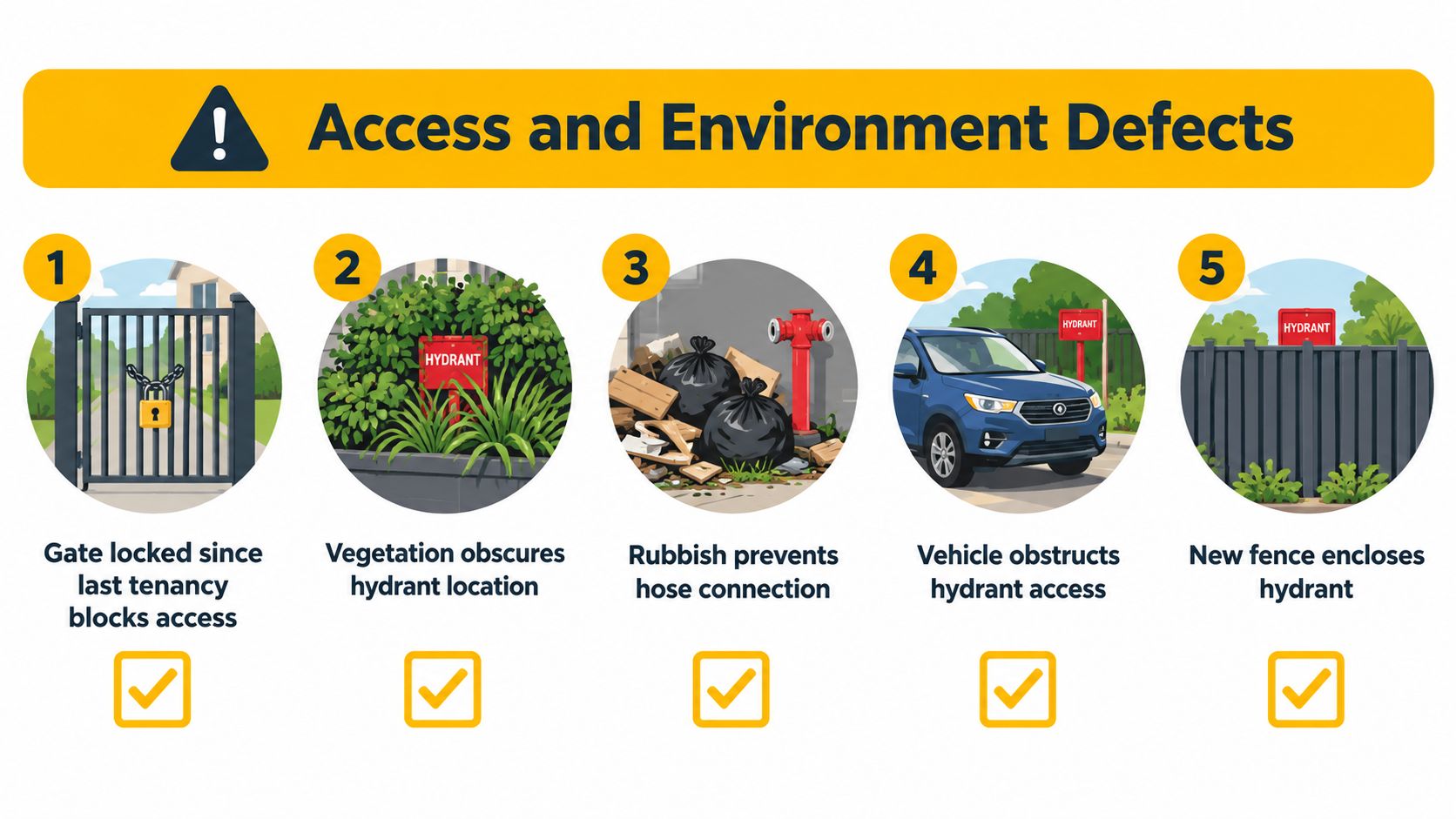
- Photograph the context: Include the hydrant, signage, approach route and nearby obstructions, not just a close-up of the outlet.
- Check gates and fences: Identify changes that could prevent access following a tenancy or security upgrade.
- Inspect landscaping: Look for overgrowth, concealed locations and soil or debris around the installation.
- Review vehicle movements: Check parking practices, delivery areas and exposure to vehicle damage.
- Look for contamination: Escalate suspected silt, insects or infestation to the contractor instead of attempting unscheduled flushing.
Photographs are useful because they let the contractor compare conditions between visits. They aren't a substitute for testing, but they can show exactly what changed.
Reinspect after the site changes
Resurfacing, roadworks and landscaping deserve a follow-up inspection because they can alter levels, access or visibility. Fit-outs deserve review where they change layouts or hydraulic demand assumptions. Severe weather should also trigger a check for debris, damage and changed surroundings.
On a South-East Queensland commercial site, assign these checks to someone involved in works approval or tenancy handover. Otherwise, the person who approves a new fence may never speak to the person who manages fire-system maintenance.
Removing an obstruction may be simple. Investigating internal contamination is a different task and belongs with competent servicing personnel. Keep that distinction clear so routine housekeeping doesn't become unauthorised work on safety-critical equipment.
Five-Yearly Hydrostatic Testing and Form 72 Records
“Tested” needs a scope and a date. Hydrostatic testing examines the pressure-bearing integrity of pipework and components. Accessible-fitting checks and flow testing answer different questions, so book the five-yearly milestone separately from routine attendance. A pressure-test result also leaves access and changed site conditions to be checked through continuing servicing.
Start with the commissioning baseline. Where the handover file lacks commissioning evidence, ask the contractor to identify what is missing and how to resolve it. A later service invoice cannot establish that the original installation was properly verified.
Queensland guidance requires the maintenance record to identify the installation, work date, name and licence number of the person who performed or personally supervised the work, a brief maintenance description and confirmation of compliance with QDC MP 6.1. All maintenance, including the five-yearly hydrostatic test, must be recorded on Form 72, according to the fire-safety maintenance advisory notes.
Keep the long-term milestone visible alongside routine servicing.
The records folder needs to connect the work to the equipment. System identity: Keep plans and asset references that match the installation. Testing evidence: Retain completed forms, supporting results and commissioning documents together. An invoice records the commercial transaction; supporting reports establish the technical scope, measurements and defect status.
Outstanding work: Keep defects, investigation findings, corrective-work evidence and unresolved responsibilities with that history. Forward schedule: Record upcoming services and the next long-term test. If access restrictions or suspected contamination remain unresolved after testing, preserve their status rather than letting the completed test close the paperwork by default.
Recordkeeping check: A replacement facility manager should be able to trace each service to the installation, its result and any resulting action without relying on the outgoing manager's memory.
Store the folder where replacement staff can retrieve it, and transfer unfinished work with the completed records. For a sale, tenancy transition or contractor change, review fire hydrant testing and certification documentation before accepting the handover. Treat missing evidence as an identified action with responsibility assigned, rather than assuming somebody previously arranged the work.
Putting It Together and When to Call a Technician
A workable program connects scheduled servicing, measured performance, changing site conditions and documented corrective work. The facility manager doesn't need to diagnose every hydraulic problem. They do need to recognise when the evidence is incomplete and engage the right person.
Queensland's official maintenance form is required under QDC MP 6.1 and is intended to work with the relevant AS 1851 and AS 2419.1 requirements. Defects should be classified, rectified or risk-controlled, and documented with results, corrective action, a responsible party and completion date in the hydrant testing and maintenance record.
Use clear escalation triggers
Contact an appropriately licensed fire hydrant and fire hose reel contractor when the service history or site condition raises questions:
- Performance has changed: Ask for interpretation of a declining result, especially where it approaches or falls below the design requirement.
- The site has changed: Arrange review after relevant landscaping, fit-out, gate, fence or roadwork alterations.
- Servicing was missed: Have the contractor establish what work is overdue and how to restore the schedule.
- Management is changing: Review system records and outstanding defects before accepting a handover.
An obstruction and an inadequate test result don't require identical responses. The technician should explain the significance of each finding and identify appropriate controls while the issue is investigated.
Make the next action definite
Start by reviewing the latest maintenance record against the physical site. Confirm that the asset references make sense, that findings have owners and that completed repairs have evidence behind them.
If those checks leave unanswered questions, book an inspection with a defined scope. Request the applicable routine-service work, any necessary performance verification and an access review, rather than asking vaguely for a compliance check.
The objective is a serviceable system with traceable evidence, not just another sticker on the cabinet.
Celtic Fire & Security offers fire hydrant testing and hydrant flow testing for un-pumped commercial systems, together with scheduled preventative maintenance across North Brisbane, Moreton Bay, Sunshine Coast, Somerset and Ipswich. Visit the website to arrange a site review and discuss your maintenance records, access concerns and flow-testing requirements.
No responses yet